




Updated 1 week ago
Custom Indoor Greenhouse with Waterproof Base: Design and Benefits

hqt
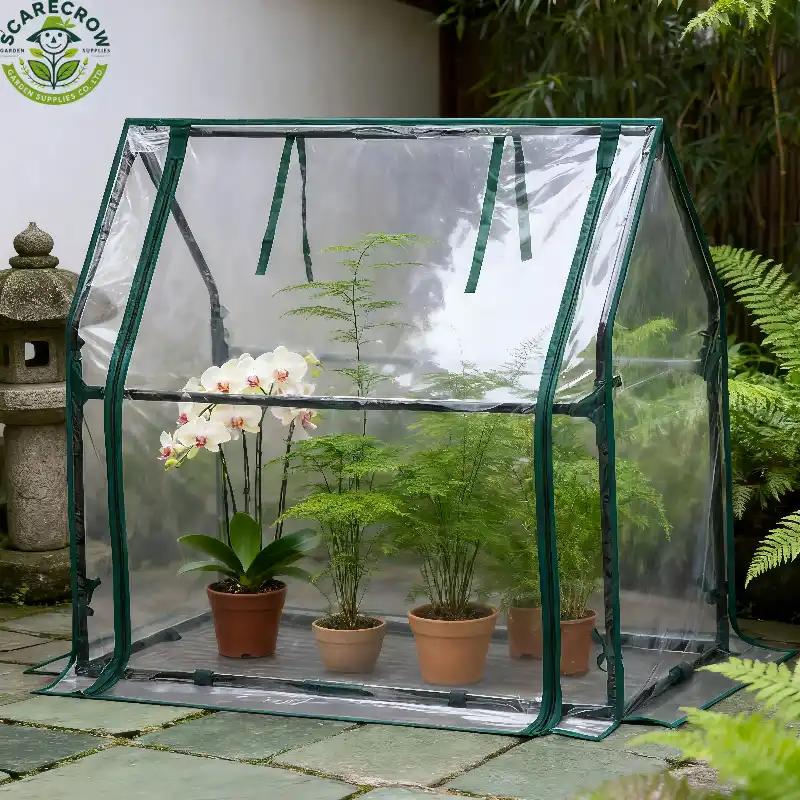
Custom Indoor Greenhouse
A waterproof base can protect a tabletop from routine watering, but what happens when moisture reaches the zipper opening or pools against a folded corner? These are common weak points in compact greenhouses. The covering material may be impermeable while water still escapes through the assembled structure.
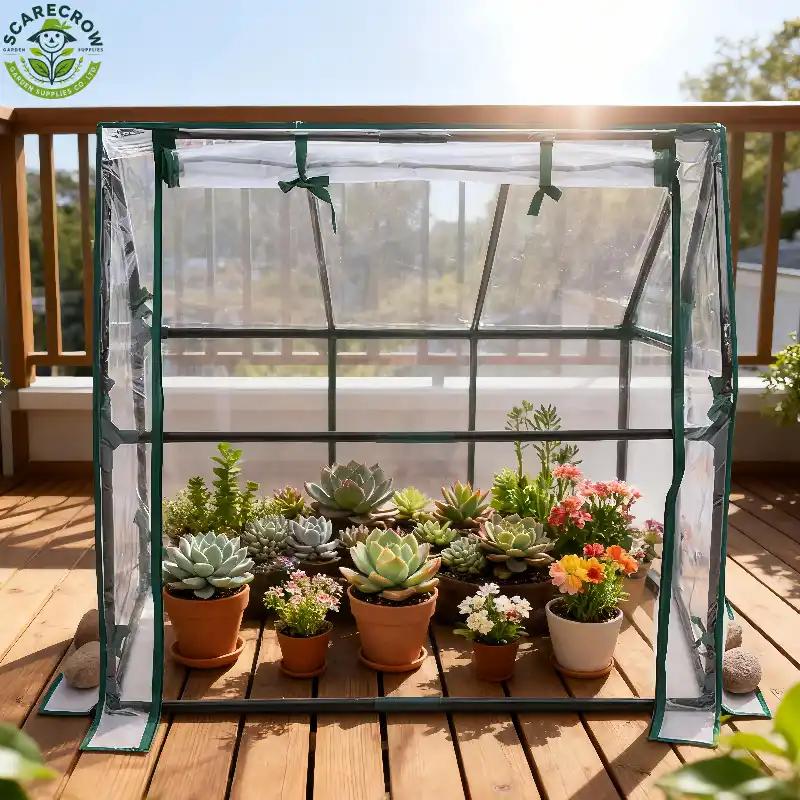
For buyers specifying a Custom Indoor Greenhouse, the critical question is not simply whether the base material is waterproof. It is how the base, frame, cover, and access openings behave together under wet operating conditions.
The mini greenhouse includes a waterproof base pad, a PVC cover and a PVC-and-iron frame. The design allows us to make a portable mini greenhouse to help you propagate your seedlings. The water-tight performance of the mini greenhouse depends on the assembly details and the purpose for which it is used.
1. Where Does Water Escape from an Indoor Greenhouse?
Water enters a mini greenhouse through irrigation, condensation and tray drainage. Condensation and tray drainage water run down the inner surface of the cover and irrigation water seeps through the cover. The way water escapes depends on the geometry of the base.
If the base of a mini greenhouse is a waterproof pad, water cannot penetrate through that base, but water flows towards the periphery and can spill out. There are three main leak paths to be aware of.
• Perimeter overflow. Water can spill out if the cover rests on a low or unsupported edge. This is especially the case if the base of the mini greenhouse is not even.
• Fastener interfaces. There can also be an issue with moisture passing through the interface of the hook-and-loop fasteners that connect the base and the frame of the mini greenhouse.
• Door openings. Water can also pass through the mini greenhouse if the covering is rolled up or if the trays are removed. Frequent bending at the corners can also wear the cover of the mini greenhouse.
A waterproof base helps prevent water loss, but it does not prevent water from spilling over the edges if the base is not supported evenly.
2. How Should the Waterproof Base be Designed?
If watering is expected to occur frequently, a waterproof pad can be used to make the base of the mini greenhouse. However, if the water is expected to pool, a plumbing tray can be used to make the base of the mini greenhouse. The designer must take into account the expected height of water and other constraints of packaging.
Three constructions are commonly considered for compact propagation enclosures.
| Base Design | Main Advantage | Technical Limitation | Suitable Application |
| Flexible waterproof pad | Foldable, compact packaging, easy positioning | Edge leakage and localized deformation | Tabletop seed starting with controlled watering |
| Flexible base with raised edges | Better containment of shallow runoff when joints remain intact | Corner joints and folds require sealing validation | Propagation using frequently watered trays |
| Separate rigid waterproof tray | Stable shape and defined water-collection area | Greater shipping volume; possible impact cracking | Repeated bottom watering or controlled drainage |
Our reference greenhouse uses a waterproof pad attached with hook-and-loop fasteners. Other base-pad configurations can be evaluated for custom orders, subject to feasibility.
Why Material Thickness Alone Is Insufficient
Increasing pad thickness may improve puncture resistance, but it does not correct poor perimeter geometry or an unsealed joint.
Material selection should also consider:
• Flexibility after repeated folding and unfolding
• Puncture resistance under wet seedling trays
• Compatibility with cleaning procedures
• Resistance to deformation during storage
Where the base incorporates bonded or welded seams, seam integrity should be checked separately from the material itself.
A reinforced sheet with poorly constructed corners can leak sooner than a thinner sheet with properly formed joints.
3. What Happens When Waterproofing Traps Moisture?
The cover is made from transparent PVC, which allows the air in the enclosed space to be exchanged less, thus allowing moisture from the growing media and plant to accumulate.
• If the internal surface of the cover is below the air's dew point, condensation occurs.
• Droplets formed by condensation fall by the force of gravity and collect around the perimeter of the base.
• Waterproofing pads prevent moisture from passing through the surface, but cannot remove moisture that has accumulated.
• This creates a trade-off between moisture retention and the health of the plants.
Moisture retention during the germination stage of the plants can help prevent the growing media from drying out too quickly. However, the seedlings may be at an increased risk of developing damping-off.
Our reference greenhouse has a zippered roll-up door which, when open, provides access to the greenhouse as well as increased ventilation. How much air actually moves through the open door will be dependent on the size of the door opening and the temperature and air movement of the surrounding environment.
For indoor applications, buyers should assess whether the enclosure allows:
• Condensation to drain without soaking vulnerable joints
• Water to be removed without dismantling the frame
• Sufficient ventilation after germination
• Easy cleaning and complete drying between growing cycles
The base should remain a moisture barrier rather than become an unintended water-storage compartment.
4. How Do Frame and Cover Details Affect Waterproof Performance?
There are several frame components such as PVC and iron, plastic connectors, and metal components with an electrophoretic coating. It is covered with roll-up PVC.
Frame stability is relevant because frame misalignments can change the position of base edges. Cover tension affects the position of condensation.
Structural Points to Inspect
• Connector fit: For a connection to be considered "tight" it may require excessive force, resulting in damage to the connector.
• Metal Protection: Electrophoretic coating offers corrosion protection, however, scratches and exposed metal provide potential sites of corrosion.
• Cover clearance: PVC should not be excessively stretched over corners and edges.
Internal dimensions need to be checked as well. Seedling growth space is not dictated by External Greenhouse dimensions. Such details are important for the custom order so that the specific needs of the customer are met.
5. How Can Buyers Verify Waterproof Performance Before Bulk Production?
A material report from a laboratory can not prove an assembled greenhouse protects indoor furniture.
We recommend evaluating production-representative samples using the intended trays, watering method, and installation surface.
| Verification | Practical Method | What to Check |
| Base leakage | Apply a defined water quantity with absorbent paper beneath the assembled unit | Visible seepage, wet spots, edge overflow |
| Loaded stability | Install trays containing wet growing media | Frame deflection, connector movement, pad deformation |
| Repeated assembly | Disassemble and reinstall the structure over agreed cycles | Joint looseness, pad damage, loss of alignment |
| Condensation management | Operate the enclosed greenhouse under representative humidity conditions | Water accumulation, drainage paths, ventilation access |
| Cleaning resistance | Clean and dry the base using the intended procedure | Surface deterioration, trapped moisture, joint damage |
Water quantity, exposure duration, load, and acceptance limits should be established before testing. No universal pass/fail threshold can be assumed from the term waterproof.
Buyers need to check on their own if the greenhouse needs to be lifted while loaded, used with a heating mat or operated with standing water and not depend on the product description alone.
6. What Should Be Confirmed for an OEM Order?
Custom dimensions should be established only after the tray layout and water management are defined for B2B procurement.
Scarecrow Garden Supplier offers OEM/ODM services for product dimensions, colors and logo printing and packaging. Alternative base pads, cover materials and frame configurations can be assessed based on production feasibility.
Our sample reference model has an MOQ of 500 pieces. Prior to placement of an order, buyers must confirm the final construction, sample acceptance, packaging, and agree to production terms.
For project-specific requests, please see the Mini Portable Greenhouse with Waterproof Base or contact Scarecrow Garden Supplier for your specific requirement (tray dimensions, water management, expected order quantity, etc.).
FAQs
Q1: What waterproof base does Scarecrow Garden Supplier offer?
Our reference mini greenhouse includes a flexible waterproof base pad secured with hook-and-loop fasteners. It helps protect indoor surfaces from watering runoff and moisture.
Q2: Is the waterproof base completely leakproof?
The base material provides water resistance, but full enclosure leakage performance depends on edge construction, fasteners, and assembly. Buyers should verify water containment through sample testing.
Q3: What materials are used in Scarecrow Garden Supplier's indoor greenhouses?
Our reference model uses a transparent PVC cover, PVC and iron frame components, plastic connectors, and an electrophoretic coating on metal parts.
Q4: Can the greenhouse prevent excessive condensation?
The transparent cover helps retain humidity, while the zippered roll-up door provides ventilation access. Condensation control depends on temperature, airflow, and watering conditions.
Q5: Can Scarecrow Garden Supplier customize the waterproof base?
Yes. Alternative base pad designs and material requirements can be reviewed for OEM/ODM projects. Final options depend on production feasibility and order quantity.