





Mini Garden Tools Wholesale
A mini garden trowel can pass visual inspection and still perform poorly in use. The handle may rotate when the blade meets compacted potting mix, press against the palm during repeated digging, or loosen where the metal head enters the grip. These defects rarely appear in product photographs. They become apparent when users apply force at an angle or work with wet hands.
For Mini Garden Tools Wholesale, considerations on grip selection should consider the gardening task at hand and not tool appearance. The controllability of a compact tool during planting, transplanting and soil cultivating is determined by numerous factors. These include grip geometry and material friction, head balance and joint construction.
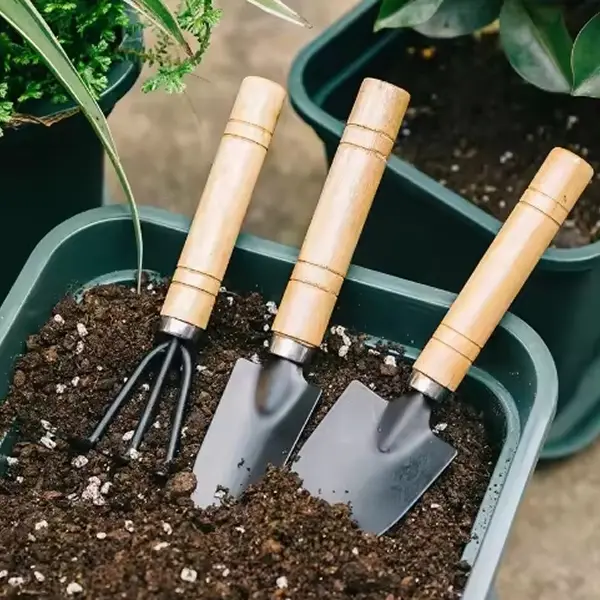
Scarecrow Garden Supplier offers mini gardening tools with either a polypropylene (PP) or wood handle. When comparing these tools, the buyeer should examine how each tool hold up and functions in the field.
1. How Does Handle Geometry Affect Grip Control?
Mini garden tools are used in confined spaces such as pots, nursery and raised trays. The short working length of these tools changes the path that force travels from the hand to the tool head.
In transplanting, the tool is typically held by the fingertips and rotated for soil loosening. In digging, greater loads are placed on the handle and a bending moment is created across the handle.
A single grip profile may not be suitable for all three operations.
Handle Diameter and Usable Grip Length
A thin walled cylindrical handle may not provide an adequate area for force distribution, and may increase the contact pressure on small areas. Increased resistance requires greater grip force. Excessive handle diameter, on the other hand, may create obstructions for fine movements especially for negotiating closely spaced seedlings.
Handle length introduces another constraint. If the grip terminates inside the palm during forceful digging, its end may create localized pressure. Overall tool length is therefore a poor substitute for measuring the actual gripping surface.
For wholesale evaluation, three dimensions deserve separate attention:
•Grip diameter: Determines finger closure and contact pressure.
•Usable grip length: Establishes whether the handle supports the intended hand position without pressing into the palm.
•Cross-sectional shape: Some handles may have an oval or subtly contoured cross-section which improves rotational stability. Smooth circular cross-sections may not resist twisting as well.
A contoured grip is not automatically more ergonomic. Deep finger grooves can restrict hand positioning and may fit some users poorly.
Wrist Position and Head Balance
When a miniature cultivator is pulled through dense soil, resistance at the tines creates a moment around the gripping hand. Increasing the distance between the load and the hand increases the torque that must be resisted.
A heavier tool head can compound this effect.
Handles with straight orientations allow for multiple grip options and are easier to manufacture, but are perceived as less ergonomic. Handles with an angle may provide better clearance for the wrist near the pot rim. The degree of benefit with angles depends on the digging direction. What may be best for downward digging may be less ideal for lateral scraping.
Assessment of wrist posture and tool balance should occur with representation tasks rather than relying on appearance.
2. Wooden, PP or Soft Grip Handles: Which Material Performs Better?
Appearance is not as important as how the material behaves during use. How a material behaves may impact ergonomics and change how the tool is used.
| Handle Material | Engineering Advantages | Main Failure Risks | Verification Priority |
| Natural wood | Rigid grip, adaptable surface finish, traditional appearance | Moisture swelling, splitting around inserts, coating deterioration | Moisture cycling, grain condition, joint inspection |
| Polypropylene (PP) | Low weight, moldable geometry, good resistance to water absorption | Slippery smooth surfaces, stress concentration, UV aging without suitable stabilization | Grip testing, molding defects, joint stability |
| TPE/TPR overmold | Compliant contact surface, potentially higher wet-grip friction | Delamination, surface wear, aging, cleaning difficulty | Adhesion, abrasion, wet-grip testing |
Soft-grip materials are included for engineering comparison; their availability from Scarecrow Garden Supplier requires confirmation.
Surface Finish Matters More Than Material Labels
A wooden grip with a thick glossy coating may become slippery when wet. Conversely, a carefully textured PP surface can provide acceptable control without additional elastomer layers.
Molded textures can also create limitations in terms of friction and cleanability. Deep recesses can trap potting soil and fertilizer and aggressive textures can cause pressure points and discomfort with prolonged use.
Additional aspects to consider with wood are the grain, the moisture content, and the type of finish. If the wood is fairly dry, a metal insert can cause splitting when the wood tries to expand and contract.
If a better cost/performance balance is the objective, PP offers a better option than wood, especially with the molded geometry and ease of forming. If the objective is improved retail presentation and/or a better tactile experience, wood may be a better option. How a tool is put together determines whether it offers better ergonomics.
3. Why Do Mini Garden Tool Handles Loosen or Break?
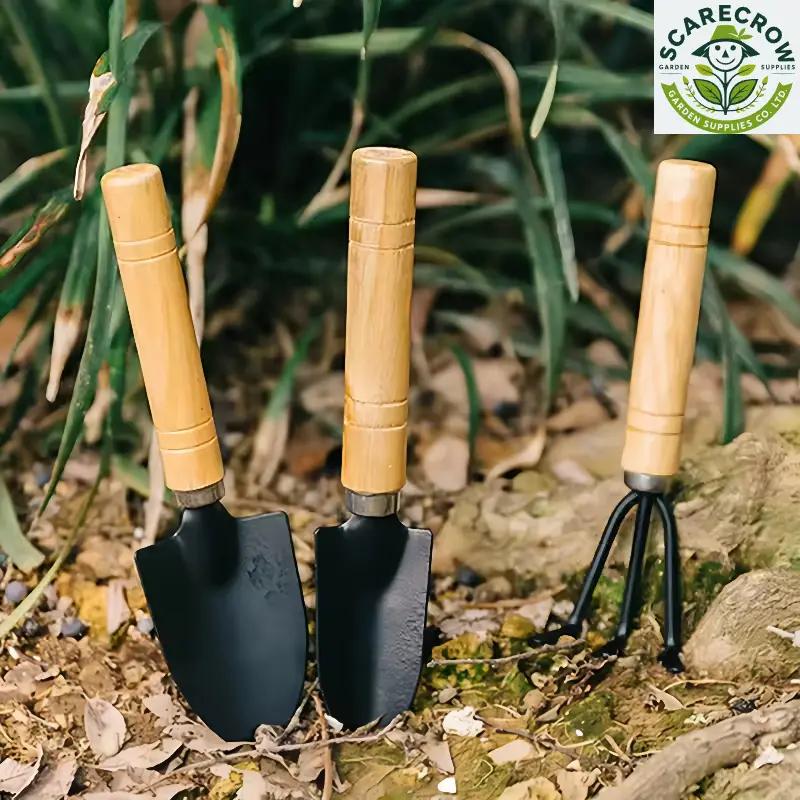
The connection of the handle to the tool head is the critical structural connection for most tools. During use, most of the force is transferred to the connection via the handle. Depending on what is encountered, different types of loads can be created.
Failures of connections between the tool head and the handle can be caused by:
•Tang Rotation: Inadequate mechanical engagement allows the metal head to rotate within the handle.
•Wood Splitting: Excessive insertion pressure or moisture causes the wood to expand, crack, and split.
•Plastic Splitting: Stress is concentrated in a thin, molded section.
Connection failure can also be caused by reversing the connection thousands of times, slowly enlarging the clearances between connected components.
Long-term reliability of a connection can't be guaranteed by increasing the length of the connection. How the connection is made affects the reliability of the connection.
Buyers should have an understanding of the connection and how it is made and examine assembled samples, especially if different tool heads share a common handle.
4. How Should Buyers Test Handle Ergonomics Before Bulk Orders?
A practical test must reproduce the intended gardening operation. Applying excessive force to a miniature trowel designed for loose potting mix provides little information about its normal performance.
One possible sequence is:
•Inspect geometry. Evaluate grip dimensions. Assess alignment of handles, surface texture and types of assembly variations.
•Compare grips. Evaluate dry and wet (gloved) hands for similar planting tasks.
•Check joints. Bend and twist handles while applying controlled loads. Inspect for cracking or breakage.
•Assess exposure to moisture. Inspect finishes and dimensions of joints of wooden components and changes due to repeated cycles of wetting and drying.
•Repeat representative tasks. Evaluate for discomfort and fatigue, loss of grip, slipping, head movement and wear.
Prior to production, come to an understanding regarding evaluation methods (i.e., testing, loads, cycles, sample size and/or lot, and rejection criteria). These may be used to verify that the supplier has tested the sample to meet the requirements, but may not in and of themselves constitute a completed claim of testing by the supplier.
5. What Should a Wholesale Handle Specification Include?
For mini Garden Tools Wholesale, the approved sample must be a measurable production reference rather than a visual one.
A specification should include:
•Handles materials and finishes.
•Grip dimensions, lengths, profiles, tolerances.
•Acceptance criteria for metal head attachment and joint stability.
•Limitation and intended use.
•Packaging requirements.
Scarecrow Garden Supplier offers PP- and wood-handled Mini Gardening Tools. Customers who wish to order in bulk must confirm if Scarecrow Garden Supplier can adjust handles and packaging to meet specific grip profiles.
For comparisons of products and bulk purchases, describe your intended use to Scarecrow Garden Supplier and include the handles you wish to have as a sample, and what evaluations you would like done to the sample.
FAQs
Q1. What handle materials are available for mini garden tools at Scarecrow Garden Supplier?
Scarecrow Garden Supplier offers miniature gardening tools with wooden and polypropylene (PP) handles. Available materials depend on the selected product model.
Q2. How does handle design affect mini garden tool performance?
Handle diameter, length, texture, and shape influence grip stability, wrist position, and tool control. Buyers should evaluate these features under actual planting conditions.
Q3. Are wooden or PP handles better for mini garden tools?
Wooden handles provide a rigid, natural-textured grip but require moisture protection. PP handles are lightweight, water-resistant, and suitable for molded ergonomic shapes.
Q4. Can Scarecrow Garden Supplier provide ergonomic garden tool handles?
Scarecrow offers existing handle configurations and can review customization requests. Specific grip shapes, materials, and structural changes require model-level feasibility confirmation.
Q5. What mini garden tool sets does Scarecrow Garden Supplier offer?
The product range includes three-piece miniature tool sets, wooden-handled trowels and cultivators, and other compact gardening sets for planting and soil maintenance.