





Propagation Greenhouse
A wholesale Propagation Greenhouse may pass a visual inspection but fail during assembly. A cover cut slightly too small puts continuous tension on the zipper. Oversized frame joints allow movement that pulls the waterproof base away from its fastening points. Both defects become expensive when repeated across hundreds of retail units.
For distributors and private-label buyers, the challenge is converting a reference greenhouse into repeatable product specifications.
At Scarecrow Garden Supplier, the PVC covers in our portable greenhouse kits are accompanied by metal frames, plastic connectors, waterproof bases, and OEM/ODM services. The following purchasing criteria will aid buyers in specifying what needs to be done to the product before it is produced.
1. Match the Propagation Greenhouse to Its Growing Environment
A compact propagation enclosure retains moisture by restricting air exchange. Although this approach limits evaporation from the growing medium and transpiration from the plant cutting, it also limits the removal of heat from the system.
Condensation can build up on the cover, and with strong sunlight, can increase the internal air temperature to the point that it is greater than the external temperature. Leaf wetness can be problematic.
When specifying a propagation greenhouse, the buyer must take into account the stage of the plant. Unrooted cuttings require protection from moisture loss and are best propagated in a more humid atmosphere, whereas more established seedlings require more ventilation.
3 application variables determine configuration:
• Plant stage: Unrooted cuttings require protection from moisture loss; more established seedlings require more air exchange.
• Growing location: Indoor applications require enclosure to be leak proof and take up less space. Outdoor applications require wind resistance, and an assessment of the propriety of the location and the means to secure it.
• Tray compatibility: The enclosure must be large enough to accommodate the seed trays and have clearance for plant growth.
2. Which Materials Affect Durability and Return Rates?
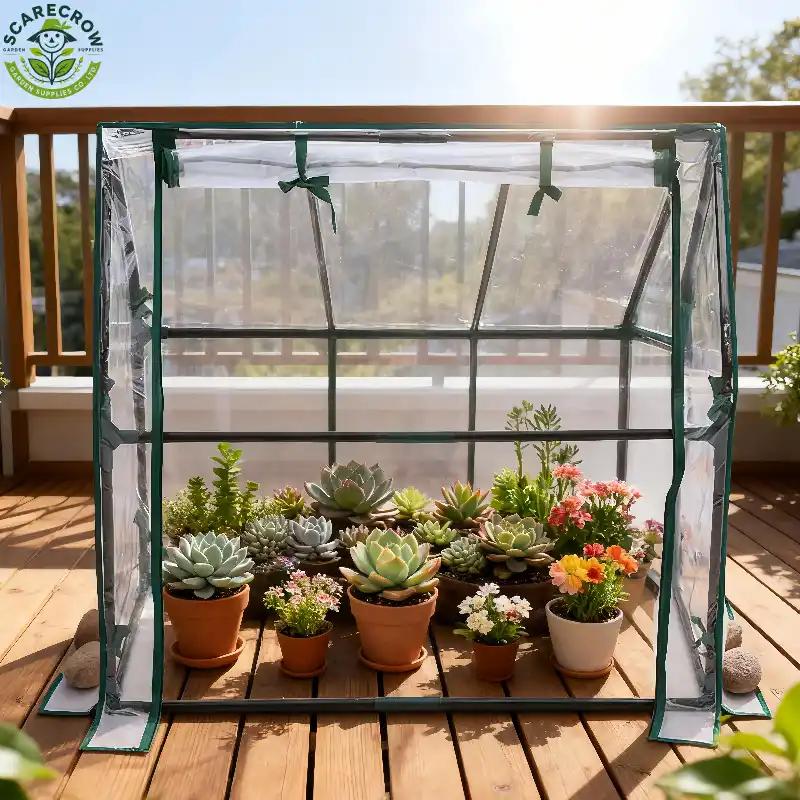
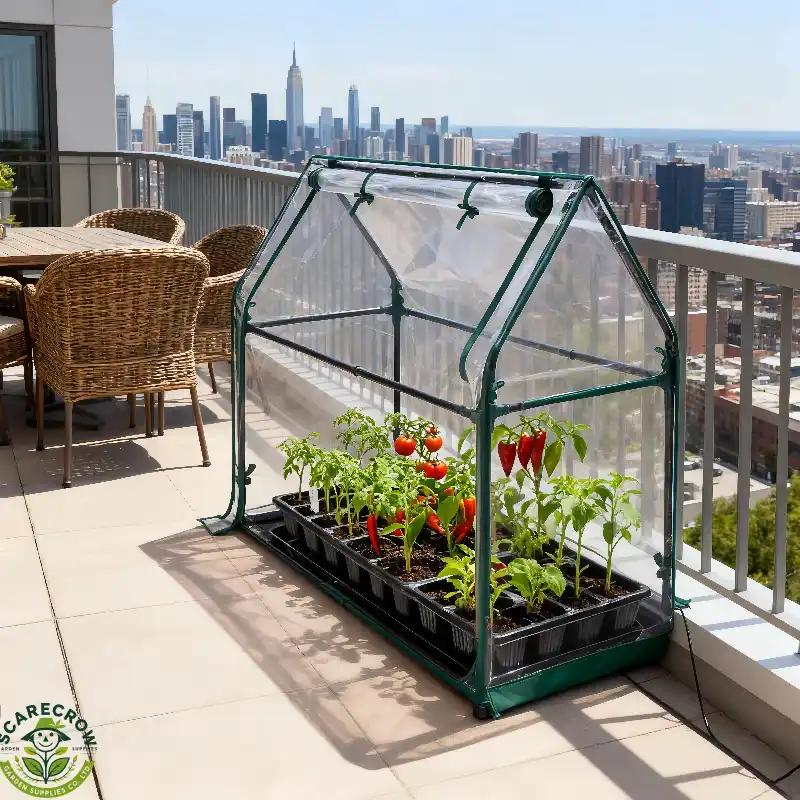
Our reference mini greenhouse has a PVC cover, an iron frame, plastic connectors and a waterproof base.
Stress and the effects of the environment differ on the materials used in the construction of the greenhouse.
| Component | Potential Failure Mechanism | Procurement Verification |
| PVC cover | Creasing, seam tearing, shrinkage and UV-related embrittlement | Check thickness uniformity, seam strength, and weathering evidence |
| Coated iron frame | Corrosion at scratches or tube ends; deformation under lateral load | Inspect coating continuity, joint fit and assembled rigidity |
| Plastic connectors | Cracking from excessive insertion force or repeated assembly | Conduct fit checks and assembly cycles |
| Waterproof base | Leakage at corners, seams and fastening areas | Test water containment under defined conditions |
| Zipper door | Seam distortion from excessive cover tension | Check alignment and repeated opening performance |
Why a Thicker Cover Is Not Always Better
Thicker PVC can improve puncture resistance but increases stiffness, folded-package bulk, and material consumption. A stiffer cover can transfer greater force to seams and zippers when dimensional allowances are not sufficient.
Buyers should consider cover thickness side by side with seams, flexibility and fit instead of taking thickness as the single quality parameter.
3. How Should OEM Specifications Be Defined?
OEM customization introduces dimensional dependencies that can be overlooked when changes are approved independently.
Increasing frame height, for example, changes the required cover dimensions. If zipper length, seam allowance, and fastening positions remain unchanged, the assembled enclosure may develop uneven tension.
Scarecrow Garden Supplier allows for customization conversations for dimensions, colors, logos on products or packaging, and retail packaging. Other alternatives are subject to feasibility.
A good OEM specification should include:
• Geometry of assembly: Dimensions, usable internal spaces, lengths of frames, connector interfaces, and tolerances.
• Construction of cover: Material and thickness, seam locations, dimensions of zippers, and tolerance for attachment.
• Design of base: Construction of edges, waterproofing, and fastening, as well as cleaning.
• Presentation at retail: Artwork and placement of logo, printed instructions, identification of components, carton configuration.
It is good practice for buyers to obtain an assembled sample to check finished dimensions against approved drawings before authorizing production.
Although the sample passes test and appears acceptable, different materials may provide different levels of outdoor durability or thermal stability. These materials should be approved for use.
4. What Should a Pre-Production Sample Prove?
A greenhouse sample should demonstrate its ability to function repeatably. The most informative tests would demonstrate the function of the sample in the environment in which it is expected to be used and maintained.
Recommended Sample Verification
• Assembly and Fit: Assemble and disassemble the unit a few times to check if there is any deformation in the unit. Check if the frames of the unit align with each other and check if the connectors retain. Also, check how the unit holds together and what kind of issues are faced during the assembly.
• Water retention: Ensure the bottom of the greenhouse is waterproof. Decide how much water you want. Ensure the base can hold water. Look for leaking water on corners and/or seams. Make sure the greenhouse base is not supporting any part of the structure.
• Zipper Operation:Check to see if the door is fully installed and operate the zipper to check for tension and/or stitching separation.
• Heat and Condensation: Check the temperature, and humidity, inside and outside. Test the unit's venting capability. Test the unit under different light conditions.
• Packaging Protection: Inspect the unit after various tests to see how well it holds together. Check for deformation of the cover and/or connector.
Claims of Mats Duration, UV and weather protection should be documented by testing applicable to the region. Testing methods and acceptance limits should be documented prior to comparison of suppliers.
How Do MOQ and Packaging Affect Landed Cost?
Purchase information from Scarecrow includes:
| Purchase | Reference |
| MOQ | 500 units |
| Packing | 1 unit/carton |
| Carton dimensions | 91 x 14 x 11 cm |
| Gross weight | 1.95 kg/carton |
| Lead time | 15 days for up to 500 units |
| Customization | OEM/ODM, dimensions, colors, logos, packaging |
Space for cartons to be stored prior to palletizing and packing. 500 cartons require about 7.0 m3. The customers should consider the weight and volume of the cartons when selecting the best shipping option.
Lead time is an estimated shipping time for orders of 500 units or less. Larger orders will require a scheduling confirmation.
Changes to carton size (e.g. increased carton size due to special packaging or the addition of accessories) and MOQ will be adjusted accordingly.
6. Set Bulk Inspection Criteria Before Shipment
An approved sample only helps if the purchase specification defines the criteria for production unit inspection.
In the case of propagation greenhouse orders, the inspection should specify:
• Critical functional defects, e.g. leaking bases, unusable zippers, broken connectors, or missing assembly components.
• Dimensional nonconformities, for example covers that do not fit the frame or elements outside the agreed dimensions.
• Material and finish defects, e.g. covers with defects, coating defects, or fittings with cracks, or other defects.
• Packaging defects, e.g. wrong labeling, missing or incomplete instructions, absence of accessories, or inadequate protective packing.
The buyers must agree on sampling methods, classification of defects, and acceptance limits prior to manufacturing. During manufacturing, the approved sample and the bill of materials will be reference for production checks.
For other requests for wholesale sourcing or private labeling garden kits, the Scarecrow Garden Supplier can explore different options on configuration and packaging and OEM.
For a request for a sourcing quotation for the Mini Portable Propagation Greenhouse, please let us know the intended application, quantity required, and any changes or requests you may have.
FAQs
Q1: What is the MOQ for Scarecrow's Propagation Greenhouse?
A: Scarecrow Garden Supplier lists a minimum order quantity of 500 units for its reference mini greenhouse. Custom order requirements should be confirmed before purchasing.
Q2: Does Scarecrow Garden Supplier offer OEM customization?
A: Yes. Scarecrow supports OEM/ODM options, including custom dimensions, colors, logo printing, and retail packaging, subject to production feasibility.
Q3: What materials are used in Scarecrow's mini greenhouse?
A: The reference product uses a PVC cover, iron frame with electrophoretic coating, plastic connectors, and a waterproof base pad.
Q4: Can buyers request samples before bulk production?
A: Yes. Scarecrow accepts sample orders for quality evaluation. Buyers should inspect cover fit, frame alignment, zipper operation, and waterproof base construction.
Q5: How does the waterproof base protect indoor surfaces?
A: The base pad helps contain moisture during watering and plant maintenance. Buyers should verify leakage resistance at seams and corners under their intended operating conditions.