





Updated 1 week ago
Wholesale Seedling Heat Mat With Thermostat: A B2B Buying Guide

hqt
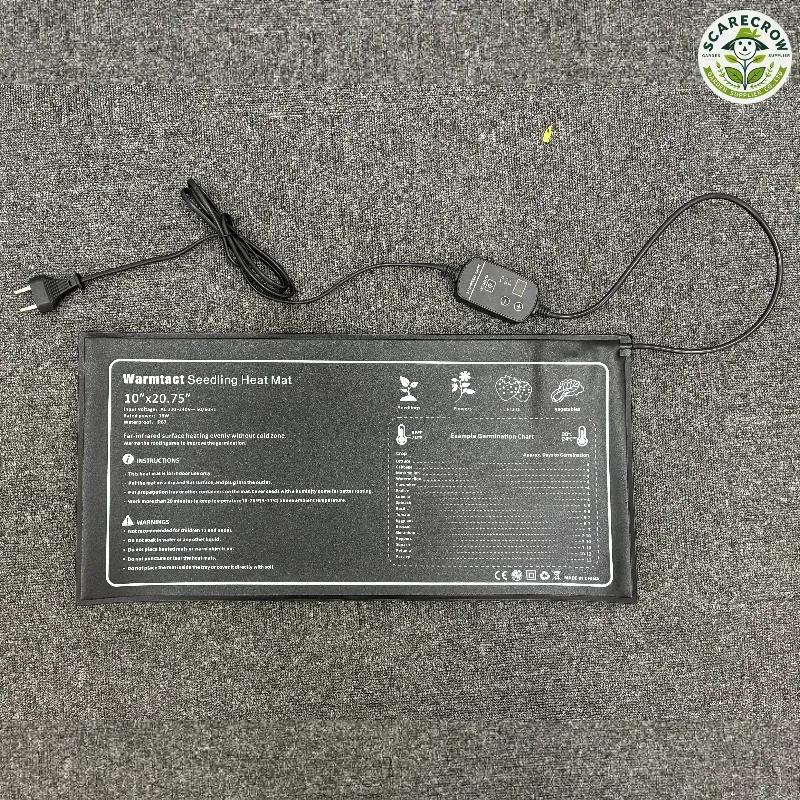
Seedling Heat Mat With Thermostat
A propagation mat can meet its rated wattage and still produce uneven germination temperatures. The problem often appears after a nursery places a loaded seed tray over the heating surface: central cells warm faster, perimeter cells lose heat to surrounding air, and a poorly positioned thermostat probe fails to detect the difference.
For distributors purchasing a Seedling Heat Mat With Thermostat, electrical power alone is a weak acceptance criterion. Heating coverage, growing-medium temperature, controller response, waterproof construction, and regional electrical compatibility must be evaluated together.
At Scarecrow Garden Supplier, we offer flexible PVC propagation mats with multiple power, size and electrical configurations. Adjustable thermostats are optional rather than standard.
1. Which Heating Specifications Actually Matter?
Resistive heating elements convert electrical energy to heat, which transfers through the surface of the mat to the tray bottom and growing medium. The temperature that the heating element delivers to the seeds is dependent on the thermal contact and the surrounding conditions.
Our product specifications include:
| Parameter | Options | What Buyers Should Verify |
| Rated power | 18W / 45W / 105W | Power-to-size combinations and actual consumption |
| Dimensions | 254 × 527 / 508 × 527 / 1219 × 527 mm | Effective heating coverage and tray compatibility |
| Voltage | 110–230V options | Exact rating of each regional SKU |
| Material | Flexible PVC | Surface integrity, edge sealing, cable strain relief |
| Waterproof rating | IPX7 stated | Test documentation and scope of protection |
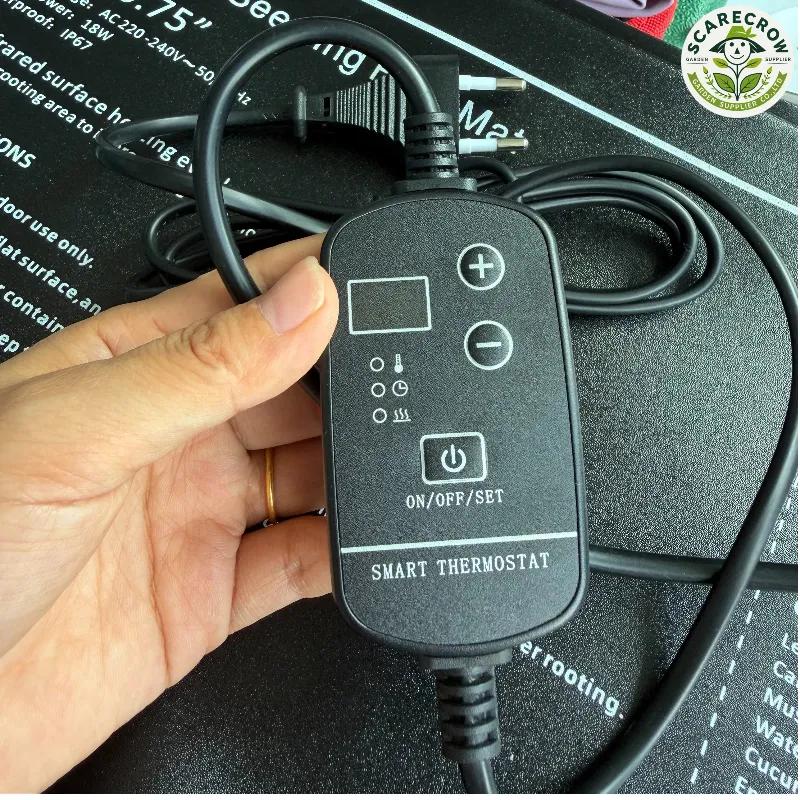
| Temperature control | Optional adjustable thermostat | Sensor design, control range, and output rating |
These dimensions and power ratings are listed as available options; specific pairings require supplier confirmation.
Heating Area vs. Rated Power
Two mats with equal wattage may deliver different heating performance if their active surface areas differ.
For engineering comparisons, power density is more informative than total power:
Power density (W/m²) = Rated power (W) / Active heating area (m²)
The calculation requires the actual heated area, which may be smaller than the external dimensions.
Extension trays can cause cold perimeter cells due to restricted heat dissipation. This can cause localized overheating.
Testing the heating performance using a covered heating mat over a growing medium is more accurate than using an uncovered heating mat.
2. How Reliable Is the Thermostat Under Real Growing Conditions?
A thermostat switches on or off heating based on the comparison of a sensor's reading to a set point. With a conventional on/off control, switching occurs around a defined temperature differential.
However, a sensor measures the immediate surroundings, not the average temperature of the propagation tray.
Probes in the air may be requesting heat while the growing medium is already too warm. Probes in contact with the heating surface can cause the medium not to reach the set temperature.
During a procurement review of thermostat-controlled systems, the following should be reviewed:
• Sensor Accuracy: Compare readings to a known, calibrated reference.
• Switching Differential: Take readings at the temperatures at which heating starts and stops.
• Load Compatibility: Are controller output ratings within the connected heating mat?
• Failure Mode Effects Analysis: What is the effect of the sensor being disconnected? What happens if there is a short circuit? What happens on power restoration?
Test with probe placed in growing medium that is representative based on the instructions for use of the controller. If one thermostat controls multiple trays, map temperatures across the entire heated area.
The temperature displayed on the controller is NOT a substitute to measure the temperature of the growing medium.
3. Can Flexible PVC Constructions be Repeatedly Used in Greenhouses?
Seedling mats can be spilled on with water, fer-tilizer, and other solutions and condensation builds up on them, then repeated handling.
The PVC layer is flexible and provides a protective barrier around the heating element. The PVC layer is also very protective of the seal at the entry/exit point of the power cord.
Failures are likely to begin at structural transitions rather than the broad heating surface.
For example, repeated bending near the cable exit can strain internal conductors or compromise the surrounding seal. Edge damage may create a moisture-entry path even when the remaining surface appears undamaged.
Scarecrow Garden Supplier lists IPX7 protection for its seedling heat mat. Buyers should request evidence supporting that rating and determine whether it applies only to the mat body or to other supplied components.
An IPX7 designation does not establish waterproof protection for an external thermostat or mains plug.
Sample verification should verify:
• Edge-seal condition after normal use and handling.
• The integrity of cable-entry and strain relief.
• The protection from moisture-ingress, if tested.
• Electrical insulation and leakage-current performance, if tested.
Water-resistance and electrical insulation are separate qualification requirements. Mechanical durability and long-term performance are also separate qualification requirements.
4. What Must Change for Different Export Markets?
A US-plug configuration and an EU-plug configuration may require different electrical designs, even when their external dimensions are identical.
Heating-element resistance determines power consumption at a particular voltage. Applying an unsuitable supply voltage to a fixed-resistance element changes its power dissipation approximately with the square of the voltage.
Therefore, the 110–230V range should not be interpreted as automatic universal-voltage compatibility for every model.
For each destination market, confirm the voltage and frequency rating, plug configuration, cable specification, thermostat compatibility, and applicable safety documentation.
Instruction language, warning labels, and product identification also belong in the purchase specification.
Scarecrow Garden Supplier can supply China, US and EU plugs, other options are open to discussion. A different plug is not evidence of regulatory compliance on its own.
5. How Should Buyers Qualify Samples Before Bulk Orders?
A sample that becomes warm is not necessarily a sample that meets the propagation requirement.
The qualification procedure should reproduce the expected installation: tray type, growing-medium depth, moisture content, ambient temperature, and placement conditions.
A typical validation sequence is:
• Inspect dimensions and construction. Look for heated coverage, check seams and cable connections, and inspect for defects.
• Measure electrical input and check voltage and power consumption with respect to operational conditions.
• Locate and position independent growing medium temperatures at center, edge and corner at representative seed depths.
• Observe thermostat cycling and record temperature variations at equilibriium.
• Repeat above steps, check for abnormal or irregular heating, and inspect connections and deterioration.
• Temperature acceptance limits should be based on the crop grown, the climate and location, and not based on a generic mat surface temperature.
For production approval, buyers also should agree on requirements for incoming inspection, and how they will validate dimensional, electrical, and functional consistency across multiple batches.
6. What Should a Wholesale Quotation Include?
A wholesale quotation should include the complete product configuration and not just a basic heating mat.
Scarecrow Garden Supplier can customize several features on heat mats, such as thermostats, colors, plugs, packaging, labels and manuals. Availability and minimum order quantities depend on the selected features.
Before quoting, customers should provide the size combination of the power and the destination market, and indicate whether they need a controller. Customers should also provide an estimated quantity.
These factors affect landed cost and inventory management as well as exposure to warranty claims for private label distributors.
Scarecrow Garden Supplier can review your requirements and our available options. For samples, quotations, or more information on product features and configuration, visit our Seedling Heat Mat page.
FAQs
Q1. Does Scarecrow Garden Supplier offer seedling heat mats with thermostats?
Yes. Scarecrow Garden Supplier offers adjustable thermostat options. The standard seedling heat mat is available without a thermostat, so buyers should specify the controller requirement when ordering.
Q2. What wattage options are available for wholesale seedling heat mats?
The options include 18W, 45W, and 105W. Buyers should confirm the wattage and size combination for their intended propagation trays.
Q3. What sizes of seedling heat mats does Scarecrow Garden Supplier offer?
Listed sizes include 254 × 527 mm, 508 × 527 mm, and 1219 × 527 mm. Other requirements can be discussed with the supplier.
Q4. Are Scarecrow Garden Supplier's seedling heat mats waterproof?
The PVC seedling heat mat has a stated IPX7 waterproof rating. Buyers should request supporting test documentation and confirm which components are covered.
Q5. Can I order seedling heat mats with US or EU plugs?
Yes. China, US, and EU plug configurations are listed. Buyers should confirm voltage, plug type, and applicable electrical requirements for their destination market.