






Updated 1 week ago
Seed Starter Tray With Grow Light: LED Spectrum and PPFD Explained

hqt

Seed Starter Tray With Grow Light
A 72-cell propagation tray can appear evenly illuminated while seedlings along its edges receive substantially less light than those in the center. The LEDs may be functioning normally. The real issue is often the relationship between photon output, mounting geometry, and the area the light must cover.
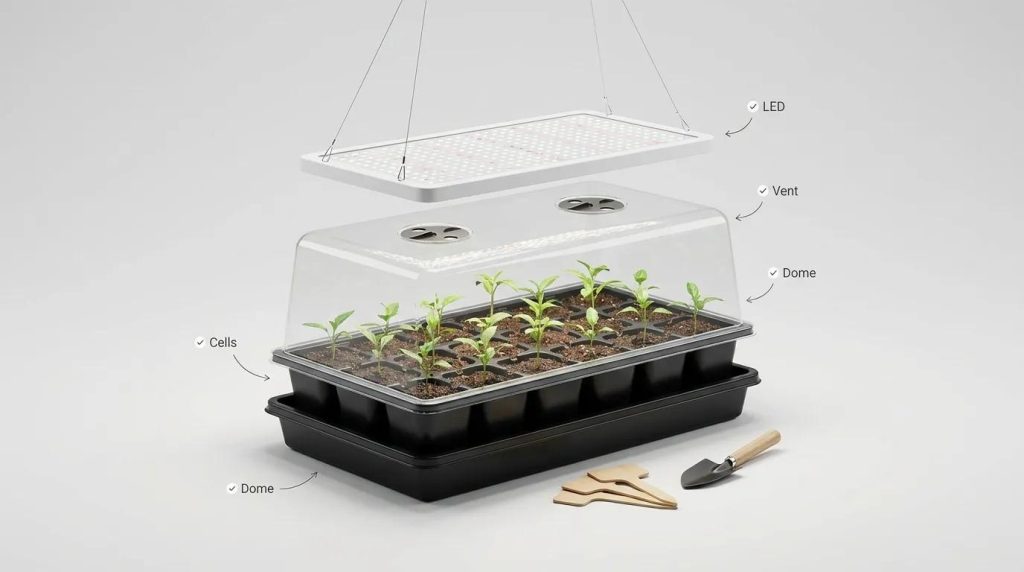
For buyers sourcing a Seed Starter Tray With Grow Light, the label "full-spectrum LED" provides little evidence of growing performance. Spectral distribution, photosynthetic photon flux density (PPFD), and daily light exposure reveal far more about whether a lighting system suits its intended tray.
Configurable seed starting kits are available at Scarecrow Garden Supplier. These include different LED arrangements, cell counts, humidity domes and lighting controls. When considering our offerings, it is important to consider the light delivered to seedlings rather than the components listed on a specification sheet.
1. LED Spectrum: Which Wavelengths Matter for Seedlings?
Lighting specifications in the 400-700nm region of the spectrum are often referred to as Photosynthetically Active Radiation (PAR): Different wavelengths of PAR can affect not only the process of carbon assimilation but also the development of the plant.
• Blue Light (400-500 nm): Blue light influences stem elongation and also the development of leaves. Too little Blue light causes stem to elongate too much.
• Red Light (600-700 nm): Red light can also influence the process of carbon assimilation and development of the plant.
• Green Light (500-600 nm): Green light can also influence the process of carbon assimilation and development of the plant.
• Far-red light (700-750 nm): Influences stem elongation in relation to Red light. However, in conventional PPFD measurements, Far-red light is not taken into consideration.
Full spectrum white LEDs and Red + Blue LEDs are both effective for seedling production. Their effectiveness depends on the balance of intensities of constituent colors rather than their appearance.
White LEDs give customers a more natural view of the plant foliage because lighting is less purple.
Scarecrow Garden Supply offers white, red-blue and mixed-spectrum LED configurations. For light wavelength-specific procurement, customers must request spectral power distribution. Color temperature or the phrase "full spectrum" cannot reveal actual photon distribution.
2. PPFD and DLI: Is the Light Output Sufficient?
LED wattage indicates electrical consumption, not light output.
PPFD, expressed in µmol/m²/s, measures the incident flux of PAR photons per unit area. It is more directly useful for evaluating propagation lighting than electrical wattage or visual brightness.
Two fixtures with similar power ratings may deliver different PPFD because of diode efficiency, optical distribution, driver losses, and mounting distance.
Calculating Daily Light Exposure
Seedlings respond to accumulated light as well as instantaneous intensity. Daily light integral (DLI) expresses the total PAR photons received over a day.
DLI (mol/m²/day) = Average PPFD × Lighting Hours × 0.0036
For example, an average PPFD of 180 µmol/m²/s maintained for 14 hours produces approximately 9.1 mol/m²/day.
This is a calculation example, not a measured Scarecrow Garden Supplier product specification.
Utah State University Extension provides a general seedling PPFD reference of approximately 200–400 µmol/m²/s, although suitable levels depend on crop species and growing conditions.
For procurement, three questions follow:
• Does the stated PPFD represent the tray average or only the brightest measurement point?
• Can the supplied timer deliver the intended photoperiod?
• Does output remain adequate after accounting for mounting height and any optical losses?
Timers deserve special consideration. A controller allowing 3-, 6-, or 12-hour cycles cannot provide a continuous 14-hour photoperiod with its preset settings alone.
Buyers of dimmable models also need the PPFD data at each adjustable output level. Increasing the percentage brightness setting does not mean more photons are reaching the plants.
3. How Tray Geometry Changes Light Distribution
Depending on the distance from the light source and spacing of the LEDs, central PPFD can be high with poor edge coverage. Increasing the mounting distance from the light source usually increases edge coverage at the expense of central PPFD.
Fixed Lights vs Adjustable Supports
Simplicity in design and assembly of a dome-mounted LEDs comes at the expense of increasing uneven illumination and insufficient clearance as the canopy grows.
Adjustable stands offer more flexibility, but introduce more packing components and sliding fits.
Cell count does not adequately describe the LED assembly to select. A 72-cell assembly may be larger than a 12-cell assembly.
Does the Humidity Dome Affect PPFD?
A humidity dome does not remove or block all light from reaching the plants. LEDs that are placed under the humidity dome to illuminate seedlings may be adversely affected by the increased humidity. A LED placed outside the humidity dome may be less adversely affected, but light transmission may be greater.
For assembled-kit validation, measure PPFD in the actual lighting arrangement. If light passes through the cover, compare measurements with the dome clean and under representative condensation conditions.
Electrical connectors and controllers should also be assessed for their intended moisture exposure. A clear dome with ventilation does not establish electrical water resistance.
4. How Should Buyers Verify LED Performance Before Ordering?
A laboratory spectrum report is useful, but it cannot replace measurements of the complete tray assembly.
For sample evaluation, use a calibrated PAR quantum sensor and measure at repeatable positions across the intended growing surface. Record average, minimum, and maximum PPFD, together with the fixture height and operating mode.
| Inspection Item | Main Failure Risk | Verification Method |
| Spectral output | Actual wavelength distribution differs from product claims | Review spectroradiometer data |
| PPFD uniformity | Strong center illumination but weak edges | Measure a defined grid across the tray |
| Mounting height | Inadequate coverage or excessive localized intensity | Repeat measurements at minimum and maximum working heights |
| Timer and dimming | Incorrect DLI or unstable output | Verify operating cycles and photon output at each setting |
| Thermal operation | Driver or LED output changes after warming | Compare measurements before and after thermal stabilization |
| Dome integration | Optical losses or moisture exposure | Test the assembled kit under representative operating conditions |
One recurring purchasing mistake is accepting a single center-point PPFD measurement. It describes neither coverage uniformity nor the minimum light available to seedlings.
Buyers must agree on measurement conditions and acceptance limits before samples are approved. Otherwise, measurements from different suppliers cannot be compared.
5. Specifying an OEM Seed Starter Tray With Grow Light
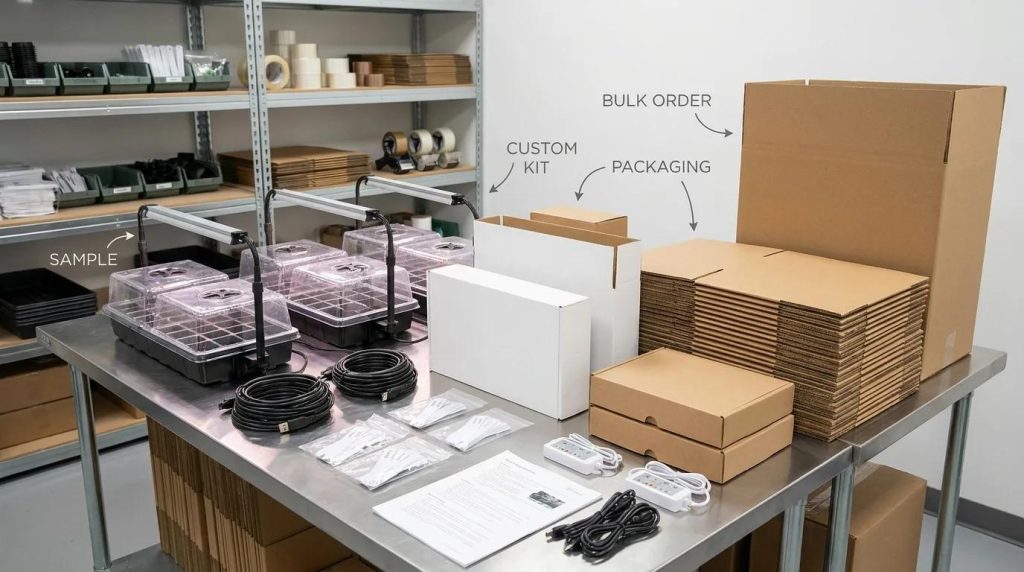
Scarecrow Garden Supplier provides tray configurations from 12 to 128 cells and different LED mounting structures and controls and has configurable private label options. These options do not represent a single fixed specification.
To prepare a technically useful RFQ, we suggest you specify:
• Growing needs: Target crops, expected seedling height, desired photoperiod, and lower and upper limit of the acceptable range of PPFD.
• Mechanical needs: Desired footprint of the tray, depth of the cells, clearance of the dome (if any), distance of light mount, and the range over which the light mount can be adjusted.
• Electrical needs: Power source and settings of the controller, arrangement of connectors, and compliance to the destination market.
• Sample acceptance: Measurement of PPFD, optical operating conditions, component fit, and functional tests.
Increasing LED quantity improves coverage but increases power consumption, heat dissipation, cost and complexity of the electronic assembly.
At Scarecrow Garden Supplier, we discuss the Wholesale and OEM configuration of LEDs, trays, humidity domes and retail packaging. Customers can provide their growing areas and lighting requirements to review sample kits and specifications.
FAQs
Q1: What LED spectrum options does Scarecrow Garden Supplier offer?
Scarecrow Garden Supplier offers configurable full-spectrum white, red-blue, and mixed-spectrum LED options for indoor seed starter trays.
Q2: What timer and brightness options are available?
Depending on the configuration, buyers can select 3/6/12-hour or 4/8/12-hour timers, single-output lighting, multi-level dimming, or custom controllers.
Q3: How should buyers evaluate PPFD in a seed starter tray?
Measure PPFD at the center, edges, and corners using a calibrated PAR quantum sensor. Record the fixture height, operating mode, and average light intensity.
Q4: Does full-spectrum LED lighting guarantee uniform seedling growth?
No. Seedling growth also depends on PPFD distribution, lighting duration, mounting distance, temperature, moisture, and crop requirements.
Q5: Can Scarecrow Garden Supplier customize LED grow light height?
Yes. Available design options include fixed dome-mounted LEDs, adjustable supports, telescopic structures, and detachable lighting arrangements.