







Updated 1 week ago
Propagation Tray With Dome: Preventing Mold and Excess Moisture

hqt
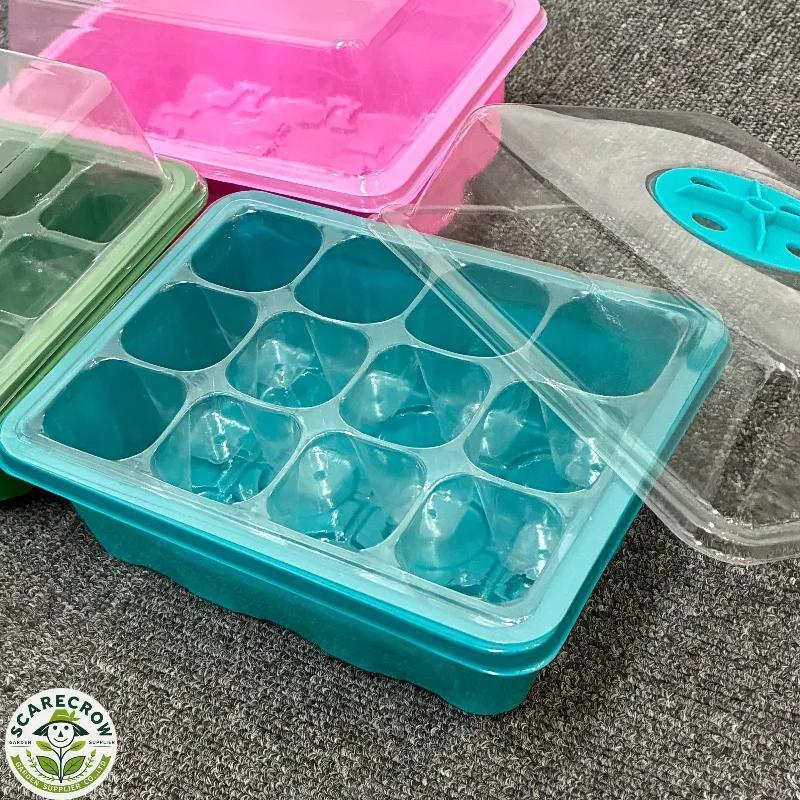
Propagation Tray With Dome
A seedling tray can develop mold even when the grower has barely watered it since sowing. The transparent cover stays fogged, the growing medium remains dark and wet, and some seedlings begin collapsing at the stem base. Opening the dome vents may reduce condensation, but it will not necessarily correct the conditions inside the root zone.
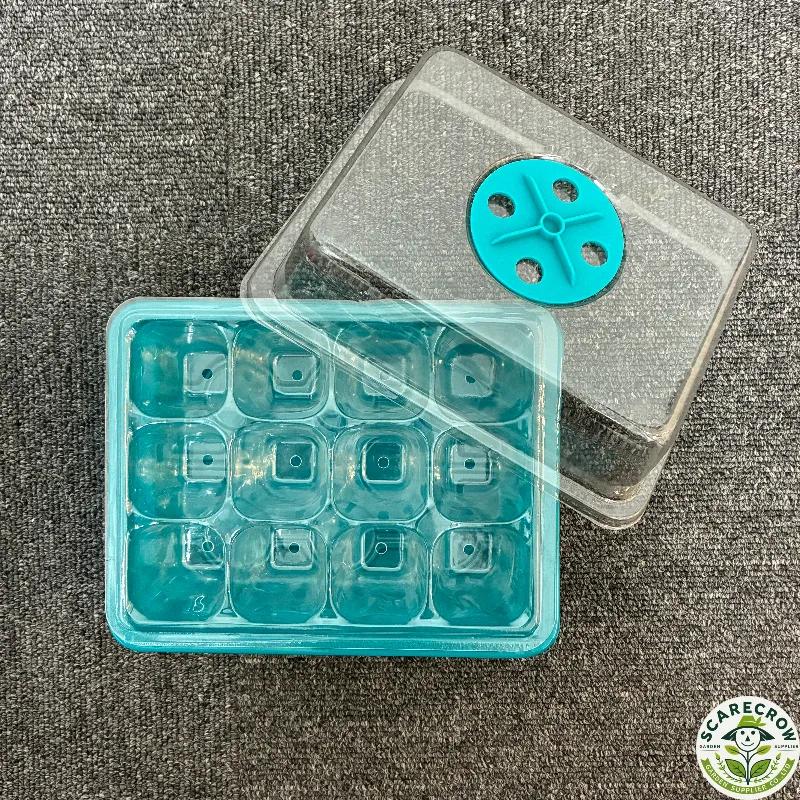
For prospective buyers looking at the Propagation Tray with Dome, the following information is pertinent. Humidity retention aids germination; however, continuous saturation of the substrate restricts the availability of oxygen and favors the development of pathogens. The growing medium, ventilation and drainage, need to work in conjunction.
Our propagation set at Scarecrow Garden Supplier includes 12 cells with a thermoformed growing insert, and a water-catching base with a dome that has a manual, adjustable rotary vent. These assist in management of moisture; however their efficiency is dependent on how the entire system is utilized.
Why Moisture Accumulates Inside a Propagation Dome?
Within the closed propagation dome, air exchange occurs at a much slower rate causing moisture to be trapped in the growing medium for a longer time. Moisture in the air will eventually reach a cooler surface and condense.
During the night, especially in the early hours before irrigation, the inside of the dome is often covered with water droplets due to condensation.
Condensation on the dome, however, doesn't necessarily mean the growing medium is waterlogged and can't support the development of roots.
There are three conditions that can further aggravate the problem:
• Fine, compacted growing medium: Water, in combination with air, will occupy the larger pore spaces of the growing medium after irrigation, and, as a result, air-filled spaces will be reduced.
• Poor drainage: Water will remain in the cells and in contact with the growing medium, resulting in a prolonged saturated condition.
• Low evaporation: A closed dome, weak surrounding airflow, and limited temperature-driven drying keep the medium wet for longer.
A good seed starting mix should retain just enough water to allow imbibition and germination and then allow excess water to drain.
Can Adjustable Vents Prevent Mold Growth?
The rate of humid air replacement is dependent on the size of the vents, temperature differential, and the airflow of the surrounding environment.
Although the rotary vents on Scarecrow Garden Supplier's propagation dome are adjustable, they are not calibrated humidity controls.
Restricted ventilation during germination can prevent the substrate surface from drying, which could negatively impact germinating seeds. Once the seeds germinate, the operating rules change.
New foliage requires greater air movement, and the covered environment may no longer be necessary. The dome can also impact the amount of time seedlings spend with wet leaves. Condensation can also drip back on the seedlings.
A working sequence is:
• Moisten the substrate prior to sowing to allow excess water to drain.
• Keep the cover in place for the seed species, and to manage moisture rather than relying on condensation.
• Increase ventilation to reduce surface wetness and condensation.
• Remove the cover when seedlings have emerged.
Mixed seed varieties complicate this sequence. One crop may emerge while another still requires a humid germination environment. Grouping seeds with similar germination requirements reduces that conflict.
There is also a design limitation: opening small vents cannot compensate for a growing medium that remains saturated because of poor drainage.
Surface Mold or Damping-Off: What Should Growers Check?
White fungus on the substrate surface is usually a result of fungi that break down organic substances, e.g. after lignin breaks down. From a biological point of view, this process isn't harmful and doesn't always mean that pathogens infect seedlings.
Rhizoctonia solani and similar oomycetes are pathogens that can also cause damping-off. Similar to other pathogens, these organisms also affect seeds and younger stem tissues.
Symptoms vary, and thus the type of corrective action also varies.
If mold is found on the surface of the substrate:
• Check the moisture content of the substrate before watering again.
• It is not recommended to over-saturate the growing medium.
• Improve air movement and remove contaminated organic matter.
If tissues of young seedlings collapse:
• Remove contaminated growing medium and seedlings.
• Determine if nearby seedlings are also infected.
• Do not use contaminated growing medium for new propagation.
• Properly disinfect and clean reusable propagation aids.
Although sufficient air circulation reduces the humidity in the microclimate of the growing medium, air circulation cannot physically remove pathogens from infected tissues.
How Does the Type of Tray and Its Construction Affect Moisture Management?
The design of a propagation kit also affects how easily water can drain from the kit and how accumulated runoff can be removed.
Scarecrow Garden Supplier's standard kit (SKU 2004) has a 12-cell thermoformed plastic insert, a separate collection tray, and a ventilated cover. Each cell of the insert is approximately 5.5 cm deep and the entire kit is approximately 18.5 × 14 × 10 cm.
When assessing a kit against requirements, the key thing to consider is not the presence of the three components of a kit. It is how they perform together once the kit has been filled and watered.
| Design Feature | Functional Benefit | Potential Failure Mode | Verification |
| Adjustable rotary dome vents | Appropriate air exchange | Restricted airflow or stuck controls | Inspect opening and check rotation |
| Growing Cells | Separate Root Environments | Water Logged due to poor Drainage | Drainage test with intended substrate |
| Collection Tray | Captures irrigation runoff | Tray contains standing water | Check clearance and remove standing water |
| Thermoformed plastic tray | Light weight, nestable | Flexing, or poor fit | Inspect loaded trays |
Thermoforming allows lightweight structures to be produced with profiles that are consistent. Wall thickness, local thinning of material around formed edges, and material stiffness all impact performance.
A more rigid tray may perform better against repeated mishandling, a lighter construction may impact and reduce the weight of the shipment. Neither design approach or material demonstrates better moisture control.
In this case, better assessment of material thickness and resin grade, drainage hole configuration, and mechanical durability should be done against approved samples.
What Should Wholesale Buyers Test Before Ordering?
An empty propagation tray may appear to be in good condition, however once cells fill with wet growing medium, there may be poor drainage or the tray may hold too much water, resulting in reduced oxygen for the plant roots.
Testing samples, especially in the condition expected in the market, can reveal differences in drainage and water retention.
1. Drainage and Water Retention
To test drainage, water to a consistent level and measure how much drains. Weigh the growing insert and check for runoff against the bottom of the insert.
2. Condensation and Ventilation
Maintain substrate, volume of water, temperature and length of time between observations constant. Compare identical trays with ventilation open and closed. Record amount of condensation and mass loss of the substrate.
Although the above tests help determine differences in drying times, pathogen resistance is not proved.
3. Fit and Handling Stability
During loading, verify that dome seating is consistent, that ventilation controls are free to rotate and that the base is not deformed.
4. Cleaning and Reuse
Check the cell corners and ventilation assemblies, and mating surfaces for substrate. Also, assess if cleaning is compatible, and if deformation occurs after normal use.
Acceptance limits should be established for bulk orders rather than assumed based on an image of the product.
Scarecrow Garden Supplier offers 12-cell seed propagation trays to wholesale and private label clients. For samples, or more information on packaging to meet market requirements, contact us.
FAQs
Q1: What is included in Scarecrow Garden Supplier's Propagation Tray With Dome?
The set includes a 12-cell growing insert, a water-catching base tray, and a transparent humidity dome with adjustable rotary vents.
Q2: How do adjustable vents help reduce mold growth?
Adjustable vents allow humid air to escape and improve air exchange. They help reduce persistent surface moisture but cannot correct waterlogged growing media.
Q3: Can a Propagation Tray With Dome completely prevent mold?
No. Mold prevention also depends on substrate drainage, watering practices, sanitation, temperature, and airflow.
Q4: Why does condensation form inside a propagation dome?
Condensation occurs when humid air contacts a cooler dome surface. It indicates moisture in the air but does not necessarily mean the growing medium is waterlogged.
Q5: How does the bottom tray affect moisture management?
The bottom tray collects irrigation runoff. Standing water should be removed to prevent prolonged contact with the growing insert and excessive substrate saturation.