








Updated 4 months ago
How to Choose Wholesale Configurations for Animated Butterfly Lights? A Detailed Guide to Wires, Transformers, Motion Sensors, RGB, and Installation Accessories

ScarecrowGarden
💡About Scarecrow Garden Supplier Co., Ltd.
Scarecrow Garden Supplier Co., Ltd. is a China-based sourcing and wholesale partner specializing in garden tools, landscaping equipment, and outdoor supplies for international wholesalers, distributors, contractors, and brands.
With hands-on experience rooted in real garden use scenarios, we focus on durable materials, functional design, and stable large-volume supply. Our product range covers pruning tools, watering systems, hand tools, outdoor hardware, and customized garden solutions to support both retail and professional landscaping markets.
Beyond products, we help our partners navigate supplier selection, quality control, compliance requirements, and long-term sourcing strategies in China. Through our blog, we share practical insights on product selection, material comparisons, industry trends, and cost-effective purchasing—helping global buyers build stronger, more competitive supply chains.

Wholesale Animated Butterfly Lights: Configuration & Price Guide | Scarecrow Garden Supplier
You receive two quotations. For the same butterfly light, Supplier A quotes $20, while Supplier B quotes $38. Your first reaction may be that Supplier A is more cost-effective.
Do not make the conclusion too quickly. Pull out the configuration lists from both quotations and compare them item by item. You may find that Supplier A’s $20 is only the bare-unit price — it does not include the transformer, the wire is only 1.5 meters long, there are no installation accessories, and the packaging is the most basic carton. Supplier B’s $38 includes the transformer, 3-meter wire, pole base, tree-mounting accessories, and reinforced packaging.
If you have not built the full sourcing framework yet, read the Complete Buying Guide for Animated Butterfly Lights before comparing individual configurations.
This is not simply a question of who is expensive and who is cheap. It is a question of different configurations.
An animated butterfly light is not just “one lamp.” It is a system made up of multiple accessories. Whether each accessory is included, what specification it uses, and what quality level it has will all affect the final price and user experience. If you do not understand these details, price comparison becomes meaningless.
For the complete product selection logic of butterfly lights, our Animated Butterfly Light Buying Guide explains the full process from beginning to end. This article focuses specifically on accessories — the items that can make the price of the same butterfly light double.
Transformer: Is It Included in the Quotation, and Is the Certification Suitable for Your Market?
The working voltage of animated butterfly lights is DC12V/24V/36V. They cannot be plugged directly into a household socket. You need a transformer to convert 110V/220V AC power into low-voltage DC power. The transformer is the small black box: one end plugs into the wall socket, and the other end connects to the wire of the butterfly light.
Why the Transformer Matters
The quality of the transformer directly affects the stability and safety of the whole light. Low-priced products are usually paired with the most basic transformers — thin housing, thin wires, and no overload protection. Better-quality transformers have overload protection, short-circuit protection, and waterproof connectors. The cost difference can reach several dollars.
More importantly, certification matters. Different markets have different certification requirements for electronic products:
- North American market: UL or ETL certification is required. Without certified transformers, your customers may have customs clearance problems, not to mention selling on platforms such as Amazon.
- European market: CE certification is required. This is a mandatory requirement in the EU.
- Australian market: RCM certification is required.
If the transformer of the butterfly light you purchase does not have the certification required by your target market, your customers may face customs detention, platform delisting, and legal liability caused by safety risks.
Two Things to Confirm When Purchasing
- Is the transformer included in the quotation? Some suppliers do not include the transformer in their quotation, but you may assume it is included when placing the order. After receiving the goods, you find that there is no transformer, and you have to purchase it separately — time, cost, and certification all need to be handled again.
- Does the transformer carry the certification mark for your target market? UL, ETL, CE, RCM — different markets require different certifications. Confirm this clearly before placing the order.
Wire Length: How to Choose Between 1.5 Meters, 3 Meters, and 5 Meters
This seems like a small parameter, but end consumers care about it a lot.
Butterfly lights are installed in gardens, and the nearest power socket may be more than 5 meters away. If the wire is too short, the customer has to connect an extension cord by themselves — the user experience is poor, and negative reviews may follow. How many negative reviews of garden lights have you seen because “the wire is too short”? Many.
The standard wire length varies greatly between factories, from 1.5 meters to 5 meters. A longer wire means higher material cost, but it also means fewer customer complaints.
Scenario-Based Selection
- Wall-side installation: The socket is on the wall, and the butterfly light is hung near the wall or at the foot of the wall — 1.5 meters may be enough, but 3 meters is safer.
- Tree-side installation: The socket is under the eaves, and the butterfly light is tied to a tree in the yard — start with 3 meters, and 5 meters is more reassuring.
- Center of a flower bed: The butterfly light stands in the middle of the flower bed, and the nearest socket is beside the house — even 5 meters may not be enough, but 5 meters is usually the upper limit of standard configuration. Longer wires need customization.
- Porch or patio: The socket is nearby — 1.5 meters is enough.
Recommendation: If your customers mainly serve the residential garden market, a standard wire length of 3 meters or above is a safe choice. A 1.5-meter wire is only suitable for indoor display or scenarios where the socket is right next to the installation location.
Installation Methods: Ground Pole, Base, and Tree-Mounting Accessories
The installation method directly affects two things: how your customer uses the butterfly light, and what accessories you need to purchase.
Ground Pole + Base
A metal pole, usually around 1 meter long, plus a base. The butterfly light is fixed to the top of the pole, and the whole unit stands on the garden ground.
Suitable scenarios: flower beds, lawns, the center of a courtyard — anywhere with enough ground space. Commercial landscape projects, such as hotel gardens and restaurant patios, also often use this method.
Advantages: Easy installation. Customers do not need to drill into trees or tie ropes. They can simply place it on the ground. The visual effect is good. The butterfly light stands above the ground, and the height and angle can be adjusted.
Disadvantages: Higher accessory cost. The metal pole, base, and fixing parts add up to a noticeable cost. The pole and base also increase packaging volume and shipping weight.
Tree-Mounting Accessories
Use screws and straps to fix the butterfly light to a tree trunk or fence. The accessory cost is low — a few screws and a few straps are enough.
Suitable scenarios: customers with mature trees in the garden, fences, columns, pergolas, or other fixed positions. It is also suitable for scenarios where landscape designers specify the installation position.
Advantages: Low cost, small packaging volume, and no ground space required. When the butterfly light is tied to a tree, the visual effect is more natural — like a real butterfly resting on the tree.
Disadvantages: Installation is slightly more complicated. The customer needs a tree or a fence for fixing. Some customers do not want to drill screws into trees. Straps alone can be used, but the stability is not as good as using screws.
Wholesale Recommendation
Many wholesalers purchase both types of installation accessories at the same time, allowing end customers to choose by themselves. This is more flexible than offering only one option, but it also means you need to manage more SKUs. If you do not want to increase complexity, at least provide tree-mounting accessories — they are low-cost and widely applicable. The pole base can be offered as an optional accessory and added when customers need it.
Solar Module: When Is It Worth Adding?
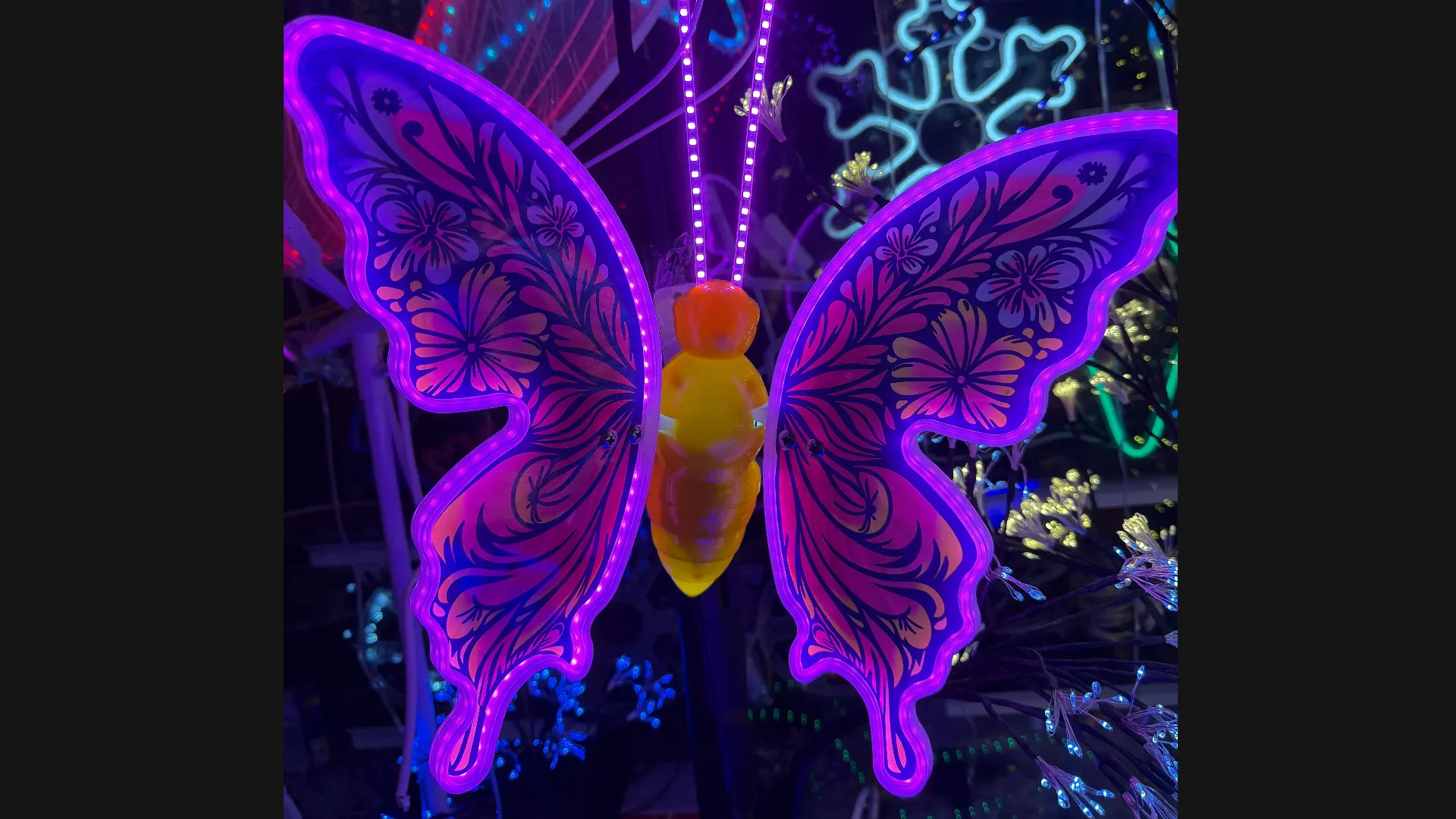
The additional cost of a solar module is about $12–13, depending on the size of the butterfly light. It includes the solar panel, rechargeable battery, and charge-discharge control board.
The solar module is not a standard configuration. It is an optional configuration. Whether it is worth adding depends on your customer’s usage scenario. We have a dedicated article comparing solar-powered and plug-in butterfly lights in detail. Here, we only discuss the decision from a configuration perspective.
Worth adding: Your customers are in areas with sufficient sunlight, wiring is inconvenient, they do not have high requirements for wing-flapping performance, and they care more about the convenience of installation-free use.
Not worth adding: Your customers are in areas with insufficient sunlight, need long-term stable operation, require strong wing-flapping performance, or purchase large butterfly lights above 24 inches.
Not recommended: Do not add solar modules to all products just because “solar sounds easier to sell.” Solar modules increase cost and complexity. If the end customer’s usage scenario is not suitable, they may increase return risk instead.
Motion Sensor: A Small Feature That Affects Experience and Selling Price
The additional cost is about $1.5. When someone approaches, the butterfly light automatically starts wing-flapping and lighting. When the person leaves, it automatically enters standby mode.
Suitable scenarios: entrances, garden paths, and commercial displays — when someone passes by, the butterfly light “comes alive,” creating a strong interactive feeling. Restaurant gardens and hotel courtyards especially like this function because it saves power and creates a surprise effect.
Not suitable: Low-price, high-volume channels. If the customer is price-sensitive, the additional $1.5 may put the product at a disadvantage during price comparison. It is also not necessarily a must-have for residential gardens — people may walk around the garden frequently, causing the sensor to trigger often, so the power-saving effect is limited.
When purchasing, confirm the sensing distance and angle. Sensor parameters vary greatly between suppliers. Some sensors trigger at 2 meters, while others need 5 meters. The sensing angle also varies. If your customer is using the product in a commercial scenario, it is recommended to choose a model with a sensing distance of 3–5 meters and a sensing angle of more than 120°.
RGB Color Changing: Suitable for Commercial Scenes, but Not Necessarily for All Residential Users
The additional cost is about $22. A single-color light becomes a multi-color gradient light, making the lighting effect more eye-catching.
Suitable scenarios: commercial displays, holiday decorations, and theme parks — places that need to attract attention. RGB color-changing butterfly lights are very striking at night and are suitable for window displays or entrance decoration.
Not suitable: Most residential gardens. Ordinary residential users often feel that RGB color changing is “too colorful” and does not match the natural style of a garden. Warm white single-color lighting looks more natural in garden environments and matches most outdoor lighting styles better.
Note: The RGB module is only suitable for the PP transparent wing series. Acrylic models and ABS printed models may not support it — confirm compatibility before purchasing. The additional cost of $22 is not small. If you buy it and later find that it is not compatible, it is a waste.
How to Design Three Wholesale Configuration Levels
If you do not want customers to combine more than ten accessory options by themselves, you can design three configuration levels to simplify purchasing decisions.
Basic Version
- External motor + stall protection
- PP transparent wings
- Warm white single color
- Plug-in version
- 3-meter wire
- Tree-mounting accessories
- Basic transformer with certification
Positioning: Entry-level high-volume model, covering the widest customer group.
Upgraded Version
- External motor + stall protection
- PP or ABS wings
- Warm white or cool white
- Plug-in version or optional solar version
- 3-meter wire
- Tree-mounting accessories + optional pole base
- Quality transformer with certification and overload protection
Positioning: Mid-range market, suitable for garden centers and boutique e-commerce sellers.
High-End Version
- External motor + stall protection
- ABS printed wings or acrylic wings
- RGB color changing or special color
- Motion sensor
- Solar or plug-in dual options
- Pole base as standard
- Quality transformer + extended wire
- Reinforced packaging
Positioning: High-end market, commercial scenarios, gift channels, and differentiated product lines.
With three levels, customers do not need to choose accessories item by item. They can directly choose the configuration level. Your SKU management also becomes simpler.
Wings Cannot Be Folded — Packaging Directly Affects Shipping Cost
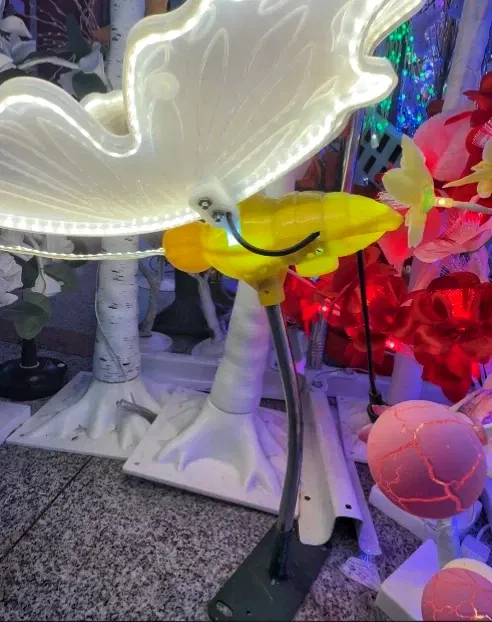
The wings are the part of the butterfly light that takes up the most space, and they cannot be folded. This means large packaging volume and high shipping costs. For wholesalers, shipping cost is a hidden profit killer — the product itself may have a good margin, but if the packaging solution is unreasonable, shipping cost will eat into the profit.
Since wing material affects visual effect, durability, and packaging pressure, buyers should also compare PP, acrylic, and ABS animated butterfly lights before finalizing the configuration.
Why the Wings Cannot Be Folded
Although PP wings have good toughness, folding will leave creases. Under the light, the crease becomes very obvious — a bright line across the wing, greatly reducing the visual effect. Acrylic wings are even more obvious: they crack when folded. ABS wings are more impact-resistant than acrylic, but folding also damages the printed pattern and wing structure.
So the wings must be packed in an unfolded state. This creates a conflict: unfolded wings mean larger packaging volume, which means higher shipping costs.
Packaging Strategies for Different Materials
PP wings: PP is relatively lightweight, and small-sized models can be arranged compactly. For small dynamic models, 20 pieces can be packed in one carton, with a carton size of about 13.78 × 13.78 × 13.78 inches. Among the three materials, PP has the highest packing density and relatively controllable shipping cost.
Acrylic wings: They must be packed separately — the wings and the body are packed in separate cartons. Separate packaging increases assembly work, but it has one advantage: the wings can be stacked more compactly when packed separately, which may take up less actual space than integrated packaging. If your warehouse has assembly capability, separate packaging may actually save shipping costs.
ABS wings: Large models above 31.5 inches are packed one piece per carton, with a single unit weighing about 3 kg. This type of packaging has no compression space — the wing size determines the carton size. The only optimization method is to consolidate them with other small-sized products and use small cartons to fill the empty spaces in the container.
How to Optimize Packaging to Save Shipping Cost
First, container consolidation is key. Do not order only one size. Mix large, medium, and small sizes in one container, and use small cartons to fill the gaps between large cartons. This gives the best loading efficiency. If you order only large models, half of the container may be filled with air, wasting freight cost.
Second, confirm the packing difference between the dynamic and static versions. Because the dynamic version needs to leave movement clearance for the wings, its packing quantity is only half that of the static version. If you need both dynamic and static versions, calculate the balance: the static version has a higher packing density and lower shipping cost, but the product price is also lower; the dynamic version has a lower packing density and higher shipping cost, but a higher product price and profit margin. Find the ratio that suits your market.
Third, ask the supplier for a loading diagram. Professional suppliers can provide a loading diagram — how many cartons can fit in each container, how they are arranged, total weight, and total volume. With a loading diagram, you can calculate shipping costs accurately instead of relying on estimates.
Fourth, separate packaging may save shipping costs in specific situations. For acrylic models, separate packaging may look like “one extra step,” but after the wings are packed separately, they can be stacked more compactly. The actual occupied space may be smaller than the integrated packaging. If you are ordering acrylic models, ask the supplier to compare the loading volume difference between integrated packaging and separate packaging — the result may surprise you.
The Impact of Packaging on Profit
The shipping cost of one butterfly light, from China to North America or Europe by sea freight, usually accounts for 15–25% of the total product cost, depending on size and destination port. If the packaging solution is optimized well, shipping cost can be reduced by 5–10 percentage points — and that 5–10 percentage points goes directly into your profit.
Do not only focus on the product unit price when negotiating. Shipping cost is a hidden profit variable.
Mixed-Color Packaging: An Easily Overlooked Detail
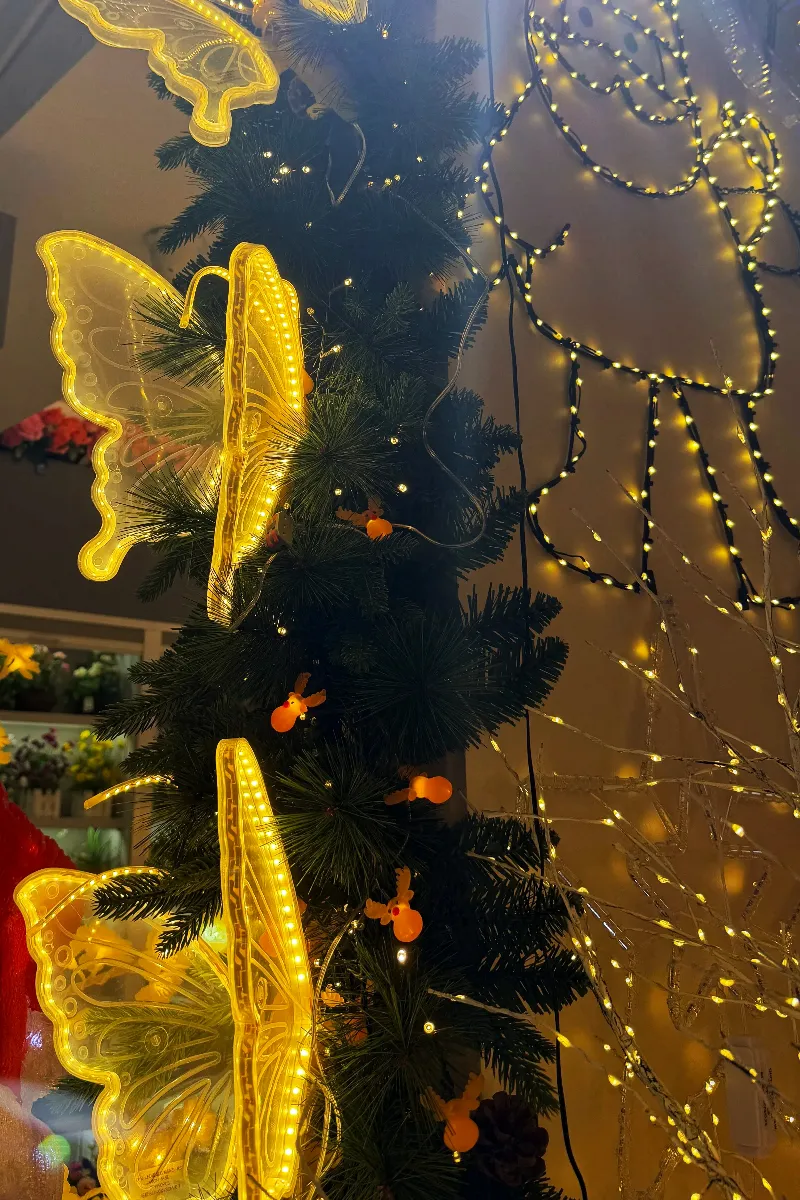
The wing colors of butterfly lights are produced one color at a time on the production line — one batch of warm white, one batch of cool white, one batch of pink. If your customer wants “10 pieces in mixed colors,” such as 3 warm white + 3 cool white + 2 ice blue + 2 pink, the factory production line cannot do this directly. Someone must re-sort and re-pack the butterfly lights of different colors.
This is secondary packaging. It sounds simple, but if you do not have your own warehouse and workers to handle it, you either need to pay the factory extra to do it, which many factories are unwilling to do, or send single-color cartons to your customer and let the customer mix them by themselves — the experience is poor. Our warehouse can handle mixed-color sorting and secondary packaging. This will be discussed later.
What Information Should You Ask the Supplier to Provide When Inquiring?
For every inquiry, make sure the supplier provides the following information:
☐ Product photos and videos
☐ Material: PP/acrylic/ABS
☐ Motor solution: internal/external, with or without stall protection
☐ Wire length
☐ Whether the transformer is included, and the transformer certification standard
☐ Installation accessory list: pole/base/tree-mounting accessories
☐ Packaging method and quantity per carton
☐ Whether solar module/motion sensor/RGB is included
☐ Whether the price includes all accessories
☐ Plug specification: US / EU / AU plug
After confirming the quotation, use an animated butterfly light inspection checklist to check whether the transformer, wire length, mounting accessories, RGB function, sensor, and packaging method match the order.
If the supplier only gives you one total price without accessory details, either they do not understand the product well, or they do not want you to compare prices clearly. Neither situation is ideal.
Final Thoughts
The more configurations an animated butterfly light has, the easier it is for quotations to become confusing. What wholesalers really need to do is not simply compare prices, but break down every configuration clearly and then compare prices under the same configuration.
Remember: for the same butterfly light, the price of a bare unit and a full-configuration unit can differ by double. When comparing prices, you must compare prices under the same configuration, not just the total price.
Once the configuration is selected, there is still one more issue: how do you consolidate products from different factories into one container? The transformer comes from Factory A, the pole comes from Factory B, and the butterfly light comes from Factory C — who will receive the goods, inspect them, assemble accessories, and re-pack everything?
This is exactly what we do in our warehouse in Nanjing. Goods from different factories arrive at our warehouse. We inspect, consolidate, and re-pack them according to your order. What you receive is a complete carton ready to be shipped to your customer, not a pile of loose accessories.
If you are planning a butterfly light purchasing configuration, contact us to discuss it — from configuration selection to consolidated shipping, we can help you make the process clearer.
Talk to Queenie about butterfly light configuration, packaging, and consolidated shipping.
[The prices mentioned in this article are based on current market conditions. Please refer to the latest inquiry quotation for the actual price.]
Simplify Your Garden Product Sourcing from China
We help you combine multiple product categories into one sourcing flow with supplier matching, sample verification, and consolidated shipping.
Written by
ScarecrowGarden
💡About Scarecrow Garden Supplier Co., Ltd.
Scarecrow Garden Supplier Co., Ltd. is a China-based sourcing and wholesale partner specializing in garden tools, landscaping equipment, and outdoor supplies for international wholesalers, distributors, contractors, and brands.
With hands-on experience rooted in real garden use scenarios, we focus on durable materials, functional design, and stable large-volume supply. Our product range covers pruning tools, watering systems, hand tools, outdoor hardware, and customized garden solutions to support both retail and professional landscaping markets.
Beyond products, we help our partners navigate supplier selection, quality control, compliance requirements, and long-term sourcing strategies in China. Through our blog, we share practical insights on product selection, material comparisons, industry trends, and cost-effective purchasing—helping global buyers build stronger, more competitive supply chains.