









Updated 4 months ago
Complete Buying Guide for Animated Butterfly Lights: What Wholesalers Need to Know from Product Selection to Inspection

ScarecrowGarden
💡About Scarecrow Garden Supplier Co., Ltd.
Scarecrow Garden Supplier Co., Ltd. is a China-based sourcing and wholesale partner specializing in garden tools, landscaping equipment, and outdoor supplies for international wholesalers, distributors, contractors, and brands.
With hands-on experience rooted in real garden use scenarios, we focus on durable materials, functional design, and stable large-volume supply. Our product range covers pruning tools, watering systems, hand tools, outdoor hardware, and customized garden solutions to support both retail and professional landscaping markets.
Beyond products, we help our partners navigate supplier selection, quality control, compliance requirements, and long-term sourcing strategies in China. Through our blog, we share practical insights on product selection, material comparisons, industry trends, and cost-effective purchasing—helping global buyers build stronger, more competitive supply chains.

Wholesale Animated Butterfly Lights: B2B Sourcing Guide | Scarecrow Garden Supplier
You are looking for butterfly lights.
Not the kind of small solar garden ornament that you stick into the soil, with wings that only sway a little when the wind blows. You are looking for the kind whose wings really move — with motor drive, program control, and a lifelike appearance when placed in a garden.
But once you start searching, you will quickly find that the information is messy. Some people call it an animated butterfly light, some call it a moving butterfly ornament, and some even sell swaying models as flapping models. Prices range from a dozen dollars to eighty dollars, and you cannot tell where the difference really is. The sample from the factory looks good, but when the bulk order arrives, the motor jams, the wings fall off, and the waterproofing does not pass at all.
This article is written for buyers facing exactly these problems. We will explain the flapping mechanism, motor selection, material comparison, accessory configuration, inspection checklist, and packaging solutions — taking apart an animated butterfly light from beginning to end.
After reading this article, you will understand one thing: the biggest difference in butterfly lights is not the appearance. It is the motor. If you choose the wrong motor, the cheaper option may become the most expensive one.
What Exactly Is an Animated Butterfly Light? First Understand What You Are Buying
Products called “butterfly lights” on the market are at least three completely different things:
Swaying Model
The wings are fixed, and the product is inserted into the soil with an iron wire stake. When the wind blows, it sways slightly. Strictly speaking, it is not really “animated.” It is more like a lighted garden stake. This is the most common type sold on Amazon. The price is low, usually $12–35 for a set of 2–4 pieces. It is suitable for budget-sensitive end consumers, but the repeat purchase rate is low and there is little room for differentiation.
Static LED Model
This is a butterfly-shaped light with wings that do not move. It is used purely as a decorative product through LED lighting effects. Some well-made models look good at night, but during the day they are just a plastic butterfly without dynamic appeal.
Animated / Flapping Model
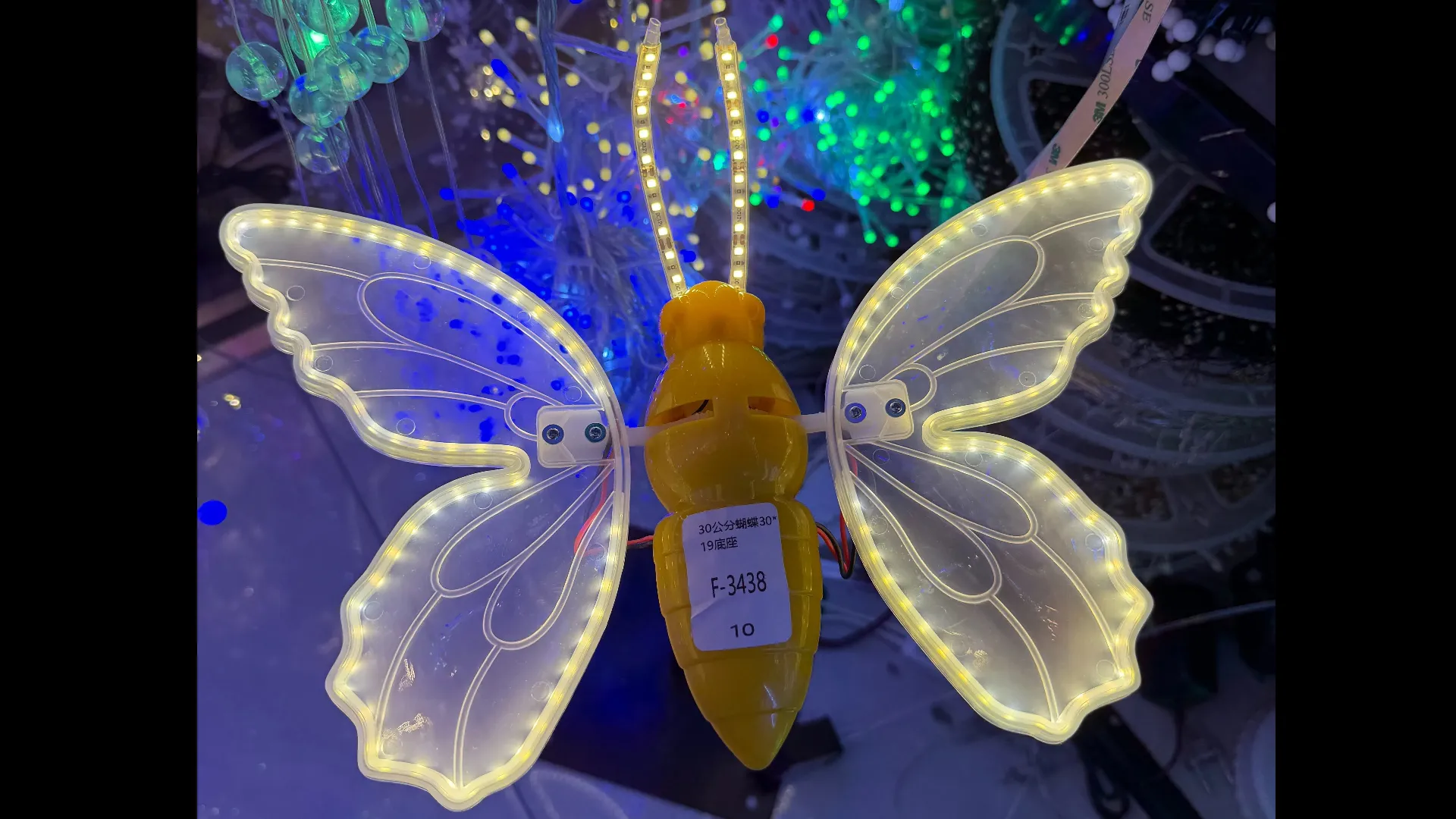
This is what we mean by an “animated butterfly light.” It has a built-in motor and control program, allowing the wings to flap rhythmically under program control, with a flapping angle of up to 80°. High-brightness LED strips are embedded in the wings and antennae, combined with breathing light or steady light modes. During the day, it is a dynamic garden sculpture. At night, it becomes a glowing living butterfly.
These three types of products have completely different target customers, pricing strategies, and profit margins. If you are a wholesaler or e-commerce seller, the swaying model can sell in volume but has thin margins. The flapping model has a higher unit price, stronger differentiation, and a lower return rate — provided that you know how to choose it.
Next, we will only discuss the flapping model.
Three Materials, Three Price Levels: How to Choose PP, Acrylic, and ABS
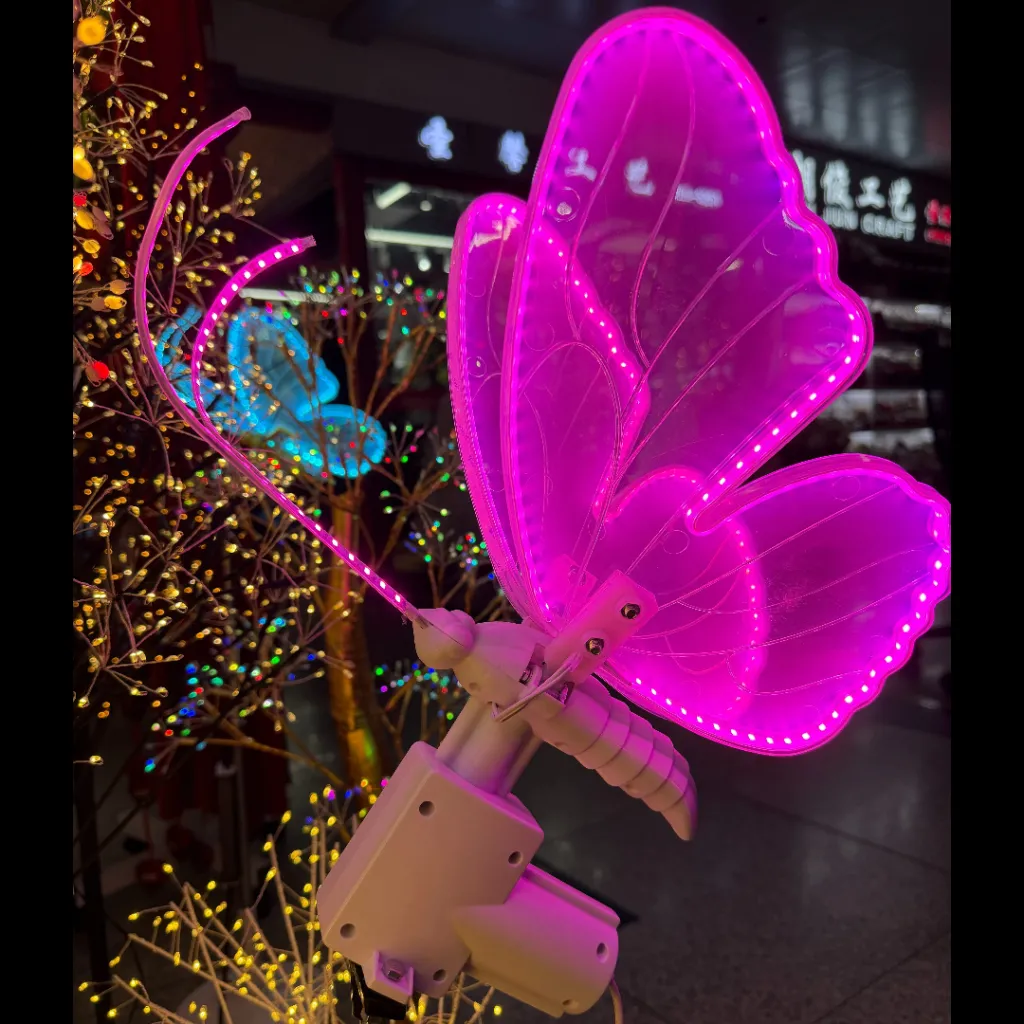
The wing material of an animated butterfly light directly determines three things: visual effect, durability, and retail pricing. Currently, there are three mainstream materials on the market: transparent PP wings, acrylic wings, and ABS printed wings. They are not simply “good, medium, and poor.” Each one corresponds to different market needs.
If you are comparing wing options, read our guide to PP, acrylic, and ABS animated butterfly lights before deciding which material fits your market.
Transparent PP Wings — The Main Volume-Selling Option
PP, or polypropylene, is the most common wing material used in animated butterfly lights. It is semi-transparent. When light passes through it, the lighting effect is even. During the day, it has a frosted texture, and at night, the lighting effect is soft. PP wings cover the widest size range, from 17.72 inches to 39.37 inches, offering the most options.
Advantages: Lightweight, affordable, and impact-resistant. The wings are not easy to crack during transportation, which is a hard requirement for wholesalers — you do not want to receive a full carton where half of the wings are broken. PP is much more flexible than acrylic. It can rebound after bending, unlike acrylic, which is brittle.
Disadvantages: Long-term outdoor exposure may cause yellowing. This is a common characteristic of PP material. If your customers are in areas with strong sunlight, such as Australia or the southwestern United States, you need to inform them in advance: after two or three years, the wings may turn slightly yellow, but this will not affect function or lighting performance.
Suitable for: Wholesalers pursuing cost performance, residential garden markets, and volume sales. Small and medium-sized PP butterfly lights are entry-level models, suitable for customers to “test the market” first.
Acrylic Wings — A High-End Visual Option
Transparent acrylic wings have the strongest visual impact among the three materials. Their light transmittance is higher than that of PP, and when light passes through, they look as clear as glass. This is especially true with the ice blue light configuration — the night effect is very eye-catching. Acrylic models currently come in only two sizes, 23.62 inches and 29.13 inches, following a boutique product route.
Advantages: High light transmittance and a visual effect closest to a “glowing glass butterfly.” The surface gloss is good, and the texture in photos is clearly better than PP. If your customers are garden centers or high-end garden product stores, acrylic models can directly increase the average order value through display appeal.
Disadvantages: Brittle. Acrylic is not as impact-resistant as PP. If the packaging is not good enough during transportation, the edges of the wings may crack easily. This is also why acrylic models usually use split packaging — the wings and body are packed separately and assembled after arrival, reducing transportation damage. In addition, acrylic costs more than PP, so the wholesale price is naturally higher.
Suitable for: Mid-to-high-end markets, garden centers, and boutique e-commerce sellers. This is not a volume model. It is a profit model.
ABS Printed Wings — The Strongest Differentiation
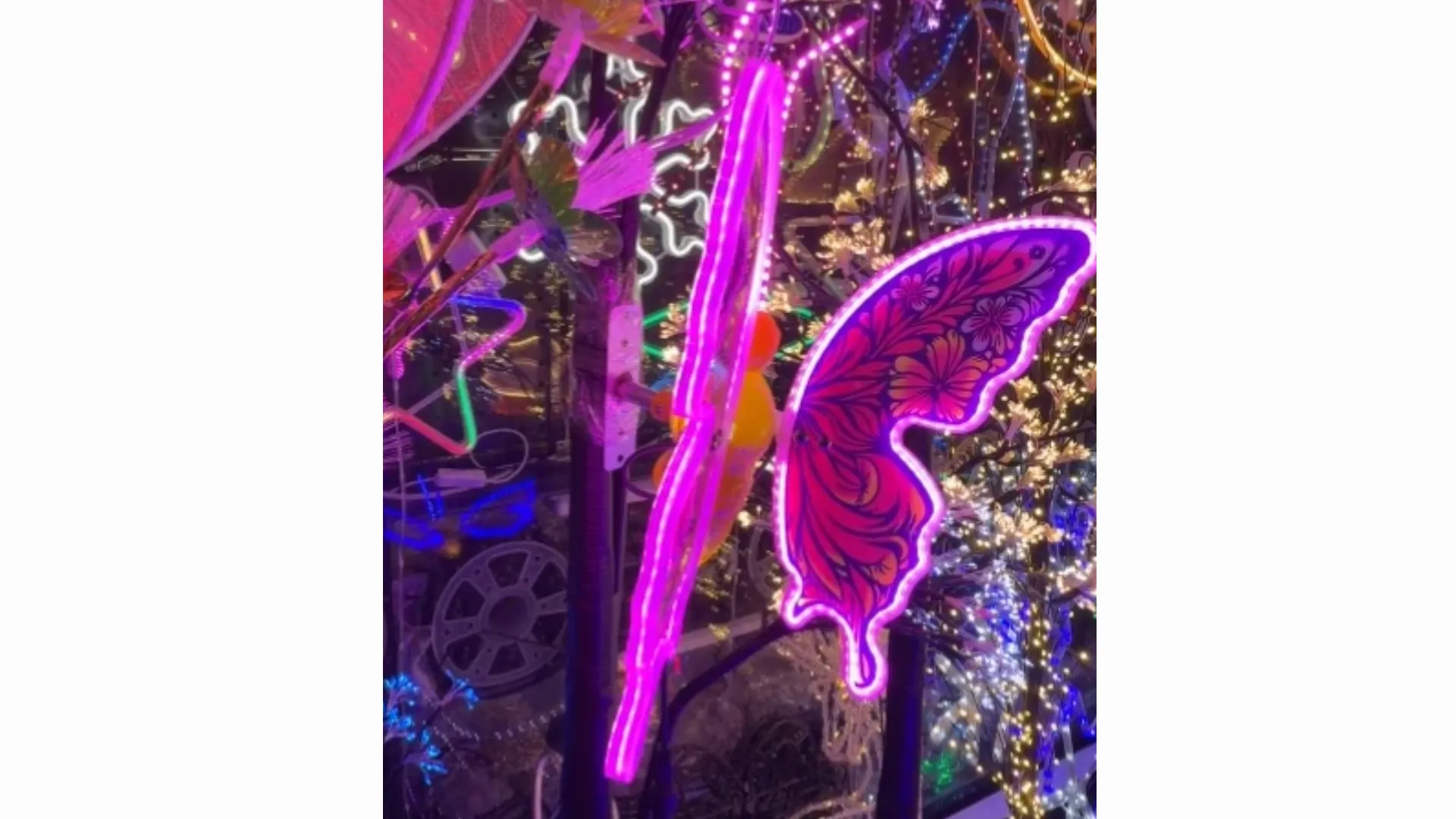
ABS wings can be printed on both sides. The patterns and colors on the butterfly wings are printed, not created by changing the light colors. When the light is off during the day, the wing pattern itself becomes the selling point. Printed models are available from 17.72 inches to 39.37 inches.
Advantages: They have visual appeal both during the day and at night, which PP and acrylic cannot achieve. When PP and acrylic are not lit during the day, they are just semi-transparent plastic pieces. ABS printed models look like colorful butterflies even during the day. Larger models above 31.5 inches also have 9 built-in sound effects, with a wing flapping angle of 80°, making them the most realistic series in terms of dynamic effect.
Disadvantages: ABS is heavier than PP, so transportation costs are slightly higher. Printed patterns may fade under long-term outdoor UV exposure. This is the same type of issue as PP yellowing — a material limitation, not a workmanship problem. If customers care a lot about long-term outdoor use, this needs to be pointed out in advance.
Suitable for: Wholesalers who need differentiation. If your customers are already selling PP models, printed models are the best option for adding another product line — the same category, but with a completely different visual selling point.
Quick Material Selection Table
| Transparent PP | Acrylic | Printed ABS | |
|---|---|---|---|
| Light Transmission Effect | ⭐⭐⭐⭐ Soft and even | ⭐⭐⭐⭐⭐ Clear and transparent | ⭐⭐⭐ Mainly based on printed patterns |
| Daytime Effect | ⭐⭐ Semi-transparent | ⭐⭐⭐ Good gloss | ⭐⭐⭐⭐⭐ Eye-catching printed patterns |
| Resistance to Transportation Damage | ⭐⭐⭐⭐⭐ Flexible | ⭐⭐⭐ Requires split packaging | ⭐⭐⭐⭐ Relatively impact-resistant |
| UV Durability | ⭐⭐⭐ May yellow after 2–3 years | ⭐⭐⭐⭐ Not easy to yellow | ⭐⭐⭐ May fade after 2–3 years |
| Price Positioning | Entry-level | Mid-to-high-end | Mid-range |
| Recommended Market | Residential garden volume sales | Garden centers/boutique stores | Differentiated product lines |
One-sentence summary: If you are not sure what to choose, start with PP models to test the market. If customers want a high-end visual effect, recommend acrylic. If customers want the product to look good during the day as well, recommend printed ABS.
But no matter which material you choose, if the motor is wrong, good-looking wings will still become returns. Material determines whether it looks good. The motor determines whether it can be used. Next, we will talk about the motor.
The Motor — The Most Critical Component of the Whole Butterfly Light
The wing material determines whether it looks good. The motor determines whether it can be used.
This is not an exaggeration. The biggest reason for returns of animated butterfly lights is not appearance. It is motor failure — the wings get stuck and stop moving, the motor makes abnormal noise, or the motor burns out after powering on. You may not feel this at the wholesale stage, because the problem often appears after the end consumer has used the product for several months. But the return will eventually come back to you.
So in this section, we will explain the motor thoroughly.
Built-In Motor vs External Motor: The First Question You Must Confirm When Purchasing
Currently, there are two motor installation methods for animated butterfly lights on the market:
Built-In Motor
The motor is inside the butterfly body.
This is the earlier solution. The motor is directly installed inside the butterfly body and drives the wings to flap. The structure is simple. The motor cannot be seen from the outside, and the overall appearance is clean.
But the problems are also obvious: the motor is enclosed inside the ABS body, with limited space for heat dissipation. After long-term operation, the temperature rises, accelerating motor aging. More importantly, if the wings are blocked by external force — for example, wind blows the wings against a branch, or a child reaches out to grab them — the motor continues to rotate while the wings cannot move. This is called “stalling.” Built-in motors do not have a stall protection mechanism. A few minutes of continuous stalling may burn out the motor.
The cost of a built-in motor is around $10. The price is low, but the failure rate is high. If your customer base is residential gardens and household users, the probability of butterfly lights being touched by children or hit by pets is not low. You need to calculate the return risk of built-in motors.
External Motor
The motor is outside the butterfly‘s body.
This is the current upgraded solution. The motor is installed outside the body and connected to the wings through a transmission rod. Heat dissipation is better, the operating temperature is lower, and the motor life is significantly longer. More importantly, external motor solutions are generally equipped with stall protection: when the wings are stuck, the program automatically cuts off power to the motor to prevent burnout.
The cost of an external motor is around $17, almost twice that of a built-in motor. But considering the return rate and after-sales cost, this money is worth spending.
Our recommendation: if this is your first time purchasing animated butterfly lights, choose the external motor model. The price advantage of built-in motors does not stand up against the return rate. If your customers clearly require the lowest price, you can provide built-in models, but you must inform them of the risks in advance.
For buyers who want to compare motor structures in more detail, we explain how to choose a motor for dynamic butterfly lights in a separate guide, including the differences between external motors and built-in motors.
Stall Protection: A Function You Cannot Hear but Must Ask About
Stall protection is not a marketing gimmick. It is a real functional difference.
Imagine this scenario: a 39-inch-long animated butterfly light is installed in a garden. At night, a gust of wind blows a nearby branch over and blocks the wings. Without stall protection, the motor continues running, the current increases sharply, and the motor burns out after a few minutes. With stall protection, the motor detects abnormal resistance and automatically stops. After the external force disappears, it resumes normal operation.
Currently, the ABS printed series is equipped with motor stall protection. If you are getting quotations from other suppliers, ask one question: “Does the motor have stall protection?” The answer will help you judge whether this is a serious factory.
Flapping Angle and Program: 80° Is the Dividing Line
The flapping angle determines whether the dynamic effect of the butterfly light is realistic enough. Low-priced products usually have a flapping angle of 40–60°. The wings only flap slightly, looking more like “shaking” than “flying.” A flapping angle of 80°, combined with multi-stage program control — slow flapping, fast flapping, and intermittent pauses — can reproduce a rhythm close to real butterfly wing movement.
The ABS printed series reaches a flapping angle of 80°, and other series also have multiple built-in flapping programs. It is recommended to confirm the specific angle when purchasing.
Motor Purchasing Checklist
Before placing an order, send these five questions to your supplier:
☐ Is the motor built-in or external?
☐ Does it have stall protection?
☐ What is the flapping angle?
☐ Is the motor noisy during operation? A good motor is almost silent, while a poor one makes a buzzing sound.
☐ How long is the motor warranty?
These four questions are enough. If the supplier answers clearly, it means the factory controls these parameters. If the answer is vague or they say “they are all about the same,” you should know what that means.
Accessory List — Why the Price of the Same Butterfly Light Can Double
If you have already requested quotations, you may have encountered this situation: for the same butterfly light, Factory A quotes $18, while Factory B quotes $35. You may think Factory B is overcharging you. In fact, that is not necessarily true — the accessory configurations may be completely different.
An animated butterfly light is not simply “one light.” It is a system composed of multiple accessories. Whether each accessory is included, and its specification and quality, will all affect the final price. If you do not clarify these details, price comparison is meaningless.
Power Adapter
The working voltage of an animated butterfly light is DC12V / 24V / 36V. It cannot be directly plugged into a household socket. You need a power adapter to convert 110V / 220V AC into low-voltage DC. The power adapter is the small black box, with one end plugged into the wall socket and the other end connected to the butterfly light cable.
This sounds like a small detail, but it is not. The quality of the power adapter directly affects the stability and safety of the whole light. Low-priced products come with the most basic power adapters, with thin shells, thin wires, and no overload protection. Better-quality adapters have overload protection, short-circuit protection, and waterproof connectors. The cost difference can be several dollars.
When purchasing, confirm two things: Is the power adapter included in the quotation? Does the adapter have certification marks for your target market? The North American market needs UL or ETL certification, while Europe needs CE certification. Without the corresponding certification, your customer may even face customs clearance problems.
Cable Length
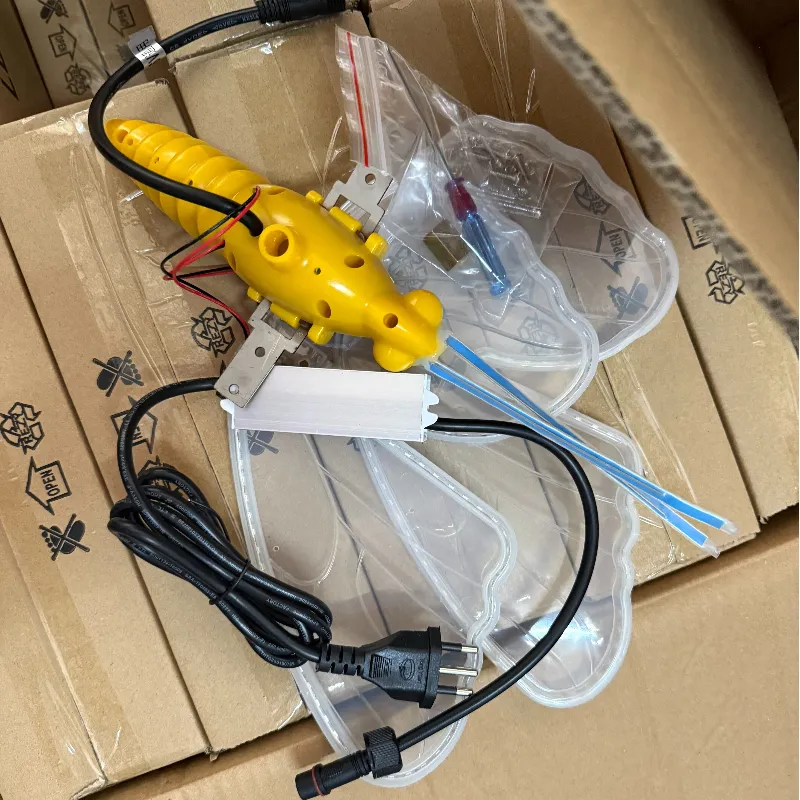
This looks like a small parameter, but end consumers care about it. The butterfly light is installed in the garden, and the nearest power socket may be five meters away. If the cable is too short, customers have to connect an extension cable themselves — the experience is poor, and negative reviews may follow.
Standard cable lengths vary greatly among factories, from 1.5 meters to 5 meters. A longer cable means higher material cost, but also fewer customer complaints. If your customers mainly serve the residential garden market, it is recommended to choose a standard cable of more than 3 meters.
Installation Method: Ground Pole with Base vs Tree-Mounting Accessories
These are two completely different installation solutions, with different accessories, different prices, and different application scenarios.
Ground Pole + Base
This includes a metal pole, usually about 1 meter, and a base. The butterfly light is fixed to the top of the pole and stands on the garden ground. This set of accessories is not cheap — metal pole, base, and fixing parts add up to a noticeable cost. But installation is simple. Customers do not need to drill into trees or tie ropes. They can simply place it on the ground. It is suitable for residential customers with enough garden ground space and for commercial landscape projects.
Tree-Mounting Accessories
The butterfly light is fixed to a tree trunk or fence using screws and straps. The accessory cost is low — just a few screws and straps. But installation is slightly more complicated. Customers need a tree or fence for fixing. It is suitable for customers with mature trees in their garden, or for landscape designers who specify installation positions.
Many wholesalers purchase both types of installation accessories at the same time, allowing end customers to choose. This is more flexible than offering only one solution, but it also means you need to manage more SKUs.
Solar Module
Solar power is an optional configuration, not a standard one. The additional cost of a solar module is around $12–13, depending on the butterfly light size.
A solar module includes a solar panel, a rechargeable battery, and a charge-discharge control board. The main quality differences lie in battery capacity and solar panel conversion efficiency. Low-priced solar panels can hardly charge on cloudy days, and the charging efficiency drops sharply in winter. If your customers are in North America or Northern Europe, this must be explained in advance.
We will discuss the detailed comparison between solar and wired models in a separate section later.
For a detailed quotation comparison, see our guide to wires, transformers, motion sensors, RGB, and installation accessories.
Motion Sensor Module
The additional cost is around $1.5. When someone approaches, the butterfly light automatically starts flapping and lighting. When the person leaves, it automatically enters standby mode. This function is popular in commercial scenarios such as restaurant gardens and hotel courtyards — it saves energy and creates an interactive experience. It is not a must-have for residential markets, but as a low-cost optional feature, it is worth offering.
RGB Color-Changing Module
The additional cost is around $22. A single-color light becomes a multi-color gradient light, creating a more dazzling effect. But note: the RGB module is only applicable to the transparent PP wing series. Acrylic models and ABS printed models may not support it. Confirm compatibility before purchasing.
How Accessories Affect Price — A Clear Table
| Accessory | Standard or Optional | Impact on Price | Purchasing Recommendation |
| Power adapter | Some factories do not include it as standard | Quality difference of $2–5 | Confirm whether it is included in the quotation and check certification standards |
| Cable | Standard, but length varies | 1.5m to 3m adds about $0.5–1 | 3m+ recommended for residential markets |
| Pole + base | Optional | Significant price increase | Necessary for commercial scenarios; optional for residential markets |
| Tree-mounting accessories | Optional | Very low price increase | Recommended as standard; low cost and more customer choice |
| Solar module | Optional | About +$12–13 | Use a dual-version strategy depending on market |
| Motion sensor | Optional | About +$1.5 | Recommended for commercial scenarios; optional for residential |
| RGB color-changing | Optional | About +$22 | Only compatible with PP series; confirm before choosing |
Now you understand: the same butterfly light can have one price as a bare unit with a basic adapter, and a completely different price when equipped with a pole base, solar module, and RGB lighting. When comparing prices, you must pull out the accessory list and compare item by item. Looking only at the total price will not give you a real result.
But no matter how many accessories are added, if the motor is wrong, you are only adding features to a light that may be returned. Accessories determine experience. The motor determines lifespan.
Solar or Wired? This Is Not a Simple Choice
Many wholesalers think this when purchasing butterfly lights for the first time: solar power requires no wiring and no electricity cost, so it must be easier to sell than wired models, right?
Not necessarily. Solar and wired models are not about “which one is better.” They are about “which one is more suitable for your customers.” If you choose the wrong one, the return rate will correct you.
Solar Models: The Selling Point Is Convenience, the Pain Point Is Weather
The end consumer profile for solar butterfly lights is very clear: they do not want to run cables, hire electricians, or increase electricity costs. Insert it into the soil and it works. It charges automatically during the day and lights up automatically at night. This user experience is indeed attractive to residential garden users.
But solar models have three issues you must think through before purchasing:
First, charging efficiency is limited by weather. The conversion efficiency of solar panels drops sharply on cloudy days, and the problem is even more serious in regions with short winter daylight hours. If your customers are in northern Canada, Northern Europe, or the UK — places where it gets dark at three or four o’clock in the afternoon during winter — solar butterfly lights may almost fail to work normally in winter. Customers will not blame the weather. They will blame you.
Second, battery life is limited. The rechargeable battery inside the solar module usually needs replacement after 1–3 years, depending on battery quality and usage environment. After battery aging, charging capacity decreases, and lighting time may drop from 8 hours to 2–3 hours. End consumers often do not know that the battery can be replaced, so they return the product directly.
Third, dynamic flapping + solar power creates a power contradiction. The flapping motor of an animated butterfly light needs continuous power, and its power consumption is much higher than that of a static LED light. Solar panels and battery capacity are limited. Maintaining enough lighting time while ensuring the flapping effect requires high specifications for the solar module. Low-priced solar solutions often compromise the flapping effect — either the flapping speed becomes slower or the lighting time becomes shorter.
Wired Models: The Selling Point Is Stability, the Pain Point Is Installation
Wired models, using DC12V / 24V / 36V, do not depend on weather. Brightness is stable, flapping performance is consistent, and operation is not affected by seasons. Large animated flapping butterfly lights above 24 inches are almost always wired models, because solar power output cannot support the flapping requirements of large wings.
But wired models have a higher installation threshold. They need a power adapter, wiring, and a nearby power socket. For residential gardens without outdoor sockets, installing a wired model means running an extension cable from indoors — some consumers find this troublesome, while others think it looks unattractive.
How to Choose? Look at Your Target Market
| Customer Type | Recommended Solution | Reason |
| Residential gardens in North America / Northern Europe | Mainly wired, solar as supplement | Winter solar efficiency is too low, creating return risk |
| Southern Europe / Australia / Southern United States | Solar + wired dual versions | Sufficient sunlight, better solar experience |
| Commercial landscapes, such as hotels and restaurants | Wired | Stable operation is required; “the light does not work today because it is cloudy” is unacceptable |
| E-commerce sellers, such as Amazon / Shopify | Solar models first | End consumers search for “solar” more often, and no wiring is the core selling point |
| Garden centers / offline retail | Dual-version display | Let consumers choose and cover a wider audience |
A Practical Recommendation
If this is your first time entering the butterfly light category, start with wired models to test the market. The problem of wired models — needing installation wiring — is something consumers can solve themselves. The problem of solar models — the light not working because the weather is bad — is something consumers cannot solve. The former is an inconvenience. The latter is product failure. In negative reviews, the severity of these two issues is completely different.
After the wired models work in the market, you can decide whether to introduce solar versions based on customer feedback. The solar module is an optional configuration. It does not require separate tooling, and the cost of adding it later is low.
Colors and Wing Styles — Not Just an Aesthetic Issue, but a Pricing Issue
When many wholesalers choose butterfly lights, they focus on size and material. Color and wing style are often treated as “whatever the factory offers.” This is a mistake. Color and style directly affect two things: whether the product sells well and how much it can sell for.
Single Color vs RGB: Two Completely Different Sales Logic
Single-Color Models
The LED lights on the wings emit a fixed color — warm white, cool white, ice blue, and pink are the four most common options. Warm white is the default configuration and also the safest choice. Warm white light looks most natural in a garden environment and coordinates well with most outdoor lighting styles, so it is not easy to go wrong.
Cool white and ice blue are suitable for modern-style gardens or commercial spaces. They look “cooler” visually, but the audience is relatively narrower. Pink sells well during seasonal periods such as Mother’s Day and Easter, but normal demand is unstable.
RGB Color-Changing Models
The LED lights can gradually switch among multiple colors, creating a more dazzling lighting effect and attracting attention. But the RGB module is an added-cost option, about +$22, and it is only compatible with certain series. More importantly, RGB color-changing models target different customers from single-color models. RGB is more suitable for commercial displays, festive decoration, theme parks, and similar scenes. Residential garden users often feel that it is “too flashy.”
Purchasing recommendation: if your customers mainly serve residential gardens, warm white single-color models should be the main option, accounting for 60–70%. Cool white and ice blue can each account for 10–15% as supplements. RGB can be offered as a differentiated option, but it does not need heavy stock. If your customers include commercial scenarios, the RGB ratio can be increased.
Wing Style: Different Styles Mean Different Prices
Butterfly light wings do not come in only one shape. Different wing styles involve different tooling costs, material usage, and production processes — all of which are reflected in the wholesale price.
Simply put: the more complex the wing, the higher the price. Large-area wings cost more than small-area wings. Hollowed-out or textured wings cost more than smooth wings. Double-sided printed wings cost more than single-color wings. Common wing styles on the market range from simple transparent PP wings to double-sided printed pattern wings, with clear price gradients.
When choosing a style, do not only look at whether the picture looks good. Ask yourself two questions: Are there competitors selling this style in my target market? Can my retail customers clearly explain this visual difference to their consumers? If the answer to both questions is “yes,” this style is worth taking.
Quick Color Selection Table
| Color / Mode | Suitable Market | Sales Rhythm | Profit Margin |
| Warm white single color | Residential gardens, safest option | Stable year-round | Standard margin |
| Cool white single color | Modern-style gardens / commercial | Year-round, low volume | Standard margin |
| Ice blue single color | Exclusive to acrylic models, high-end | Year-round, low volume | Slightly higher |
| Pink single color | Mother’s Day / Easter | Strongly seasonal | Seasonal premium |
| RGB color-changing | Commercial / festive / themed scenes | Seasonal + project-based | Added-margin option |
Inspection Checklist — What to Check When Bulk Goods Arrive at the Warehouse
The sample has been confirmed, the bulk order has been placed, and the container has arrived — this is the moment when you cannot relax. Butterfly lights are electromechanical products. The motor, LED strips, control board, and waterproof sealing can all cause returns once they reach the end consumer if any one of them has a problem.
Below is the inspection process we actually carry out in our warehouse. You can use it directly.
Before shipment, buyers should use an animated butterfly light inspection checklist to verify movement, lighting, waterproofing, accessories, packaging, and carton loading.
Step 1: Open the Carton and Check Packaging Integrity
Do not rush to take out the product. Check the packaging first. Is the carton obviously compressed or deformed? Are the internal cushioning materials in place? The wings of animated butterfly lights are the easiest part to damage during transportation. If the carton has been crushed, there is a high probability that the wings already have problems.
Confirm that the packaging quantity matches the order: 20 pieces per carton for small animated models, 15 pieces per carton for medium models, 40 pieces per carton for small static models, and 1 piece per carton for large models. If the quantity does not match, take photos as evidence first, then contact the factory.
Step 2: Power On Each Unit and Test Flapping
This is the most critical and time-consuming step. Every butterfly light must be powered on and tested:
- Do the wings flap normally? Is the flapping rhythm even?
- Is there any abnormal noise? A good motor is almost silent, while a poor motor makes a buzzing sound. For motor sound standards, refer to our motor topic.
- Is the flapping angle consistent? The left and right wings should flap symmetrically. If one side is higher than the other, there is a problem with the motor or transmission rod.
- Is the lighting normal? Both breathing mode and steady light mode should be tested, and check whether any LED strip section does not light up.
This process is boring, but it must be done. For a carton of 20 pieces, testing all units takes about 1–2 hours. If you skip this step, defective butterfly lights will reach consumers, and the return cost will be much higher than the inspection cost.
Step 3: Check Waterproof Sealing
IP65 means dustproof and protected against water spray — garden rain is fine, but the product cannot be soaked in water. This is the standard waterproof rating for animated butterfly lights, but you cannot simply rely on the label. Focus on three areas:
- Body seams: Are there obvious gaps or glue overflow? The sealant should be even and smooth.
- Cable outlet: Is there a sealing ring or sealant where the cable exits the body? This is a high-risk water-entry point.
- Battery compartment, for solar models: Is the cover tight? Is there a waterproof rubber strip?
If you have concerns about waterproofing, you can do a simple test: use a shower head to simulate moderate rain, spray from different angles for 3–5 minutes, then open the product and check whether there are water marks inside. This is not a formal IP65 test, but it can help you filter out obviously unqualified goods.
Step 4: Check Accessories
Check each item against the order: power adapter quantity, cable length, installation accessories, such as pole base or tree-mounting accessories, and solar modules if included. Missing accessories are common, especially power adapters. Some factories do not include power adapters in their quotations, while you may have assumed they were included when placing the order.
Inspection Checklist Summary
☐ Packaging is intact, with no compression or deformation
☐ Quantity matches the order
☐ Each unit is powered on and tested for flapping — rhythm, sound, angle, and lighting
☐ Waterproof sealing is checked — seams, cable outlet, battery compartment
☐ Simple waterproof test: spray with a shower head for 3–5 minutes and check for water marks inside
☐ Accessories are checked — power adapter, cable, installation accessories, solar module
☐ Photos are taken as evidence — any abnormal issue should be recorded immediately
Packaging and Logistics — Do Not Let Freight Costs Eat Your Profit
The packaging solution for butterfly lights directly affects two costs: transportation cost and damage rate. These two costs move in opposite directions — stronger packaging lowers the damage rate, but increases freight cost. You need to find the balance point.
Packaging Differences Between Static and Animated Models
Static models, where the wings do not move, are more compact in packaging: 40 small units per carton, with carton size around 19.69 × 19.69 × 14.17 inches. Since the wings do not need movement space, they can be arranged tightly.
Animated models, where the wings have a flapping mechanism, take up more packaging space: 20 small units per carton, with carton size around 13.78 × 13.78 × 13.78 inches. The wings need space for movement and cannot be pressed too tightly. For butterfly lights of the same size, the packing quantity of animated models is only half that of static models, which means the transportation cost per unit doubles.
Special Handling for Large Sizes
Butterfly lights above 31.5 inches are packed 1 piece per carton, with a single unit weighing about 3 kg. The carton size is large, the value per carton is high, and the transportation cost takes up a large proportion. If your customer wants to order large-size models, it is recommended to consolidate them with small and medium sizes in the same container. Use the cartons of small and medium sizes to fill container gaps and reduce the average freight cost per unit.
Split Packaging for Acrylic Models
Acrylic wings are brittle and cannot be packed together with the body. Acrylic models generally use split packaging — the wings and body are packed separately and assembled after arrival. Split packaging reduces the damage rate, but increases assembly work. If your warehouse has assembly capability, this is not a problem. If not, you need to inform customers in advance that “simple assembly is required.”
Mixed Loading Notes
If you load different series and different sizes of butterfly lights in the same container, pay attention to two points: heavy goods at the bottom and light goods on top; large cartons placed beside small cartons to fill gaps. This is not just common sense — we have seen 40-inch large butterfly light cartons placed on top of small PP model cartons, and the small cartons were all crushed.
Final Thoughts
Animated butterfly lights are a category worth developing. The market is growing, end-consumer branding has not yet been monopolized, and there is enough profit space. But the premise is that you know how to choose products, how to inspect goods, and how to help your customers avoid pitfalls.
Remember this main principle: motor first. Choose the right external motor with stall protection, and everything else becomes a configuration issue. Material determines whether it looks good. Accessories determine whether the user experience is good. Color determines whether it sells well. But the motor determines whether this light can last.
This article covers the core steps from product selection to inspection, but each step can be explored in more depth. If you want to learn more about a specific topic — motor workmanship details, technical parameters of solar modules, pricing strategies in different markets, or supply chain verification methods — we will break them down one by one in later topic articles.
Next Step: From This Article to Your First Order
If this is your first time entering the animated butterfly light category, start here:
Step 1: Determine Your Target Market Configuration
Are your customers mainly in North America or Europe? Residential gardens or commercial landscapes? Cold regions or warm regions? These answers determine whether you should choose wired or solar, PP or acrylic, built-in motor or external motor. If you are not sure, start with the safest combination: external motor + transparent PP wings + warm white single color + wired model + 3-meter cable. This configuration covers the widest customer group and has the lowest return risk.
Step 2: Get Samples
Do not place an order based only on pictures. Animated butterfly lights are electromechanical products. Pictures cannot show motor noise, flapping rhythm, or light uniformity. Get at least two samples — one built-in motor model and one external motor model — and power them on at the same time for comparison. You will immediately see the difference yourself.
Step 3: Inspect the Goods
When the bulk goods arrive, inspect them item by item according to the checklist above. In particular, power on each unit and test the flapping. This is the most time-consuming step and also the one you must not skip. If your warehouse does not have inspection capability, you can consider working with a supply support team that has warehouse execution capability.
Step 4: Test the Market in Small Batches
Do not place a large order the first time. Start with 200–300 pieces, covering 2–3 sizes and 1–2 colors. Then decide whether to reorder based on end-market feedback. Animated butterfly lights are not standard products. Preferences vary greatly between different markets — your customer data is more reliable than any buying guide.
After reading this article, you may feel that purchasing butterfly lights is much more complicated than expected. You need to choose an external motor, check accessories item by item, consider how packaging affects freight, and power on each unit during inspection. None of these things is difficult on its own, but together they form a complete purchasing process.
This is what Scarecrow does.
We are not sourcing agents — we do not simply help you find a factory and take a commission. We are a supply support team based in Nanjing, with our own warehouse. Butterfly lights from different factories are delivered to our warehouse, where our team inspects them, performs power-on testing, checks accessories, repacks them, sorts mixed colors, and consolidates cartons. What you receive is a full carton that can be sent directly to your customers, not a pile of loose parts that you need to handle yourself.
One container may contain 15 different products from different factories, with different lead times and different standards. We organize them here, inspect the goods, complete the accessories, and repack them according to your order. This is what our warehouse does.
If you are considering purchasing animated butterfly lights, contact us to discuss your plan. Whether you are testing this category for the first time or already selling it and want to switch suppliers, we can help you make the purchasing process smoother.
Talk to Queenie about your butterfly light sourcing plan.
[Prices in this article are based on current market conditions. Please refer to real-time quotations for specific pricing.]
Simplify Your Garden Product Sourcing from China
We help you combine multiple product categories into one sourcing flow with supplier matching, sample verification, and consolidated shipping.
Written by
ScarecrowGarden
💡About Scarecrow Garden Supplier Co., Ltd.
Scarecrow Garden Supplier Co., Ltd. is a China-based sourcing and wholesale partner specializing in garden tools, landscaping equipment, and outdoor supplies for international wholesalers, distributors, contractors, and brands.
With hands-on experience rooted in real garden use scenarios, we focus on durable materials, functional design, and stable large-volume supply. Our product range covers pruning tools, watering systems, hand tools, outdoor hardware, and customized garden solutions to support both retail and professional landscaping markets.
Beyond products, we help our partners navigate supplier selection, quality control, compliance requirements, and long-term sourcing strategies in China. Through our blog, we share practical insights on product selection, material comparisons, industry trends, and cost-effective purchasing—helping global buyers build stronger, more competitive supply chains.