








Updated 4 months ago
Tunisia Full-Category Garden Tools Procurement Guide: From Product Selection to Market Entry Strategy

ScarecrowGarden
💡About Scarecrow Garden Supplier Co., Ltd.
Scarecrow Garden Supplier Co., Ltd. is a China-based sourcing and wholesale partner specializing in garden tools, landscaping equipment, and outdoor supplies for international wholesalers, distributors, contractors, and brands.
With hands-on experience rooted in real garden use scenarios, we focus on durable materials, functional design, and stable large-volume supply. Our product range covers pruning tools, watering systems, hand tools, outdoor hardware, and customized garden solutions to support both retail and professional landscaping markets.
Beyond products, we help our partners navigate supplier selection, quality control, compliance requirements, and long-term sourcing strategies in China. Through our blog, we share practical insights on product selection, material comparisons, industry trends, and cost-effective purchasing—helping global buyers build stronger, more competitive supply chains.

Wholesale Garden Tools Tunisia: Sourcing Guide for Agri-Buyers | Scarecrow Garden Supplier
Many companies that have been involved in agriculture-related products for years already have experience sourcing from China. They are familiar with supplier communication, sample confirmation, and shipment procedures. When these companies want to enter the garden tools category, they often assume it is simply a matter of adding a few more SKUs and asking several factories for quotations.
But garden tools and agricultural supplies do not follow the same industry logic.
China’s exports of garden-related products to Tunisia increased by 30% in 2025 compared with 2024, and continued to grow by 27% year on year in the first four months of 2026. The market is clearly growing. This is not a fluctuation, but a trend. However, growth itself does not automatically mean opportunity. If you use the logic of purchasing agricultural machinery to source pruning shears, or use the mindset of supplying agricultural input stores to arrange products for garden center shelves, you are very likely to run into problems.
This does not mean garden tools are not worth doing. It means that if you enter this category with the habits of agricultural procurement, you may step into many avoidable traps.
This article is written for a specific type of buyer: companies with agricultural channel experience that now want to enter the full-category garden tools market, but do not yet know how deep the category structure is, which products to start with, and whether their agricultural background will help them or mislead them.
Based on China Customs export data to Tunisia from 2024 to 2026, combined with Tunisia’s climate, crop structure, and channel characteristics, we provide a phased product entry roadmap.
Three Differences That Often Catch Agricultural Buyers Off Guard
Moving from agricultural supplies to garden tools is not simply category expansion. It is a switch in industry logic. The following three differences directly affect procurement decisions.
Difference 1: Products with the Same Name Can Have Very Deep Product Levels
Agricultural machinery categories are relatively standardized. The specifications of a tractor or sprayer are clear, and the differences between products at the same level are limited. Garden tools are different. Under the same product name, there may be completely different product tiers.
Take pruning shears as an example. Under the same name “pruning shears,” you may encounter:
- Bypass pruning shears — two blades cross each other like scissors. Suitable for live branches, with clean cuts that help plants heal.
- Anvil pruning shears — the blade presses down onto a flat surface. Suitable for dead branches and hard branches, with a stronger cutting force but rougher cuts.
- Ratchet pruning shears — cut in stages through a ratchet mechanism. Suitable for thicker branches and users with weaker hand strength.
- Professional fruit tree shears — long blades, narrow tips, and the ability to reach deeper into tree canopies.
According to B2B platform quotations, prices can range from less than $1 to more than $30. The differences come from blade material such as SK5 carbon steel, 65Mn spring steel, and stainless steel; heat-treatment hardness; spring durability; safety lock structure; handle material such as TPR-coated handles, PP plastic, and wood; and rivet connection versus bolt connection.
What does this mean for procurement? If you only look at the name “pruning shears” in a supplier’s catalog and choose the cheapest option, you may receive a low-cost product whose spring loosens after only two uses, and end customers may never buy it again after one use. Or you may choose the most expensive version, but your channel customers may not need professional fruit tree shears at all, resulting in slow-moving inventory.
Agricultural machinery does not usually have this problem. The power and capacity of a sprayer are clearly stated, and the loss from choosing the wrong specification is limited. But choosing the wrong tier of pruning shears directly affects end-user experience and repeat purchases.
Difference 2: The Same Industry Has Multiple Channels, and Each Channel Needs Different Products
The channels for agricultural machinery are relatively concentrated, mainly through agricultural input stores and distributors. But garden tools cover at least six types of channels, and each channel needs different products:
| Channel | Core Products | Customer Concerns |
|---|---|---|
| Agricultural input stores | Drip irrigation, sprayers, shade nets, weed mats, grafting knives, plant tying tape | Practicality, durability, stable replenishment, price tiers |
| Hardware stores | Pruning shears, hand saws, hoses, spray guns, tool kits, protective products | Durability, tool display, accessory supply |
| Garden centers | Flower pots, hand tool sets, gloves, watering cans, plant labels | Appearance, packaging, bundled sales, seasonal display |
| E-commerce | Small tool sets, pruning shears, soil moisture meters, small drip irrigation kits | Packaging size, weight, images, differentiation |
| Landscaping service providers | Loppers, pole pruners, hedge trimmers, brush cutters, protective products | Professional durability, spare parts, maintenance, and efficiency |
| Nurseries/orchards | Seedling pots, sprayers, shade nets, plant tying tape, drip irrigation fittings | Stable specifications, bulk replenishment, consumable cost |
What does this mean for procurement? For the same pruning shear, an agricultural input store wants durability and professional specifications; a garden center wants attractive packaging and a comfortable grip; e-commerce needs compact size suitable for parcel delivery. If you use one product line to serve all channels, the product may not be strong enough for professional channels or too rough for retail channels.
Difference 3: “Good Enough to Use” Does Not Sell Well in Garden Retail
Customers for agricultural machinery, such as farms and orchards, focus on function, durability, and price. As long as the machine can do the job, simple packaging and instructions are not a major problem.
But garden retail is different. Customers in garden centers and e-commerce channels will look at:
- Packaging — Does it have clear product images, usage descriptions, and specification labels? French or Arabic labels are almost necessary in the Tunisian market.
- Instructions — Applicable branch diameter, usage scenarios, and safety reminders.
- Display — Does the tool set come with a blister card or display box? Are flower pots designed for stacking?
- Combination appeal — A pruning shears + saw + gloves set is more likely to attract impulse purchases than a single product.
A pruning shear without packaging, instructions, or specification labels may still sell in an agricultural input store. In a garden center, it may not even get picked up by customers.
What does this mean for procurement? When sourcing from China, you are not only sourcing products. You are also sourcing packaging, labels, instructions, and display solutions. These are rarely considered in agricultural supply procurement, but in garden retail, they directly affect sell-through.
Your Agricultural Background Is Not a Burden — It Is an Advantage, Depending on Where You Are Starting From
The differences above may make entering garden tools sound full of risks. But your agricultural channel experience is actually your biggest advantage in Tunisia’s garden tools market. The key is knowing which products can reuse your existing channels.
Buyers with different agricultural backgrounds have different product advantages when transitioning into garden tools:
| Your Background | Your Channel Advantage | Most Suitable Garden Categories to Start With | Categories That Require New Channels |
| Agricultural machinery /irrigation engineering | Agricultural input stores, farm customers, and engineering channels | Irrigation fittings, sprayers, shade nets, pipe fittings | Flower pots, hand tool sets, garden center products |
| Agricultural input distribution, such as fertilizers and pesticides | Agricultural input stores, small farmers | Sprayers, weed mats, plant tying tape, small drip irrigation kits | Pruning shears, flower pots, decorative products |
| Orchard planting/ olive processing | Orchard customers, agricultural cooperatives | Pruning shears, pole pruners, grafting knives, shade nets, insect nets | Flower pots, watering cans, balcony gardening |
| Agricultural product trading | Wholesale channels, exporters | Shade nets, weed mats, grow bags, seedling pots | Pruning tools, power equipment |
China Customs export data confirms the growth of these categories in Tunisia:
- Valves, pipe fittings, and irrigation fittings — exports reached US$10.6 million in 2025, up 26% year on year. Irrigation fittings are used in both agricultural and gardening scenarios, so your agricultural input channels can sell them directly.
- Sprayers — exports reached US$2.03 million in 2025, up 46% year on year. Portable and backpack sprayers are standard products for small farmers, and demand is almost the same across agricultural and gardening channels.
- Shade nets and insect nets — exports reached US$7.4 million in 2025, up 70% year on year. This was the fastest-growing category. Olive nurseries, citrus seedling cultivation, and vegetable greenhouses all use these products heavily, and these are exactly your agricultural customers.
You do not need to abandon your existing channels and start from zero. Your agricultural input store customers, orchard customers, and irrigation engineering customers are exactly the first buyers for garden tools. What you need to do is not rebuild channels, but add garden categories into your existing channels.
This means your product entry strategy should start with these “agriculture + gardening common-use” categories, rather than flower pots and balcony gardening kits, which require new channels such as garden centers or e-commerce.
Full Overview of Garden Tool Categories: Ten Major Categories Spread Across Six Industrial Clusters in China
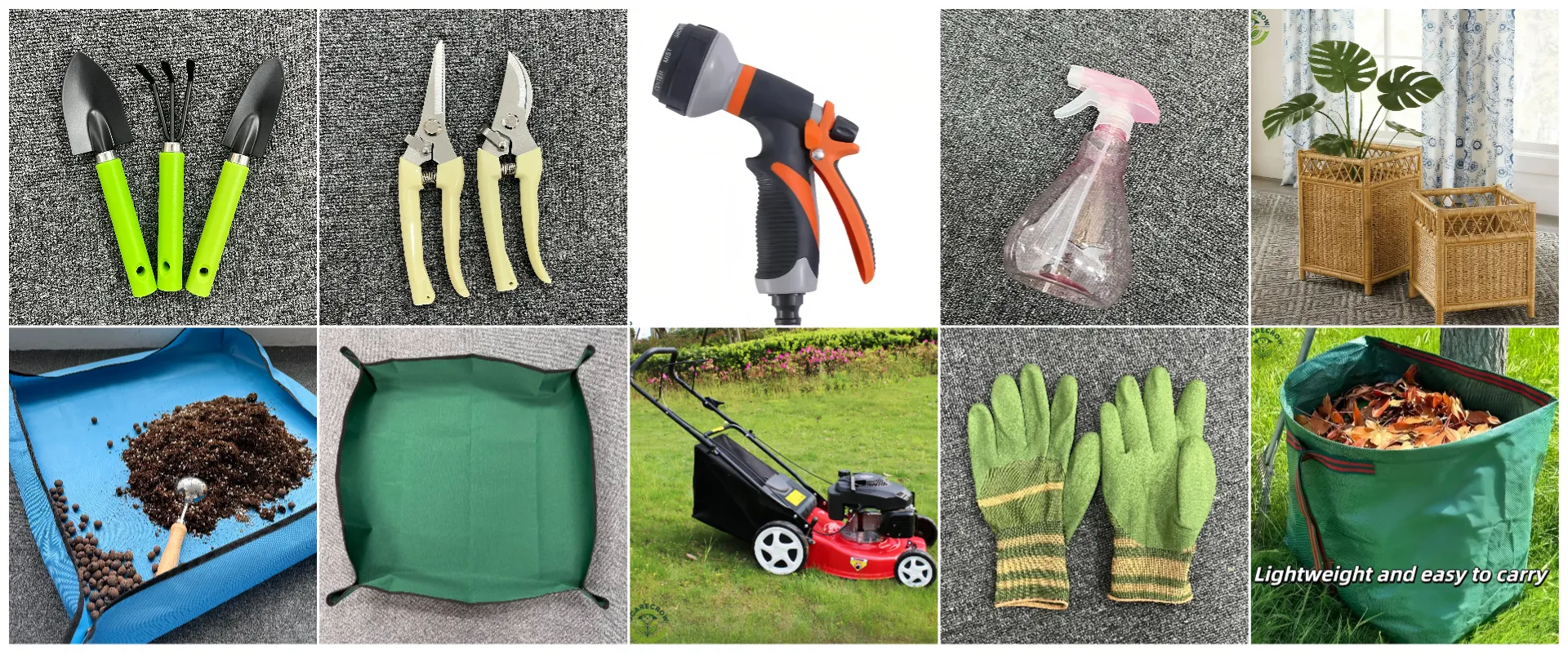
Before discussing export data, you first need to understand how many categories “full-category garden tools” actually include, and where they come from in China.
Garden tools are not one single category. They are a product matrix made up of ten major categories and hundreds of subcategories. Each major category has second-level segments, and new entrants often make different mistakes in each category:
| First-Level Category | Second-Level Segments | Common Mistakes by New Entrants |
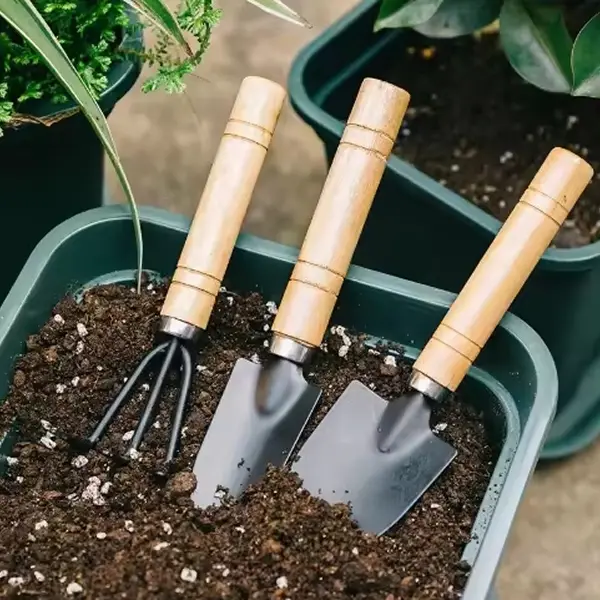
| Manual garden tools | Trowels, hand forks, hand rakes, hoes, weeders, transplanters, tool sets | Choosing only cheap models and ignoring handle comfort, steel thickness, and packaging display |
| Pruning and cutting tools | Pruning shears, loppers, hedge shears, folding saws, pole pruners, grafting knives | Looking only at appearance and failing to distinguish bypass, anvil, ratchet, and professional fruit tree models |
| Watering and irrigation | Hoses, spray guns, quick connectors, drip irrigation kits, timers, sprinklers, micro-sprayers | Underestimating Tunisia’s water-saving demand and selling only ordinary watering tools |
| Sprayers | Hand pressure sprayers, backpack sprayers, electric sprayers, accessories | Ignoring seals, nozzles, straps, batteries, and spare parts |
| Shade and protective nets | Shade nets, insect nets, bird nets, weed mats, ground covers, mulch films | Not understanding shade rate, gram weight, UV stability, and packaging specifications |
| Garden safety and protection | Gloves, sun hats, sun sleeves, knee pads, goggles | Only selling low-end gloves and ignoring high-temperature sun protection and thorn resistance |
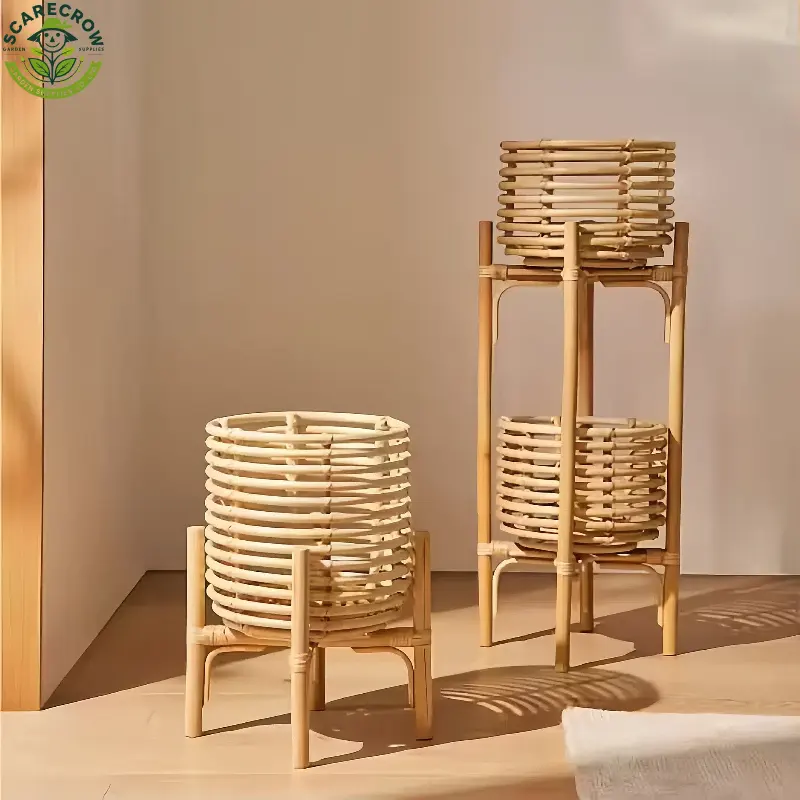
| Planting containers | Flower pots, seedling pots, grow bags, outdoor planter boxes, raised garden beds | Ignoring volume, transportation cost, UV resistance, and load-bearing capacity |
| Plant supports and accessories | Plant tying tape, plant clips, supports, tomato cages, plant labels | Treating small accessories as unimportant, when they are actually suitable for improving product line completeness |
| Lawn and outdoor maintenance | Lawn mowers, brush cutters, edgers, hedge trimmers, chainsaws, blowers | Blindly adding high-ticket machinery without after-sales and spare parts capability |
| Cleaning and storage | Garden waste bags, pop-up bins, tool bags, carts, storage bags | Ignoring seasonal cleanup and landscaping service channel demand |
Where Do These Categories Come From in China?
Garden tool categories are spread across different industrial clusters in China. If a buyer connects directly with factories, they may need to deal with suppliers across half of China.
Shade nets and insect nets — Huimin County, Binzhou, Shandong, known as “China’s plastic rope and net capital.” It is the largest chemical fiber rope and net industrial cluster in northern China, with full-chain independent production from wire drawing and net weaving to cutting and edge binding. Its large-scale capacity and vacuum compression packaging technology are especially suitable for ocean shipping to Tunisia. Taizhou, Zhejiang is the second cluster for shade nets.
Plastic flower pots and garden plastic products — Huangyan District, Taizhou, Zhejiang, known as “China’s mold capital.” Seventy percent of China’s plastic molds are produced in Taizhou; extrusion molds account for 80% of the national total, and blow molds account for 75%. What does this mean? If the Tunisian market needs a dedicated UV-resistant flower pot, Taizhou’s mold capability can complete development within a short time. Linyi, Shandong and Shuyang, Jiangsu are the second and third clusters for plastic flower pots.
Hand tools, including pruning shears, shovels, hoes, saws, and knives — Yangjiang, Guangdong, known as the “world capital of knives and scissors.” Its knife and scissor output accounts for 75% of China’s total, and its export volume accounts for 85%. The hardware knife and scissor industry has a scale of more than RMB55 billion, and garden pruning shears and landscaping cutting tools are important categories. The lifespan, precision, and durability of OEM products have reached international standards, but the cost is 5–6 times lower than branded products. This means OEM customization has significant profit potential. Wuyi, Zhejiang is a garden machinery equipment industrial cluster, and Yongkang, Zhejiang is known as the “world hardware capital.” According to industry data, its annual electric tool output value exceeds RMB9.2 billion.
Irrigation equipment and sprayers — Fujian has water-saving irrigation equipment manufacturers covering pressure-compensating drip irrigation pipes, automatic backwash filtration systems, hydraulic control valves, and other products. Taizhou, Zhejiang is a plant protection machinery cluster covering agricultural pumps and sprayers. Fujian’s drip irrigation plus Taizhou’s sprayers together cover the full range of scenarios in Tunisia, from field irrigation to pesticide spraying by small farmers.
Garden gloves and protective products — Zhongcun Town, Pingyi County, Shandong, known as “China’s famous labor protection glove town.” Its production of yarn labor protection gloves accounts for more than 60% of China’s total, with an annual output of 6 billion pairs of various gloves. Yiwu, Zhejiang is also an important trading channel for garden gloves.
Steel products, including fences, supports, and iron flower stands — Yongkang, Zhejiang and Linyi, Shandong. Yongkang’s hardware industrial cluster has been recognized as world-class, while Linyi is also a wood products cluster producing wooden flower stands, fences, and planter boxes.
What Does the Dispersion of Industrial Clusters Mean?
Shade nets are in Shandong, flower pots are in Taizhou, hand tools are in Yangjiang, irrigation is in Fujian, and gloves are in Pingyi. These industrial clusters stretch about 1,800 kilometers from north to south. If you manage these suppliers yourself, communication and coordination alone will consume a large amount of energy. This is why many buyers entering the garden tools industry from another industry eventually choose a Chinese supply partner to coordinate multi-category procurement. It is not because they cannot find factories, but because managing more than a dozen factories across six industrial clusters costs far more than expected.
What China Export Data Reveals About Tunisia’s Garden Market
Your agricultural background tells you which categories can reuse existing channels. But what is happening in the overall market? Which categories are growing, which are shrinking, and what is the procurement rhythm? Let’s look at China Customs export data.
Overall Trend: Not Fluctuation, but Continuous Growth
| Year | Total Exports of Garden-Related Products | Year-on-Year Change |
| Full year 2024 | Approx. US$57.3 million | — |
| Full year 2025 | Approx. US$74.6 million | +30.2% |
| January–April 2026 | Approx. US$31.2 million | +26.8% compared with the same period in 2025 |
Data source: China Customs export statistics
Exports increased by 30% in 2025 compared with 2024, and continued to grow by 27% year on year in the first four months of 2026. This was not driven by a spike in a single month. Almost all categories were growing.
The Three Fastest-Growing Categories
Shade nets and insect nets — up 70% year on year in 2025, and up 85% year on year in the first four months of 2026. This is the fastest-growing category, without exception. In August 2025, monthly exports reached US$1.01 million, exactly during Tunisia’s hot summer season, when the demand for shade in olive nurseries and vegetable greenhouses was released intensively. A new trend in 2026 is that exports in January and February were significantly higher than in the same period of 2025, indicating that Tunisian buyers are placing orders earlier, possibly due to long ocean shipping cycles.
Lawn mowers and agricultural/forestry machinery — up 64% year on year in 2025, and up 78% year on year in the first four months of 2026. Urban greening and high-end property maintenance in Tunisia are increasing, and lawn mowers are shifting from “luxury products” to “standard equipment.” The growth of agricultural and forestry machinery is related to the modernization of olive cultivation.
Sprayers and sprinkler irrigation equipment — up 46% year on year in 2025. North Africa has the lowest per capita freshwater resources in the world, and water-saving irrigation is a national-level rigid demand. Portable sprayers are standard products for small farmers, and monthly exports are stable.
The story of fast-growing categories is attractive, but the foundation of your business should not depend only on the fastest-growing categories. It should depend on stable categories that generate orders every month.
The Largest Categories — The Stable Growth Base
Plastic products, including flower pots, garden products, and packaging — account for about 25–28% of garden-related exports, with monthly exports of about US$1.5–1.6 million. They grew by 22% year on year in 2025 and by 34% in the first four months of 2026. Tunisia’s summer heat and strong sunlight mean plastic garden products must be UV-resistant. This is a key point for product differentiation.
Valves, pipe fittings, and irrigation fittings — exports reached US$10.6 million in 2025, with monthly exports of about US$800,000–900,000, up 26% year on year. As mentioned earlier, this category overlaps strongly with agricultural channels.
Steel products, including garden hardware, fences, and supports — exports reached US$10.8 million in 2025, up 26% year on year. Fences and supports are needed in both orchard and courtyard scenarios.
The Slowest-Growing Category — Hand Tools
Hand tools, including shovels, hoes, shears, saws, and knives, grew only 13% in 2025 compared with 2024, and grew 9% year on year in the first four months of 2026. This was the slowest growth among all categories.
But this does not mean there is no demand. Tunisia has 80 million olive trees, and they need pruning every year. The reason hand tools are growing slowly is that the category is very deep. Products with the same name vary greatly in tier, making new entrants hesitant to place orders. In addition, this category has long been occupied by European brands, so Chinese products need a differentiated entry point.
How should buyers enter this category? There are two paths:
- Combination sets — combining pruning shears, pole pruners, folding saws, and gloves reduces the end customer’s decision-making cost and also reduces your SKU management complexity.
- OEM customization — use your own brand to avoid the brand barrier of European brands and differentiate through packaging and specifications.
Hand tools are not impossible to sell. But they should not be the main category in the first batch. Build channels first through other categories, then penetrate the market with hand tool combination solutions.
Seasonal Patterns
Tunisia’s garden procurement rhythm is very clear:
- January: One of the annual peaks, driven by year-end stocking and New Year procurement.
- February: Low point, affected by Chinese New Year and Ramadan.
- March to May: Recovery period, driven by the spring planting season.
- June to August: Shade nets peak due to rigid demand in the hot season, while plastic products remain stable.
- September to October: Steel products reach a peak, lawn mowers recover due to autumn lawn maintenance, and pruning shears demand rises after olive harvesting.
- November to December: Valves and pipe fittings peak, driven by year-end shipment volume.
Understanding this rhythm allows you to place orders 45–60 days in advance. Considering ocean shipping and customs clearance time, this helps ensure inventory availability during peak seasons.
Three Common Traps When Entering Garden Tools from Another Industry
The previous sections explained category complexity, channel differences, and retail logic. These are the “what” level of understanding. But knowing the differences does not mean you will avoid mistakes. The following three traps are the most common reasons new entrants fail, beyond the differences themselves.
Trap 1: Launching All Categories at Once
Garden categories are fragmented. A complete product line may involve 10 categories, more than 60 products, and hundreds of SKUs. New entrants often want to “sell everything,” resulting in scattered inventory, heavy capital occupation, and slow turnover. The correct approach is phased entry: start with categories that overlap with agricultural channels, then expand gradually.
Trap 2: Managing 10–20 Factories by Yourself
Garden categories are spread across different industrial clusters: shade nets in Shandong, flower pots in Taizhou, hand tools in Yangjiang, irrigation in Fujian, and gloves in Pingyi. If a buyer communicates with all these factories directly, language, time differences, sample confirmation, shipment coordination, and quality inspection all become costs. Communication costs eat into profit, delivery schedules become difficult to control, and quality becomes inconsistent.
Trap 3: Ignoring Climate Adaptation and Using Generic Products for the Tunisian Market
Tunisia’s summer afternoons often exceed 35°C. Ordinary plastic flower pots may become brittle after only one or two seasons under continuous exposure. North Africa has the lowest per capita freshwater resources in the world, so ordinary watering cans may have less market potential than drip irrigation equipment. Tunisia has 80 million olive trees that require professional pruning shears, not ordinary household scissors. If generic products are not adapted to the local market, the return rate will be high and brand reputation will suffer.
Tunisia Garden Product Entry Roadmap: Three Stages
Full-category does not mean buying everything at once. The following three-stage roadmap is designed based on export data, Tunisia’s climate characteristics, and channel logic. Each stage explains why these categories should be selected and where they come from in China.
Stage 1: Core Entry Categories — Agricultural Channels Can Be Reused Directly
These categories best match Tunisia’s climate, fruit tree structure, and agricultural channels. Market education costs are low, and your existing customers are the first buyers.
| Category | Why Start with This Category | Chinese Industrial Cluster | Key Checkpoints |
| Pruning tools | 80 million olive trees need pruning every year; rigid demand and repeat purchases | Yangjiang, Guangdong, the knife and scissor capital | Blade material, suitable scenarios for bypass/anvil/ratchet types, spring durability |
| Irrigation tools | North Africa has the lowest per capita freshwater resources in the world; water-saving irrigation is a national-level rigid demand | Fujian, water-saving irrigation equipment manufacturers | Dripper flow consistency, meaning whether each dripper on the same pipe releases water evenly; uneven flow may cause some plants to lack water; pressure resistance, filtration system, connector specifications |
| Shade nets / insect nets | Exports grew 70% in 2025; the fastest-growing category | Huimin, Binzhou, Shandong, the plastic rope and net capital | Shade rate, gram weight, UV stability, cutting specifications |
| Sprayers | Standard products for small farmers; used in both agriculture and gardening | Taizhou, Zhejiang, plant protection machinery cluster | Seals, nozzles, straps, spare parts supply |
| Basic hand tools | High channel penetration, but should enter through combination sets | Yangjiang, Guangdong + Yongkang, Zhejiang | Steel thickness, handle comfort, set combination logic |
| Protective products | Tunisia has high temperatures and strong sunlight; sun protection and thorn resistance matter more than ordinary gloves | Pingyi, Shandong, labor protection glove town | Breathability, anti-slip, thorn resistance, sun protection |
Stage 2: Home Gardening Expansion — From Agricultural Channels to Garden Centers
After the first stage builds channel confidence, you can expand into home gardening categories. These products require new channels such as garden centers or e-commerce, but their unit prices are relatively low and inventory risk is controllable.
| Category | Why Do It in the Second Stage | Chinese Industrial Cluster | Key Checkpoints |
| Flower pots and planting containers | Large volume and high transportation cost, so channel demand should be confirmed first | Huangyan, Taizhou, Zhejiang, the mold capital | UV resistance, load-bearing capacity, drainage holes, container loading efficiency |
| Grow bags and balcony gardening | Growth categories for garden centers and e-commerce channels | Taizhou, Zhejiang + Linyi, Shandong | Material weather resistance, packaging volume, combination solutions |
| Plant supports and small accessories | Suitable for improving product line completeness and repeat purchases | Yongkang, Zhejiang + Yiwu, Zhejiang | Packing quantity, material softness, bundled sales |
| Plant labels | Small accessories with high profit margins, suitable for supplementing SKUs | Yiwu, Zhejiang | Wooden/bamboo laser-engraved logo is feasible with an MOQ of 500–1,000; OEM logo printing on plastic labels is not cost-effective |
Stage 3: Power Equipment — Requires After-Sales Capability and Is Not Recommended for the First Batch
Power equipment has a high unit price, but after-sales is complex. It requires spare parts, maintenance, instructions, and safety compliance. If your channel has not yet built service capability, it is not recommended to start blindly with these products.
| Category | Why Do It in the Third Stage | Chinese Industrial Cluster | Key Checkpoints |
| Lawn mowers | Exports grew 64% in 2025, but after-sales and spare parts are required | Wuyi, Zhejiang, garden machinery cluster | Spare parts package, battery platform, safety instructions |
| Brush cutters / chainsaws | Mainly for professional users and require maintenance capability | Wuyi, Zhejiang + Yongkang, Zhejiang | Gas-powered/electric choice, spare parts supply, operation training |
| Electric tools | Exports grew 31% in 2025; Yongkang is a world-class cluster | Yongkang, Zhejiang, world hardware capital | Battery compatibility, certification, after-sales risk |
| Electric sprayers | More efficient than manual models, but involve batteries and maintenance | Taizhou, Zhejiang | Battery safety, charging specifications, sealing tests |
How Many Products Are There in Full-Category Garden Tools?
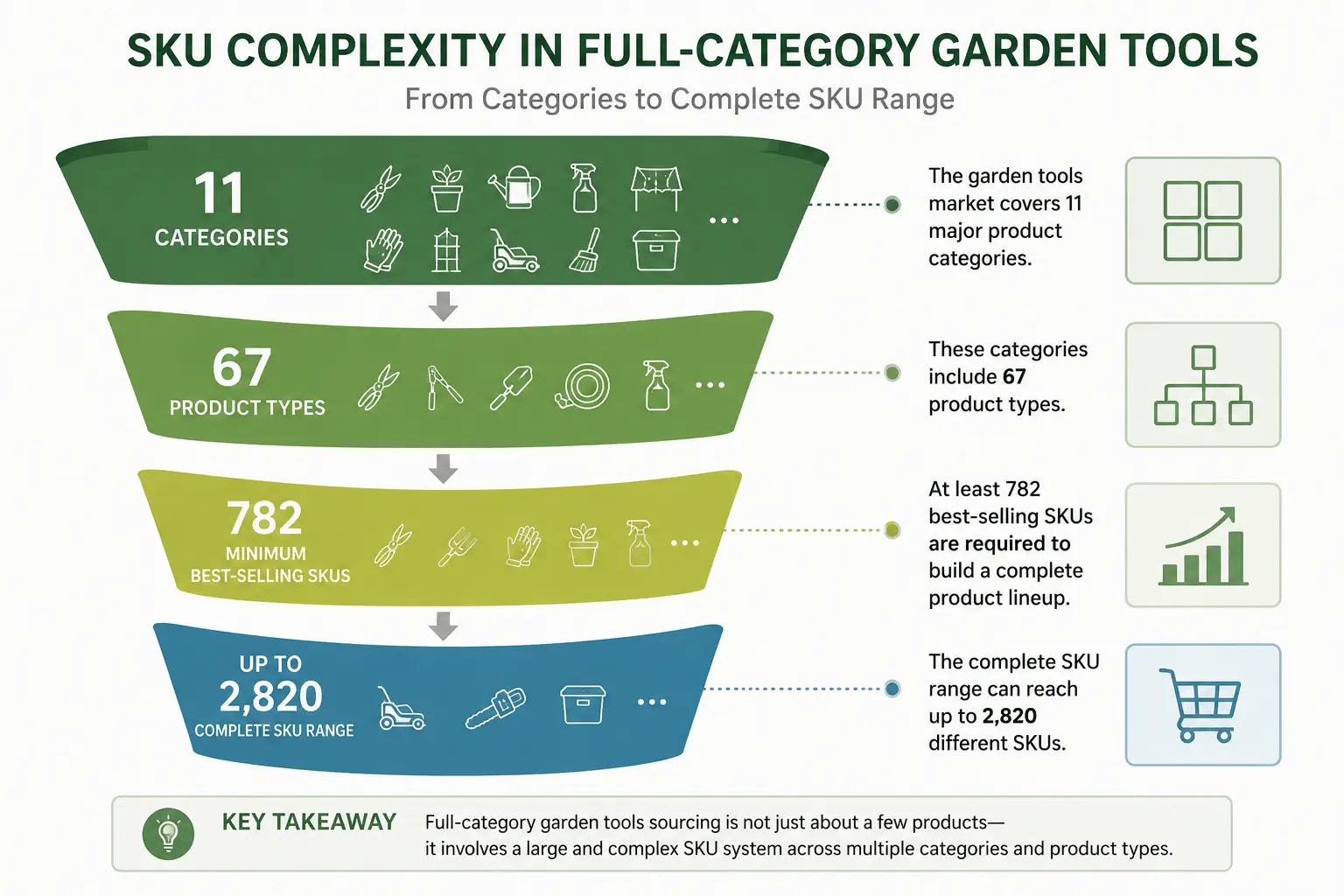
The above is the logic of phased entry. But if you are determined to build a full-category product line and cover all needs across all channels at once, you first need to understand how large this product pool is and what the consequences of launching everything are.
Full Product Pool Overview
Based on product selection suitable for the Tunisian market, a complete product line covers 11 categories and 67 types of products. But “67 types of products” is only the first layer. Each product type also has variations in style, material, and specification.
Take pruning shears as an example. Under the same name “pruning shears,” there are actually:
- Blade type: bypass type for live branches, anvil type for dead branches
- Head type: straight head, curved head
- Blade material: SK5 high-carbon steel, 65Mn spring steel, stainless steel, chrome vanadium steel
- Handle: plastic, rubber-coated, aluminum alloy
- Function: standard one-hand model, labor-saving ratchet model, telescopic model
- Cutting diameter: 15mm, 20mm, 25mm, 30mm
- For pruning shears alone, common SKUs can reach 30–50
Take loppers as an example. Under the same name “lopper,” there are:
- Head type: bypass straight head, bypass curved head, anvil type
- Handle length: 45cm, 60cm, 80cm, 100cm
- Handle material: aluminum alloy, steel tube, fiberglass
- Function: standard model, labor-saving ratchet model, saw-and-shear dual-use model
- For loppers alone, common SKUs can reach 15–25
Take shade nets as an example. Under the same name “shade net,” there are:
- Shade rate: 30%, 50%, 70%, 80%, 90%
- Material: PE round yarn, PE flat yarn, aluminum foil shade net
- Color: black, green, silver
- Width: 1m, 2m, 3m, 4m, 6m, 8m
- Length: 10m, 25m, 50m, 100m
- For shade nets alone, common SKUs can reach 30–50
Take flower pots as an example. Under the same name “plastic pot,” there are:
- Function: gallon pots, air-pruning pots, two-color pots, imitation ceramic pots, self-watering pots
- Diameter: 8cm to 50cm, with one specification every 2cm
- Color: black, white, red, antique color, matte color
- For plastic flower pots alone, common SKUs can reach 50–100
Based on this logic, the full-category calculation is as follows:
| Category | Product Types | Minimum Best-Selling SKUs | Complete SKU Range |
| Manual garden tools | 8 types | 50 | 50–120 |
| Pruning and cutting tools | 8 types | 80 | 80–250 |
| Watering and irrigation | 8 types | 100 | 100–300 |
| Spraying tools | 4 types | 40 | 40–160 |
| Shade, protection, and covering | 6 types | 90 | 90–360 |
| Protective products | 7 types | 80 | 80–280 |
| Lawn and outdoor machinery | 6 types | 60 | 60–240 |
| Planting containers | 5 types | 200 | 200–750 |
| Plant supports and accessories | 6 types | 36 | 36–180 |
| Cleaning, storage, and transport | 5 types | 30 | 30–120 |
| Soil and measurement | 4 types | 16 | 16–60 |
| Total | 67 product types | 782 | 782–2,820 |
Conclusion: If you want to do full-category garden tools, the complete SKU range is about 800–2,800. Even if you only select best-selling models from each category, you need at least 300–500 SKUs to cover basic demand.
Consequences of Launching Everything at Once
What does 800 SKUs mean? Behind every SKU is a supply chain. If you launch everything at once:
Consequence 1: Huge Capital Pressure
Assume the first-order MOQ for each SKU is 500 pieces and the average unit price is US$2. The first purchase cost alone would be:
800 SKUs × 500 pieces × US$2 = US$800,000.
Including ocean freight, duties, and customs clearance fees, the total investment may exceed US$1.2 million. This does not include warehousing, staff, and marketing costs.
Consequence 2: Scattered Inventory and Slow Turnover
When 800 SKUs are spread across the Tunisian market, most SKUs may sell only a few dozen pieces per month. Slow turnover means capital is tied up for a long time. Some seasonal products, such as shade nets peaking in August and lawn mowers recovering in October, may take half a year to clear if the stocking timing is wrong.
Consequence 3: Exploding Management Complexity
The 11 categories are spread across more than six industrial clusters, stretching about 1,800 kilometers from north to south. Each factory has different lead times, quality standards, packaging requirements, and payment terms. Managing 800 SKUs means maintaining 10–20 supply chain relationships at the same time. Sample confirmation, shipment coordination, and quality inspection all become communication costs.
Consequence 4: High Trial-and-Error Cost
Which sells better in Tunisia, curved-head pruning shears or straight-head pruning shears? Which shade rate is better for olive nurseries, 70% or 80%? You do not know. If you test every SKU once, trial-and-error costs may reach 20–30% of the total purchase amount. Choosing the wrong SKU means dead stock. The Tunisian market is not large, so even clearance sales can be difficult.
Consequence 5: After-Sales System for Power Equipment Is Not Ready
Lawn mowers, brush cutters, chainsaws, and other power equipment require spare parts, warranty, and technical support. If you launch power equipment all at once before establishing an after-sales system, customer complaints may directly damage your brand reputation.
How to Solve This
There are two paths:
Path 1: Phased Entry
Follow the three-stage roadmap mentioned earlier. Start with the six categories in Stage 1, including pruning, irrigation, shade nets, sprayers, hand tools, and protective products, with about 40–50 selected SKUs. After Stage 1 runs smoothly, expand to Stage 2 and Stage 3. This keeps initial capital pressure low, trial-and-error costs lower, and inventory risk controllable.
Path 2: Work with Scarecrow Garden Supplier for Full-Category Coordination
If you are determined to build a full-category product line, you do not need to manage 10–20 factories by yourself. Scarecrow Garden Supplier can:
- Select best-selling models suitable for Tunisia from 800+ SKUs — not every SKU is suitable for the Tunisian market. Curved-head pruning shears versus straight-head pruning shears, 70% shade rate versus 80% shade rate — these choices require market judgment, and factories cannot make these decisions for you. Based on Tunisia’s climate, crops, and channel characteristics, Scarecrow helps you select the most suitable 300–500 SKUs from 800+ SKUs.
- Centralize the product range — match suppliers from six industrial clusters and select products based on suitability for the Tunisian market, so buyers do not need to find factories one by one.
- Reduce MOQ pressure — multiple categories can be consolidated into one container shipment, allowing more flexible order quantities for each category instead of requiring every SKU to meet the factory’s lowest MOQ.
- Standardize packaging and labeling — factories in different industrial clusters have different packaging habits. Scarecrow coordinates them uniformly to ensure consistent standards when products arrive in Tunisia.
- Centralize sample delivery — samples from multiple categories can be sent together, instead of requiring buyers to communicate with 10 factories separately.
- Mixed shipment — products from multiple categories are integrated into one container to reduce transportation cost per item.
- Seasonal procurement planning — organize timelines according to Tunisia’s procurement rhythm to avoid stockouts during peak seasons.
Simply put: full-category garden tools are possible, but you do not need to carry the management complexity of 800+ SKUs by yourself.
How a Chinese Supply Partner Helps You Cross These Barriers
There is a lot of information above: ten categories, six industrial clusters, six common traps, and a three-stage roadmap. You may ask: now that I know all this, how should I execute it?
This is where a Chinese supply partner creates value. The role is not to make decisions for you, but to turn information into an executable procurement plan.
Help you distinguish which products can reuse agricultural channels and which products require new channels. Not all garden products are suitable for your existing customers. Irrigation fittings and sprayers can be sold directly through agricultural input stores, but flower pots and hand tool sets require garden centers or e-commerce. Based on your channel structure, we can design the product entry sequence: first products that can reuse existing channels, then products that require new channels.
Help you design a product line expansion path from agricultural input stores to garden centers. Your first batch of customers may be agricultural input stores and orchards, with products mainly including irrigation, sprayers, and shade nets. After these categories run smoothly, you can gradually add garden center categories such as flower pots, hand tool sets, and plant labels using the same supplier relationships. We can help you plan this expansion rhythm and avoid excessive inventory pressure caused by launching too many SKUs at once.
Help you centralize sample delivery across multiple categories and reduce the communication cost of finding samples separately. Garden categories are spread across six industrial clusters. If you look for samples yourself, you may need to cover Shandong, Zhejiang, Guangdong, and Fujian. We can centralize samples of pruning tools, irrigation fittings, shade nets, sprayers, hand tools, gloves, and other categories, so you receive them together, review them at once, and then decide which products to order first.
Help you coordinate packaging, delivery schedules, and quality standards across multiple factories. Factories in different industrial clusters have different packaging habits, lead-time rhythms, and quality standards. We coordinate them uniformly, including sample confirmation, packaging review, and pre-shipment inspection, to ensure that products from different categories arrive in Tunisia with consistent standards, without requiring you to monitor each factory individually.
Help you plan procurement timelines according to Tunisia’s seasonal rhythm. Shade nets peak in July and August, but considering 25–35 days of ocean shipping and about 10 days of customs clearance, you need to place orders in May or June. Demand for pruning shears rises after olive harvesting in October and November, so you need to prepare stock in August or September. We can help you arrange the annual procurement schedule to avoid stockouts during peak seasons.
Data source: China Customs export statistics
Key Takeaways
- Moving from agriculture-related products to garden tools is not category expansion. It is a switch in industry logic. Products with the same name have deep product tiers, channels are diverse, and retail logic is completely different.
- Your agricultural background is an advantage. Irrigation fittings, sprayers, shade nets, and similar categories are common to both agricultural and gardening scenarios, and your existing channels are the first buyers.
- China’s exports of garden-related products to Tunisia grew by 30% year on year in 2025 and continued to grow by 27% in the first four months of 2026. The market is continuing to grow.
- The fastest-growing categories are shade nets, up 70% and 85%; lawn mowers, up 64% and 78%; and sprayers, up 46%.
- Hand tools grew the slowest, up 13% and 9%, but the demand from 80 million olive trees is real. Combination sets and OEM customization are needed as entry points.
- Garden categories are spread across six industrial clusters in China, stretching about 1,800 kilometers from north to south. The communication cost of managing more than a dozen factories yourself is much higher than expected.
- A complete full-category product line ranges from about 800 to 2,800 SKUs. Even if only best-selling models are selected, at least 300–500 SKUs are needed.
- The three-stage entry approach is: first categories that can reuse agricultural channels, then home gardening expansion, and finally power equipment.
Frequently Asked Questions
Can My Existing Agricultural Input Store Channels Sell Garden Tools?
Yes, but not all categories are suitable. Irrigation fittings, sprayers, shade nets, weed mats, and similar products are used in both agricultural and gardening scenarios, so agricultural input store customers are natural buyers. Pruning shears and hand tool sets require more professional display and instructions, while flower pots and grow bags are more suitable for garden centers. It is recommended to start with common-use categories first, then expand gradually.
Should I Launch Full-Category Products from the Beginning?
Not recommended. Garden categories are fragmented. A complete product line may involve 10 categories and hundreds of SKUs. Launching everything at once can easily lead to scattered inventory, heavy capital occupation, and slow turnover. It is recommended to enter in three stages: Stage 1 focuses on categories that overlap with agricultural channels, including pruning, irrigation, shade nets, sprayers, hand tools, and protective products; Stage 2 expands into home gardening, including flower pots, grow bags, and small accessories; Stage 3 introduces power equipment.
What Is the Biggest Risk When Sourcing Garden Tools for the First Time?
Underestimating category complexity. Under the same name “pruning shears,” prices on B2B platforms can range from less than US$1 to more than US$30. The differences come from blade material, heat treatment, spring, safety lock, and handle material. If you place an order only based on product name and price, you are very likely to choose the wrong product tier. It is recommended to request samples first and confirm material and hand feel before placing bulk orders.
China’s Garden Product Industrial Clusters Are Spread Across Different Locations. How Should I Manage Them?
Shade nets are in Shandong, flower pots are in Taizhou, hand tools are in Yangjiang, and irrigation is in Fujian. Managing communication, samples, lead times, and quality across more than a dozen factories by yourself is costly. Many buyers entering the garden tools from other industries choose a Chinese supply partner to coordinate multi-category procurement, centralize samples, standardize packaging, and consolidate shipments.
Tunisia’s Summer Is So Hot. How Long Can Plastic Flower Pots Last?
According to industry experience, Tunisia’s summer afternoons often exceed 35°C. Under continuous exposure, ordinary plastic flower pots may become brittle after one or two seasons. UV-resistant flower pots are a necessary differentiation point. Huangyan, Taizhou has the mold capability to develop dedicated UV-resistant flower pots within a short time, but you need to confirm UV additives and testing standards with the supplier in advance.
When Should I Place Orders for the Peak Season?
According to industry experience, ocean shipping takes about 25–35 days and customs clearance takes about 10 days, with actual timing varying by port and cargo type. You need to place orders 45–60 days before the peak season. Shade nets peak in July and August, so orders should be placed in May or June. Demand for pruning shears rises in October and November, so stock should be prepared in August or September. January is one of the annual peaks, so preparation should begin in October or November.
Tell us your current channel structure — agricultural input stores, orchard customers, or irrigation engineering projects — and we can design a phased product entry plan based on your starting point.
Simplify Your Garden Product Sourcing from China
We help you combine multiple product categories into one sourcing flow with supplier matching, sample verification, and consolidated shipping.
Written by
ScarecrowGarden
💡About Scarecrow Garden Supplier Co., Ltd.
Scarecrow Garden Supplier Co., Ltd. is a China-based sourcing and wholesale partner specializing in garden tools, landscaping equipment, and outdoor supplies for international wholesalers, distributors, contractors, and brands.
With hands-on experience rooted in real garden use scenarios, we focus on durable materials, functional design, and stable large-volume supply. Our product range covers pruning tools, watering systems, hand tools, outdoor hardware, and customized garden solutions to support both retail and professional landscaping markets.
Beyond products, we help our partners navigate supplier selection, quality control, compliance requirements, and long-term sourcing strategies in China. Through our blog, we share practical insights on product selection, material comparisons, industry trends, and cost-effective purchasing—helping global buyers build stronger, more competitive supply chains.