









Updated 2 months ago
Mini Greenhouse Zipper and Ventilation Quality: What B2B Buyers Should Check
SCARECROW GARDEN SUPPLIER

mini greenhouse zipper ventilation quality
A consumer assembles a mini greenhouse, places it on the balcony, and uses it for two weeks. Then the zipper jams. The door panel won’t close properly. The internal temperature drops overnight, and the seedlings they were protecting are damaged.
They return the product. The return reason says “defective.” The defect may trace back to a component that costs a fraction of the product’s retail price.
For B2B buyers sourcing mini greenhouses, zipper quality and ventilation design are not minor details. They affect how the product functions in daily use — and whether the consumer’s experience matches what was promised at purchase. Yet they are often the last components that buyers think to specify in an RFQ.
This article examines what B2B buyers should check when evaluating zipper quality, door design, and ventilation features on mini greenhouse samples — and how to communicate real product limitations to retail customers.
The Zipper: A Small Component That Deserves Specification
In many mini greenhouse designs, the zipper serves a dual function. It closes the door panel — which is one way to regulate temperature and humidity inside the structure. And it provides access for watering, inspecting, and adjusting plants. When the zipper fails, both functions are affected.
Why Mini Greenhouse Zippers May Fail
Zipper failure in mini greenhouses can happen for several reasons. Whether these apply to your specific SKU depends on the materials, design, and use environment — so verify each against the actual product:
Material and use environment mismatch. Mini greenhouses used outdoors or in semi-outdoor spaces (balconies, patios) expose the zipper to UV, moisture, and temperature cycling. Some zipper materials may degrade under prolonged UV exposure — the extent depends on the material grade and formulation. Ask the supplier what material they use and whether they have UV resistance data for that specific zipper.
Frame flex misaligns the zipper track. When the frame flexes under wind or handling, the cover shifts, and the zipper track that was aligned during assembly may become misaligned. The slider catches, the consumer forces it, and the zipper tape may tear. This is a frame quality problem that manifests as a zipper issue — which is why frame rigidity and zipper performance are connected.
Tension on the zipper when the door is rolled up. When the roll-up door is in the open position, it is typically held up by ties or loops. The weight of the rolled cover creates downward tension on the zipper’s bottom end. Over time, this tension may pull the slider or stress the tape at the attachment point.
Stitching at zipper attachment points. The zipper is sewn onto the cover material. If the stitching is single-line or uses weak thread, the attachment point may fail before the zipper itself. The zipper pulls away from the cover, and the door cannot close properly.
What Buyers Should Specify
When you source mini greenhouses, the zipper specification may include:
- Zipper material: Ask the supplier what material they use and whether upgraded options are available
- Zipper grade: Ask what grade they use and whether a higher grade is available
- Weather resistance: Ask whether the zipper has any water-resistant or weather-rated treatment — and if so, what that claim is based on
- Stitching: Ask whether the zipper is single-stitched or double-stitched to the cover
- Reinforcement: Ask whether stress points (top and bottom of the zipper) have reinforced stitching
If the supplier cannot answer these questions, the zipper may be sourced as a commodity component — the cheapest available option. That may be the right call for a budget-tier product, but it should be a conscious choice, not a default.
Comparing Mini Greenhouse Door and Ventilation Designs?
Review zipper material, stitching, door alignment and the actual ventilation mechanism before approving a model. Compare the details that affect everyday opening, closing and ventilation rather than relying on product appearance alone.
The Door Panel: Design Details That Affect Durability
The roll-up door is a common access and ventilation design for many mini greenhouse models. It is simple: a panel of the same cover material, attached at the top, with a zipper running down one or both sides. To open, you unzip and roll the panel upward, securing it with ties.
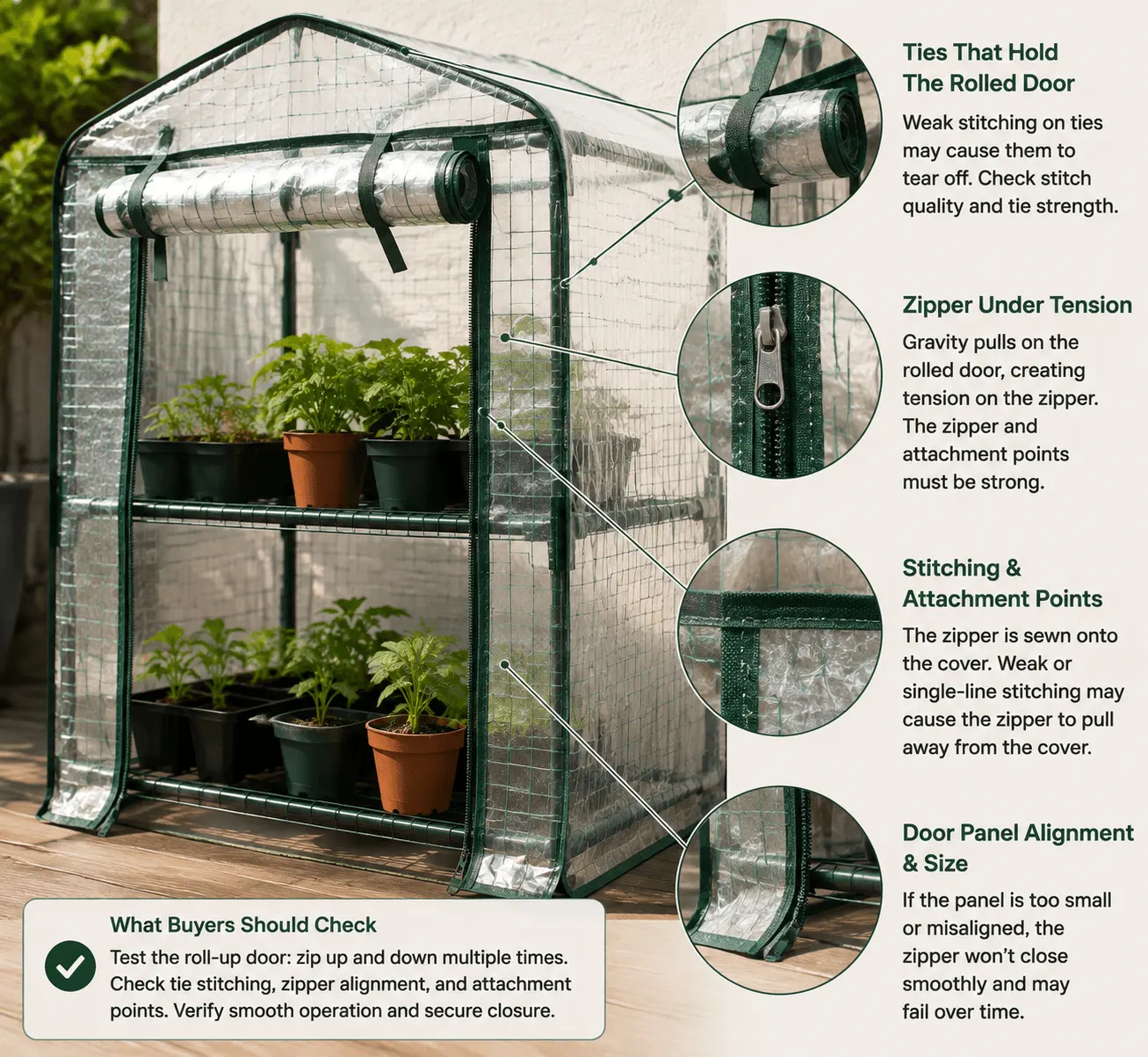
This design has areas to check:
The zipper runs vertically, which means gravity works against it. When the door is partially open, the weight of the rolled material creates tension on the zipper. When the door is closed, the zipper must hold the cover taut against wind pressure from outside. Both situations stress the zipper and its attachment points.
The ties that hold the rolled door. They are typically fabric loops sewn onto the cover. If the stitching is weak, the loops may tear off, and the door cannot be secured in the open position. This forces the consumer to leave the door hanging — which stresses the zipper further.
The door panel alignment. If the cover is cut slightly too small or too large, the zipper does not align with the frame edges. Misalignment makes the zipper harder to close and increases stress on the teeth and tape.
What Buyers Should Check on the Sample
When you receive a sample, test the door panel and zipper:
Zip and unzip the door multiple times. Feel for catching, resistance, or misalignment. This is an internal screening test — it helps you compare samples or batches, but it is not a standardized pass/fail protocol. Define your own acceptance criteria based on your quality target.
Roll the door up and secure it with the ties. Check whether the ties hold the weight without stretching or tearing. Check whether the rolled door stays in place or sags.
Close the door and push gently on the cover panel from outside. This simulates wind pressure. Watch whether the zipper holds or whether the door panel pulls away from the frame edge.
Inspect the stitching at the zipper attachment points. Look for single vs double stitching, thread quality, and any reinforcement at stress points.
These checks take a few minutes. They help you assess the product’s door and zipper quality before committing to bulk.
Ventilation: Design Varies by Model
Ventilation control in mini greenhouses varies by design. Some models rely mainly on a roll-up door for airflow. Others add adjustable vents, mesh openings, or other airflow features. Buyers must inspect the actual SKU to understand what ventilation mechanism is included — and what its limitations are.
For models that rely primarily on a roll-up door, ventilation is essentially binary: the door is either closed (which traps heat and humidity) or open (which exposes plants to outside air, wind, and pests). On a sunny day, the temperature inside a closed mini greenhouse can rise rapidly. On a windy day, opening the door for ventilation means exposing plants to wind stress.
For models with additional ventilation features — side windows, mesh vents, or adjustable flaps — the user has more control over airflow without fully opening the door. These features may reduce overheating complaints, particularly in warm markets or sunny balconies. Whether these options are available depends on the specific model and supplier.
Mini greenhouses also tend to have a high surface-area-to-volume ratio, which means the internal temperature may fluctuate more than in larger greenhouses. The structure may heat up quickly when the sun hits it and cool quickly when the sun goes behind a cloud or sets. This temperature volatility is a design characteristic, not a defect — but consumers who do not understand it may blame the product.
What This Means for B2B Buyers
Product specification. Ask the supplier what ventilation mechanism the specific model includes. If your market includes warm climates or sunny balconies, ask whether models with additional ventilation features are available.
Consumer education. The instruction sheet should include guidance on temperature management: when to open the door or vents, when to keep them closed, and how to monitor internal temperature. If the supplier’s instruction sheet does not cover this, consider adding your own insert. A consumer who understands the ventilation design is less likely to blame the product for temperature-related issues.
Market positioning. Mini greenhouses are best positioned as seasonal plant protection — not as full-time growing environments. Setting these expectations in your marketing and packaging reduces the gap between what the consumer expects and what the product delivers.
Need Model-Specific Ventilation Checks?
Send your target use environment and sample requirements so door and airflow features can be verified before bulk ordering. Review the actual model under the conditions that matter to your market.
How Component Quality Connects to After-Sales Cost
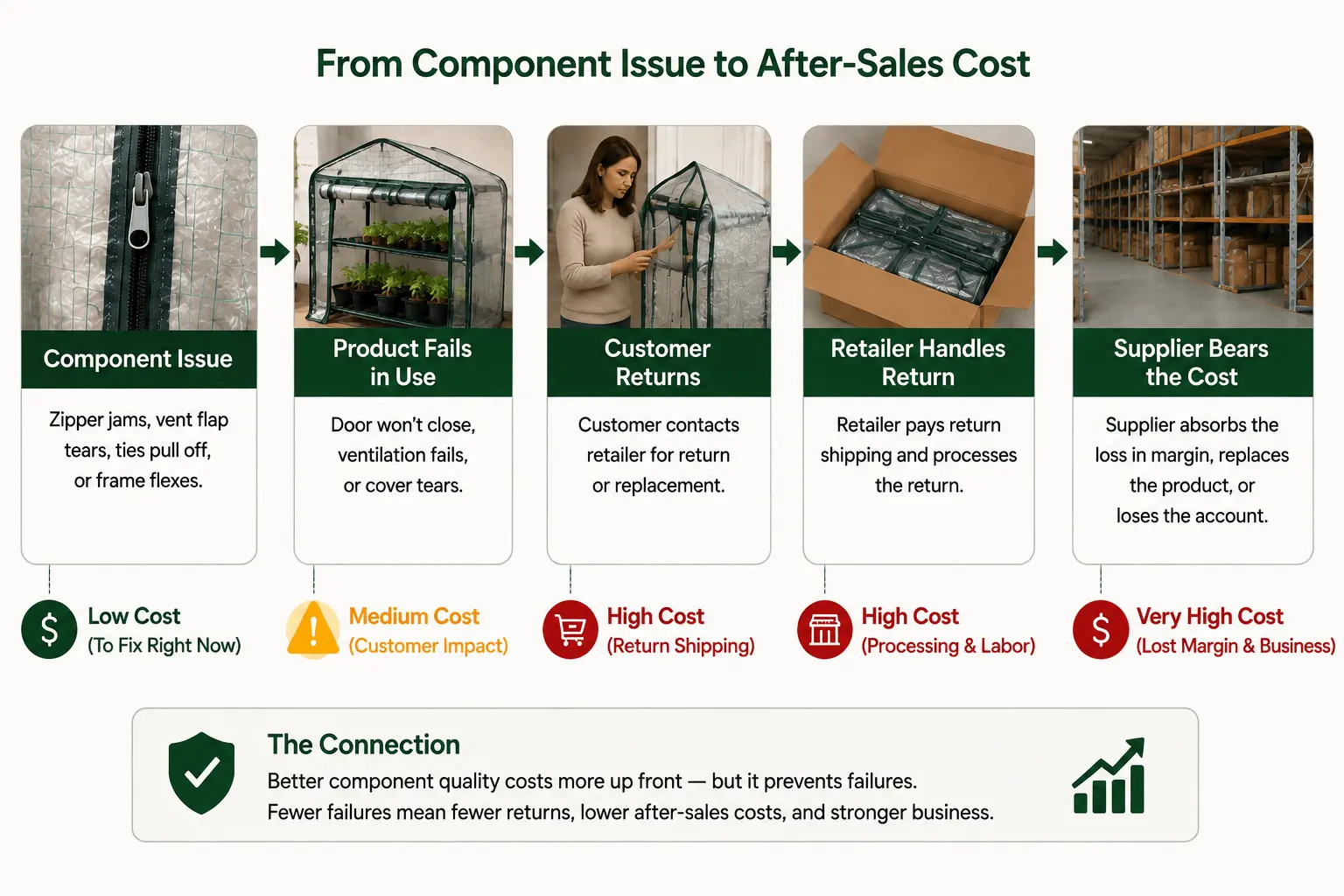
The connection between small component quality and after-sales cost is straightforward. A mini greenhouse returned because of a jammed zipper costs you the same in reverse logistics as one returned because the frame collapsed — but the zipper issue may be more preventable through specification and sample testing.
For mini greenhouses, components that may drive quality-related returns include:
- Zipper issues — jamming, teeth separation, tape tearing
- Cover tearing at stress points — where the cover is stretched over the frame, particularly at corners and connector points
- Missing or damaged small parts — connectors, pegs, or other components missing from the carton or arriving broken
- Assembly difficulty — instructions that are unclear, components that do not fit, or tolerances that make assembly frustrating
Whether these apply to your product, and in what proportion, depends on the SKU, the supplier, and the market. Each has a root cause that can be addressed at the specification and inspection stage — before the product reaches a consumer. A zipper that is specified, tested on a sample, and verified during pre-shipment inspection is less likely to fail in the field.
Zipper and Ventilation Checklist for Mini Greenhouse Buyers
| Component | What to Ask the Supplier | What to Check on Sample | Why It Matters |
| Zipper | Material, grade, weather resistance | Multiple open-close cycles; check catching | Zipper failure affects door function and ventilation |
| Zipper stitching | Single vs double; reinforcement at ends | Pull test at attachment points | Weak stitching = zipper detaches from cover |
| Door ties | Material, stitching, quantity | Roll door up; check tie durability | Door sags and stresses zipper if ties fail |
| Door alignment | Cover cut precision vs frame opening | Close door; check zipper alignment | Misalignment stresses zipper and tape |
| Ventilation design | What mechanism is included? Roll-up door only, or additional vents? | Test all ventilation features | Determines temperature control options |
| Instruction sheet | Temperature management guidance included? | Read instructions; check completeness | Consumer education reduces temperature-related complaints |
Small Components Are Not Small Decisions
A mini greenhouse is a system. The frame holds the cover taut. The cover keeps the zipper aligned. The zipper controls the door. The door or vents control ventilation. When any component in this chain is underspecified, the effect may cascade to the next component — and the consumer experiences the result as a product that does not work.
Specify the zipper. Test the door. Understand the ventilation design of the specific model you are sourcing. These are not the most exciting parts of the process, but they are the parts that help prevent the product from coming back.
Send us your mini greenhouse component requirements and target market conditions. We will help you identify suppliers who can meet your zipper grade, ventilation, and cover specifications — and provide samples for hands-on component testing. You focus on growing your business. We help you find the right suppliers, verify quality, and get it shipped.
Ready to Review Zipper and Ventilation Quality?
Send us your mini greenhouse component requirements and target market conditions. We will help you identify suppliers who can meet your zipper grade, ventilation and cover specifications — and provide samples for hands-on component testing.
Related Articles
Mini Greenhouse Frame Quality: Tubes, Coatings, Connectors and Structural Stability
Mini Greenhouse Assembly Quality: Fit, Missing Parts, Instructions and Consumer Complaints
Waterproof Bases, Condensation and Drainage: What Wholesale Mini Greenhouse Buyers Need to Verify