






Updated 4 months ago
How to Choose PP, Acrylic, and ABS Animated Butterfly Lights? Market Positioning and Price Differences by Material
ScarecrowGarden
💡About Scarecrow Garden Supplier Co., Ltd.
Scarecrow Garden Supplier Co., Ltd. is a China-based sourcing and wholesale partner specializing in garden tools, landscaping equipment, and outdoor supplies for international wholesalers, distributors, contractors, and brands.
With hands-on experience rooted in real garden use scenarios, we focus on durable materials, functional design, and stable large-volume supply. Our product range covers pruning tools, watering systems, hand tools, outdoor hardware, and customized garden solutions to support both retail and professional landscaping markets.
Beyond products, we help our partners navigate supplier selection, quality control, compliance requirements, and long-term sourcing strategies in China. Through our blog, we share practical insights on product selection, material comparisons, industry trends, and cost-effective purchasing—helping global buyers build stronger, more competitive supply chains.

Animated Butterfly Lights Wholesale Guide: PP vs. Acrylic vs. ABS | Scarecrow Garden Supplier
You receive quotations for three butterfly lights: PP wings at $20, acrylic wings at $20 and $30 in two different sizes, and ABS printed wings at $28. They all look attractive, but you are not sure which one to choose.
Many wholesalers choose materials in a simple way: either “take the cheapest one” or “take the best-looking one.” That is fine—if you are only making a one-time purchase. But if you plan to develop butterfly lights as a long-term product category, material selection directly determines who your customers are, where your profit margin comes from, and how high your return rate may be.
This article is dedicated to materials. For the overall product selection logic of butterfly lights, including motors, accessories, inspection, and other details, our Complete Buying Guide for Animated Butterfly Lights gives a full introduction. We recommend reading that article first. This article focuses on one question: how to choose between the three materials.
Why Do Butterfly Lights Differ So Much in Price and Visual Effect?
When three butterfly lights are placed in front of you, the differences you can see are clear: the PP model has a semi-transparent frosted look, the acrylic model looks as clear as glass, and the ABS model has colorful printed patterns on the wings.
The differences you cannot see are: PP is light and flexible, acrylic is brittle but bright, and ABS is heavier and more solid.
The price difference behind supplier quotations is not only about “different material costs.” Material affects four things:
- Visual effect: how the product looks during the day and at night
- Packaging method: whether it can be packed as one piece or needs separate packaging, and how high the carton loading density is
- Transportation risk: whether the wings may break during shipping
- Outdoor durability: what the product may look like after two years of outdoor use
Choosing a material is essentially choosing which market you want to serve.
If you are still comparing motors, solar options, configurations, packaging, and inspection requirements, start with the Complete Buying Guide for Animated Butterfly Lights first.
PP Transparent Wings: Best for High-Volume Basic Models
PP, or polypropylene, is the most common wing material used in animated butterfly lights. This is not because it is the best, but because it is the most balanced: low price, light weight, impact resistance, and good night-time lighting effect. It also covers the widest size range, from 17.72 inches to 39.37 inches.
Advantages of PP Wings
Lightweight: Transportation cost is lower, and more units can be loaded into the same carton volume. Small animated models can be packed 20 pieces per carton, while static models can be packed 40 pieces per carton. This gives PP the highest carton loading density among the three materials.
Low cost: PP has the lowest cost among the three materials. For wholesalers, a lower purchase price means more flexible pricing space.
Impact resistant: PP has the best flexibility among the three materials. The wings can rebound after bending, unlike acrylic, which may crack when bent. The wings are less likely to be damaged during transportation. For wholesalers, this is a hard requirement—you do not want to receive a carton where half of the wings are broken.
Good night-time effect: PP is semi-transparent, so the light passes through evenly and softly. Both warm white and ice blue lighting effects work well. Night-time display is where PP wings perform best.
Disadvantages of PP Wings
Average daytime effect: When the light is not on, PP wings look like a piece of semi-transparent plastic and do not have especially strong visual appeal. If your customer is a garden center, shoppers may not notice the movement when they walk past during the day.
May yellow after long-term outdoor use: This is a common characteristic of PP material, not a manufacturing defect. After 2–3 years of outdoor sunlight exposure, the wings may turn slightly yellow, but this does not affect function or lighting effect. If your customers are in regions with strong sunlight, such as Australia or the southwestern United States, this should be communicated in advance.
Suitable Markets for PP Wings
- Basic models for garden centers, mainly for affordable high-volume sales
- Entry-level e-commerce models for Amazon or Shopify
- Spring and summer promotional products for seasonal volume sales
- First test orders when you are not sure whether the category will work
Purchasing Advice
PP is suitable as a main product line, but the wing thickness and transparency must be confirmed. Different factories may produce PP wings with very different thicknesses. If the wings are too thin, they may shake noticeably during movement and look unstable. If they are too thick, light transmission becomes weaker and the lighting effect is reduced. When taking samples, confirm the wing thickness specifications with the supplier.
Acrylic Wings: Suitable for Premium Visual Effect and Gift Scenarios
Transparent acrylic wings have the strongest visual impact among the three materials. Their light transmission is higher than PP, and when the light passes through, the wings look as clear as glass. Acrylic wings are available in two sizes: 23.62 inches and 29.13 inches. This is a more boutique-style product line.
Advantages of Acrylic Wings
Highest light transmission: Among the three materials, acrylic is the clearest. After the light passes through, the visual effect is closest to a “glowing glass butterfly,” especially with an ice blue light configuration. The night-time effect is very eye-catching.
Good surface gloss: The texture looks clearly better than PP in photos and product listings. If your customers are e-commerce sellers, acrylic models can produce better product photos and video materials, which may help improve conversion.
Suitable for premium positioning: Garden centers, boutique garden product stores, and gift shops can use acrylic models to raise the average order value through a stronger display effect.
Disadvantages of Acrylic Wings
Brittle: This is the biggest problem with acrylic. Its impact resistance is far weaker than that of PP. If the packaging is not well designed, the wing edges may easily crack during transportation. A small crack may not be obvious during the day, but once the light is on, the crack will create obvious light refraction and affect the overall effect.
Higher cost: Acrylic material costs more than PP. Together with the additional cost of separated packaging, the wholesale price is naturally higher.
Limited size options: At present, there are only two sizes. If your customers need smaller or larger specifications, acrylic models may not have a suitable option.
Suitable Markets for Acrylic Wings
- Gift shops, where the product needs to look refined
- Premium garden decoration, for customers willing to pay more for visual effect
- Indoor and outdoor display scenarios, such as commercial spaces, showrooms, and sample rooms
- Boutique retail channels, where the product is sold for value rather than volume
Purchasing Advice
For acrylic models, the packaging solution must be confirmed. Separated packaging is necessary—the wings and body should be packed separately and assembled after arrival. Ask the supplier: Are the wings protected with individual corner guards? Has the product passed a drop test? If the supplier says “one-piece packaging is fine,” it is recommended to test one carton first to check the transportation damage rate before placing a bulk order.
ABS Printed Wings: Decorative Value Even During the Day
ABS wings can be printed on both sides. The patterns and colors on the butterfly wings are printed, not created by light. This is something PP and acrylic cannot achieve: when the light is not on during the day, the printed ABS wings are already a selling point.
Advantages of ABS Printed Wings
Visual appeal during both day and night: When PP and acrylic are not lit, they are only semi-transparent plastic pieces. ABS printed models look like colorful butterflies during the day. The patterns and colors on the wings stand out in sunlight. This means your customers do not need to wait until night to display the product.
Most realistic movement effect in large sizes: For ABS printed models above 31.5 inches, the wing-flapping angle reaches 80°, and the product includes 9 built-in sound effects. This is currently the strongest animated-effect series: the wings move with a wide flapping angle, the rhythm feels natural, and the sound effects add to the experience.
Large differentiation space: Printed patterns can be customized. If your customers want OEM or brand-exclusive designs, ABS printed wings are the easiest solution for differentiation.
Disadvantages of ABS Printed Wings
Heavier than PP: ABS has a higher material density than PP, so butterfly lights of the same size are heavier. Transportation cost is slightly higher, and carton loading density is not as good as PP.
Printed patterns may fade: Under long-term outdoor UV exposure, printed patterns may fade after 2–3 years. This is similar to PP yellowing—it is a limitation of the material itself, not a manufacturing defect.
Higher cost than PP: Due to material cost and printing process cost, ABS printed models have a higher wholesale price than PP models.
Suitable Markets for ABS Printed Wings
- Holiday decorations, such as Easter, Mother’s Day, and Christmas
- Theme gardens, children’s gardens, butterfly theme parks, and commercial landscapes
- Commercial displays that need to attract attention during the day
- Retailers that need differentiation and already sell PP models but want to add another product line
Purchasing Advice
ABS printed models are suitable as differentiated products, but not necessarily as the lowest-price main product. If your customer base is mainly price-sensitive, PP models are more suitable. If your customer base is already mature and needs new visual selling points, ABS printed models are the best choice.
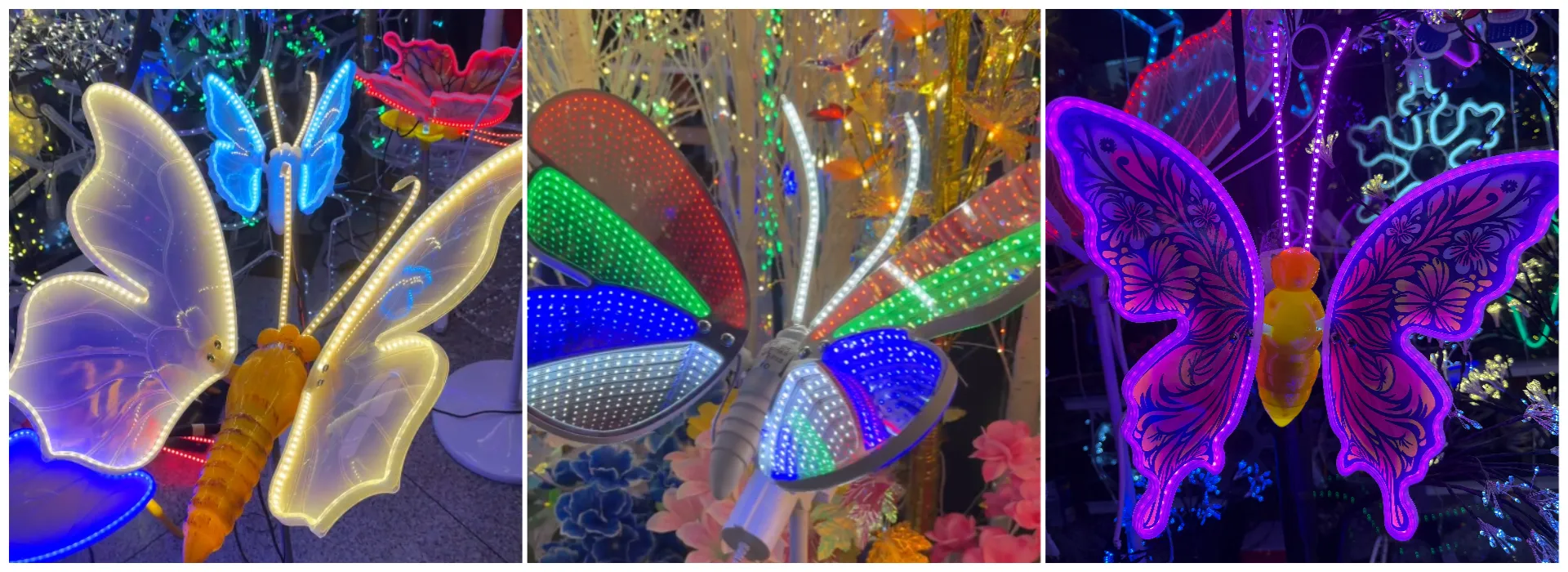
Wholesale Purchasing Comparison of the Three Materials
| Item | PP Transparent | Acrylic | ABS Printed |
|---|---|---|---|
| Cost | Lowest | Highest | Medium |
| Night-Time Effect | ⭐⭐⭐⭐ Soft and even | ⭐⭐⭐⭐⭐ Clear and transparent | ⭐⭐⭐ Printed pattern + light |
| Daytime Effect | ⭐⭐ Semi-transparent | ⭐⭐⭐ Good gloss | ⭐⭐⭐⭐⭐ Eye-catching printed pattern |
| Drop Resistance | ⭐⭐⭐⭐⭐ Flexible | ⭐⭐⭐ Brittle, requires separated packaging | ⭐⭐⭐⭐ Relatively impact resistant |
| Packaging Requirement | One-piece packaging is acceptable | Separated packaging is required | Depends on size; large models need individual cartons |
| UV Durability | May turn yellow after 2–3 years | Not easy to yellow | May fade after 2–3 years |
| Suitable Market | High-volume residential garden products | Gifts/premium retail | Differentiation/ holiday/commercial |
| Suitable Order Stage | First test order | Add after the category matures | When differentiation is needed |
How Different Materials Affect Packaging and Logistics
Packaging and logistics costs are often overlooked by many wholesalers when choosing materials, but they directly affect profit.
PP: Can be packed relatively compactly, with lower transportation risk. Small animated models can be packed 20 pieces per carton, giving good loading efficiency. The transportation damage rate is low, and no extra packaging cost is required.
Acrylic: Must use separate packaging. The wings and body are packed separately and assembled after arrival. Separated packaging reduces damage rate, but increases carton volume and assembly workload. If your warehouse has assembly capability, this is not a problem. If not, you need to tell customers in advance that “simple assembly is required.”
ABS: Depends on size and shape. Small ABS models can use one-piece packaging, while large models above 31.5 inches are packed 1 piece per carton. The carton volume is large, and transportation cost accounts for a higher proportion. It is recommended to load them together with small and medium-sized models, using smaller cartons to fill container gaps.
Animated models cannot be compressed like ordinary static lights. The wings need space for movement and cannot be pressed too tightly. For butterfly lights of the same size, the carton quantity of animated models is only half that of static models, which means the transportation cost per unit doubles. This cost should be calculated into the final selling price in advance.
That is why material selection should be checked together with wholesale configurations for animated butterfly lights, especially packaging, installation accessories, and carton structure.
Are Butterfly Lights Easy to Sell If the Price Is High? Holiday Scenarios Are the Breakthrough Point
Many wholesalers are interested in the butterfly light category, but they have one concern: the price is relatively high. Will consumers be willing to buy?
This concern is reasonable. The retail price of animated butterfly lights is indeed higher than that of ordinary solar garden lights. A 24-inch animated flapping butterfly light retails at $35–60, while ordinary solar stake lights priced at $12–35 can include 2–4 pieces. When consumers see this price for the first time, they may hesitate.
But “high price means difficult to sell” is not a conclusion. The key is how you sell it, who you sell it to, and in what scenario you sell it.
Holiday Scenarios: Consumers Have Much Higher Budgets During Holidays
Butterfly lights have a natural advantage: they are one of the few garden decorations that combine movement, lighting, and holiday atmosphere. This combination is especially powerful in holiday scenarios.
Christmas: This is the biggest holiday sales window for butterfly lights. In North America and Europe, outdoor Christmas decoration is a strong demand. Consumers may spend hundreds of dollars on Christmas string lights, inflatable snowmen, and reindeer lights. A $40–60 animated butterfly light placed next to a Christmas tree, with wings flapping in the snow and light blending with Christmas string lights, creates a scene more attractive than any static decoration.
You can suggest your customers make a “Christmas butterfly light set”: one animated butterfly light + Christmas string lights + tree-mounting accessories, sold as a bundle. Consumers are buying “a complete Christmas garden decoration solution,” not “one butterfly light.” Solution pricing is easier to accept than single-product pricing.
Easter: Butterflies are naturally a symbol of spring. In Easter garden decoration, butterfly lights are more unique than rabbit lights. There are already too many rabbit lights on the market, while butterfly lights have more room for differentiation.
Mother’s Day: Pink butterfly lights + gift packaging can be positioned directly as “a garden gift for mom.” Mother’s Day gift budgets are usually between $30 and $80, so a $40–50 butterfly light falls well within this range.
Material Selection for Different Holiday Scenarios
| Holiday | Recommended Material | Recommended Color | Reason |
| Christmas | PP transparent + RGB | RGB color-changing / warm white | Matches Christmas string lights, with the most dazzling color-changing effect |
| Easter | ABS printed | Printed patterns | Spring garden + colorful butterfly, attractive during both day and night |
| Mother’s Day | Acrylic | Pink / ice blue | Refined feeling + gift attribute |
| Halloween | PP transparent | Ice blue / cool white | Ghostly atmosphere + animated effect, suitable for Halloween mood |
How to Sell Outside Holiday Scenarios
Holiday scenarios are the breakthrough point, but they are not the only sales scenario. In daily sales, the selling point of butterfly lights is not “cheap,” but “unique”—it is the only decoration in the garden that can move.
Several daily scenarios are easier to sell:
- Garden path entrance: A butterfly light placed at the entrance of a path can flap and light up when someone passes by, especially when paired with a motion sensor.
- Patio or porch decoration: It does not require a large garden. A small patio can also display one butterfly light.
- Commercial spaces: Restaurant gardens, hotel courtyards, theme parks—commercial customers are less sensitive to price and more sensitive to effect.
The key is not to sell butterfly lights cheaply, but to make consumers feel they are worth the price. Animated flapping + lighting + garden decoration in one product is a combination that is almost irreplaceable in garden products.
How Wholesalers Should Choose Materials Based on Customer Type
E-commerce sellers such as Amazon and Shopify sellers: PP basic models should be prioritized. E-commerce buyers are price-sensitive, and PP models offer the best cost performance. With good product photos and videos, the nighttime effect of PP models is already attractive enough.
Garden centers: PP main models + a small quantity of ABS differentiated models. PP is used for volume sales, while ABS is used for window display and premium customers. Combining the two materials covers different price levels.
Gift shops: Acrylic or ABS is more suitable. Gifts need to look refined or distinctive. The glass-like texture of acrylic and the printed patterns of ABS are both advantages.
Commercial scenario customers: Large ABS models or RGB versions are more suitable. Commercial spaces need to attract attention even during the day, and the daytime effect of ABS printed models is something PP and acrylic cannot match.
First-time buyers: It is recommended to test the market with wired PP models first. PP has low cost, low transportation risk, and broad market acceptance. After the category works, acrylic or ABS models can be added based on customer feedback.
Material Is Not an Isolated Choice — It Must Be Considered Together with the Motor
Finally, there is one thing many wholesalers overlook: good-looking wings need a stable motor to support them.
Acrylic and ABS have higher visual value than PP, and their retail prices are also higher. But if the motor is chosen incorrectly—using an internal motor without stall protection—a $50 acrylic butterfly light and a $20 PP butterfly light will face the same result after three months: the wings stop moving.
High-end materials paired with a low-stability motor create even greater customer complaint losses. This is because customers pay a higher price and have higher expectations. If a $20 PP butterfly light breaks, the customer may let it go. If a $50 acrylic butterfly light breaks, the customer will definitely request a return.
So no matter which material you choose, the motor solution must be an external motor + stall protection. Material determines whether it looks good; the motor determines whether it lasts.
Material affects the visual effect, but movement stability still depends on the motor, so buyers should also understand how to choose a motor for dynamic butterfly lights.
Final Thoughts
PP, acrylic, and ABS are not absolutely good or bad. The key is who your customers are, where your sales channel is, what your budget is, and what packaging and logistics costs you can accept.
For wholesalers, the right approach is not simply to find the lowest price, but to find the most suitable material combination for your market. If you are not sure, start with PP models to test the market. The cost is low, the risk is small, and the market coverage is wide. After you understand what your customers need, you can add acrylic and ABS models.
Want to test all three materials? Scarecrow can help you prepare a mixed sample pack—one PP, one acrylic, and one ABS butterfly light, shipped to you together. You can compare them side by side, look at them during the day, check them at night, feel the texture, and listen to the sound. This is more useful than reading ten articles.
If you are not sure which material is suitable for your market, contact us to discuss.
Talk to Queenie about PP, acrylic, and ABS butterfly light options for your market.
[The prices mentioned in this article are based on current market conditions. Please refer to the latest inquiry quotation for specific pricing.]
Simplify Your Garden Product Sourcing from China
We help you combine multiple product categories into one sourcing flow with supplier matching, sample verification, and consolidated shipping.
Written by
ScarecrowGarden
💡About Scarecrow Garden Supplier Co., Ltd.
Scarecrow Garden Supplier Co., Ltd. is a China-based sourcing and wholesale partner specializing in garden tools, landscaping equipment, and outdoor supplies for international wholesalers, distributors, contractors, and brands.
With hands-on experience rooted in real garden use scenarios, we focus on durable materials, functional design, and stable large-volume supply. Our product range covers pruning tools, watering systems, hand tools, outdoor hardware, and customized garden solutions to support both retail and professional landscaping markets.
Beyond products, we help our partners navigate supplier selection, quality control, compliance requirements, and long-term sourcing strategies in China. Through our blog, we share practical insights on product selection, material comparisons, industry trends, and cost-effective purchasing—helping global buyers build stronger, more competitive supply chains.