




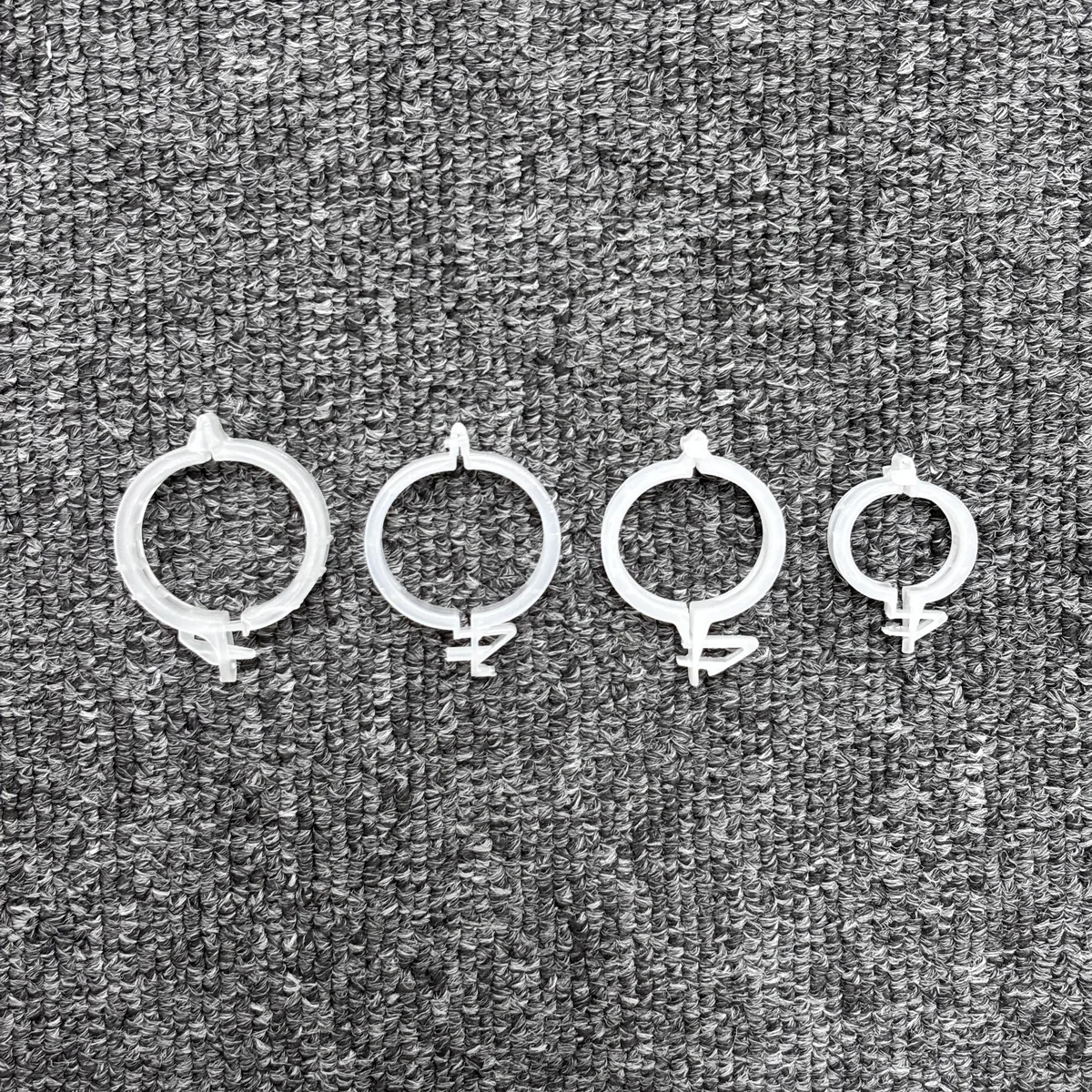
Four white round clips shown closed, with different visible sizes and closing shapes.
“Tomato clips” is not a complete purchasing description. A request might concern a main-stem-to-support-line connection or a fruit-cluster support, while the photograph supplied with it may show a different component altogether. The intended job and the pictured part both matter.
Within a plant ties and support range, the three pictured families below should be identified separately. Their catalogue names help distinguish the enquiries; they do not establish three mutually exclusive applications or a compatible kit.
The white elongated hook
The white pieces have a long body, a large open hook at one end and smaller retaining features at the other. They are catalogued as fruit-cluster support hooks.
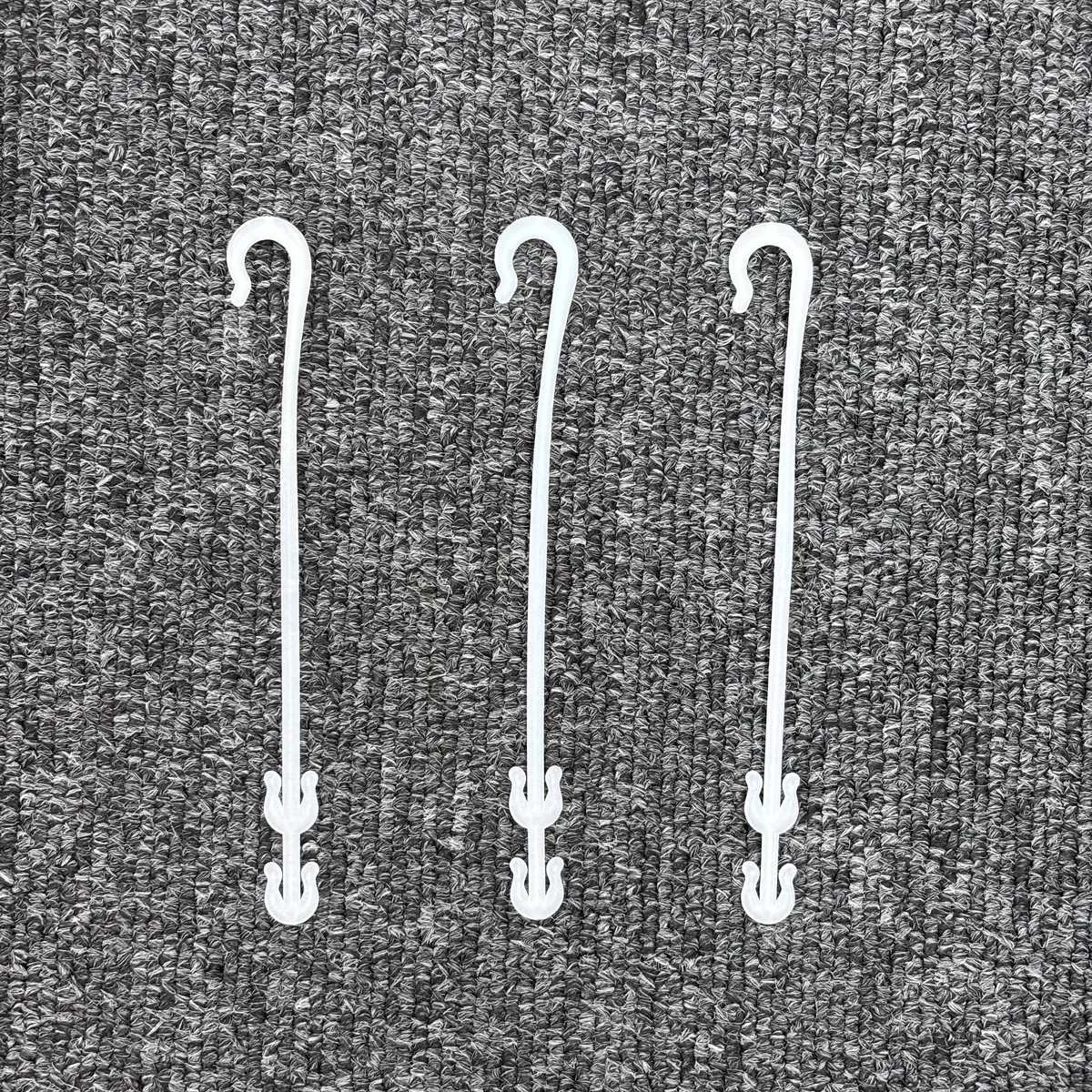
For a fruit-cluster support enquiry, this photograph identifies the hook family to discuss. The fixing points and intended support arrangement still need to come from documentation for the offered part; an unmounted view does not show where it attaches.
This is not the pre-wound-twine high-wire hook used in an overhead lowering system. A request for that system should not be filled with this elongated component on the strength of the word “hook”.
The round clip
The round examples have a circular opening and projecting closing sections. The photographs show open and closed appearances; they do not establish a tracked sequence for the same individual clips.
If the requirement is a main-stem-to-support-line connection, carry the round clip forward as a candidate for that enquiry. Its actual placement and compatibility must be matched to the offered model. A recognizable round outline is not a confirmed stem or line fit.
There is no scale establishing the pictured diameters. Different visible sizes cannot be assigned millimetre sizes or existing product numbers from these photographs. The order needs the dimensions of the offered part, rather than a size inferred from the arrangement of pieces in an image.
The green curved component
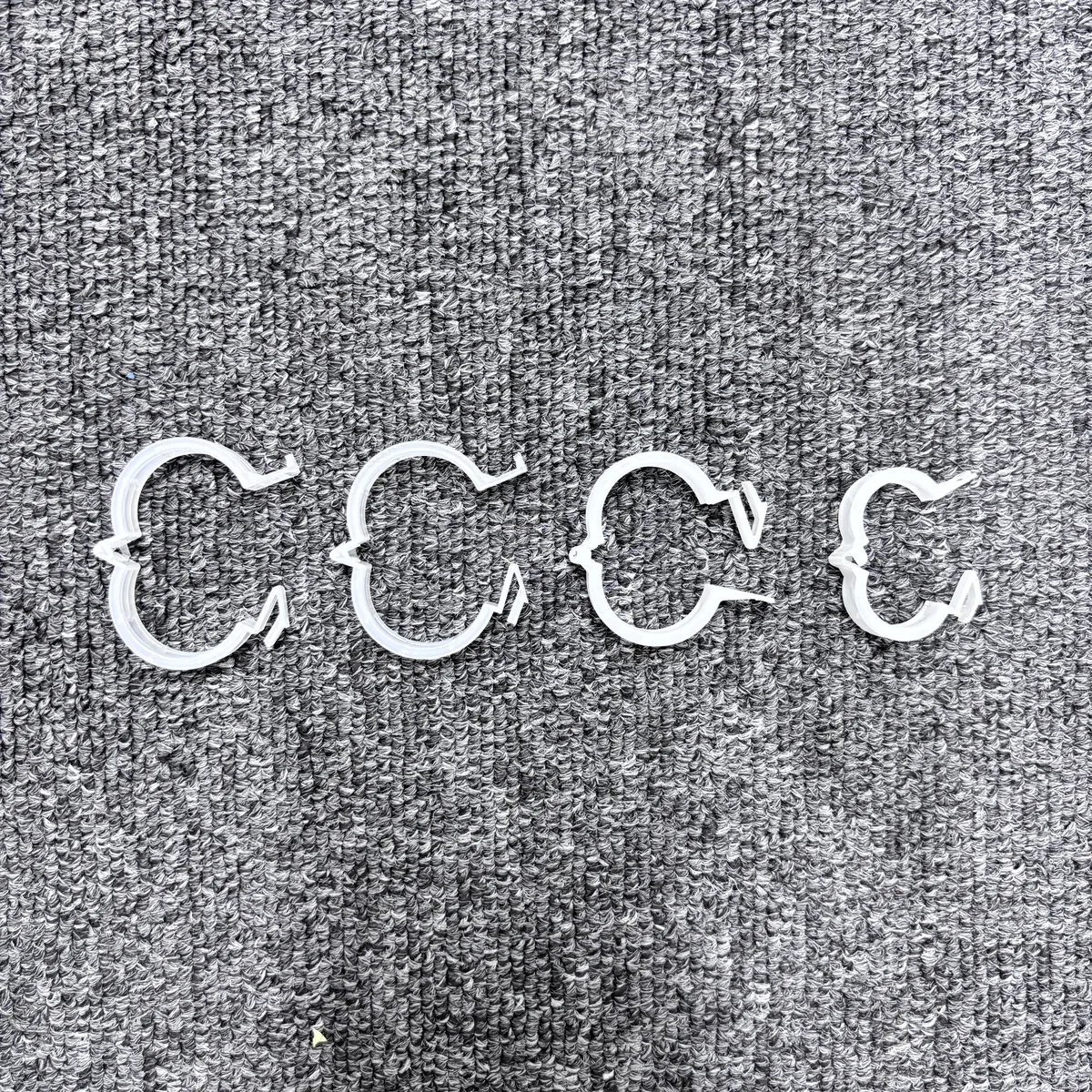
The green pieces have an arched body with several inward-facing clip-like features. The source catalogue calls them fruit-stalk support clips.
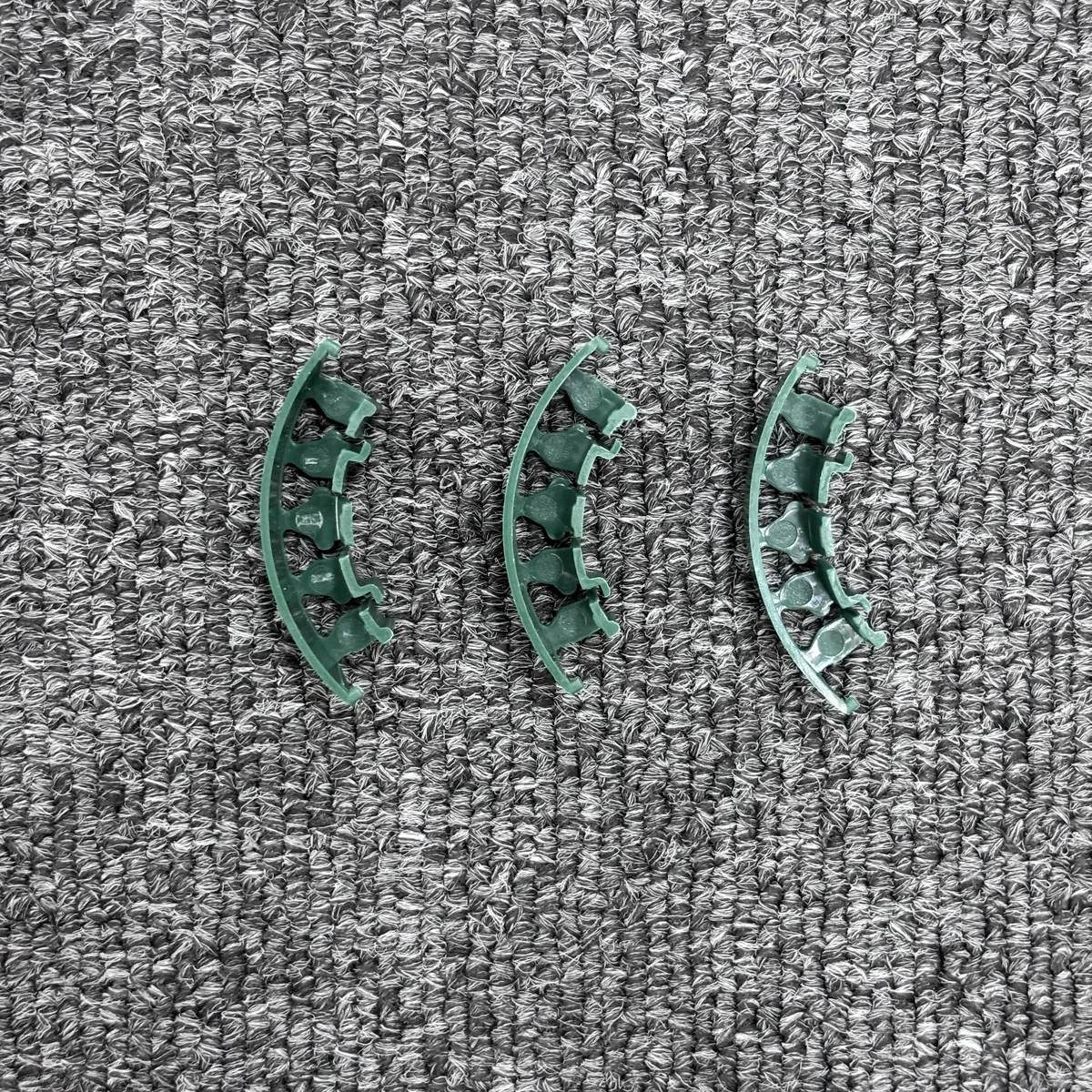
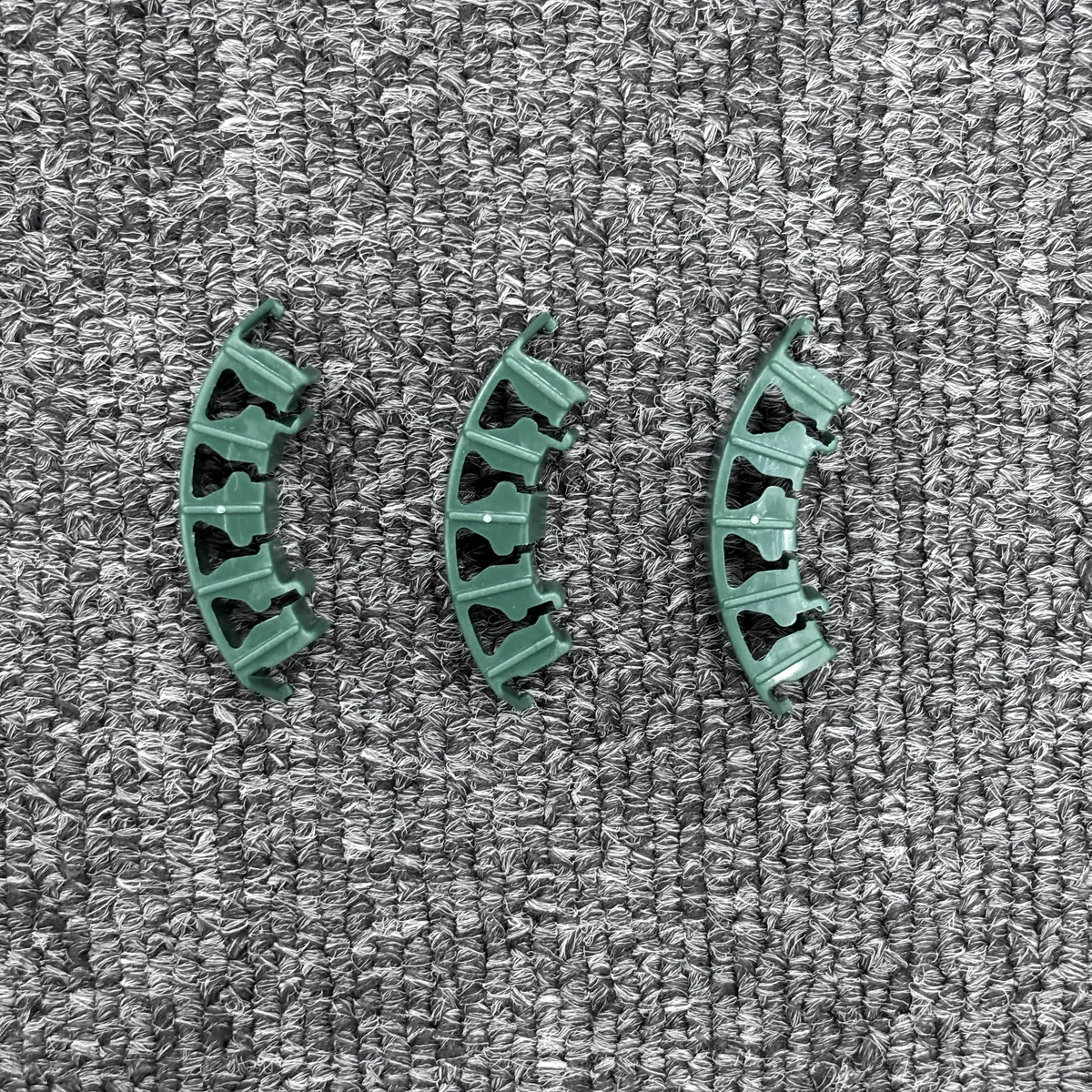
That catalogue identity keeps the green component distinct from the white hook and round clip. It does not establish the exact plant part it contacts, where it is placed or which crop it suits. These views therefore do not make it a verified tomato-kit component.
The words “fruit cluster” and “fruit stalk” also do not, on their own, prove that the white hook and green curved part have different fitting positions. Their roles may only be compared once the intended application is documented for each offered part.
The assortment decision follows the actual requirement. If you need both stem-to-line fixing and fruit-cluster support, keep those requirements as separate enquiry lines, each with its corresponding candidate photograph. If you need only one, the other pictured families do not have to be added to make the range look complete.
For the green curved part, an enquiry should include its photograph and the intended application. Until that application is matched to the offered part, keep it at the clarification stage rather than adding it as a confirmed tomato accessory or a substitute for the white hook.

Written by
ScarecrowGarden
💡About Scarecrow Garden Supplier Co., Ltd.
Scarecrow Garden Supplier Co., Ltd. is a China-based sourcing and wholesale partner specializing in garden tools, landscaping equipment, and outdoor supplies for international wholesalers, distributors, contractors, and brands.
With hands-on experience rooted in real garden use scenarios, we focus on durable materials, functional design, and stable large-volume supply. Our product range covers pruning tools, watering systems, hand tools, outdoor hardware, and customized garden solutions to support both retail and professional landscaping markets.
Beyond products, we help our partners navigate supplier selection, quality control, compliance requirements, and long-term sourcing strategies in China. Through our blog, we share practical insights on product selection, material comparisons, industry trends, and cost-effective purchasing—helping global buyers build stronger, more competitive supply chains.