




Updated 1 week ago
Reusable Plant Labels in 2026: A Practical Alternative to Disposable Garden Tags

hqt
Reusable Plant Labels
The cost of plant tag loss may appear to be minimal. A plant tag, however, can take a long time to locate in an organization with hundreds or thousands of tags. The result is lost productivity. Plant ID labels that fade, are lost, or are illegible in a garden center or commercial herb garden means locating the plant, making a new ID label and replacing it in its original planting location. A garden center experiences this repeatedly with seasonal fluctuation of plant inventory.
Reusable plant labels provide a different cost structure. Initially, there is a greater expense to buy reusable markers, however, the cost is recouped with repeated identification cycles. Whether this cost structure works depends on the survival of the marker in outdoor conditions, the ease of which the marker's identification can be changed, and the frequency with which the planting area is changed.
For 2026 sourcing programs, Scarecrow Garden Supplier has offered an alternative to disposable plant labels with their natural slate markers and stainless steel stakes. The markers are appropriate for use in a wide range of environments.
Where Disposable Plant Labels Really Cost Money
Nothing beats plastic tags for high volume propagation. Low weight and compact size make plastic tags convenient for use in seedling trays, and adaptable to commercial nursery workflows.
The economy changes, however, if tags are left outside during multiple planting cycles.
Prolonged exposure to ultraviolet radiation can degrade some plastics, resulting in discoloration and embrittlement. Text on tags can deteriorate before the plastic does. Repeated insertion into compacted soil can place bending stress on tags, particularly at the transition from the label head to the stem.
What affects the overall cost per planting cycle for procurement teams? There are two main factors. The first is the cost to purchase the tags. The second is how many times tags need to be replaced. There are other costs associated with each tag that affect the bottom line. These include the labor required to affix and clean tags, storage and packaging, and the cost to dispose of the tags.
Reusing a marker doesn't always mean it is cost effective. A marker becomes cost effective if the time saved from not replacing the marker is less than the time required to clean the marker.
Reusable Plant Labels vs Disposable Materials: Which Performs Better?
Material selection should begin with the identification task. A permanent botanical display and a rapidly rotating seedling tray impose very different demands.
| Material | Technical Strength | Primary Failure Mode | Best Application |
| Disposable plastic | Lightweight, low initial cost, printable | UV aging, fading, bending | Commercial propagation |
| Rewritable PVC | Flexible, inexpensive to relabel | Surface staining, ink adhesion problems | Indoor pots and seed trays |
| Natural slate | Rigid mineral surface, reusable writing area | Edge chipping, splitting along cleavage planes | Herb gardens and raised beds |
| Metal markers | Durable substrate, engraving compatibility | Corrosion, bending, coating damage | Permanent botanical identification |
Slate occupies a useful position between inexpensive temporary tags and permanently engraved identification plates.
Its mineral structure avoids the UV-related polymer degradation associated with some plastics. However, natural slate contains cleavage planes formed during metamorphism. Impact loads or excessive bending can cause separation along these planes, especially near thin edges.
This makes slate suitable for stationary garden identification but less attractive for automated nursery lines where labels are frequently dropped, stacked, or mechanically handled.
How Weatherproof Are Slate Plant Labels?
The term weatherproof needs qualification. A slate plate may remain structurally sound outdoors while the writing becomes unreadable after rainfall.
Slate Surface and Writing Durability
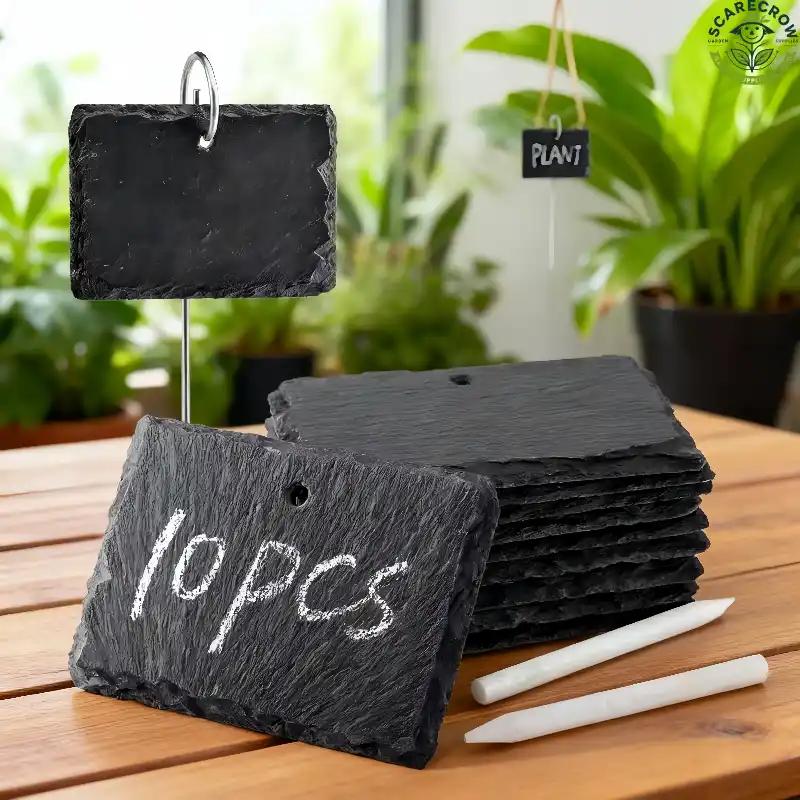
Scarecrow Garden Supplier's standard slate plant labels feature a polished writing surface designed for erasable soapstone chalk.
The surface allows plant names to be removed with a damp cloth. Unlike permanently printed tags, the same marker can identify different crops across successive seasons.
That convenience creates a practical limitation: removable chalk is not the same as permanent weather-resistant lettering.
The markings can come off with excessive water, sprinkler impact, and/or repeated wiping. Longer identification periods may require use of a paint marker. An oil-based paint marker may provide a better retainment of the markings. Removing the markings may require additional solvent, and residue may be left behind.
Permanent identification may be better served by the use of an engraving tool rather than repeated marker pen labeling.
Customers are encouraged to evaluate the product's substrate and marking durability functions separately:
• Durability of the substrate: Would exposure to outdoor elements (e.g., weather, UV rays, etc.) cause the slate to break/crack/flake?
• Marking durability: Would the chosen ink/chalk resist fading due to outdoor elements (e.g., weather, UV rays, repeated handling/irrigation, etc.)?
If permanent identification is required, engraving would be better suited over repeated labeling.
Stainless Steel Stakes and Soil Conditions
Depending on the soil conditions and stake length, other mechanical failures (bending of the rod, breaking the rod, and/or damage to the slate) may occur.
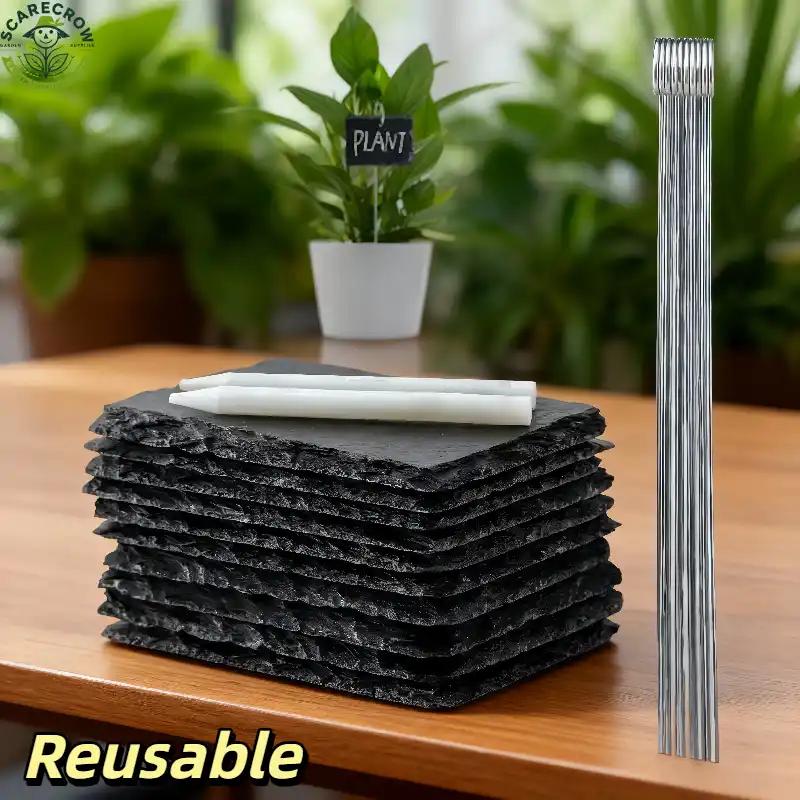
From what is listed on Scarecrow's website, a 40 cm long stainless steel stake is supplied. As mentioned before, stainless steel's performance is dependent on several factors.
Coastal conditions and the use of chloride-containing fertilizers can accelerate corrosion in stainless steel of lower grades. Information about the alloy is not always provided by the manufacturer. Therefore, a procurement team may need to confirm this information for a higher grade of stainless steel with a more corrosion resistant performance.
Stake length can also effect the overall stability of the assembly. A longer exposed section of the stake increases bending leverage under lateral loading.
Pre-forming a hole may reduce the risk of the rod bending and help stabilize the assembly for dense soil conditions.
Where Reusable Slate Labels Make Commercial Sense
The strongest applications combine repeated plant changes with a relatively stationary display.
For example, in a herb garden, if the identification for mint, basil and parsley rotate, reusable slate markers would allow the identification to be changed without having to replace the entire assembly.
• Rigid Markers: A rigid marker can provide visible identification above mulch or low vegetation. Stake length should account for soil depth and the irrigation system.
• Garden Centers: Natural stone provides a different appearance from plastic tags, and supports decorative gardening displays and private label retail kits. Increased ship weight and breakage remain concerns.
• Hotels and Restaurants: Slate can be used to identify permanent herb beds and landscaped displays.
• Inventory Control: However, in barcode based systems, slate markers are not suitable to replace nursery labels.
What Should Buyers Test Before Placing A Bulk Order?
There are a few things buyers can test:
• Weather Resistance: Most material descriptions do not give a good indication of weather resistance. To assess this, samples must be exposed to different conditions similar to the climate of the final market.
• Writing Retention: Write samples with the marking material of interest, expose to weathering, and determine if the marking is legible. Repeat this to determine if the mark is obstructed by residue, and if so, remove the residue and repeat the process.
• Stone Integrity: Edges and cleavage planes are weakest parts of stones and are susceptible to weathering and stress. Examine these after representative handling and exposure to freeze-thaw weathering.
• Stake Performance: Check straightness, the strength of the bond between the stake and the slate, and corrosion after repeated exposure to soil.
• Packaging: After transport, and before the samples are offered for sale, examine corners, edges, and other contact points for defects.
For wholesale shipments, stone-to-stone contact can cause chipping even when the product itself performs well outdoors. Packaging should prevent plate movement and keep metal rods from scratching slate surfaces.
Wholesale Specifications and the Sustainability Trade-Off
Scarecrow Garden Supplier lists the following standard configuration:
| Specification | Product Information |
| Materials | Natural slate and stainless steel |
| Slate plate | 10 × 7 × 0.5 cm |
| Support rod | 40 cm |
| Standard set | 10 labels, 10 rods, 2 soapstone chalks |
| Minimum order | 500 pieces |
| Customization | Shapes, dimensions, logo branding, packaging |
From an environmental perspective, reuse is generally more important than natural materials. There are material and energy costs associated with extraction, production, protection and transport of materials.
When considering sustainability, what matters is the service life and replenishment, as well as the weight of the freight, rather than automatically assuming that stone is preferable to plastic.
When assessing Reusable Plant Labels, Scarecrow Garden Supplier's range of slate markers provides options that are standard and fully customizable. Buyers are encouraged to contact for samples to assess writing and packaging, as well as stake strength before placing a bulk order.
FAQs
Q1. What materials are used in Scarecrow Garden Supplier's reusable plant labels?
Our plant labels combine natural slate plates with stainless steel support rods. The slate provides a rewritable surface, while the rods support outdoor installation in garden soil.
Q2. Are reusable slate plant labels waterproof?
The slate plates are designed for outdoor use and resist ordinary moisture exposure. However, soapstone chalk markings may fade or wash away under heavy rain or repeated irrigation.
Q3. How can reusable plant labels be cleaned and rewritten?
Write on the slate surface with soapstone chalk and wipe it clean using a damp cloth. The labels can then be reused for different herbs, flowers, or vegetables.
Q4. What are the standard dimensions of Scarecrow's slate plant labels?
The standard slate plate measures 10 × 7 × 0.5 cm and comes with a 40 cm stainless steel rod. Custom dimensions are also available.
Q5. What is included in a standard slate plant label set?
Each standard set contains 10 slate labels, 10 stainless steel support rods, and two soapstone chalks for erasable plant identification.