





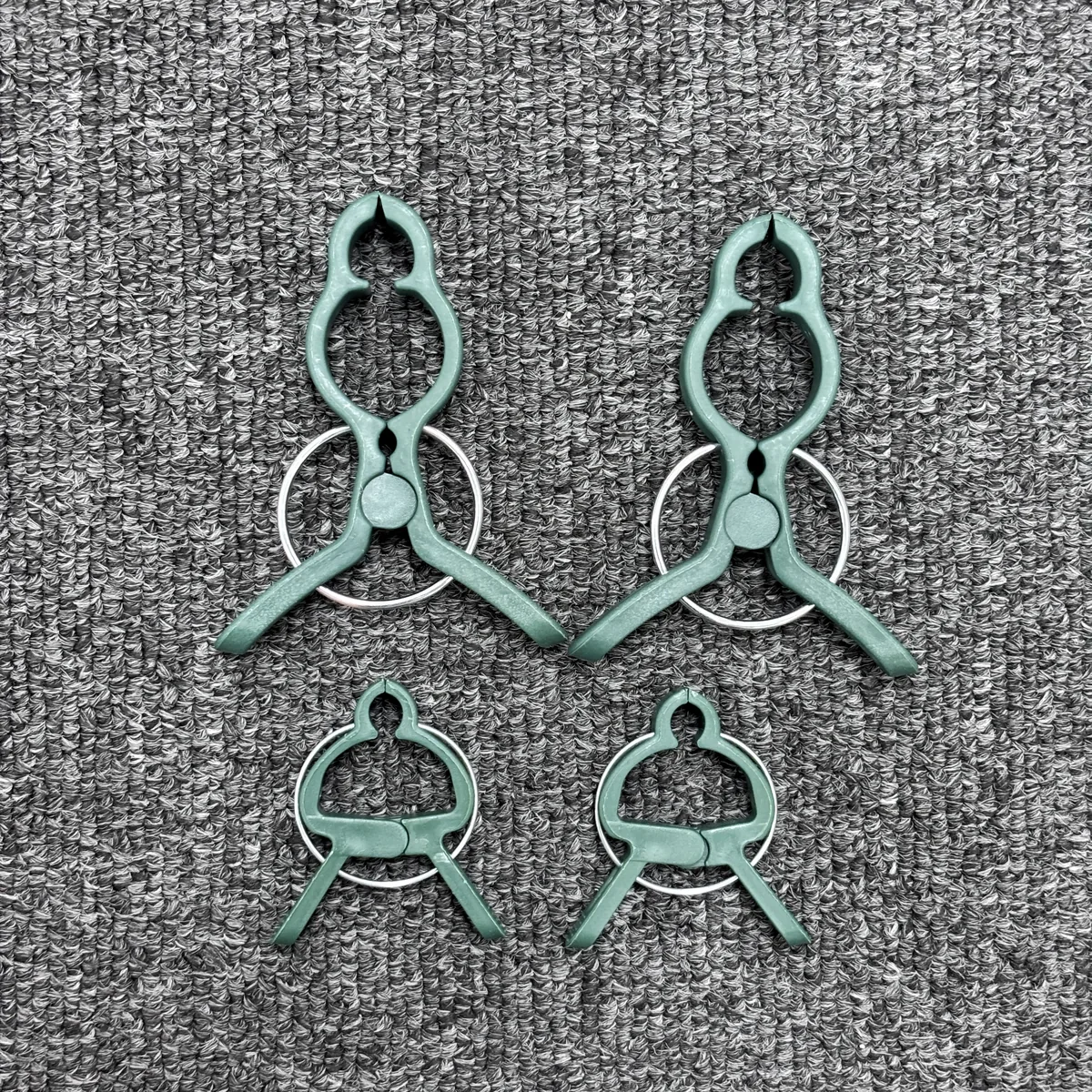
Green clips with differently shaped openings and visible silver-coloured spring-like parts.
When a supplier reports that a plant clip was cycled and its opening response did not change, that observation can sound like a holding guarantee. Whether it supports that conclusion depends on which force was measured, where it was measured and what the cycling subjected the clip to. An opening-response result does not become a retention result simply because it appears in a cycle-test summary.
This article is about reading that kind of report. It is not a validated universal fatigue-test protocol, and it does not publish force values, cycle counts or lifetimes for any clip.
Start with what the photo shows
The photograph shows four green clips with differently shaped openings and visible silver-coloured spring-like parts. Paired lower arms, central regions and upper openings can be identified. There is no scale or force value in the image.
Those visible regions do not establish how the clips operate. The static image does not show that pressing a particular arm opens a clip, which member supplies a closing force, or that all four clips share the same pivot arrangement.
It also does not establish material composition, clamping force or reuse life. An appearance photograph and a measured test result are different kinds of evidence.
Which force was measured
The first thing a cycle-test summary has to make clear is which force it is talking about, because two very different forces can both be reported in newtons.
The actuation input is the force applied to open or operate the clip. A useful result states the input location, force direction and travel. For the same target moment about a stated pivot, a larger perpendicular distance from the pivot to the force's line of action means a smaller required force. Distance along an arm alone does not define that comparison. This is a general mechanical relationship, not a measured mechanism for the clips pictured here.
The retention at the held interface is a different quantity. A holding result needs the held object or interface, the contact arrangement, the loading direction and the slip, release or displacement endpoint being assessed. Without those details, the reported holding result cannot be interpreted reliably.
A force cannot be renamed from one of these into the other just because both are reported in the same unit. And the mechanisms are not interchangeable either. A ring's latch release, a spring-jaw actuation and the deformation of a flexible body are different mechanical events, so each needs its own described setup. A reading from one arrangement does not authorise a claim about another.
What the cycling added
The loading history matters too. Repeated operation and time spent held under deflection or load are different conditions; the word "cycled" does not explain either one fully.
Repeated operation means opening and closing the clip again and again. Time held under deflection or load means leaving it deformed or loaded for a period. A BASF-authored snap-fit design manual treats relaxation and repeated loading as separate design considerations. That is general polymer-design guidance, not evidence about the composition or fatigue mechanism of the photographed clips.
Even choosing "repeated operation" leaves the condition still open. The cycle action, the travel and any stops, the rate, the environment and the observation point together define what was exercised. None of those is a universal default that a reader can assume. And a change in the opening response is a change in that particular endpoint. Calling it "hinge recovery" gives it a meaning the report has not earned.
Three reports, three different conclusions
Three logical combinations of evidence lead to different conclusions.
Report one: the opening response is reported unchanged after cycling, and retention was not measured. In this case the report can speak to the opening response under the cycling condition stated. It says nothing about holding after cycling, because holding was never measured. Any sentence that turns this into a statement about post-cycle holding performance is going beyond the evidence.
Report two: retention is shown only before cycling, and after cycling the observations are visual only. Here holding was measured once, before cycling, and the later inspection was by eye. Holding after cycling remains unresolved. A visual check can record what is visible; it cannot stand in for a retention measurement that was not run.
Report three: the same model has both an actuation measurement and a specified retention or slip endpoint, measured before and after cycling under an applicable, documented setup. This supports a before-and-after comparison of both specified endpoints within that setup. It does not establish plant injury, a growing-season outcome or a years-of-life guarantee.
Of these three examples, the first supports a narrower opening-response comparison; the third can address both actuation and the stated retention endpoint. The mechanism, fixture, travel, measurement method and applicability of the setup determine how far each result can be used. Missing detail limits the relevant conclusion rather than proving that no measurement occurred.
What a buyer can decide
Given all this, the practical step is to keep three claim types apart.
Actuation is a claim about the force or travel needed to open or operate the clip. It needs input location, direction and travel to mean anything.
Retention is a claim about how well the clip holds. It needs the held interface, contact arrangement, loading direction and a defined endpoint.
Reuse concerns performance over repeated use or time. A claim that a specified performance remains unchanged needs that endpoint assessed before and after the defined loading history. It cannot be inferred from an unrelated force reading or an appearance check.
Keep each conclusion within the endpoints and loading history the report actually covers. When it addresses opening response but not retention, say so. The plant clips category provides product-range context; it does not supply missing test evidence.

Written by
ScarecrowGarden
💡About Scarecrow Garden Supplier Co., Ltd.
Scarecrow Garden Supplier Co., Ltd. is a China-based sourcing and wholesale partner specializing in garden tools, landscaping equipment, and outdoor supplies for international wholesalers, distributors, contractors, and brands.
With hands-on experience rooted in real garden use scenarios, we focus on durable materials, functional design, and stable large-volume supply. Our product range covers pruning tools, watering systems, hand tools, outdoor hardware, and customized garden solutions to support both retail and professional landscaping markets.
Beyond products, we help our partners navigate supplier selection, quality control, compliance requirements, and long-term sourcing strategies in China. Through our blog, we share practical insights on product selection, material comparisons, industry trends, and cost-effective purchasing—helping global buyers build stronger, more competitive supply chains.