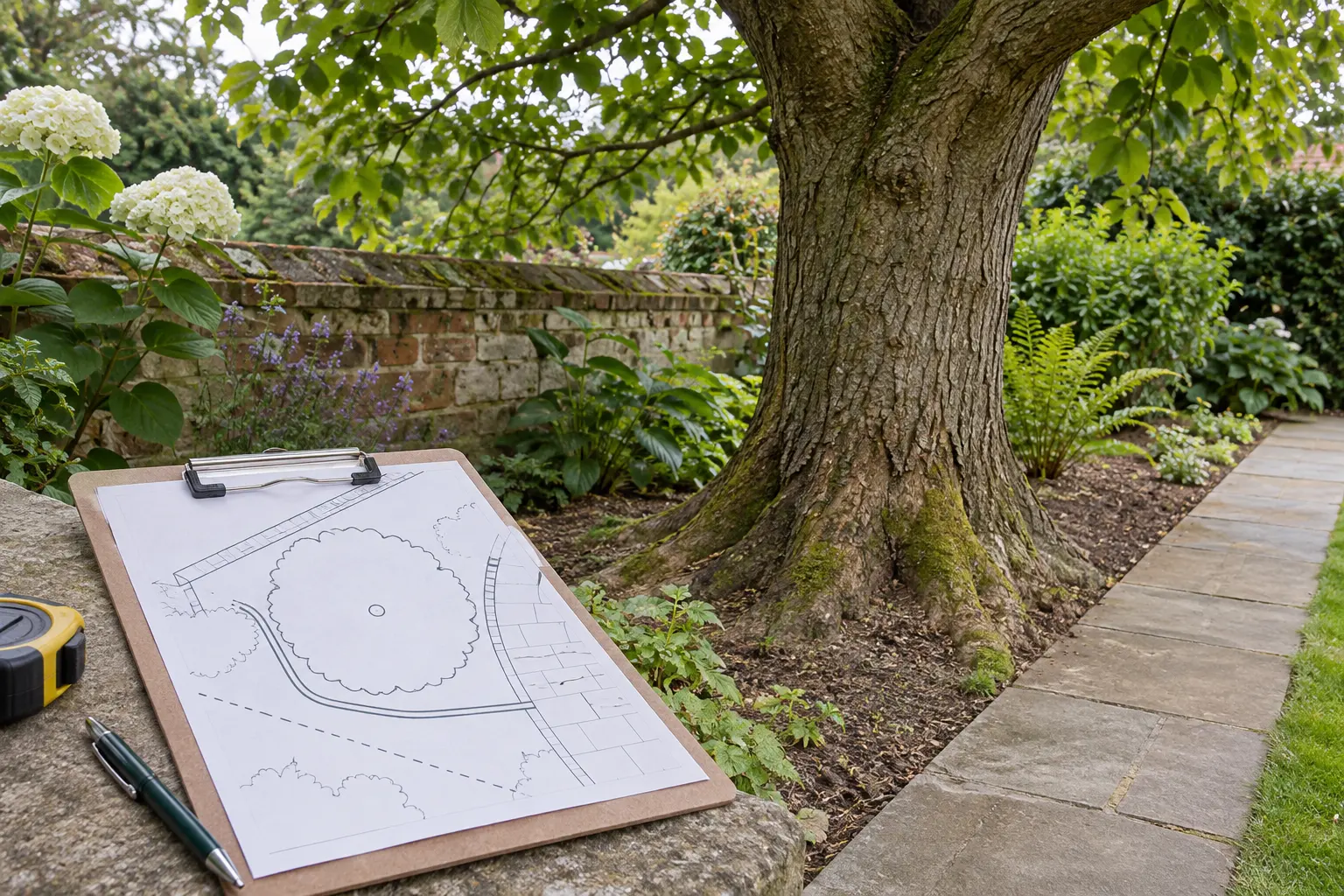







Diagram comparing independent trellis support and raised-bed-mounted trellis connections
The customer has a metal raised bed, wants to grow tomatoes, and tomatoes need support. So they ask whether a trellis can be bolted to the bed. The hardware exists, the screws go in, and there is now a structure whose behaviour in a summer gust nobody has analysed.
“Does it fit” is the easy question here. “Does it work” is the technical one, and the two are routinely confused.
Decide what supports the trellis
The first question is not how to attach a trellis to a bed. It is what the trellis is standing on.
Four arrangements exist and they have different structural logic.
An independent trellis stands on its own feet or is anchored in the ground behind or beside the bed, and it carries its own load. Because the bed is not involved in carrying it, this arrangement avoids one class of problem; it does not avoid the others. An independent trellis still has to be stable in wind, which means its feet, its anchor or its ballast have to be adequate for its height and its exposure, and that has to be checked rather than assumed from the fact that the bed is not being loaded.
A trellis with legs inserted into the soil inside or beside the bed carries load through its own legs into the ground, and the bed constrains it laterally. Whether the legs actually carry that load into the ground depends on what is under them: shallow soil over a hard layer, a bed open to the ground, and a bed with a closed base are three different situations, and in the third the legs may be bearing against the base rather than into soil.
A trellis fixed to the bed's frame transfers load into the bed, and this is where all the complexity lives. Some beds are designed for it, with reinforced points and documented fixings. Many are not, and the frame member that looks strong to the eye was sized to hold soil pressure, not to resist a lever arm at two metres.
A trellis integrated into the bed's design is a different product from a bed with an accessory, and it should be sold as such.
The useful discipline here is to ask the question in this order: what will hold the trellis up, and only then, what will hold the trellis on.
The bracket is not the whole connection
The second step is to follow the load path, because the bracket is the visible part of a chain of components that must all be adequate.
The chain runs from the plant and its support, into the trellis, into the bracket, into the fixing, into the bed panel, and into whatever structure gives the panel its rigidity. Any link that has not been verified means the connection is not verified, regardless of how strong the bracket is.
Wind is the load that most often decides the outcome, and it acts on a shape that collects it. A trellis on a raised bed is a light structure with a large surface area, fixed at its base and free at its top, which turns wind load into a bending moment at the fixing. Raising the trellis height lengthens the lever arm and may increase the moment at the fixing point for that reason, and how much it increases depends on the load and on the geometry of the specific assembly rather than on a rule of thumb.
RHS guidance on a different structure illustrates why loads of this kind deserve respect. In its discussion of cold frames and mini greenhouses, RHS notes that gusts of wind are the main cause of damage, and that lightweight frames are vulnerable to wind damage and need pegging down. That observation is about those structures, and it is not a test result for a trellis bolted to a raised bed. What it supports is a reason to take wind seriously in a light structure; it is not evidence that any particular bed-and-trellis assembly will or will not hold.
The second load is the plant, and indeterminate tomatoes make it concrete: such varieties need support, whether trained onto stakes, on a frame, or suspended by string from a wire above, and standard horticultural practice has them taking considerable labour to prune and train. A mature indeterminate tomato crop on a trellis is a meaningful mass, and it is a mass that moves.
The bed's own load matters too, and in a way that is easy to miss: a raised bed holds soil, and the panels are already resisting soil pressure. Whether the panel that receives the trellis bracket has reserve capacity for an additional outward and upward pull is a question about the specific model, and it cannot be answered from the outside. The same logic governs a castered planter asked to carry a full load while moving, and the documentation request is the same in both cases: a whole-unit statement rather than a component figure.
Account for the mature plant, not the empty display
The third step is to compare the demonstration with the use, and the gap between them is where buyers get misled without anyone lying.
An empty trellis on a display bed is a light aluminium frame in still air. It looks robust, it does not flex, and the fixings hold. A loaded trellis in July is a structure carrying crop mass, tied to plants that sway, on a bed whose panels are warm and whose soil is wet, in a garden where wind arrives in gusts, and after a season in which the fixings have been through thermal cycling and the plants have been tied and untied many times.
Three mechanisms sit in that gap, and they are things to assess for the specific assembly rather than outcomes to predict. Wind loading acts on the trellis surface area and on the plants, and it is the mechanism RHS identifies as the main cause of damage for the lightweight structures it discusses. Cyclic loading from plant movement is a mechanism that can work a fixing loose over a season in a way a static test does not capture, and whether it does depends on the fixing, the movement and the exposure. Corrosion and loosening at the fixing points are mechanisms to check for, particularly where dissimilar metals meet or where water sits, and their rate depends on the materials and the site.
None of those are arguments against ever fixing a trellis to a bed. They are arguments against assuming that a fixing that holds on a calm day is a fixing that holds.
Offer a supported combination or keep the products separate
The last section is the commercial decision, and it has two legitimate answers.
Related reading: raised garden bed construction and configuration options.
The first answer is a supported combination: the bed and the trellis are sold together because the manufacturer has documented the combination, meaning the specific fixing points, the specific brackets, the specific maximum trellis height, the specific anchor or ballast requirement, and any load limit. That documentation makes it a system, and a system can be specified, warranted and supported.
The second answer is two separate products, supplied separately, with the customer choosing how to support their plants. This is not a worse answer. It is the correct answer where the documentation does not exist, and it has the advantage of being honest.
What must not happen is the middle case, where the products are sold together because they fit, and the fit is demonstrated with screws. A screw that engages is evidence of a thread, not of a structural system, and a fixing point that accepts a bolt is not evidence that the panel behind it was designed to carry a trellis load. The sentence worth putting in a catalogue is not “compatible with trellis” but “trellis fixing points provided at these positions for trellises up to this specification”, and that sentence is only available where the manufacturer documents the combination, the load path and the limits.
There is also an instruction that should not be given, no matter how helpful it seems: how to add holes, raise the height, or reinforce the bed to take a trellis. Any of those changes the product from the one that was designed, and a supplier who provides the instructions has taken on the engineering. The correct response to a customer who wants to modify a bed to take a trellis is to point them at a product designed for it.
For buyers, the actionable version of this article is a documentation request rather than a product choice. Ask the bed manufacturer, for each accessory, whether the combination is documented, and if so, with what fixing points, what limits and what anchoring. A supplier who can answer that is selling a system. A supplier who answers “it fits” is selling a bag of parts and a risk, and the risk lands on whoever installed it.
Considering raised beds and trellises for the same wholesale order? Share the intended bed and trellis models, fixing arrangements and manufacturer documentation. We can help coordinate sourcing, while structural compatibility must be verified for the proposed combination.
One supply note to keep in view. Where a genuine supported combination exists, the sensible commercial structure is to offer the bed, the trellis and the fixing kit as a specified set in single-product bulk quantities for projects repeating one configuration, and to offer them as separately orderable items in mixed quantities for retailers whose customers are matching components themselves. Both are legitimate, and the difference is whether the combination is documented, not whether it is convenient.

Written by
ScarecrowGarden
💡About Scarecrow Garden Supplier Co., Ltd.
Scarecrow Garden Supplier Co., Ltd. is a China-based sourcing and wholesale partner specializing in garden tools, landscaping equipment, and outdoor supplies for international wholesalers, distributors, contractors, and brands.
With hands-on experience rooted in real garden use scenarios, we focus on durable materials, functional design, and stable large-volume supply. Our product range covers pruning tools, watering systems, hand tools, outdoor hardware, and customized garden solutions to support both retail and professional landscaping markets.
Beyond products, we help our partners navigate supplier selection, quality control, compliance requirements, and long-term sourcing strategies in China. Through our blog, we share practical insights on product selection, material comparisons, industry trends, and cost-effective purchasing—helping global buyers build stronger, more competitive supply chains.