







Drip irrigation diagram comparing residual drainage with continued flow from a reservoir
The pump has stopped. Water is still coming out of the dripper. The customer is now convinced the controller is broken, or that the system was supplied faulty, and those are possibilities to investigate alongside other causes: continued flow can come from the relative heights of outlet and water level, from water already sitting in the pipework, from the state of an anti-siphon device or a valve, or from the pump actually still running. The groups have to be separated before anything is concluded.
This is one of those faults that looks electrical and may turn out to be mechanical, and either way the layout has to be drawn before anyone reads a controller display or reaches for a multimeter.
Confirm what “stopped” actually means
The word “stopped” is doing too much work in the customer's description, and it has to be unpacked before anything else.
Three states are being confused. The schedule has ended, meaning the controller's programme has reached its end for this cycle and will run again later. The controller displays something that looks like off, which may mean off, or may mean between cycles. And the pump is actually not running, which requires establishing that the pump has no power and is not turning, not merely that the customer believes it should be off by now.
Each state has a different implication, and the diagnostic path differs. If the schedule ended and the pump is genuinely off but water continues, the question is about water already in the system and about any path that lets supply through. If the controller is between cycles and the customer expects the pump to run continuously, the question is about the programme. If the pump is running when the customer believes it is off, the question is electrical or control-related.
One safety instruction belongs at the very top of this and should never be softened: a customer or retail staff member should not open, dismantle or probe any part of a pump or controller that is connected to power. Checking that a switch is off, that a plug is out, or that a display shows a state is fine. Investigating inside a housing, testing with tools, or working on a wet system with power connected is not, and this applies to mains-powered and to low-voltage systems, because the water and the customer are not the only variables. Faults of this kind belong to someone competent to assess them.
Draw the water levels and outlet positions
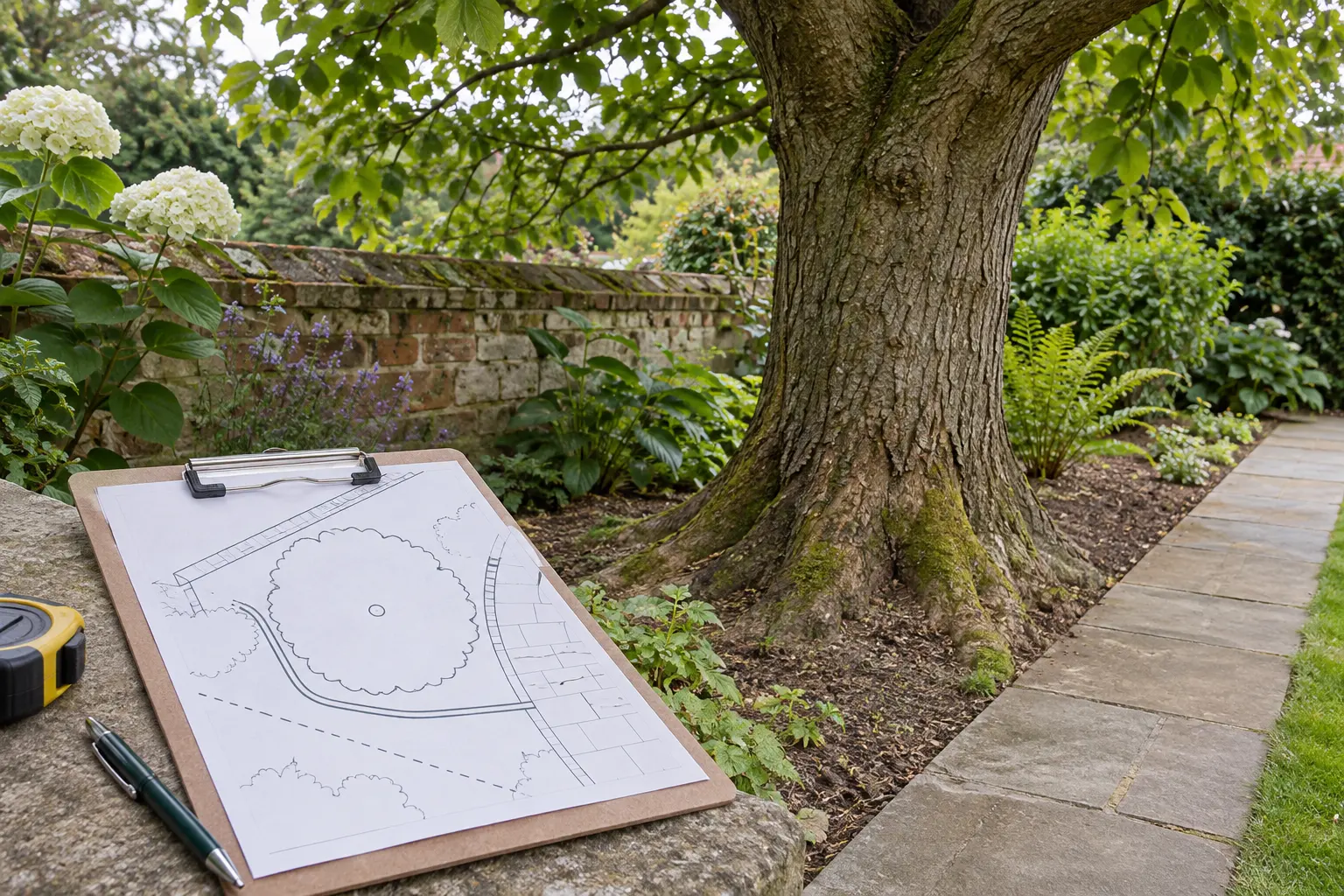
The second step is a drawing, and it is the fastest way to explain most of these cases.
The drawing needs four marks: the water surface in the reservoir, the pump intake, the highest point of the delivery line, and the outlet or dripper position. A vertical reference line, with those four points on it, is enough.
Two relationships on that drawing are worth establishing, and one common assumption about them is wrong. A water surface sitting above the outlet does not by itself mean the system will deliver water once the pump stops. Whether it does depends on whether a continuous liquid path exists from the reservoir to the outlet, and on what sits in that path: a closed valve, an air break, a check valve or a device that admits air all change the answer. The second relationship is more reliable: if the delivery line rises above the reservoir's water surface and then falls to the outlets, that raised section holds a volume of water which may drain out after the pump stops, depending on how the line is arranged and what is fitted at the outlet end.
Neither of those is a fault. Both are consequences of layout, and both are invisible in a customer's description.
This is also where a figure from the trade becomes useful, with its limits clearly stated. Irrigatia's public product information describes their systems as watering every three hours, adjusting with the weather to water longer when hot and less when cool, and the specifications for the SOL-C60 and SOL-C120 state a maximum height of 5 m from water source to plants. That tells you the manufacturer designs around a lift capability, which means the relationship between water level and outlet position is a parameter they have thought about rather than an accident. It does not tell you what is inside the system, and 5 m is a figure stated for particular models in one brand's range, on the model pages that publish it, not a general capability of small irrigation kits.
The drawing is also where a customer's assumption usually breaks. People assume the reservoir level is irrelevant because the pump does the work. It is not irrelevant: the pump's job is to overcome a lift, and the level is what sets that lift.
Separate residual drainage from continued transfer
The third step is to distinguish two possibilities that look the same from the outside and need different answers.
Water already in the system leaving it is one possibility. The volume involved is whatever the delivery line and any dripper bodies hold, and it is finite. It stops on its own. If a customer reports water continuing for a bounded period and then stopping, that is a plausible explanation, though not the only one, since a partly closed valve or a small leak would behave in a similar way over a short window. A system that drains its lines after each cycle is behaving normally, and some designs are intended to do precisely that.
Water being supplied from the reservoir after the pump has stopped is the other. Here the volume is not the pipe contents; it is whatever the reservoir can pass, and it continues as long as the path is open and the water level permits.
The distinction matters because the responses point in different directions. The first is managed by accepting it, or by arranging the outlets so the drainage goes somewhere harmless. The second is managed by finding out what is allowing supply through, which is a question about the layout and about the valves and devices fitted to it.
How to observe the difference, without touching anything live: note the time the cycle ends, watch the outlet for a bounded period, and note whether the water seems to be the pipe's contents finishing or something sustained. Simultaneously note the reservoir level, and note whether any valve on the line is fully closed. Brief drainage from the outlets and a continuing fall in reservoir level are different observations; do not use pipe volume to explain a fall in reservoir level. Water already in the line when the pump stops flowing out of the dripper is not being drawn from the reservoir at all, so it cannot on its own explain a reservoir level that keeps falling. A reservoir that continues to drop is being drawn from somewhere, which means the question to answer is what is allowing supply through, or whether there is a leak, rather than whether the dripper's output matches the volume of the pipe. This article will not give a threshold time for that observation, because the correct period depends on the system's pipe volume and flow rate, and a generic number would be a fiction dressed as a specification.
Use the arrangement specified for the system
The fourth step is the one that decides whether the layout is acceptable, and it is the point where general plumbing knowledge becomes dangerous.
Continued flow after a pump stops may be residual drainage or fresh supply from the reservoir. If fresh supply continues, establish its direction and mechanism before selecting a remedy. An ordinary liquid-line check valve opposes reverse flow but may still pass water in the normal delivery direction. A manufacturer-specified anti-siphon device may interrupt a siphon by admitting air; a physical air gap is a separation in the water path, not a valve triggered by falling reservoir level. Different arrangements can address overlapping risks, but they must not be substituted without checking the system instructions and installation conditions.
So the instruction is not “fit a non-return valve.” The instruction is that the arrangement specified for that specific system must be used, that an ordinary check valve is not equivalent to all anti-siphon devices, and that incorrect positioning may prevent the required protection.
What the manufacturer's own documentation says for a named model is the part that settles this. Irrigatia's public product page for the SOL-C36Q lists, in its kit contents, “1 x Anti-Siphon Device” alongside the controller, the water level sensor, the inlet filter and the drippers. That makes the device a standard part of that kit rather than an accessory, and it means the anti-siphon arrangement is already in the system the customer owns, while its installation and condition still need to be checked against the instructions for that kit. The same page presents the Q series as fully compatible with existing accessories including drippers, seep hose and flat hose.
Here the limit of this article's evidence has to be stated plainly. What the page establishes is that the device is supplied as part of the kit. It does not establish how the device works inside that system, what its internal mechanism is, or where and at what height it is fitted, and this article therefore describes none of those. In particular, the working principle of anti-siphon devices as a class, as published by irrigation component manufacturers, describes those devices and not this model, and should not be presented as an account of what is inside the C36Q.
What follows is procedural rather than descriptive. The device is supplied as part of the kit, its condition and its fitting should be checked against the manufacturer's own instructions for that model, and where those instructions are not available they should be requested rather than replaced with a general plumbing assumption. Advising a customer to modify the pipework, add a valve, or reposition a device on the basis of general practice is not a substitute for that check, and this article gives no such instruction.
Make the corrected layout part of the customer guidance
The final step is to turn this diagnosis into something that prevents the next call.
Three things belong in the customer guidance. A simple statement of what the system does after a cycle, so that a customer expecting water to stop instantly is not surprised. A statement of the layout conditions the system requires, in terms a customer can check: the reservoir must be at this relationship to the outlets, the delivery line must run this way, the specified anti-siphon arrangement must be fitted as supplied. And a short list of what to look at if water continues: has the cycle ended, is the level in the reservoir falling, is any valve on the line not fully closed, has anything been changed at the outlet end.
The value of that guidance is not just fewer support calls. It is that the same information protects the customer from the more serious version of this situation, which is a system that continues to deliver water while the customer is away. A customer who understands that a path from reservoir to outlet can exist will think about the reservoir level before leaving, and that thought is worth more than any after-sales email.
The layout conditions are part of the product, and a system sold without them will produce this article's question in every market where it is sold.
Related reading: reservoir-pump and solar irrigation kit designs.
Evaluating reservoir-fed or solar irrigation kits? Send the model, water source position and outlet arrangement. Scarecrow Garden Supplier can help compare documented kit configurations and request the manufacturer's installation requirements.

Written by
ScarecrowGarden
💡About Scarecrow Garden Supplier Co., Ltd.
Scarecrow Garden Supplier Co., Ltd. is a China-based sourcing and wholesale partner specializing in garden tools, landscaping equipment, and outdoor supplies for international wholesalers, distributors, contractors, and brands.
With hands-on experience rooted in real garden use scenarios, we focus on durable materials, functional design, and stable large-volume supply. Our product range covers pruning tools, watering systems, hand tools, outdoor hardware, and customized garden solutions to support both retail and professional landscaping markets.
Beyond products, we help our partners navigate supplier selection, quality control, compliance requirements, and long-term sourcing strategies in China. Through our blog, we share practical insights on product selection, material comparisons, industry trends, and cost-effective purchasing—helping global buyers build stronger, more competitive supply chains.