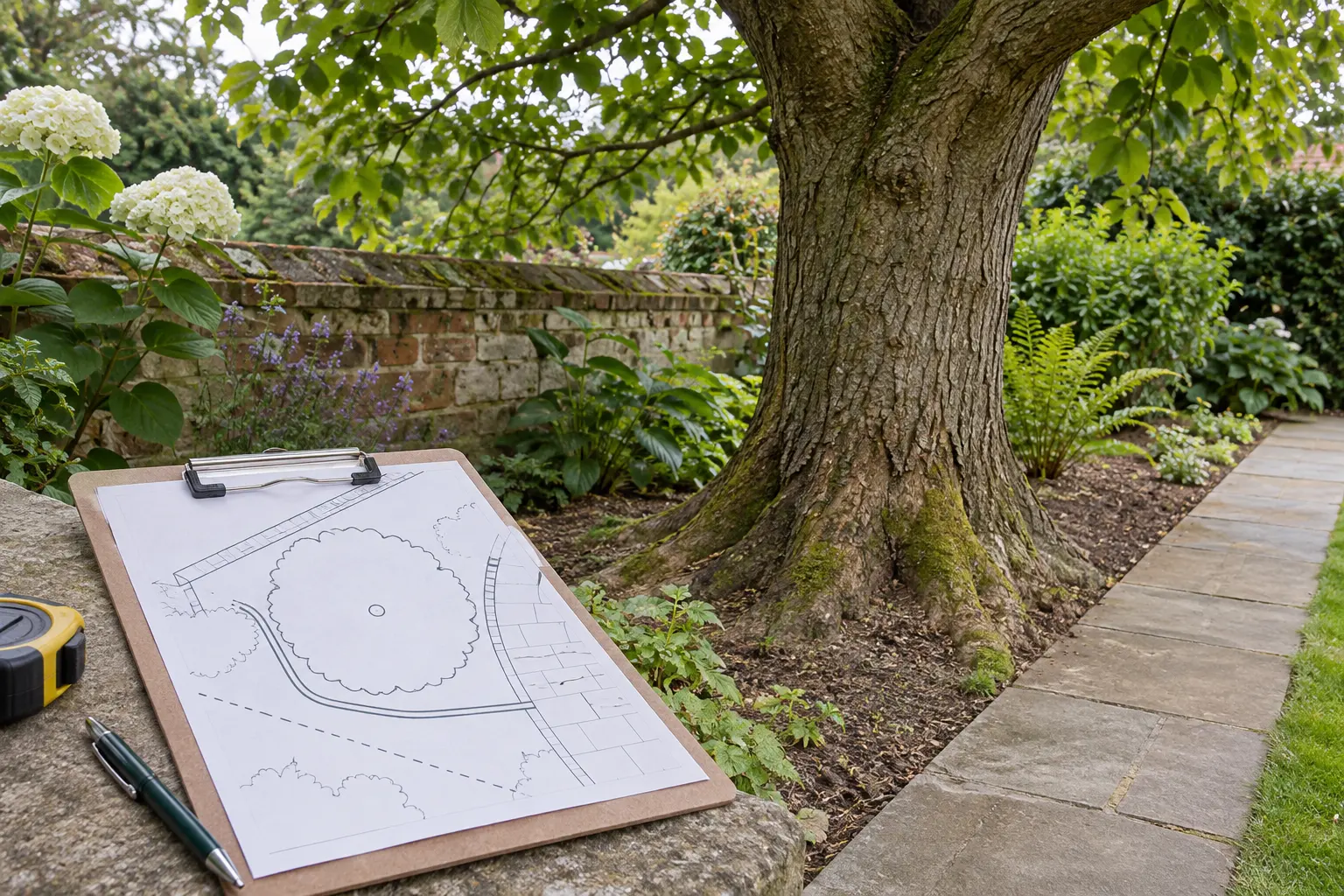







Raised bed side-view illustration comparing standing reach, seated reach and knee clearance
A raised bed sold as “easier on your back” is a claim about a working position, and a working position depends on the gardener as much as on the bed. Buy a tall bed for someone who gardens from a wheelchair and the height may be right while the reach, the knee space and the route are all wrong. Buy a low bed for someone with limited hip mobility and the reach is fine while the bending is not.
The product question is not “how tall” but “which working position, reached how, with what underneath.”
Start with the gardener's working position
Three working positions have to be considered separately, because they produce different answers.
A standing gardener works from the side and needs the bed's rim at a height that allows work without stooping, and needs the bed's width to be within reach. A seated gardener works from a chair, a stool or a wheelchair, and needs the rim at a height that puts the growing surface within easy reach of a seated posture, plus room below the rim for legs. A gardener using a walking aid, or working one-handed, has a different constraint again: they need to be able to lean or rest on something, and need something sturdy to lean or rest on that was designed and verified for that purpose rather than the bed's rim assumed to be one.
UMN Extension gives one figure that is specifically tied to a working position and it is worth quoting exactly because of how it is framed: for wheelchair users, 27 inches is generally a comfortable height. That is a comfortable height for a defined group in a defined posture, offered in UMN's guidance on choosing the right size, under its height discussion, and not as an accessibility standard. It is not a general recommendation for all raised beds, it is not a reach standard for any particular user, and it is not an accessibility standard.
That is the single most important distinction in this article. A university extension recommendation published in a gardening guide is horticultural advice. It is not an accessibility certification, and the guidance it appears in does not present it as one: the figure sits within a section on choosing the right size for the gardener, with no compliance claim, no standard reference and no certification attached. A supplier who presents a bed as “certified accessible” on the basis of that kind of figure has converted advice into a claim it cannot support.
So the wrong question is “what height is accessible.” The right question is “who will use this, in what position, and what does that position require.”
Check reach from the sides that are actually accessible
Reach is a separate dimension from height, and it is the one that most often turns a good-height bed into an unusable one.
UMN states the reason clearly: arm reach is usually a good indicator of how wide a raised bed should be, because the gardener should be able to reach the centre of the bed comfortably, to avoid having to step into it for maintenance, which compacts the soil. The guidance then gives widths for ground-level beds, where a maximum of 2.5 feet applies if the bed can only be approached from one side, and up to 5 feet if it can be approached from both sides.
Those widths belong to the ground-level beds the guidance is describing. They are horticultural sizing advice about not having to step into a bed, and they are not a reach standard for a seated gardener, a wheelchair user, or a raised bed at any particular height. What transfers is the principle that reach, not bed width in the abstract, sets the usable dimension.
Two distinctions do transfer to any raised bed. Whether the bed can be reached from one side or two halves the usable width, which is the difference between a bed against a wall and a bed in open ground. And the criterion differs with the access the site allows. Where both long sides can be reached, the test is whether each side reaches the centre, because the two arcs together cover the bed. Where only one side can be reached, reaching the centre is not enough: the test is whether that one side can reach the furthest planting area it has to serve, or the far half of the bed is out of practical use.
For a gardener working from a seated position, the reach question is compounded by the fact that reaching down and out over a rim is a different movement from reaching down and out at ground level. The rim itself is an obstacle: the gardener has to reach over it, not merely to it. This is why a bed that is well within reach when empty can become difficult when full of a mature crop, and why the check should be done with the plants at their final size rather than with bare soil.
In an accessible design, the reach side is also the access side, which means it should not be where a path narrows, where a tap stands, or where a tool is stored. Accessible gardening guidance generally makes the same point about the approach to a bed, describing a route that is firm, level, unobstructed and wide enough to turn, and it applies with equal force to a raised bed, because the bed is only as usable as the route to it. That formulation comes from accessible gardening guidance as a body of practice rather than from the university extension source cited above, and the distinction matters for the same reason the height figure does: general practice is not a specification.
Look below the rim
The space under and around the rim is where most “accessible” raised beds fail, and it is invisible in the product photograph.
Related reading: bottomless raised beds and installation surfaces.
Four things have to be described rather than assumed. The base: whether the bed sits on panels closed to the ground, on legs, or on a frame that leaves an open span beneath. The legs or frame: where they sit relative to the working side, since a frame that runs to the ground on that side rules out a head-on approach whatever the rim height is. The clearance below the rim: how much open height and depth there is on the working side, at the position a seated person's knees and feet would occupy. And the working-side facade: whether the panel there is full height, recessed, or open.
Knee space matters where the intended approach is head-on, and there the bed's understructure must be open on the working side, or have a recess, at the height and depth a seated person needs. Where the intended approach is parallel to the bed rather than head-on, the requirement is different and has to be checked as its own layout, including the path to it, the room to turn and what the seated gardener can actually reach. A base frame that extends to the ground on a working side rules out a head-on approach from that side; it does not by itself rule out every other way of working at the bed. Foot space matters because a seated gardener's feet must go somewhere, and a base frame that drops to the ground on a working side removes the space a head-on approach needs. The frame and bracing have to be strong enough to span without a support exactly where the knee space is needed.
One thing the rim is not: unless the whole unit has been verified for it, the rim is not a handrail, a grab rail or a load-bearing support for a person leaning or pushing up on it. A panel edge that is comfortable to rest a hand near is not the same as a rail designed to take a person's weight, and a supplier who describes a rim as a support has taken on a claim that belongs to a whole-unit assessment rather than to a panel.
A bed on a closed base is a planter. A bed on legs with clear space beneath is a table. A bed with a recessed working side is something in between. Those three are different products for different gardeners, and the height figure alone does not distinguish them.
This is also where an overlooked consequence sits: a raised bed acts as a container, and UMN notes that raised beds dry out faster than ground soil, with taller beds needing more frequent watering. For a gardener with limited mobility, that extra watering is a heavier burden than it is for most others, because it means more trips with a can or a hose. A tall bed that solves the bending problem and creates a watering problem has not solved the accessibility question, it has moved it. UMN also notes that a raised bed with a low side panel may be more reachable for young children and cheaper to build, which is the same principle in the other direction: matching the structure to the user rather than to a slogan.
Include the route and the tools
A bed is used as part of a journey, and the journey has to work.
The route is the first part. From the house to the bed, over what surface, with what gradient, with what width. A firm, level, unobstructed surface is the requirement, and it should be continuous rather than only at the bed. A paved path that ends in a gravel strip in front of the bed has moved the obstacle rather than removed it.
Watering is the second. A tap at the far end of the garden, a hose that has to be dragged, a can that has to be carried: each is a task that becomes harder with limited mobility. The distance from water to bed is a design variable, and it may argue for a bed position that is less ideal horticulturally and much better practically.
Tools are the third. Tools that require two hands, tools that require a firm grip, tools with long handles: the bed's height changes which tools work. A bed at seated working height makes short-handled tools usable and long-handled tools awkward, which is the opposite of a ground-level bed. Storage near the bed, at a reachable height, keeps the tools where they are used.
None of this is in a raised bed's specification, and all of it determines whether the product is used. A dealer selling to a community garden or an accessible gardening project is really selling a layout, and the bed is one component of it.
Describe accessibility without promising certification
The last section is about language, and it is where a well-intentioned supplier can create a liability out of a good product.
What can be said honestly: this bed's rim is at this height, measured under stated conditions; this bed has knee clearance of this depth on this side; this bed's planting area is reachable from the stated access side or sides; this configuration is one the manufacturer documents. Those are descriptions of a configuration, measured against a stated working position, reach requirement, knee and foot space, and route condition. They are testable, and they stop short of any certification claim.
What a supplier should not say without a verifiable record is that a particular configuration has been used in an accessible gardening project, or that a project of that kind has adopted it. If there is such a record, name it and let the buyer check it. If there is not, the sentence should not appear.
What cannot be said: this bed is accessible; this bed is suitable for all wheelchair users; this bed is certified accessible; this bed meets accessibility requirements. The first two are claims about people the supplier has not met, and this article's evidence does not support a certification of any kind. The third and fourth add a claim about a regulatory framework that varies by market and that this article cannot and should not characterise. Accessible design requirements differ enormously between jurisdictions, and whether any of them apply to a garden product in a given market is a question for that market.
A workable commercial approach is a stated suitability, with the working position named and the verification condition given: for a gardener working from a seated position, check the rim height against their comfortable working height, check the knee clearance against their chair, and check the route before deciding. That last instruction is unusual in product copy and it is the most honest sentence available, because it puts the decision where the information is.
For buyers and project specifiers, the practical structure is a configuration matrix rather than a product range: working position, rim height, base and leg layout, knee and foot clearance, reachable width from one and two sides, and route requirement. The matrix is a screening tool, not a decision. It narrows the field to a few candidates, and those candidates then have to be checked against the actual person, the actual chair and the actual route, because no matrix can carry those three.
That is the whole argument, and it fits in one line. A badge answers a question nobody asked, which is whether the product is accessible. A matrix gets a specifier as far as a shortlist, and the shortlist gets settled in the garden. Sell the matrix, and then go and look.
Sourcing raised beds for different gardening environments? Send the intended working position, access requirements and preferred dimensions. Scarecrow Garden Supplier can help compare documented models, without assuming accessibility certification or unverified support capacity.

Written by
ScarecrowGarden
💡About Scarecrow Garden Supplier Co., Ltd.
Scarecrow Garden Supplier Co., Ltd. is a China-based sourcing and wholesale partner specializing in garden tools, landscaping equipment, and outdoor supplies for international wholesalers, distributors, contractors, and brands.
With hands-on experience rooted in real garden use scenarios, we focus on durable materials, functional design, and stable large-volume supply. Our product range covers pruning tools, watering systems, hand tools, outdoor hardware, and customized garden solutions to support both retail and professional landscaping markets.
Beyond products, we help our partners navigate supplier selection, quality control, compliance requirements, and long-term sourcing strategies in China. Through our blog, we share practical insights on product selection, material comparisons, industry trends, and cost-effective purchasing—helping global buyers build stronger, more competitive supply chains.