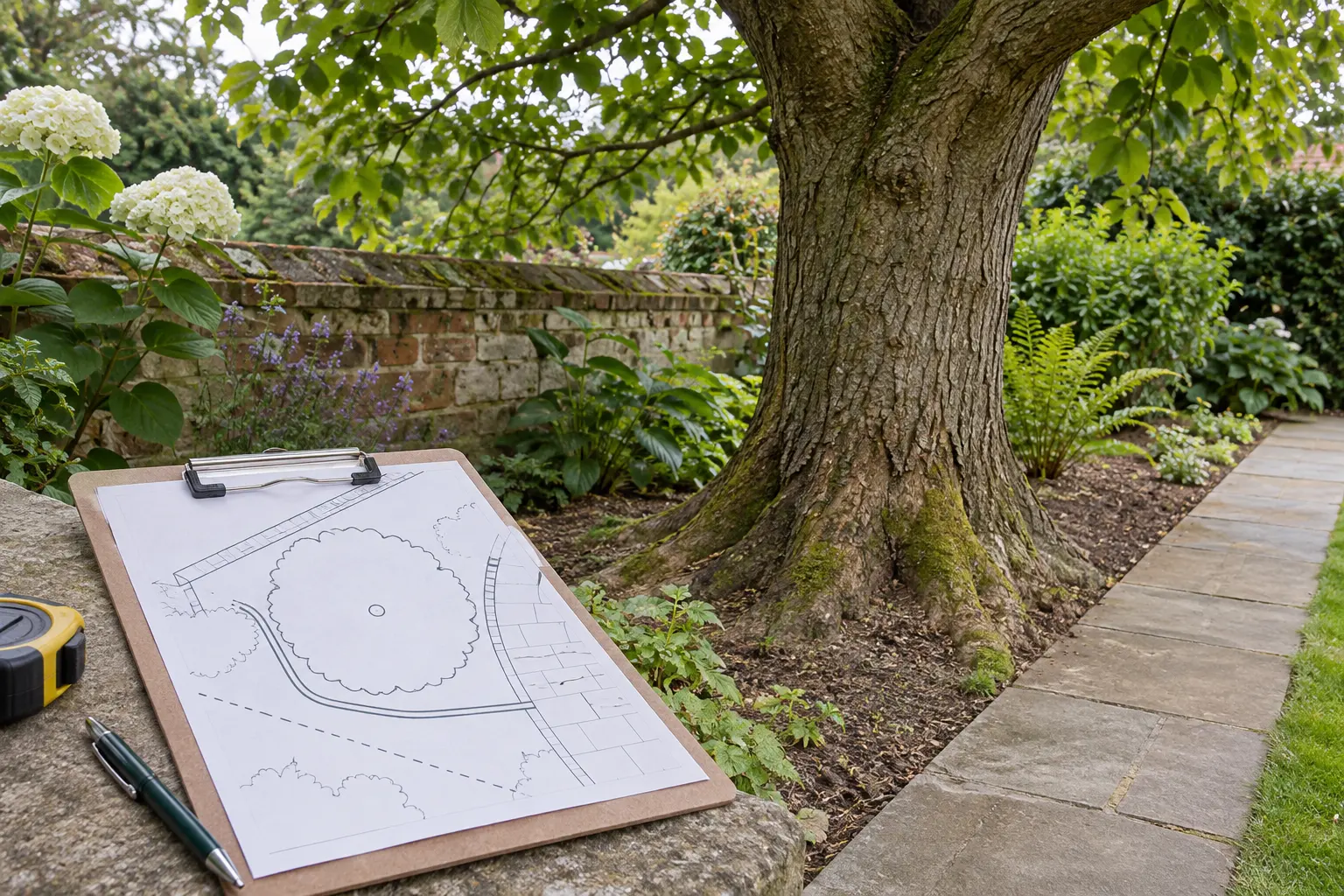









Top-view comparison of modular raised bed layouts showing different internal soil areas
Two-thirds to one-half topsoil, one-half to one-third plant-based compost. That is the mix a university extension service recommends for a raised bed, and it is not one material. It settles, it compacts, and it is sold in units that have nothing to do with the units the bed is dimensioned in.
Which is why a customer who asks how much soil their modular bed needs cannot be answered with a figure. A configurable product has one fill answer per configuration, and producing those answers is a geometry job followed by a purchasing job.
Fix the layout before estimating anything
The first discipline is to fix the layout, and to fix it from the manufacturer's documented configurations rather than from the product photograph.
Related reading: modular raised garden bed configurations.
Before any arithmetic, two things have to be established from the manufacturer's own documentation, because neither can be read off a listing. The first is which configurations the manufacturer actually supports for this model, since a panel set that can physically be assembled into six shapes does not mean all six are documented builds. The second is whether the bed is open to the ground or has a base, because that single fact changes what is being calculated.
A modular bed is designed with a set of buildable layouts, and those layouts differ in the length of the perimeter and in whether the interior is enclosed, divided or open. A rectangle, a U shape, an L shape and a corner arrangement are layouts that some specific modular systems may support, and where a system supports them they can be built from the same panel set without holding the same volume even when they use the same number of panels. Whether a given product supports them at all has to be read from its own configuration drawing. Some modular systems also allow internal dividers, which reduce the growing volume per unit of floor area while adding structure.
The photograph on the listing is a marketing decision, not a specification. The specification is the configuration drawing, and it is the only thing that tells you which layouts are supported. Estimating fill from the photograph means estimating the fill of that one layout and applying it to all of them, which is the specific error this article exists to prevent.
The base question changes the arithmetic more than any other. A bed open to the ground holds the volume above the soil surface, so the fill depth is measured from the existing ground up to the growing level. A bed with a base holds the volume inside its own panels, from the base panel up. Those are different calculations on different starting points, and the difference is the entire question of whether the customer is filling a container or top-dressing a patch of ground. Which of the two a given model is belongs to that model's documentation.
Measure the space the medium actually occupies
Once the layout is fixed, the next step is to measure the space the medium actually occupies, which is not the outside of the product.
The inner dimension is generally smaller than the outer, and how much smaller depends on the panels, any framing and the connectors used, so it should be measured on the assembled model or read from its own documentation rather than derived by subtracting twice a nominal panel thickness. The effective internal contour is the shape the medium actually sits in, which in a curved or angled bed differs from a simple rectangle. The growing height is the depth of medium, which differs from the panel height if the medium is not filled to the rim. And the outer dimension is what the product occupies on the patio, which is the only one of the four that appears in a listing.
Every one of those four has to come from the model in hand, measured or taken from its own drawing. No dimension in this article is a figure to be applied to a bed; the method is the deliverable.
The growing height is the one customers most often miss and the one worth explaining. Filling to the rim means medium spilling over the edge at every watering and no freeboard for mulch. Most planting guidance assumes the medium sits somewhat below the top, and that space is volume the customer paid for and cannot plant in.
Universities give useful reference points here. UMN Extension recommends a raised bed soil mix of roughly two-thirds to one-half topsoil with one-half to one-third plant-based compost, warns that too much compost creates water-holding problems because compost dries out and then repels water when dry, and notes that potting soil is unsuitable for raised beds because it dries out too fast. That mixture composition matters to the fill calculation because it is not a single-density material: a mix of topsoil and compost settles differently from either alone.
UMN also notes the settlement problem directly. Where layered materials are used, such as branches, leaves, compost and soil, the bed needs ongoing topping up as those materials decompose. That is not a defect; it is a known behaviour of organic fill, and it means the first fill is not the last purchase.
One further product note from UMN that is relevant to metal beds specifically: galvanised steel is described as a popular alternative to traditional wooden beds, usually sold in panel widths of 24 inches, and the guidance warns that some prefabricated metal raised beds sold online have been found to contain lead. That last point belongs to verified sourcing, not to maths, and it is worth mentioning to any buyer because the fill question is often the moment a customer starts asking what the panels are made of.
Calculate curved and straight sections consistently
The geometry is straightforward and it must be applied consistently, because mixing conventions is where estimates go wrong.
Straight sections are simple: length multiplied by width multiplied by depth gives the volume, provided all three are in the same units. The trap is unit mixing, and it is extremely common because product dimensions arrive in one unit and soil is sold in another. A bed dimensioned in centimetres with soil sold in cubic feet or litres requires an explicit conversion step, and that step should be written down rather than done in someone's head.
Curved and composite sections need their own treatment and should not be forced into the rectangle formula. A rounded corner is not a rectangle with the corner cut off; a true half-circle end is not a semicircular approximation of a square end. Where a bed combines a straight run with a curved end, the volume is the sum of the straight prism and the appropriate curved solid, each computed on its own geometry.
The complication in modular beds is that some layouts produce a shape that is neither a clean rectangle nor a clean curve, such as an L with an internal corner or a long run with rounded ends. Two honest approaches exist. Break the shape into a small number of simple solids that can each be computed, accepting a small approximation and stating it. Or compute the internal contour area by a method that handles the actual outline, then multiply by depth. Using different methods for different parts of the same bed is legitimate, and it is often the most accurate route: a straight section measured as a rectangle and a curved end measured by its true outline can be summed, because volume is additive across areas that do not overlap. What produces a figure that cannot be checked is not the mixed method but an inconsistent outline assumption between sections, an area counted twice, a section left out, or units and assumed depth that differ from one part of the sum to another.
| Layout type | Method | Where it goes wrong |
|---|---|---|
| Straight rectangle | Length x width x depth, all in the same unit | Unit mixing between product dimensions and soil packaging |
| Layout with one rounded end | Straight prism plus the appropriate curved solid | Treating the curve as a cut corner |
| L shape or internal corner | Two or three simple solids, summed | Counting the shared corner twice |
| Outline with irregular contour | Contour area by a method that handles the outline, multiplied by depth | Mixed methods are fine, but an inconsistent outline assumption, a double-counted area, a missed section or a unit or depth mismatch between sections is not |
It is worth being explicit that the deliverable here is a method the customer can re-run, not a single number. A geometry path that reads “measure the inside of the assembled layout, compute the area of this outline, multiply by this depth” is reproducible and auditable. A published figure for “the 4-in-1 bed” is neither, because it does not say which of the four.
Turn volume into a purchasing estimate
Volume is not a bag count, and the conversion involves three uncertainties that should be named rather than smoothed.
The first is unit and packaging. Soil is sold by volume or by weight, and bags carry a nominal capacity such as a stated number of cubic feet or litres. Bulk soil is sold by volume or by the tonne, and the two are not interchangeable without a density. Getting from a computed volume to a purchasing quantity means knowing which of those the supplier uses.
The second is density, and it is the most volatile term. Volume multiplied by density gives weight, and density varies with moisture content, with compaction and with the mix itself. Public estimating tools reflect this: sand estimators, for instance, distinguish dry, wet and compacted conditions because the same volume weighs materially different amounts. A topsoil-and-compost mix behaves the same way, and it also settles after wetting and over time. This is precisely why a fill volume computed from internal dimensions cannot be converted into a weight reliably without a density figure, a moisture content and a settled condition for the mix in question, and why a supplier should resist quoting one from the other. The volume is a figure the geometry supports; the weight of what the customer loads is not, and no fill weight for a given volume should be published or quoted as if it followed from the calculation.
The third is settlement, which UMN's guidance makes explicit for layered fills and which applies more modestly to any organic mix. A bed filled to a level in spring will not be at that level in autumn. Customers should be told this, because the alternative is a complaint that the bed “used up” its soil.
The practical output is a range rather than a figure: this much to fill the bed to the intended growing depth, plus an allowance for settlement, expressed in the units the customer will actually buy. A range honestly presented is more useful than a precise number that pretends to certainty it does not have.
Give each configuration its own fill note
The last step is documentation, and it is what separates a configurable product sold well from one sold with a recurring support problem.
Each documented layout should have its own note, stating the internal dimensions used, the growing depth assumed, the computed volume at that depth, and the purchasing quantity in both common units with the settlement allowance shown separately. The internal dimensions are the starting point for every note, because the outside dimension does not describe the space the medium occupies in any layout, and a layout reached by rearranging the same panels has a different internal contour even when the panel count is identical. The note should say which layout it refers to, in the same terms the configuration drawing uses, so a customer can match note to build.
What should not be produced is a single bag count for a multi-configuration product. That figure will be right for one layout and wrong for the rest, and it will be quoted back at the dealer by every customer who built a different one. A product that can be built six ways has six fill answers, and the honest document says so. The clip quantity problem in a greenhouse crop runs on exactly the same logic: the demand figure comes from the configuration, never from a headline number.
For brands and retailers, this is a content and packaging task more than a maths task. It means aligning three documents that are usually produced by different people: the configuration drawing, the fill notes, and the packaging labels. When those three disagree, the customer discovers it with a hose in one hand and an empty bag in the other, and no amount of after-sales goodwill fixes the first impression. It also means holding two supply patterns, since a retailer selling single beds to gardeners wants a spread of small quantities while a project buyer fitting out a community garden wants one configuration repeated, and the fill documentation should be available in both conversations.
Comparing modular raised beds for wholesale supply? Send the permitted layouts, internal dimensions, preferred materials and quantities. We can help coordinate model specifications and packaging requirements for bulk or mixed wholesale orders.

Written by
ScarecrowGarden
💡About Scarecrow Garden Supplier Co., Ltd.
Scarecrow Garden Supplier Co., Ltd. is a China-based sourcing and wholesale partner specializing in garden tools, landscaping equipment, and outdoor supplies for international wholesalers, distributors, contractors, and brands.
With hands-on experience rooted in real garden use scenarios, we focus on durable materials, functional design, and stable large-volume supply. Our product range covers pruning tools, watering systems, hand tools, outdoor hardware, and customized garden solutions to support both retail and professional landscaping markets.
Beyond products, we help our partners navigate supplier selection, quality control, compliance requirements, and long-term sourcing strategies in China. Through our blog, we share practical insights on product selection, material comparisons, industry trends, and cost-effective purchasing—helping global buyers build stronger, more competitive supply chains.