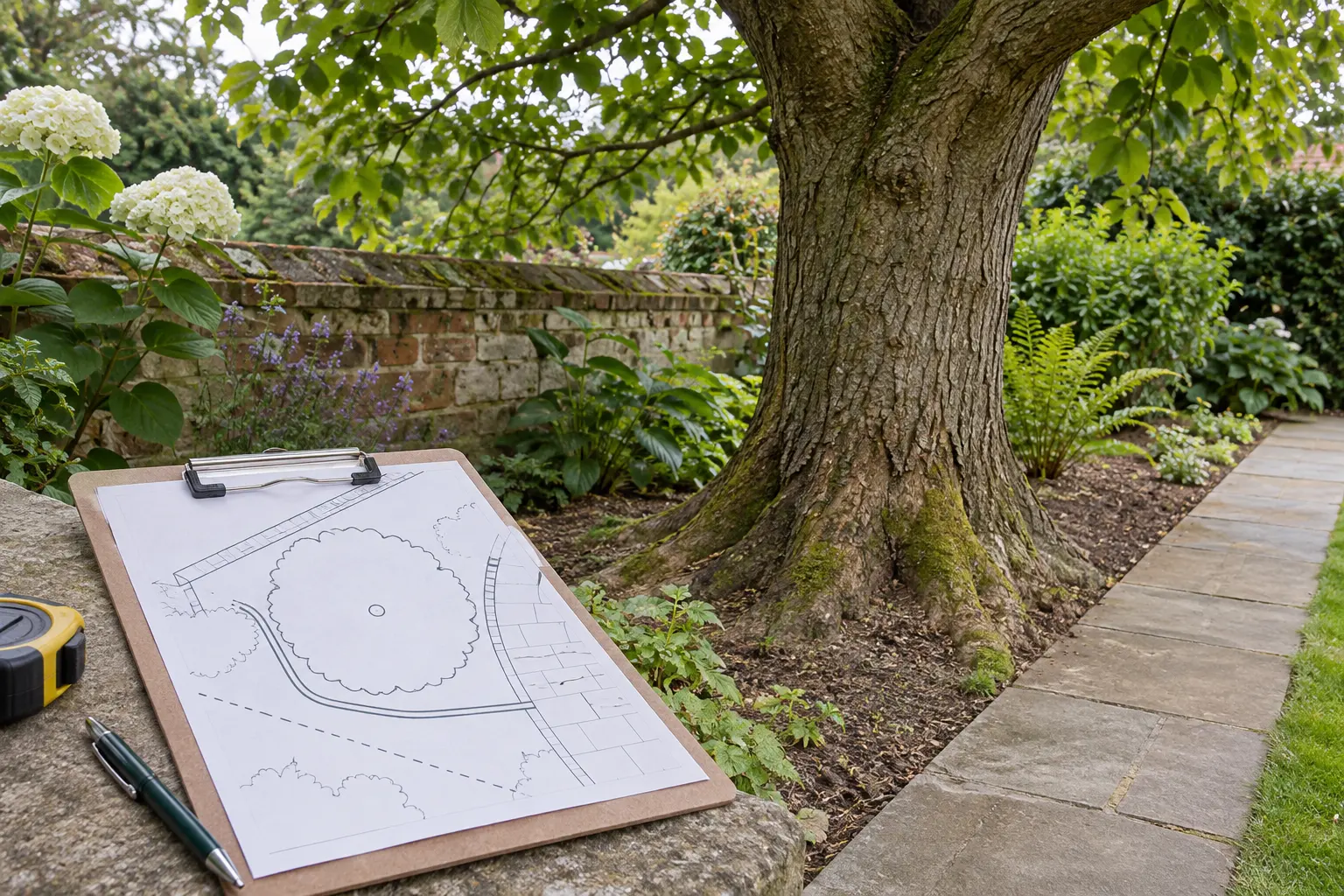






Illustration of plant tie clearance around stems at different growth stages
A band that grips the stem all the way round is not more secure. It is a common root of plant tie problems, and the plant that suffers is the one the tie was bought to protect.
A tie has two jobs that get confused: locating the stem relative to a support, and bearing the load the stem puts on that support. Neither requires firm contact all the way around the stem. What firm all-round contact produces is a band around a growing cylinder, and what happens next depends on the closure, the material and whether anyone adjusts it: the band may loosen, it may stay put while the stem grows into it, or it may be reset to a new diameter before either becomes a problem.
RHS's tree staking guidance makes the principle explicit, and although it addresses trees rather than herbaceous plants, it is the clearest statement of the mechanics available. RHS advises leaving a small gap of no more than 2.5 cm (1 in) between the trunk and the stake where needed, and loosening the ties gradually as the trunk thickens. RHS also notes the purpose of a spacer block in tree ties, which is to prevent the trunk rubbing against the stake, and stresses that ties should be checked regularly to make sure they do not become too tight as the trunk grows.
Three ideas transfer directly. What a tie has to avoid is sustained constriction, rubbing at a fixed point, and any restriction on normal growth. That is a different requirement from a full band being inherently wrong: a tie may pass around the stem, as the figure-of-eight method does, provided it does not tighten into it. Rub prevention is a design feature, not a side effect. And tightness is a condition that changes by itself over time, so it needs inspecting rather than assuming.
What does not transfer is the specific dimension. A 2.5 cm gap is a tree-staking figure, given for trunks against stakes, and it belongs to the structure and inspection regime of tree staking rather than to herbaceous stems. Repeating it as a plant tie specification would be exactly the kind of number-dragging this article is arguing against. The mechanical description that follows should be read the same way: it describes how different closure structures respond to a thickening stem under stated inspection conditions, and it is not a claim about safe pressure on any particular plant.
What changes as the stem thickens?
Different tie designs respond to stem growth in mechanically different ways, and the differences are worth describing in structural terms rather than in claims about softness.
Related reading: plant ties and support options for wholesale buyers.
An adjustable tie with a buckle, slot or hook-and-loop closure can be released and refastened at a new diameter. Its behaviour as the stem grows is to stay at the diameter at which it was last set, which means it becomes progressively tighter until someone adjusts it. That is acceptable if the adjustment happens, and it is the mechanism that fails when a crop gets busy.
An elastic or stretch tie expands with the stem to a limit. The available extension is finite, and the material applies tension as soon as it is stretched, not only at the end of its range. Further stem growth therefore has to be met by checking the tie and adjusting or replacing it, and there is no percentage of extension that marks a safe period before any of that is needed. The limit is a property of the material and the installed length, and it is worth knowing before choosing the product.
A tie with a fixed loop, a clip, or a rigid ring accommodates growth only within the allowance built into it. A fixed loop sized with slack, or a ring that is deliberately loose at installation, has room for the stem to thicken before it becomes a constraint; what it cannot do is follow a stem indefinitely without being changed. That makes the initial fit and the inspection regime critical rather than optional.
A wide contact tie spreads load over an area rather than a line. The reasoning that wide contact is gentler than a narrow band is widely held in horticultural practice. Published experimental evidence quantifying tissue damage by tie width and closure design is not readily available, so the claim belongs in the category of widely held practice rather than demonstrated result. Presenting it as proven would be inventing authority.
There is one further claim to resist, and it comes up in every product conversation: that a material's stretch percentage or its softness demonstrates that it will not damage a stem. Neither follows. Stretch percentage describes how far a material extends under load. Softness describes surface feel. Damage to a stem depends on pressure over time, contact geometry, the plant's own growth rate, and the interaction with movement and wind. A soft material pulled tight can still constrict. A firm material with a wide, well-shaped contact face may be entirely suitable. Material properties are inputs to a suitability judgement, not a substitute for one.
Can the tie be adjusted where it is installed?
The most carefully designed adjustable tie is useless if the grower cannot reach it, and this is a selection criterion that almost never appears on a spec sheet.
Installation position determines accessibility. A tie at the base of a plant, in a dense canopy, behind foliage, or against a support frame is reachable only with effort. A tie at the top of a stem that has grown above the last support may be reachable only from a ladder. In a commercial crop, the adjustability that matters is the adjustability the crew can perform in the time the crew actually has.
The way to find out is to take a sample of the tie and try it, in the position it will actually be used, rather than to judge from a description. Three tests are worth running. Can the closure be operated one-handed while the other hand holds the stem? Can it be released and re-closed without removing the tie from the support, which is the difference between an adjustment and a re-installation? And does the released tie stay where it is put, or does it fall to the floor when opened, which converts every adjustment into a recovery exercise? How long each of those takes is something the trial tells the buyer, and it varies with the closure, the gloves and the reach.
The support itself is part of this. A tie that runs to a horizontal wire at head height can be adjusted by sliding rather than by reaching. A tie that runs around a stake at ground level requires bending for every adjustment. System layout and tie design interact, and buying decisions made independently of each other produce the combination nobody wants: a well-designed tie in a system that makes it unreachable.
This is also where the honest limit of a description appears. Whether a specific tie suits a specific plant cannot be established from a structural description alone. What a structural description can do is tell the buyer which questions to ask about the crop: what stem diameters will occur, at what height will adjustment happen, how much movement will the plant see, who will do the adjusting, and whether the supplier states a re-use or inspection condition for the product.
Include inspection in the product handover
The last piece is the least glamorous and the one that determines whether any of the design work above translates into a healthy crop.
RHS states the inspection requirement for tree ties with unusual precision: ties should be checked regularly so they do not become too tight as the trunk grows, and while an annual check is usually enough for slow-growing trees such as Cornus kousa and Acer palmatum, fast-growing trees such as Betula utilis and eucalyptus may need checking several times a year. RHS also recommends checking stakes and ties after severe weather.
That is a schedule for tree ties, set by the growth rate of a woody trunk, and it should not be lifted across to herbaceous stems as if it were a plant tie timetable. What transfers is the reasoning behind it: the inspection interval follows the plant's growth rate and the site's weather, so a crop that grows fast, or a site that is exposed, needs looking at more often than a slow one in shelter. How often, for a given crop, is a judgement the grower makes from how fast the stems are actually thickening.
The practical version for a plant tie product handover has four lines. What the tie is intended for, in terms of stem size and support type. How to check that it is not becoming too tight, described as an action rather than a principle. That the interval depends on the plant's growth rate and the site's weather, with fast-growing plants and exposed sites needing more frequent checks. And what to do if the tie has been left too long, which usually means releasing or replacing rather than adjusting a little.
A tie is not sold when the customer chooses it. It is sold when they still know how to check it in August.
That also shapes how the range is supplied. Growers who standardise on one stem size want single-size bulk quantities, because the same tie runs down every row. Retailers whose customers are growing a bit of everything want mixed multi-size orders, because the tie that suits a mature shrub is not the tie that suits a seedling. Both are legitimate ways to buy the same product, and a range that offers only one is a range that has chosen its customers rather than served them.
Selecting plant ties for different crops or retail ranges? Share the stem sizes, support methods and required closure types. We can help compare suitable wholesale product options, with crop compatibility checked for each selected tie.

Written by
ScarecrowGarden
💡About Scarecrow Garden Supplier Co., Ltd.
Scarecrow Garden Supplier Co., Ltd. is a China-based sourcing and wholesale partner specializing in garden tools, landscaping equipment, and outdoor supplies for international wholesalers, distributors, contractors, and brands.
With hands-on experience rooted in real garden use scenarios, we focus on durable materials, functional design, and stable large-volume supply. Our product range covers pruning tools, watering systems, hand tools, outdoor hardware, and customized garden solutions to support both retail and professional landscaping markets.
Beyond products, we help our partners navigate supplier selection, quality control, compliance requirements, and long-term sourcing strategies in China. Through our blog, we share practical insights on product selection, material comparisons, industry trends, and cost-effective purchasing—helping global buyers build stronger, more competitive supply chains.