







Wholesale Plastic Plant Labels | Scarecrow Garden Supplier
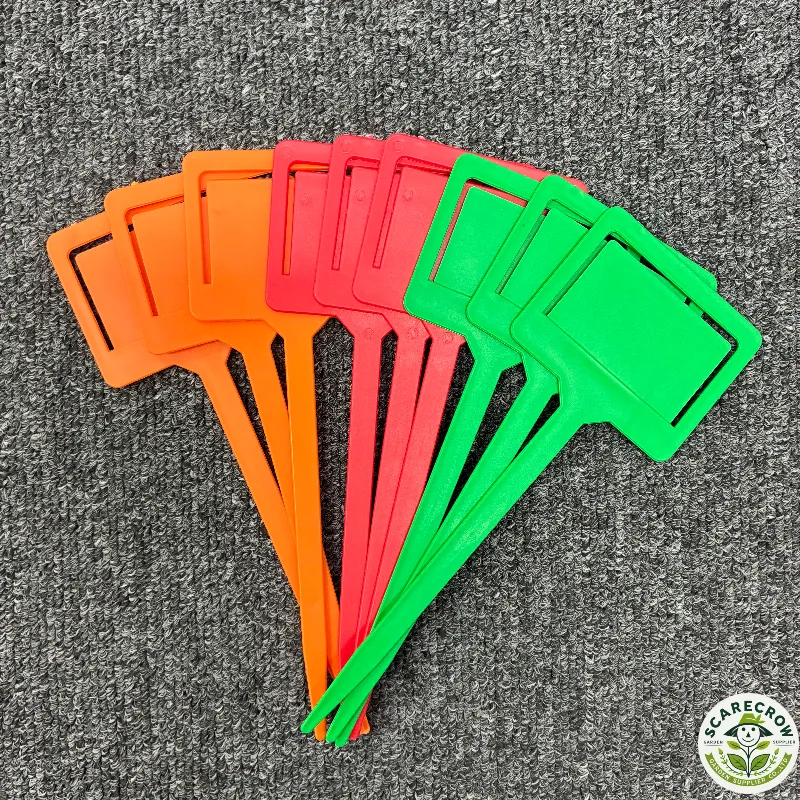
Two orders sit on the desk at the same time. One is a nursery bulk order for the same plant label, loose, in large counts. The other is a retail pack of the same label, ten to a card, with the buyer's branding on it. The question is whether these can share one physical label and save the trouble of carrying two.
The answer splits in a way that is easy to miss. "Same label" and "same sellable item" are two different questions. A shared blank can genuinely reduce the number of physical parts you source. It does not, by itself, reduce the number of finished items you sell, pack, or stock. Those two facts decide whether a shared base is available and useful, and they are settled separately.
The layers are not the same layer
It helps to name the layers before doing any arithmetic, because most confusion comes from multiplying across them.
The base label is the specification: its material, writable surface and geometry. If two packs use a genuinely identical blank, they share this layer. Any print applied to the label belongs to the pack that carries it, so the shared layer is the unprinted blank, not a printed label.
The pack is the sellable unit and its count. Ten per card and a hundred per bag are different packs even when the pieces inside are the same.
Accessories and printed pieces are their own layer. A pen, a wire stake, a printed insert card or a barcode sticker is not part of the label, and its demand is not the label's demand.
The carton and shipment is the logistics layer. It follows from the pack, not from the label.
A retailer can assign separate item numbers to pack variants even when the physical label is shared, because the pack is what the customer buys. That is not a contradiction of sharing the base. It is the base and the pack being different things.
One caution on identifiers. A warehouse item number you create internally and a GS1 GTIN are not the same kind of identifier. Whether a GTIN has to change when a count or pack changes is governed by the applicable official guidance, and that guidance keys off whether the change is at the retail consumer unit level or at a higher packing level. The two are treated differently. If you are not using GTINs, this layer may not be relevant to you at all, and it should not be imposed as a rule on a plain quantity calculation. The arithmetic below is unit arithmetic. It is not an identifier allocation rule.
The quantity relationship
Index the packs that use the exact same approved base. For each pack, let the completed pack quantity be a non-negative integer, and let the confirmed pieces per pack be a positive integer. The label pieces required across those packs are:
N = sum over packs of (packs × pieces per pack)
Two rules go with it. First, do not change the denominator between levels: keep pieces per pack and packs per order as separate factors, and never divide one by the other to make the numbers tidy. Second, compute accessory demand on its own confirmed per-pack quantity. It cannot be read off the label count, because accessory counts and label counts are not locked to each other.
If one pack includes a pen and another does not, pooling the label demand does not make the two offers identical. The labels pool. The pens do not.
A worked illustration
The numbers below are a transparent arithmetic illustration, not a quotation or a Scarecrow configuration. Their only job is to show which demand pools and which does not.
Suppose you plan two packs that use the same approved blank label:
- Nursery bulk pack: 400 packs, 100 pieces per pack
- Retail pack: 2,000 packs, 10 pieces per pack
Shared label pieces: (400 × 100) + (2,000 × 10) = 40,000 + 20,000 = 60,000 pieces.
That 60,000 is the pooled base demand. It is the total piece count your two programs need from the shared blank. It is not, by itself, a quotation or a commitment: whether a supplier quotes that as a single run, keeps the two pack programs on one line, or applies its own production and packing limits is a separate question answered by the supplier's quoted scope, not by this sum.
Now the layers that do not pool:
- Printed insert cards, needed only in the retail pack: 2,000 (one per retail pack), and zero for the bulk pack.
- A marker included only in the retail pack: 2,000 if it is one per pack, and zero for bulk.
- Finished packs to assemble and sell: 400 bulk packs plus 2,000 retail packs, which is 2,400 finished sellable units, not 60,000.
Notice what happened. The base pooled to a single 60,000-piece demand. The packs did not pool, because 2,400 sellable units of two different formats are two different commitments. The accessory demand did not pool, because it follows the pack that includes it. And the pack count is not the label count. All three distinctions are visible in the same small example, and none of them require a spreadsheet.
This illustration counts pieces, packs, cards and markers only. It does not price them, and it does not decide how the shared blank is produced or printed. Anything else, such as a different blank, a pack-specific print, or a different accessory, stays outside it until you add it with its own confirmed per-pack figure.
When the proposal does not pool
Sharing the base is only real if the unprinted blank is actually the same. It is not the same because the catalogue title looks alike, and it is not proven by a photo, a colour name or a product listing.
The conditions that break pooling are about the blank's own physical identity, not about what is printed on it later. A different material is a different blank. A different writable surface is a different blank, even if the outline matches. A different geometry is a different blank. If any of these differ between the bulk offer and the retail offer, the two blanks are not confirmed as the same, and the arithmetic above does not apply until the blank is unified or the packs are treated as separate programs.
Two things here do not break pooling by themselves. First, a different print or artwork applied after the blank is made is a pack-level difference: it changes what each pack carries, but it does not stop the two packs from drawing on the same unprinted blank, so their blank demand can still be added. It does not, on the other hand, promise that a supplier will put both packs on one production run, one minimum or one quote. Second, a different model number or supplier name is a naming difference, and a name is not proof of a physical difference. A different number on a quote means the blank's identity has to be confirmed, not that it has already been proven different. Until the blank itself is confirmed the same by a physical identity you can point to, treat the two as not-yet-shared, and the pooled figure waits.
The same photo showing a nice label proves that a label exists. It does not prove the two packs use the same specification.
What pooling does and does not buy you
Pooling a base component can simplify part sourcing. One approved blank, one set of checks, one physical input to plan around. That is a genuine benefit and it is the reason to look for a shared base in the first place.
What it does not remove is everything that is specific to the pack. Physical sorting into two pack formats, packing labour, any pack-specific print run with its own minimum, the confirmed production constraints of the source, stock segregation so the two formats do not get mixed, and the demand exposure if one format sells and the other does not. All of that stays, because it belongs to the pack layer.
Whether MOQ pooling, colour mixing, warehouse repacking, cancellation flexibility or cost savings are available depends on a specific supplier's quoted scope. A valid all-in quoted price for each fulfilled pack scope is usable even when a supplier does not expose its internal cost breakdown. This is not a landed-cost, tax or accounting exercise. It is a decision about whether one base is available and how the two demands add up.
The readiness result
You have one of two endings here.
Either the shared label specification is confirmed, the pack variants are distinct, and the total label requirement and pack-specific materials are resolved. In that case you can order, and the arithmetic gives you the base quantity while the pack layer stays its own commitment.
Or one assumption is still open: the base identity between the two offers, or the confirmed pieces per pack on one of them. Name that single open item and hold, because the pooled number is only as good as the base and the per-pack figures it rests on.
If you want to fix the shared part first, start with the actual plant label format, then keep its bulk and retail packing requirements separate rather than merging them into one number. And once the pack is set, it is worth checking artwork against the final pack contents so the printed pack and the physical pack agree.

Written by
ScarecrowGarden
💡About Scarecrow Garden Supplier Co., Ltd.
Scarecrow Garden Supplier Co., Ltd. is a China-based sourcing and wholesale partner specializing in garden tools, landscaping equipment, and outdoor supplies for international wholesalers, distributors, contractors, and brands.
With hands-on experience rooted in real garden use scenarios, we focus on durable materials, functional design, and stable large-volume supply. Our product range covers pruning tools, watering systems, hand tools, outdoor hardware, and customized garden solutions to support both retail and professional landscaping markets.
Beyond products, we help our partners navigate supplier selection, quality control, compliance requirements, and long-term sourcing strategies in China. Through our blog, we share practical insights on product selection, material comparisons, industry trends, and cost-effective purchasing—helping global buyers build stronger, more competitive supply chains.