






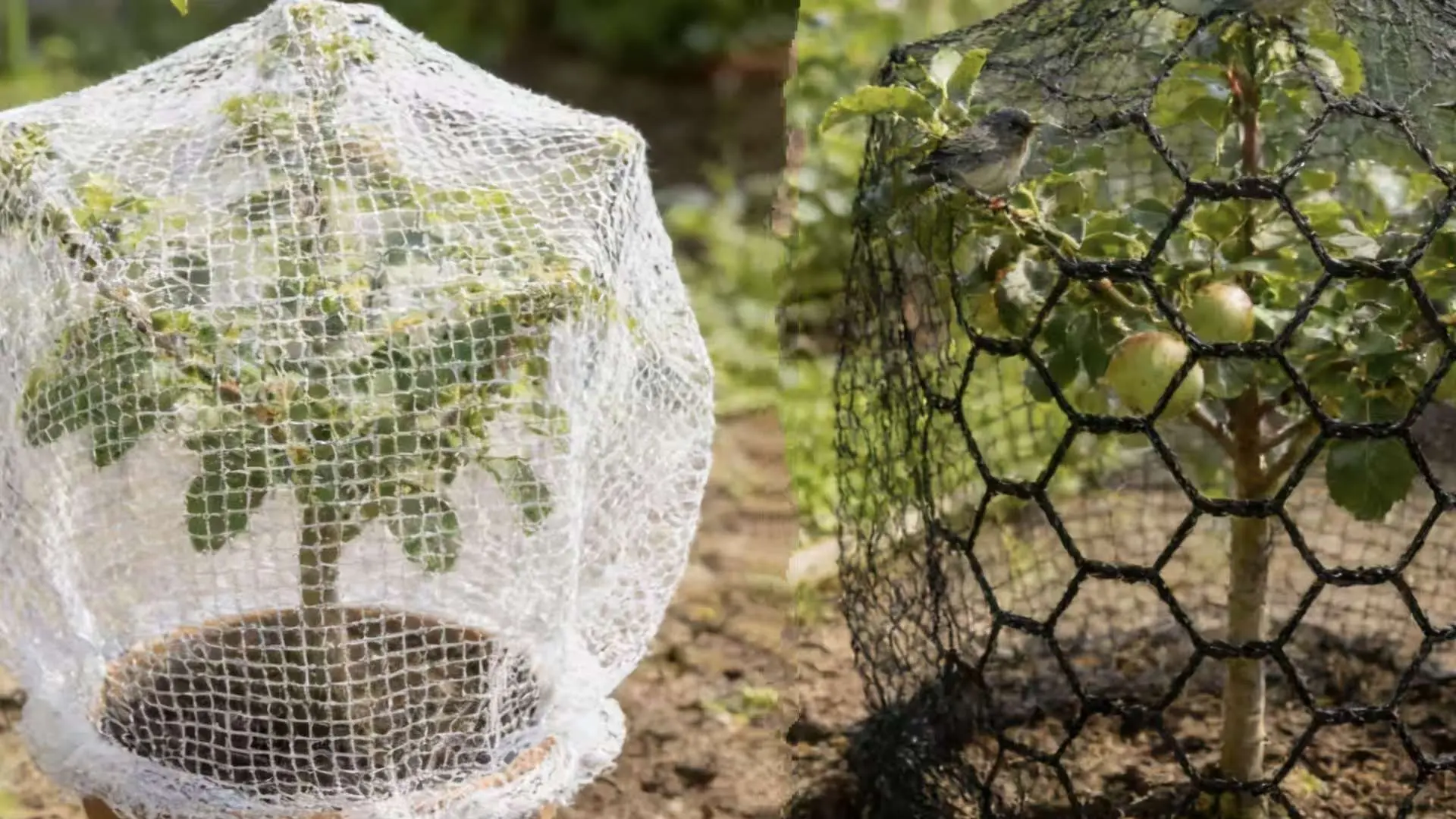
Introduce two different colors of insect-proof nets to B-end customers such as wholesalers and retailers.
The netting went on in May and did its job. No flea beetles on the brassicas, no cabbage white butterflies, no holes in the leaves. Then the squash started flowering and the grower stood at the edge of the bed with a roll of netting in one hand and a question that the netting catalogue does not address: if this stays closed, where does the pollen come from?
The answer is not the same for every crop, and getting it wrong costs a season.
Start with what you intend to harvest
Begin with the harvested part, because it helps determine whether pollination is needed to produce that harvest.
For crops grown for leaves, roots, stems or immature flower heads, pollination is generally not needed to produce the harvested part. Cabbage, lettuce, kale, collards, broccoli and cauliflower are examples. Keeping insects out does not remove a pollination step from that harvest, although temperature, space and pests already inside the cover still need attention.
Many fruit crops, including ordinary non-parthenocarpic cucumbers and squash, depend on adequate pollination for a marketable harvest. Insufficient pollen transfer can reduce fruit set or produce misshapen fruit. The crop and variety matter, so a fruiting crop should not automatically be assigned one covering rule.
A third group produces fruit but does not need insects to do it. Some fruiting crops, including tomatoes and peppers, can self-pollinate. Wind or movement can help release pollen, and bees can improve pollination in some crops. Not requiring insects is different from receiving no benefit from them.
Then there is the case that catches people out: a crop grown for seed. If the harvest is seed rather than food, pollination is required regardless of which group the food crop belongs to, and the netting decision has to account for it.
Crops that need pollinators to reach the flowers
For a crop that depends on visiting pollinators, plan to open or remove the exclusion cover at flowering unless pollination is being managed inside it.
The timing is set by the plant rather than by a date. Once the flowers are open and receptive, insects have to be able to reach them, and a cover that is still closed at that point has excluded the very visit the crop needs.
Flowering, not a calendar date, is the trigger. A grower watching for the first open flowers on a squash plant has a better cue than a grower counting days from transplant, because the date shifts with weather and the flowers do not.
The decision also has a geometry to it. Netting that has to open for flowering and close again afterward is a different product requirement from netting that stays up all season. It needs to lift and resecure without tearing, which puts weight on the material and on how the edges are held down. A cover that is opened and reclosed repeatedly is a cover whose fixing points get worked, and the edges are where that shows first.
Self-pollinating crops still need a suitable flowering environment
Tomatoes, peppers and eggplant have flowers capable of self-pollination. Their management under netting differs from a squash crop that relies on insects moving pollen between separate flowers.
Self-pollination still requires pollen release and transfer. Flower movement can help, and bees can assist some crops. A shake does not guarantee fruit set, and heat can interfere with flowering and fertilization.
Temperature and airflow are part of the covering decision. Depending on the material and weather, a cover can change the crop environment. Monitor conditions and vent, adjust or remove it when needed.
For supplier guidance, separate two questions: does this crop need visiting pollinators, and is the covering maintaining suitable conditions? Flowering can matter to both; a self-pollinating crop does not automatically need its net opened when flowers appear.
Varieties that can set fruit without pollination
There is a real exception, and it is the one that most often gets mishandled in retail copy.
Some cucumber varieties bred for greenhouse and hoophouse production are parthenocarpic, meaning they set fruit without pollination.
If certain parthenocarpic cucumber varieties are pollinated, seeds can develop and the fruit may become misshapen. Follow the breeder's advice for the particular variety rather than assuming every parthenocarpic cucumber responds identically.
For a variety whose grower instructions call for excluding pollinators, keeping an insect barrier in place during flowering can be appropriate. Temperature, ventilation and the rest of the growing environment still have to be managed.
The trap is the vocabulary. Parthenocarpic is not the same as all-female, all-female is not the same as seedless, and none of the three is the same as self-pollinating. A variety description that says all-female is telling the grower about flower type, not about whether fruit needs pollination. A seed packet or catalogue entry that says parthenocarpic is making a claim about fruit set. Those are different words making different claims, and the retail copy has to use the one the breeder used.
The only reliable source for this is the specific variety's own description. Packets and catalogues state it, and the statement belongs on the product page or the growing card rather than in a general note about cucumbers.
The word to look for on the packet is parthenocarpic, or wording that says the variety sets fruit without pollination. A packet that says only all-female has told you about flower type and nothing about fruit set, so it cannot be used as evidence for keeping the cover closed. And the conclusion does not carry from one variety to the next within the same crop: two cucumber varieties can sit on different sides of this question, which is why the answer has to be read off the packet in hand.
Once the crop and flowering plan are clear, compare insect netting specifications for the target pest and the way the cover will be opened and secured.
Plan what changes when the net opens
Opening the net for flowering is not a neutral act. It removes the barrier that was the reason for buying the net.
Opening the cover can allow target pests to reach the crop as well as pollinators. The local pest season and crop stage determine how that risk changes; flowering is not a universal peak-damage period for every pest.
Plan the change before flowering: identify the crop's receptive flowers, arrange pollinator access or another suitable pollination method, and continue scouting when the barrier is opened. Do not assume that a mesh fine enough to exclude a target pest will also admit the pollinators the crop needs.
Check inside the covered area as well as around its edges. Pests may have entered during opening or been present before the cover was installed, and exclusion can also limit access by natural enemies. Finding insects inside calls for an appropriate crop-specific response, not an assumption that the net is still providing complete protection.
Put the flowering decision on the pack
For a supplier selling netting to growers and to retail customers, the pollination question can be turned into four short lines on the packaging or the product page, and doing so solves a customer problem before it happens.
State what the cover is designed for: insect exclusion, frost protection or another specified use. Those functions should be supported for the actual material; a mesh used for insect exclusion does not automatically provide frost protection.
State which crops do not require pollination for the harvested part, while retaining the need to monitor temperature, space and pests.
State the flowering exception for crops that depend on visiting pollinators: the cover must allow that access, or pollination must be managed by another suitable method.
State the variety condition. Where parthenocarpic varieties are involved, note that the variety description decides whether flowering cover should stay closed, and point the customer to the seed packet rather than to a general rule.
Those four lines do not make the net better. They make the customer's decision correct, which is what keeps the net on the bed next season.
Choosing netting for a crop program? Tell us the crop, variety, target pest and how you plan to manage flowering so we can discuss the cover specifications your order needs.
Written by
ScarecrowGarden
💡About Scarecrow Garden Supplier Co., Ltd.
Scarecrow Garden Supplier Co., Ltd. is a China-based sourcing and wholesale partner specializing in garden tools, landscaping equipment, and outdoor supplies for international wholesalers, distributors, contractors, and brands.
With hands-on experience rooted in real garden use scenarios, we focus on durable materials, functional design, and stable large-volume supply. Our product range covers pruning tools, watering systems, hand tools, outdoor hardware, and customized garden solutions to support both retail and professional landscaping markets.
Beyond products, we help our partners navigate supplier selection, quality control, compliance requirements, and long-term sourcing strategies in China. Through our blog, we share practical insights on product selection, material comparisons, industry trends, and cost-effective purchasing—helping global buyers build stronger, more competitive supply chains.