








Updated 2 months ago
How Garden Centers Should Build a Shovel and Spade Range Without Overloading Inventory
SCARECROW GARDEN SUPPLIER

garden center shovel and spade assortment planning
A garden center cannot stock every shovel and spade on the market. The shelf space is finite. The display height is fixed. The customer walks in with a task in mind — not a model number.
So the question is not “how many shovels should I carry?” The question is “which shovels and spades, at which quality tiers, cover the most customer tasks without creating dead inventory?”
This guide is for garden center buyers and retail planners who need to build a shovel and spade assortment from scratch — or rethink one that has too many slow-moving SKUs and not enough of the tools that actually sell. It is not a tool-type primer. If you need the basic distinction between round point, square point, and spade, our comparison guide covers that. Here, we focus on range architecture: how to select, tier, and manage your shovel and spade SKUs.
Start With Customer Tasks, Not With the Number of Models
The most common mistake in garden tool retail is starting with a supplier catalog and picking products that look good. The second most common is starting with a competitor’s range and copying it.
Both approaches miss the point. A garden center’s assortment should start with what customers actually do in their gardens:
| Season | Primary Tasks | Tools Needed |
| Spring | Digging beds, turning soil, planting | Round point shovel, garden spade, hand trowel |
| Summer | Weeding, edging, maintaining | Spade (edging), hand shovel, cultivator |
| Autumn | Clearing, transplanting, composting | Square point shovel (scooping), spade, rake |
| Winter | Pruning, light maintenance | Minimal shovel demand; focus on pruners and loppers |
Spring is typically the peak sales period for shovels and spades in Northern Hemisphere markets. The exact duration and timing of the peak window varies by region, climate, and local gardening culture — verify against your own POS data and market. Your range needs to be fully stocked before that window opens — not arriving mid-season when the demand has already passed.
This is why assortment planning starts with tasks, not models. If you know that your customers are primarily spring diggers in mixed soil, you need a round point shovel (for digging) and a garden spade (for edging and cutting). If your customers include a segment of serious landscapers, you need a professional-grade option. The number of SKUs follows from the task analysis, not the other way around.
Define Core, Secondary and Specialist Shovel SKUs
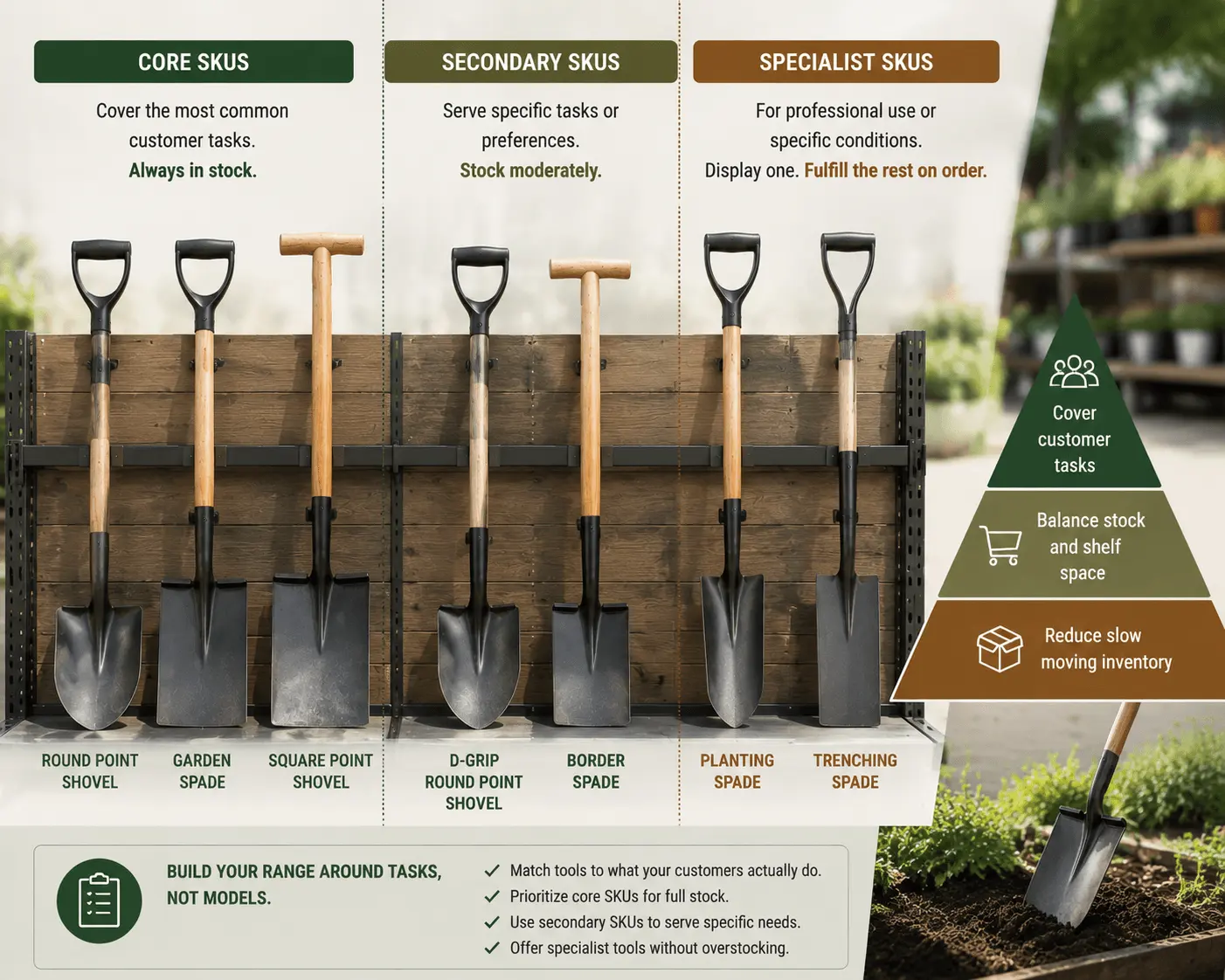
Not every SKU in your range deserves the same shelf space, the same inventory depth, or the same reorder urgency. A useful framework borrowed from retail assortment planning — and adapted to garden tools — divides your range into three tiers:
Building a Shovel & Spade Range?
Start with customer tasks, shelf space and quality tiers before adding more SKUs. Build a focused range where each shovel or spade has a clear role instead of creating unnecessary overlap between models.
Core SKUs
These are the tools that cover the most common customer tasks. They should always be in stock. If a customer walks in during spring and your core round point shovel is not on the shelf, you have lost a sale — and possibly a repeat customer.
| Tier | Typical SKUs | Suggested Inventory Strategy |
| Core | Round point shovel (long handle), garden spade (D-grip), square point shovel | Prioritize stock availability; fast reorder; do not let shelf go empty during season |
| Secondary | D-grip round point shovel, border spade, digging spade with step | Moderate stock; adjust by season; reorder when stock falls below your defined threshold |
| Specialist | Professional-grade spade, tree planting spade, trenching spade | Small stock or order-in; consider displaying one unit and fulfilling the rest on request |
Secondary SKUs
These cover specific tasks or user preferences that are real but less frequent. A D-grip round point shovel serves customers who prefer more control. A border spade serves customers working in tight spaces. These SKUs sell steadily but not at the volume of core items.
Specialist SKUs
These are for professional users or specific soil conditions. A professional-grade spade with a forged boron steel blade and fiberglass handle serves landscapers and serious gardeners. A trenching spade serves a narrow but real need. These SKUs may sell slowly, but they serve customers who will go elsewhere if you do not have them.
The specialist tier is where many garden centers go wrong — either by overstocking (tying up cash in slow-moving inventory) or by omitting (losing the professional customer entirely). The solution is to display one unit and fulfill the rest on order. This keeps the shelf looking complete without loading inventory.
Risk Alert: Do not assume that “more SKUs = more sales.” A range with 12 shovel and spade SKUs where 4 sell well and 8 sit for two seasons is worse than a range with 6 well-chosen SKUs. Dead inventory costs money twice — in tied-up capital and in shelf space that could display a faster-selling product.
Entry-Level vs Core vs Professional Price/Quality Tiers
Within each SKU tier, you may also need to decide on price/quality positioning. A common approach is three tiers:
| Tier | Example Evaluation Dimensions | Target Customer |
| Entry-Level | Confirm blade material, actual thickness, handle material, and finish on sample | Occasional home gardener |
| Core | Confirm whether blade is tempered/forged; evaluate handle material, finish, and connection | Regular gardener, small landscaper |
| Professional | Confirm blade material, heat treatment, actual thickness, handle material, and finish on sample | Professional landscaper, contractor |
For a detailed breakdown of consumer vs professional specifications — including blade construction, handle material, connection type, and finish differences — see our dedicated Consumer vs Professional Garden Shovels guide.
You do not need all three tiers for every tool type. A typical garden center might carry:
- Round point shovel: Entry-level + Core (two price points for the most popular tool)
- Garden spade: Core only (one solid option covers most needs)
- Square point shovel: Entry-level only (scooping does not require professional-grade for most customers)
- Professional spade: Professional only (specialist SKU, one high-end option)
This gives you 5 SKUs covering 3 tool types and 3 price tiers — without overloading inventory.
How Handle Length and Display Space Affect Assortment
This is a practical constraint that catalog planning often ignores: long-handle tools need vertical space.
- A long-handle shovel or spade may measure in the range of 150–170cm total length (Illustrative Example — use actual total length for each SKU). Your display rack needs to accommodate this height without the tool tipping or blocking aisles.
- A D-grip tool is generally shorter — and can sit on lower shelves or in horizontal display fixtures.
- If your display area has limited vertical space, measure your actual fixture heights, widths, and safety clearances before deciding how many long-handle SKUs to display.
Measure your display area before finalizing your assortment. The available height and width determine how many SKUs you can physically show — and a tool that is not on display does not sell as well as one the customer can pick up.
A practical layout approach:
| Display Zone | Tools | Rationale |
| Top rack | Long-handle round point shovel (core) | High visibility, high demand |
| Middle rack | Long-handle spade, square point shovel | Secondary tools, still visible |
| Lower rack | D-grip spade, D-grip round point, hand tools | Compact display, easy to pick up |
| End cap or feature display | Seasonal highlight (e.g., professional spade in spring) | Draws attention, rotates by season |
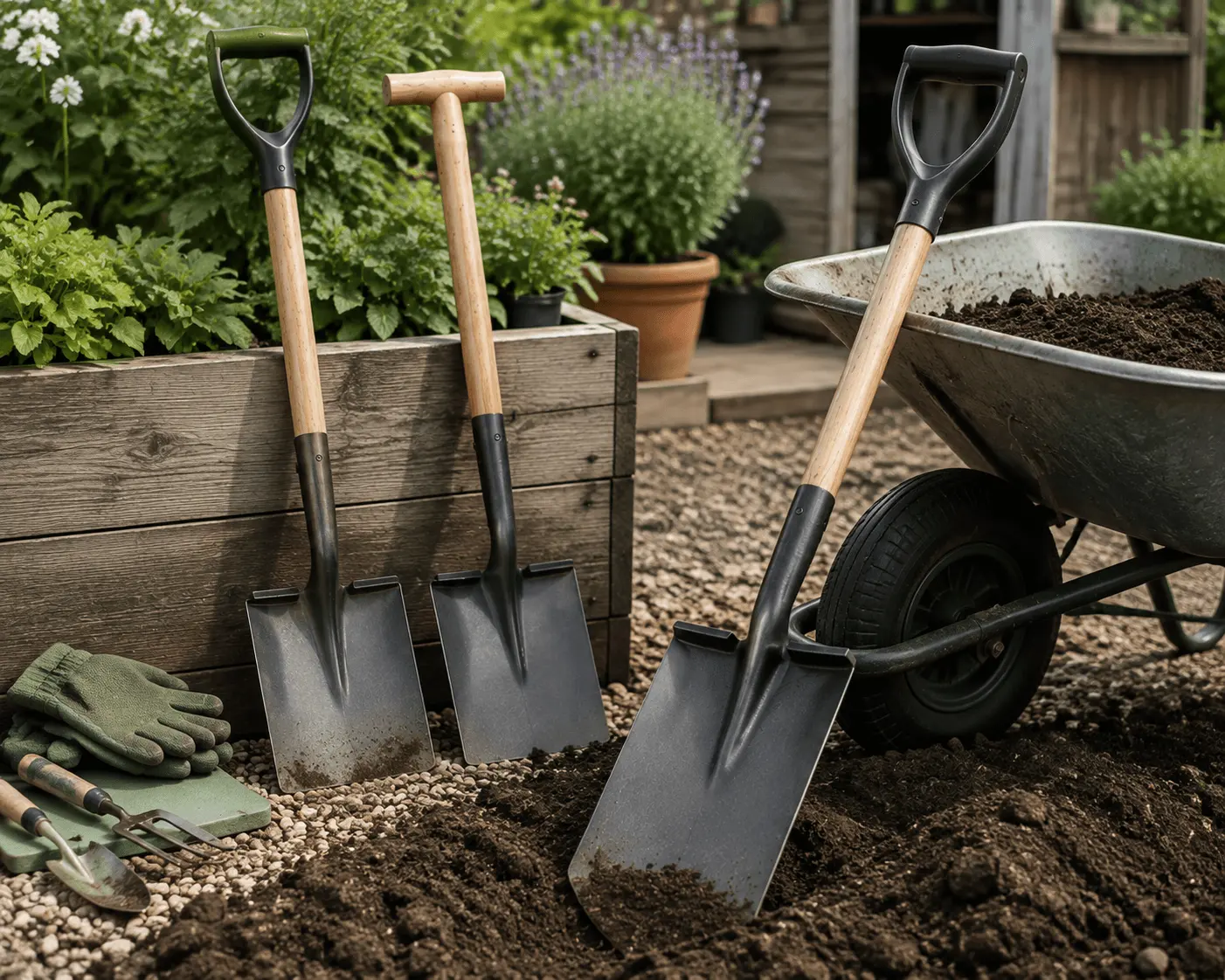
When to Add Spades, Hand Tools and Tool Sets
A shovel range rarely exists in isolation. Customers who buy a shovel often need related tools. The question is when to add them to your assortment — and when adding them creates more complexity than value.
Add a spade when customers ask for “something for edging” or when you are missing the cutting/prying category. Add hand tools (hand shovels, trowels, transplanters) when you have underused lower-shelf space and need basket-building items. Add tool sets seasonally as gift options in spring. Do not add all of these at once — let the range grow based on what customers pick up.
For detailed guidance on hand shovel and trowel assortment planning, see our Hand Shovel Wholesale Guide and Garden Trowel Buying Guide.
Need a Broader Garden Tool Assortment?
Review adjacent hand tools and coordinated categories without forcing unnecessary SKUs. Expand the range around genuine customer tasks and complementary products rather than simply adding more models.
Trial Orders, Reorder Signals and Slow-Moving SKU Control
Trial Orders
When introducing a new SKU, do not commit to a full season’s stock on the first order. Start with a trial quantity — enough to display and sell through one peak sales period. If the SKU sells, reorder. If it does not, you have limited your exposure.
Reorder Signals
Reorder based on data, not gut feeling. The signals to watch:
- Sell-through rate: How many units sold vs. how many stocked. Define your own reorder thresholds based on POS data, margin, and lead time — do not rely on generic benchmarks.
- Seasonal pattern: Shovel and spade demand typically peaks in spring in Northern Hemisphere markets, but the exact curve varies by region. Reorder timing should match your market’s actual demand pattern.
- Customer requests: If customers ask for a tool you do not stock, track these requests. Use your own judgment and POS data to decide when a request pattern justifies a trial order.
Slow-Moving SKU Control
A SKU that has not sold within a defined period is a candidate for clearance or removal. Define the period based on your store’s turnover rate and season length. Before removing a SKU, check:
- Was it displayed well? (A tool stuck behind other products may not have been visible.)
- Was it priced right? (A professional spade at a premium price may need better signage or explanation.)
- Was it the right tool for your market? (A trenching spade in a suburban garden center may simply not have enough demand.)
If the answer is “right tool, wrong display” — fix the display and try one more season. If the answer is “wrong tool for this market” — clear it and replace the slot with something that matches your customer base.
Example Assortment Framework for a Garden Center
Here is a starting framework for a mid-size garden center with moderate display space:
| SKU | Tool Type | Tier | Handle | Display Zone | Stock Level |
| 1 | Round point shovel | Entry-level | Long handle | Top rack | Based on POS data |
| 2 | Round point shovel | Core | Long handle | Top rack | Based on POS data |
| 3 | Round point shovel | Core | D-grip | Lower rack | Based on POS data |
| 4 | Garden spade | Core | D-grip | Middle rack | Based on POS data |
| 5 | Square point shovel | Entry-level | Long handle | Middle rack | Based on POS data |
| 6 | Professional spade | Professional | Fiberglass, D-grip | Feature display | Small stock or order-in |
Next Step: Build a Shovel Assortment That Works
A well-planned shovel and spade range is not the one with the most SKUs. It is the one where every tool on the shelf has a customer task behind it, a price tier that makes sense, and a display position that lets the customer find it.
If you are building a range from scratch or rethinking an existing one, start with the task analysis. Then map your SKUs to core, secondary, and specialist tiers. Then measure your display space and match the tools to the zones you have. The result is a range that turns over, not one that sits.
Send us your current SKU list, your display dimensions, and your target market — and we can help you build a shovel and spade assortment that covers your customers’ tasks without overloading your inventory, subject to model and factory availability.
Want to Review Your Current SKU List?
Send your current assortment or target channel and we can help organize sourcing priorities. Review where your range already has strong coverage, where products overlap, and which gaps may deserve attention first.
Related Articles
Shovel Range Planning for Hardware Stores, Landscaping Suppliers and Agricultural Retailers
Building a Full-Size Garden Tool Range: How Distributors Can Combine Shovels, Rakes, Forks and Hoes
Consumer vs Professional Garden Shovels: What B2B Buyers Should Specify Differently