






Updated 2 months ago
Seedling Tray With Grow Light: LED Spectrum, Timer, Height and Cell Count Explained

hqt
Seedling Tray With Grow Light
A Seedling Tray With Grow Light is more than a propagation tray with an LED attached to the top. For indoor seed starting, the practical performance of the system depends on how the LED spectrum, light duration, lamp height, cell size, drainage and humidity control work together.
At Scarecrow Garden Supplier, we develop Seedling Tray With Grow Light kits around these combined variables. A 72-cell tray with a powerful light, for example, is not automatically better than a 24-cell kit. The correct specification depends on what will be grown, available indoor space, expected seedling age at transplanting and the retail positioning of the product.
What Makes a Seedling Tray With Grow Light Different?
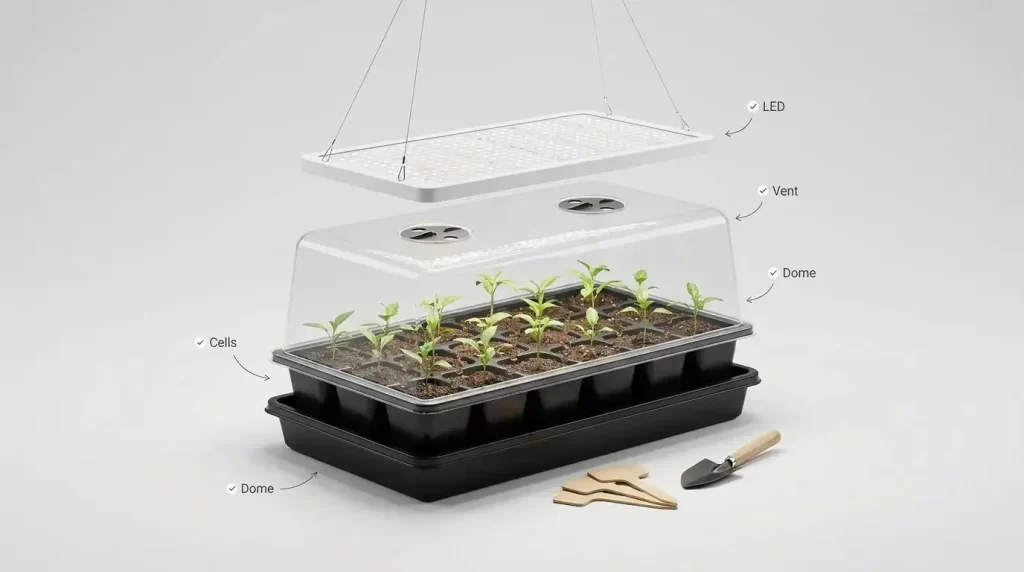
A complete Seedling Tray With Grow Light normally combines several functional components:
| Component | Technical Role | What Buyers Should Check |
| Cell tray | Holds growing medium and roots | Cell volume, depth, drainage |
| Base tray | Collects excess water | Fit, rigidity, water capacity |
| Humidity dome | Retains moisture | Height, clarity, seal |
| Vent system | Controls air exchange | Number and adjustment range |
| LED grow light | Provides indoor light | Spectrum, output, coverage |
| Controller | Manages lighting | Timer, dimming levels |
| Light support | Sets lamp distance | Fixed or adjustable height |
This system approach is important because improving one specification while ignoring the others can create a poorly balanced product.
LED Spectrum: Full Spectrum or Red-Blue?
The first major decision in a Seedling Tray With Grow Light is the light configuration.
Full-Spectrum White LED
Full-spectrum white LEDs are well suited to mainstream home gardening because they provide broad-spectrum illumination while maintaining a natural-looking indoor environment.
They are commonly selected for:
•Herbs and leafy vegetables
•Flower seedlings
•Tomato and pepper starts
•Apartment gardening
•General-purpose retail kits
For Scarecrow Garden Supplier projects, full-spectrum white is often practical where a buyer wants one Seedling Tray With Grow Light SKU to serve several seed-starting applications.
Red-Blue and Mixed Spectrum LEDs
Red-blue LEDs provide a more specialized grow-light appearance, while mixed-spectrum configurations allow additional product differentiation.
| Light Type | Main Advantage | Typical Positioning |
| Full-spectrum white | Natural appearance, broad application | Mainstream retail |
| Red-blue | Functional grow-light positioning | Specialist gardening |
| Mixed spectrum | Greater configuration flexibility | Premium kits |
Spectrum should not be evaluated alone. Buyers should also confirm LED quantity, power, brightness levels and light distribution across the entire tray. If more technical plant-light data is required, parameters such as PPFD at a defined distance can provide a more useful comparison than LED count alone.
Timer Settings: Match Duration to the Growing Environment
A timer makes a Seedling Tray With Grow Light more repeatable in daily use. Scarecrow Garden Supplier can configure common settings such as:
•3 / 6 / 12 hours
•4 / 8 / 12 hours
•No-timer entry-level versions
•Custom controller options for OEM programs
Timer length should not be interpreted as a universal growing recommendation:
•3–4 hours: Mainly useful as supplemental lighting where seedlings already receive natural daylight.
•6–8 hours: Suitable for mixed environments where window light provides part of the daily light requirement.
•12 hours: More useful where the grow light supplies a larger proportion of the available light.
Actual requirements can vary with factors like plant species, LED output, and distance and level of ambient daylight. That’s why we suggest choosing a controller based on its end use case, rather than just choosing the controller with the highest number of timer functions.
Light Height: Fixed Designs vs. Adjustable Structures
The growing distance of the LED to the seedling canopy has a large effect on how evenly light is distributed to the young plants.
The design of a dome-mounted LED keeps our Seedling Tray With Grow Light simple and cuts cost, making it an ideal choice for beginner and promotional kits.
Adjustable structures provide more flexibility as seedlings grow.
| Structure | Adjustment | Best Application |
| Dome-mounted LED | None | Compact starter kits |
| Clip-on light bar | Limited | Standard retail |
| Raised bracket | Medium | Vegetable seedlings |
| Telescopic support | Wide | Premium indoor kits |
| Detachable panel | Flexible | Multi-purpose growing |
A practical adjustable design should also remain stable when fully extended. For OEM development, Scarecrow Garden Supplier considers bracket strength, tray balance, assembly method and carton volume—not only maximum light height.
Cell Count Should Be Evaluated With Cell Volume
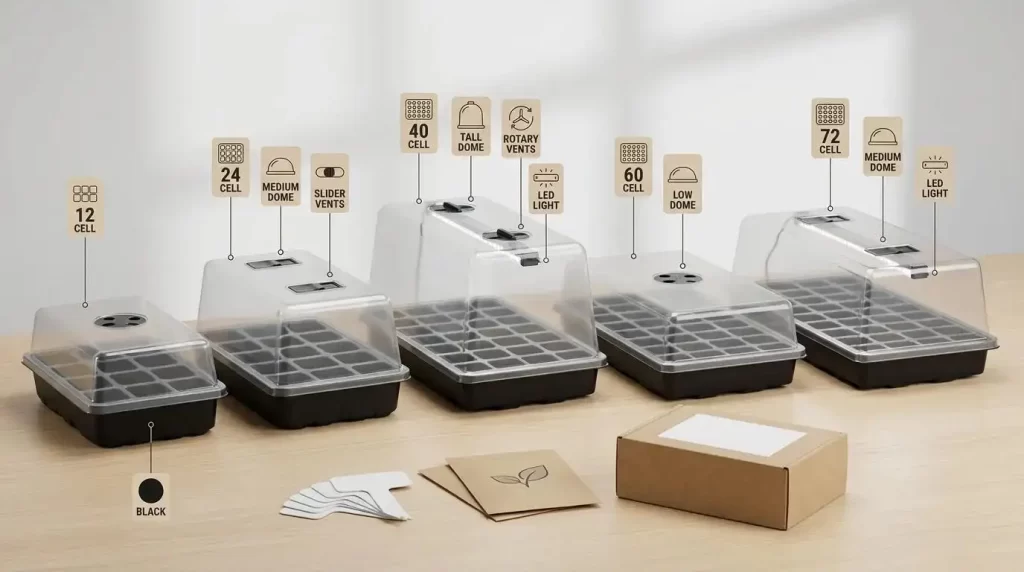
Available Scarecrow Garden Supplier configurations can include 12, 24, 40, 60, 72, 80, 96 and 128 cells, allowing a Seedling Tray With Grow Light to be developed for very different user groups.
| Cell Count | Typical Use | Key Trade-Off |
| 12 | Herbs, gift kits | Large cells, low capacity |
| 24 | Home vegetables | Balanced root space |
| 40 | Mixed seedlings | General-purpose format |
| 60–72 | Seasonal propagation | Higher capacity |
| 80–128 | Bulk starting | Smaller individual cells |
More cells increase planting capacity but generally reduce the available growing volume per plant when overall tray dimensions remain similar.
Therefore, buyers should specify:
•Cell top opening
•Cell depth
•Bottom opening
•Approximate cell volume
•Seedling type
•Expected transplant stage
A 24-cell Seedling Tray With Grow Light may be more appropriate for plants kept in the tray longer, while 72- or 128-cell formats can suit higher-volume early-stage propagation.
Drainage, Base Tray and Material Cannot Be Ignored
Cell structure affects water management as much as root capacity.
•Drainage holes: Openings should allow excess water to leave the cell without losing excessive growing medium.
•Base tray: The base should fit the insert properly and remain sufficiently rigid when lifted with water inside.
•Material: PP, PS, or PET can be selected based on rigidity, level of transparency, forming structure and cost.
•Tray thickness: Extremely light weight trays may have a low material cost, but trays can deform during the filling or the watering and handling process.
Scarecrow Garden Supplier can adjust cell depth, drainage pattern, material, tray thickness and reinforced-edge structure when a standard configuration does not match the buyer's intended market.
Humidity Dome Height and Ventilation Need to Work Together
The dome creates a humid micro-environment during germination, while adjustable vents allow the growing environment to change as seedlings develop.
Available design directions include:
•Low domes for compact packaging
•Taller domes for additional growing clearance
•Single or dual top vents
•Rotating or sliding vent controls
•Side ventilation
•Different dome thicknesses
The fit between the tray and dome also matters. A loose dome reduces perceived quality; an excessively tight dome can be inconvenient to remove.
During Seedling Tray With Grow Light development, we therefore review dome fit, vent operation, LED mounting clearance and finished carton dimensions together.
How to Match the Main Specifications
| Target Product | Spectrum | Timer | Light Structure | Cell Count |
| Beginner kit | Full spectrum | Basic | Fixed | 12–24 |
| Apartment kit | Full spectrum | 6–12h options | Fixed/adjustable | 24–40 |
| Vegetable starter | Full spectrum | Multi-setting | Adjustable | 40–72 |
| Premium kit | Full/mixed | Multi-setting + dimming | Telescopic | 40–72 |
| High-capacity kit | Multi-bar LED | Configurable | Raised | 72–128 |
There is no universal "best" Seedling Tray With Grow Light. The correct specification is the combination that provides suitable light coverage, root volume, moisture control and user convenience without unnecessarily increasing product complexity.
What B2B Buyers Should Confirm Before Production
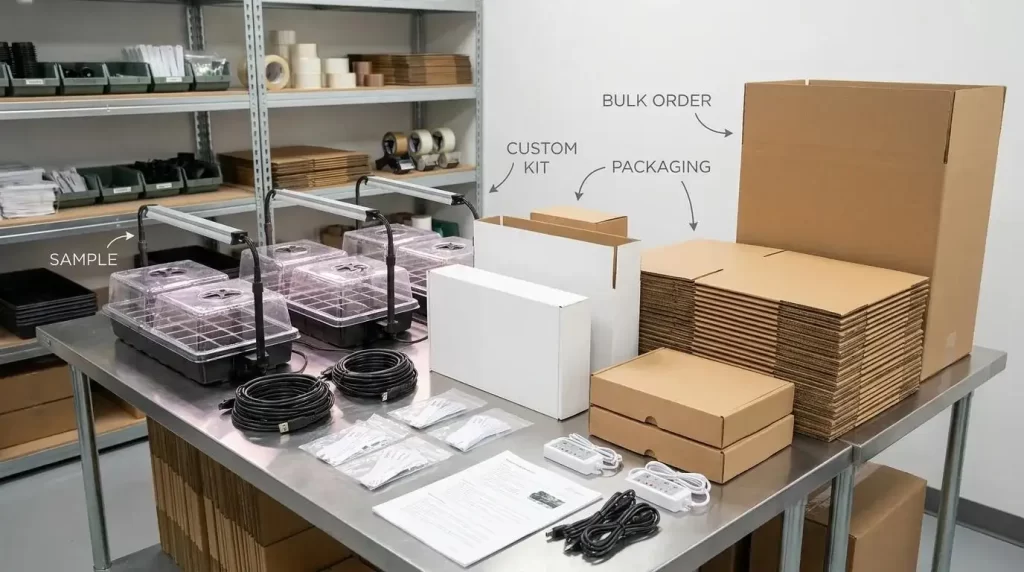
Before approving a bulk order, we recommend defining:
•Cell count, cell depth and drainage pattern
•Tray and dome material
•Dome height and ventilation
•LED spectrum and output
•Brightness adjustment
•Timer settings
•Fixed or adjustable light height
•USB, adapter or regional plug requirement
•Cable length
•Manual and warning labels
•Barcode and private-label requirements
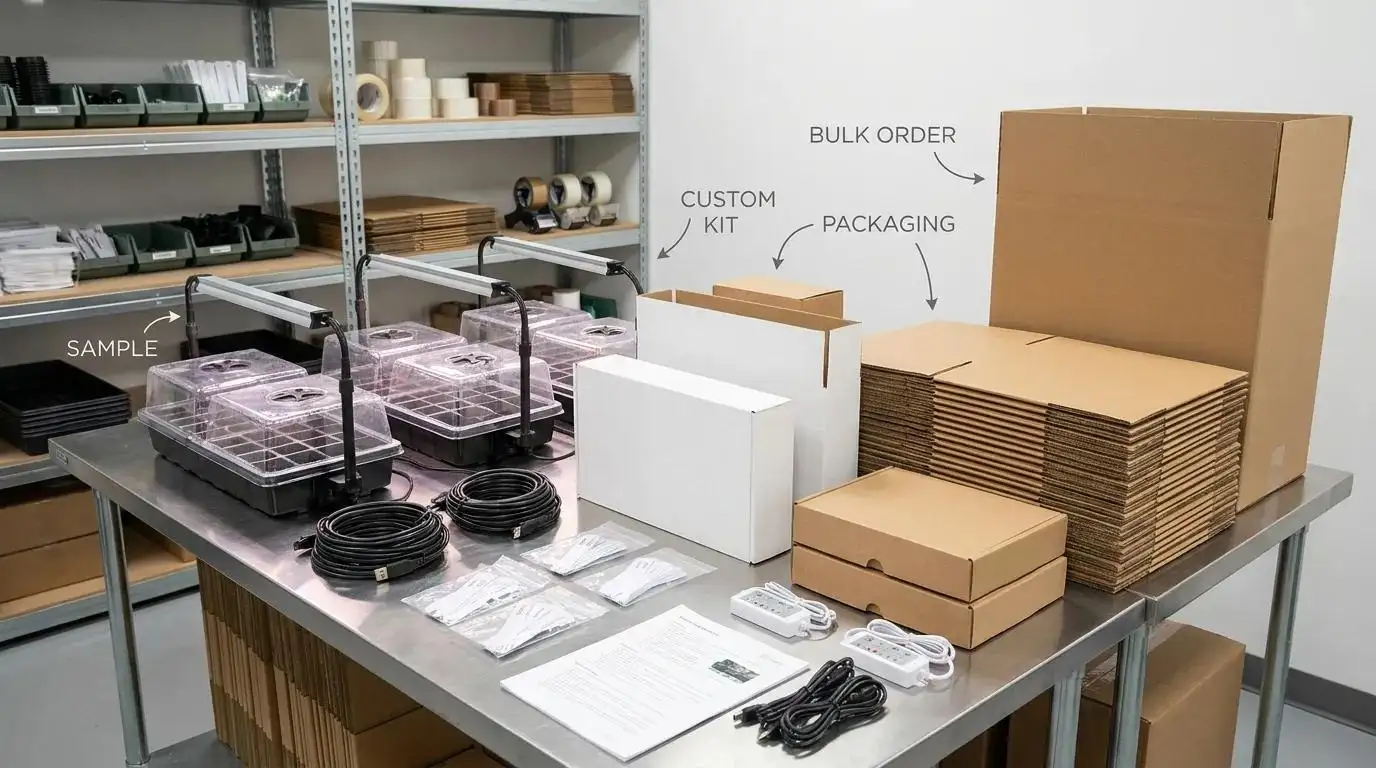
•Retail box or e-commerce mailer structure
For Scarecrow Garden Supplier, these specifications form one product-development process rather than separate options. We can match the tray, dome, LED, controller, accessories and packaging around an existing SKU or a new private-label concept.
A well-designed Seedling Tray With Grow Light should ultimately make indoor propagation simpler without adding features that the target customer does not need. Buyers developing a new retail or wholesale range can share their target cell count, market, sales channel and preferred LED configuration with Scarecrow Garden Supplier to identify a practical starting specification for sampling and OEM development.
FAQs
Q1. What cell counts does Scarecrow Garden Supplier provide for a Seedling Tray With Grow Light?
Scarecrow Garden Supplier covers the common cell counts of 12, 24, 40, 60, 72, 80, 96 and 128. The cell count depends on the size and type of seedlings, desired root growth and the size of the available tray.
Q2. Can the LED spectrum be customized?
Yes, you can change the spectrum, and the tray can come with full-spectrum white, red-blue, mixed-spectrum, or general-spectrum LEDs. Full-spectrum white is more popular for general gardening shoots since it is a closer to natural light.
Q3. Does Scarecrow Garden Supplier offer timer functions?
Yes, you can select timers that can be set at 3/6/12 hours or 4/8/12 hours. Simpler timers can also be selected. For OEM projects, specific controllers can be requested.
Q4. Can the brightness of the grow light be adjusted?
Depending on the selected configuration, a single output light can be ordered or multi-level lighting can be ordered with three, five, or other levels of brightness.
Q5. Can the grow light height be adjusted as seedlings grow?
Yes, orders can include grow lights that can be clipped at different heights, raised on adjustable supports, mounted on telescoping supports or brackets, include LEDs mounted in a dome, or can include light panels that can be removed from the tray. Adjustable support systems can be incorporated in more sophisticated systems.