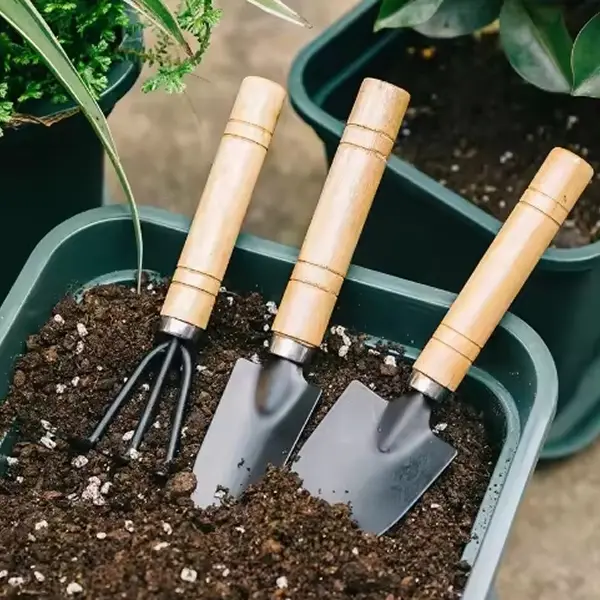








The bench is set before the mat is unrolled. On it sit the plant still in its old pot, the next pot one size up, a bag of mix, a trowel, a pair of snips, and whatever the root ball will need once it is out. Only then does the question of mat size become answerable, because the mat is not covering a table. It is creating a work surface that has to hold all of that at once, with both hands free.
Measure the mat with the corners fastened
A flat dimension does not tell you how much working space remains after the corners are fastened. The usable floor depends on the corner construction and the shape of the raised sides. Subtracting twice the edge height from the flat size would require a simple, upright-wall geometry; it is not a reliable rule for every flexible mat.
The assembled working area is the measurement a buyer needs. Snap the corners, lay the mat on the bench, and measure the flat bottom inside the raised edge. Two numbers, length and width, and they are the space you actually get. A potting mat listing that states only the flat size leaves this to the tape measure.
Read the product listing first, in case the supplier publishes both figures, the flat size and the size with the corners fastened. When only the flat size is given, measure the usable floor with the corners fastened.
The bench matters too. Unsupported parts of a flexible mat can sag when loaded. Check the fastened mat on the bench, with the pots and tools in place, and keep the working floor supported. A flat-size measurement alone does not show how the raised sides and the work will fit.
Give the root ball somewhere to go
Once the plant is out of its old pot, three things compete for the same square of mat: the root ball waiting to be settled, the new pot being filled, and the hands moving between them. A mat that only just holds the pot leaves nowhere to put the root ball down, and a root ball held in one hand while the other hand scoops mix is a root ball that gets dropped.
Work through the sequence on paper before choosing a size. The old pot comes off and goes to one side. The root ball rests on the mat while you loosen the outer roots. The new pot is set in place, partly filled, and the root ball is lifted into it. At every step something is on the mat that is not the pot.
Two hands also need room to move. Filling a pot means scooping from the bag, lifting, and tipping, and the trowel travels through an arc. If the mat ends where the pot ends, that arc lands on the bench. A margin of open mat around the pot is not wasted space; it is where the soil that misses the pot is supposed to fall.
Choose for the repotting job you repeat
The size question resolves differently depending on what the buyer's customer actually does all season. Someone repotting a run of small succulents works with several pots on the mat at once, moving from one to the next without clearing the surface. That job wants a mat big enough to hold three or four small pots in a row, with the mix bag within reach and the spent pots pushed to the back edge.
Someone moving a single large houseplant into a bigger pot has the opposite problem. One pot occupies most of the surface, the root ball is heavy, and the mat needs enough depth in front of the pot to set the root ball down without rolling it off the edge. A mat chosen for the small-pot run may be too shallow here; check the actual pot and root-ball space before using the same layout.
The useful comparison is not small job versus large job. It is how many objects have to sit on the mat at the same time, and how far the hands travel while the plant is out of its pot.
Back to the bench
The bench from the opening had one plant, one pot, one bag, and a trowel. With the corners fastened, the mat has to hold the pot with room in front for the root ball, room at the side for the trowel to work, and enough margin that spilled mix stays on the mat rather than the floor. If the fastened mat leaves all three, the size is right for that job. If any one of them is missing, the next size up is the answer, provided the bench can take it.
Planning a potting mat order? Send Scarecrow Garden Supplier your bench dimensions, usual pot sizes and quantity so we can discuss a suitable sample to check.

Written by
ScarecrowGarden
💡About Scarecrow Garden Supplier Co., Ltd.
Scarecrow Garden Supplier Co., Ltd. is a China-based sourcing and wholesale partner specializing in garden tools, landscaping equipment, and outdoor supplies for international wholesalers, distributors, contractors, and brands.
With hands-on experience rooted in real garden use scenarios, we focus on durable materials, functional design, and stable large-volume supply. Our product range covers pruning tools, watering systems, hand tools, outdoor hardware, and customized garden solutions to support both retail and professional landscaping markets.
Beyond products, we help our partners navigate supplier selection, quality control, compliance requirements, and long-term sourcing strategies in China. Through our blog, we share practical insights on product selection, material comparisons, industry trends, and cost-effective purchasing—helping global buyers build stronger, more competitive supply chains.