






Updated 3 months ago
Wholesale Plant Cloche: A B2B Buyer’s Guide to Product Types, Quality Risks, OEM, and Sourcing Execution

ScarecrowGarden
💡About Scarecrow Garden Supplier Co., Ltd.
Scarecrow Garden Supplier Co., Ltd. is a China-based sourcing and wholesale partner specializing in garden tools, landscaping equipment, and outdoor supplies for international wholesalers, distributors, contractors, and brands.
With hands-on experience rooted in real garden use scenarios, we focus on durable materials, functional design, and stable large-volume supply. Our product range covers pruning tools, watering systems, hand tools, outdoor hardware, and customized garden solutions to support both retail and professional landscaping markets.
Beyond products, we help our partners navigate supplier selection, quality control, compliance requirements, and long-term sourcing strategies in China. Through our blog, we share practical insights on product selection, material comparisons, industry trends, and cost-effective purchasing—helping global buyers build stronger, more competitive supply chains.
Wholesale Plant Cloche: B2B Sourcing & OEM Guide | Scarecrow Garden Supplier
You are making a sourcing decision for an autumn-to-winter protection product line. Your customers need plant cloches — but “cloche” covers everything from a £3 PET plastic cover to a £50 Victorian glass dome. Choose the wrong type, and you are stuck with inventory that either sits on shelves or comes back as returns.
This guide breaks down four things: the types of cloches available, the core specs and quality risks for each, the common pitfalls in OEM and sourcing execution, and how to choose based on your channel and customer base.
Who Needs Plant Cloches — and What Is the Most Important Sourcing Decision?
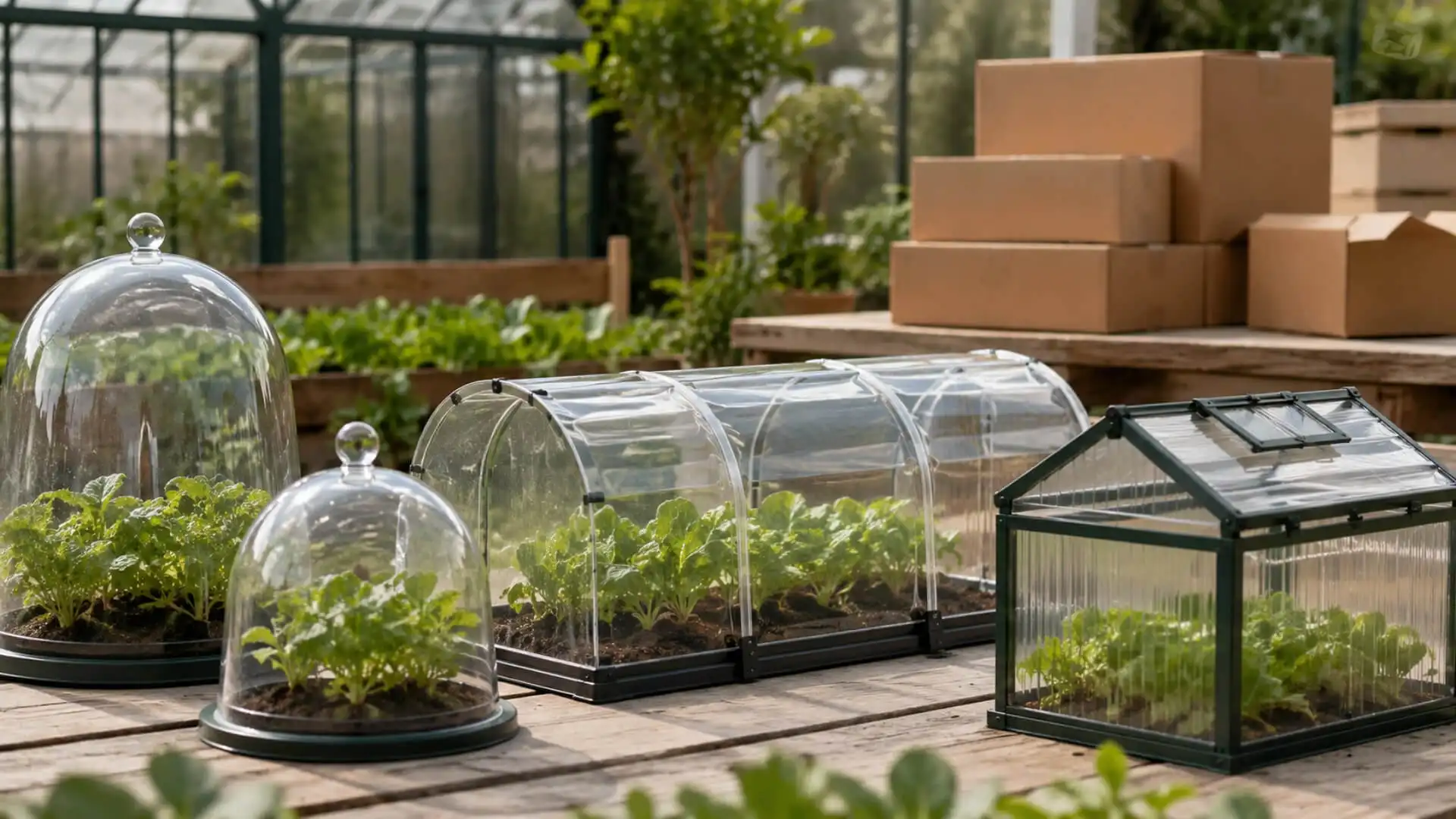
Plant cloche is not one product. It is a product family. Bell cloche, barn cloche, tunnel cloche, pop-up cloche — four forms, four customer profiles, four sourcing logics.
The most important decision is not “which cloche to buy.” It is “who your customers are, what plants they protect, and in what climate.” Those three questions determine the type, material, and price point you should be sourcing.
Because the right specification depends on the buyer’s customer, crop, climate, and protection objective, it is important to understand how to approach 【choosing plant cloches for different customers and use cases】 before confirming the product range.
| Buyer Type | Core Need | Recommended Type |
| Garden Centre | Retail display appeal, seasonal SKU rotation | Bell (display presence) + Tunnel (functional) |
| Nursery/Grower | Bulk protection, reusability across seasons | Tunnel (row cover) + Barn (seedbed) |
| E-commerce Seller | Lightweight, low return rate, mail-order packaging | PET Bell sets + Foldable Tunnel |
| Hardware/DIY Store | Durability, multi-season use | Galvanized steel Tunnel + PC Bell |
| Landscaper | Fast deployment, large-area coverage | Extended Tunnel + anchoring system |
| Distributor | Flexible mixed orders, CBM efficiency | Full-category mix |
If you are a distributor, you need to cover all categories — but each type has different order volumes, MOQs, and lead times. If you are a garden centre, you may only need three SKUs — but picking the wrong one means half a shelf of dead stock.
Four Cloche Types: Specs, Positioning, and Sourcing Logic
Bell Cloche — Single-Plant Protection
The original cloche form — French for “bell,” dating back to Victorian glass domes. Today, materials range from glass to PET.
Core Specs:
| Parameter | Budget (PET) | Mainstream (PC) | Premium (Glass) |
| Diameter | 20–25 cm | 25–30 cm | 30–40 cm |
| Height | 20–25 cm | 25–35 cm | 35–45 cm |
| Cover Material | PET 0.5 mm | PC 2 mm | Glass 3 mm |
| Ventilation | None | Top flip vent | Adjustable top vent |
| Handle | None | Plastic knob | Metal/wooden knob |
| Retail Price Band (UK reference) | £3–8 | £8–15 | £15–40 |
Sourcing note: PET bell cloches are the most trouble-prone — thin, light, no anchor points. Wind blowing them away is the number-one complaint. If your customers are in windy areas, PET is not a good choice. PC bell cloches are the mainstream option for garden centres — impact-resistant (roughly 200–250 times that of glass, for solid PC sheet; twin-wall slightly lower), unlikely to shatter. But pay attention to UV coating: PC without UV stabilizer yellows in 2–3 years.
Barn Cloche — Multi-Plant Row Protection
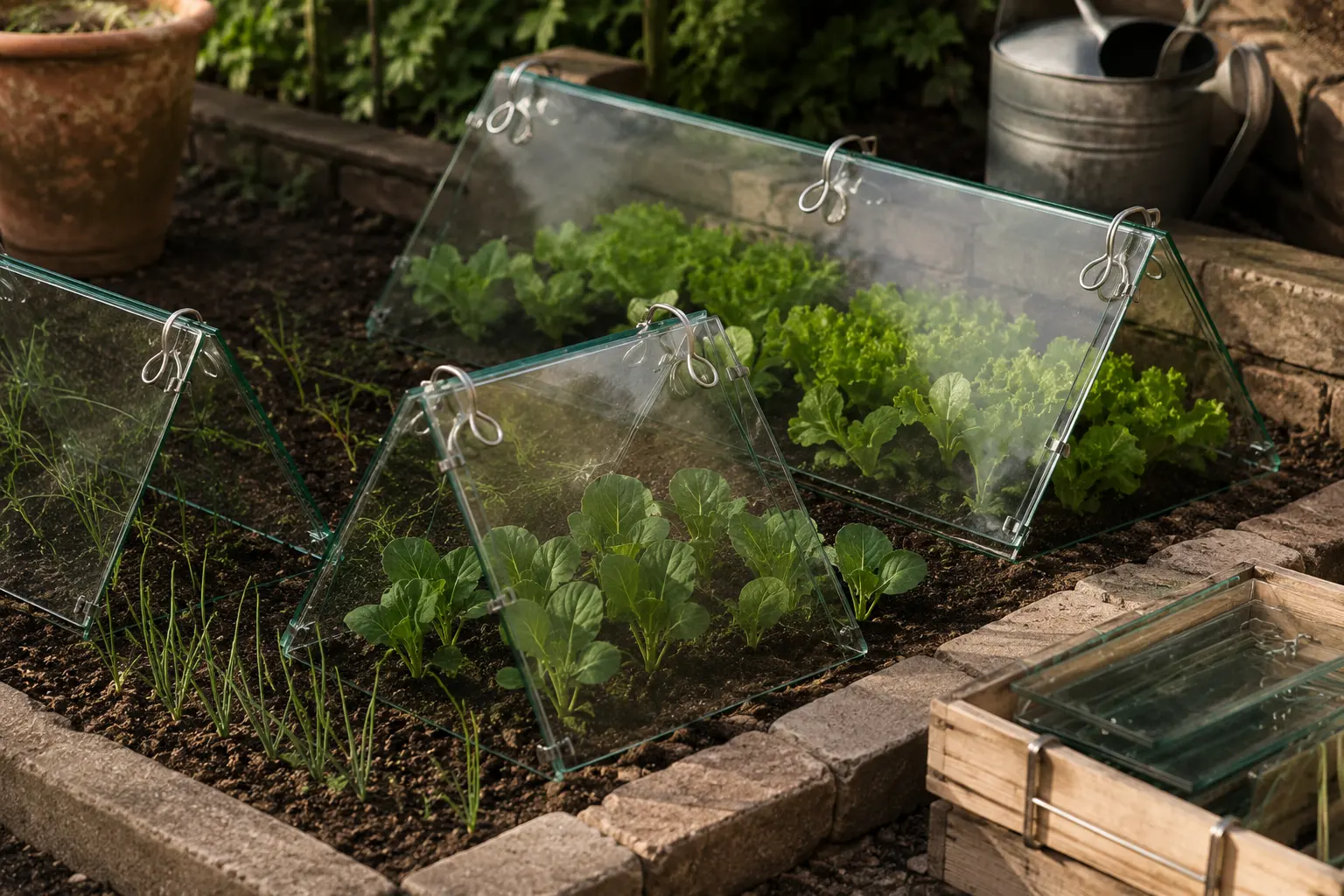
Traditional glass barn cloches are an iconic product in British horticulture. Four glass panels + wire clips, assembled into an A-frame.
Core Specs:
| Parameter | Low Barn | High Barn | Seedbed |
| Length | 40–50 cm | 50–60 cm | 80–100 cm |
| Width | 25–30 cm | 30–40 cm | 30–40 cm |
| Height | 20–25 cm | 30–40 cm | 20–25 cm |
Sourcing note: Glass barn cloches have the highest shipping breakage rate of all types — glass + metal clips + loose parts. If packaging is inadequate, you receive a container of broken glass. But barn cloches also carry the highest margin of the four types — garden centre buyers who want barn cloches are typically not price-sensitive; they care about glass quality and traditional appearance. High margin comes with high return risk — shipping breakage is the primary cause. Packaging specs are among the most important terms in your supplier negotiation.
Tunnel Cloche — Row Protection
The form closest to frost covers, but cloche tunnels use rigid or semi-rigid covers + metal hoops, not fleece.
Core Specs:
| Parameter | Small | Medium | Large |
| Length | 1–2 m | 2–4 m | 4–6 m+ |
| Width | 40–50 cm | 50–60 cm | 60–80 cm |
| Height | 30–40 cm | 40–50 cm | 50–60 cm |
| Frame Tube Diameter | 10–12 mm | 12–16 mm | 16–20 mm |
| Tube Wall Thickness | 0.25–0.3 mm | 0.3–0.5 mm | 0.5–0.8 mm |
| Cover Material | PE film | PE/PP nonwoven | PE film/PC panel |
| Closure | Tie both ends | Zipper door | Zipper door + flip top |
Sourcing note: Tunnel cloches concentrate the most quality risks — frame, cover, zipper, ground pegs. Every component can fail. When all other conditions are equal, a 0.25 mm hoop is far more likely to deform in wind than a 0.5 mm one. Zipper issues are among the most common customer complaints. Tube wall thickness and zipper grade are two parameters you must confirm on your spec sheet.
Pop-up Cloche — Quick Deployment
Spring wire frame + PE cover. Unfold and use. The most convenient — and the most “disposable” type.
Sourcing note: Spring fatigue is the core issue — low-quality springs may not fully recover after repeated folding and unfolding. If your customers need multi-season reuse, pop-up is not the right choice. It works best as an “entry-level” or “emergency” product line.
Material Selection: Cover, Frame, and Critical Components
Cloche material selection is more complex than frost covers — because cloches are rigid structures. Cover material, frame material, and connectors are independent variables, and each choice affects cost, lifespan, and return rate.
Buyers who need to define cover materials, frame finishes, coating levels, and component requirements in greater detail can refer to our guide to 【plant cloche material specifications for wholesale sourcing】.
Cover/Panel Materials
| Material | Light Transmission | Frost Lift vs. Outdoor | Impact Resistance | Typical Lifespan | Cost Positioning |
| Glass 3–4 mm | 90–95% | 5–8 °C (reference value) | Poor — fragile | 10 years+ | High |
| PC 2–4 mm | 85–90% | 4–6 °C (reference value) | Excellent — roughly 200–250× glass (solid sheet) | 5–10 years | Mid–High |
| Acrylic 2–3 mm | 88–93% | 4–6 °C (reference value) | Poor — brittle, shatters on impact | 5–8 years (practical; material 10 years+) | Mid |
| PET 0.5–1 mm | 88–92% | 2–4 °C (reference value) | Fair | 1–3 seasons | Low |
| PE film 0.1–0.2 mm | 85–90% | 2–3 °C (reference value) | Poor — tears easily | 1 season | Lowest |
Frost lift data are industry experience reference values. Actual performance depends on sunlight, wind speed, seal integrity, and soil heat capacity.
Five materials, five trade-offs. Here is the shortcut if you need one:
If you are a garden centre buyer, remember one thing: PC + UV coating — impact-resistant, good light transmission, long lifespan. It is the balanced choice for most applications. But every material has its place: PE for entry-level seasonal products, glass for premium traditional markets, acrylic for display scenarios. Other trade-offs are best confirmed through sample testing and inspection.
For detailed material grade, thickness, and coating comparisons, see Plant Cloche Materials Explained.
Frame Materials
| Material | Spec | Suitable Types | Key Risk |
| Galvanized steel tube | 12–20 mm × 0.3–0.8 mm | Tunnel, Barn | Wall thickness overstatement — quoted 0.5 mm, actual 0.35 mm |
| Powder-coated steel tube | Same + coating | Tunnel | Coating chips → corrosion |
| Fiberglass rod | 8–12 mm | Lightweight Tunnel | Lower strength than steel |
| Spring steel wire | Pop-up only | Pop-up | Fatigue deformation |
Five Critical Weak Points
These are the top five sources of cloche returns:
- Vent hinges/clips — break after repeated opening/closing
- Zippers (tunnel type) — jam, skip teeth, corrode
- Frame connectors — plastic joints crack
- Cover attachment points — tear at wind-load concentration points
- Anchoring pegs — bend, pull out
Zippers and hinges are cloche-specific risks — frost covers do not have these components. If you are sourcing cloches after buying fleece, these two parts need extra inspection attention.
Quality Risks and Inspection Planning
Plant cloche has no unified international QC standard — inspection parameters must be agreed with suppliers in advance. This is the same situation as frost covers.
Four Major Quality Risks
These are not theoretical risks. We have seen a container of tunnel cloches where every zipper was jammed — the supplier had swapped #8 for #5.
| Risk | Typical Symptom | Possible Cause | What You Can Do |
| Cover tearing / thickness overstatement | Cracks early, poor light transmission | Insufficient thickness, recycled material, no UV stabilizer | Micrometer thickness check, QUV testing |
| Weak frame / connector failure | Deforms in wind, joints break | Thin tube walls, poor welding, weak plastic parts | Caliper tube wall check, load testing |
| Zipper / hinge failure | Jammed, teeth skip, breaks | Low zipper grade, poor hinge material | Repeated open/close test ≥ 500 cycles |
| Poor ventilation | Internal overheating, plant scorch on sunny days | No vent, insufficient vent area | Temperature monitoring, vent area calculation |
Five Signs of Cost-Cutting
- Tube wall overstatement: Quoted 0.5 mm, actual 0.35 mm — caliper verification
- Cover thickness overstatement: Quoted 2 mm PC, actual 1.5 mm — micrometer verification
- Omitted UV stabilizer — the most insidious cut: visually identical to properly stabilized material, but customers complain about yellowing 6 months later — QUV testing verification
- Insufficient galvanized coating: Quoted Z275, actual below spec — salt spray testing verification
- Zipper downgrade: Quoted #8, actual #5 — tooth width measurement + functional testing verification
For detailed inspection checklists and test methods.
OEM, MOQ, Packaging, Logistics, and Lead Times
MOQ and Lead Times
| Product Type | MOQ | Lead Time | Notes |
| Plastic Bell Cloche | 500–2,000 pcs | 30–45 days | Injection mold fee may apply separately |
| PC Bell Cloche | 300–1,000 pcs | 35–50 days | PC raw material cost is higher |
| Tunnel Cloche | 500–2,000 sets | 30–45 days | Can mix different sizes |
| Barn Cloche (Glass) | 200–500 sets | 45–60 days | Glass procurement cycle is longer |
| Custom Brand/Packaging | Additional 500–1,000 | +15–30 days | Printing, color masterbatch MOQ |
MOQs and lead times are industry experience reference values. Actual figures depend on your order volume, customization level, and factory relationship.
These numbers are not fixed. Your order volume, level of customization, and relationship with the factory all affect the final MOQ and lead time.
Key reminder: Cloche is an assembled product — frame, cover, and accessories come from different factories. Your supplier is likely an integrator, not a manufacturer. That means lead time is not one factory’s production cycle — it is the coordination cycle of multiple factories. One delay in any component delays the entire shipment. This is one reason we built a warehouse — when goods from different factories arrive, someone needs to receive, inspect, and organize them before shipping.
OEM Options
- Custom colors: PE film and PC panels can be custom-colored, but color masterbatch has an MOQ (typically 500–1,000 kg minimum; industry experience reference value)
- Custom packaging: Printed color box MOQ typically 1,000 pcs minimum
- Custom labels: PC/glass bell cloches can be laser-engraved with logos, MOQ 500–1,000 pcs
- Custom sizes: Tunnel cloche length is adjustable (add or remove hoops); width is determined by hoop arc
Packaging and CBM
| Type | Packaging Method | CBM Optimization |
| Bell Cloche | Nest 3–5 same-size bells | 50–70% volume reduction after nesting |
| Tunnel Cloche | KD: hoops + cover separated | 30–50% CBM reduction after disassembly |
| Barn Cloche | Flat-pack: glass + frame separated | Flat-pack CBM is optimal |
| Pop-up | Folded storage | Already compact |
Glass barn cloche packaging is the biggest challenge — glass panels + metal clips + loose parts require foam/honeycomb board isolation between each layer. Packaging cost may account for 10–15% of FOB price.
For detailed packaging specs and shipping solution plans.
Sourcing Calendar: Autumn 2026 & Winter 2026–27 Protection Season
Cloche is a seasonal product. The sales window runs September through March. Miss the window, and inventory becomes cost.
| Timeline | Action | Key Decision |
| July | Place sample order | Confirm type, material, specs — you still have time for sample testing |
| August | Approve samples, place production order | Weight/thickness verification, QUV test (needs 3 weeks), zipper/hinge functional testing |
| September | Production | Maintain communication with factory, confirm no material substitution |
| October | Inspection + shipment | AQL 2.5 sampling, zero tolerance on Critical defects |
| November | Arrival + distribution | Ocean freight 25–35 days; check outer carton integrity on arrival |
| December–February | Peak retail season | Adjust replenishment based on sales data |
Replenishment window: First replenishment in January (based on December sales data), last replenishment in February (demand drops sharply after March). Replenishment requires 8–10 weeks lead time (production + ocean freight). Orders placed after November may not reach in time for peak sales.
If you are only now starting to look for cloche suppliers — you still have time, but the window is closing. Order in August, inspect and ship in October, arrive in November — just in time for December peak retail. One month later, and you are gambling on air freight for replenishment.
Scarecrow’s Role: Managing the Risks You Cannot See in Cloche Sourcing
Cloche sourcing is more complex than fleece — because it is an assembled product. Frame, cover, and accessories come from different factories. One weak link affects the entire shipment.
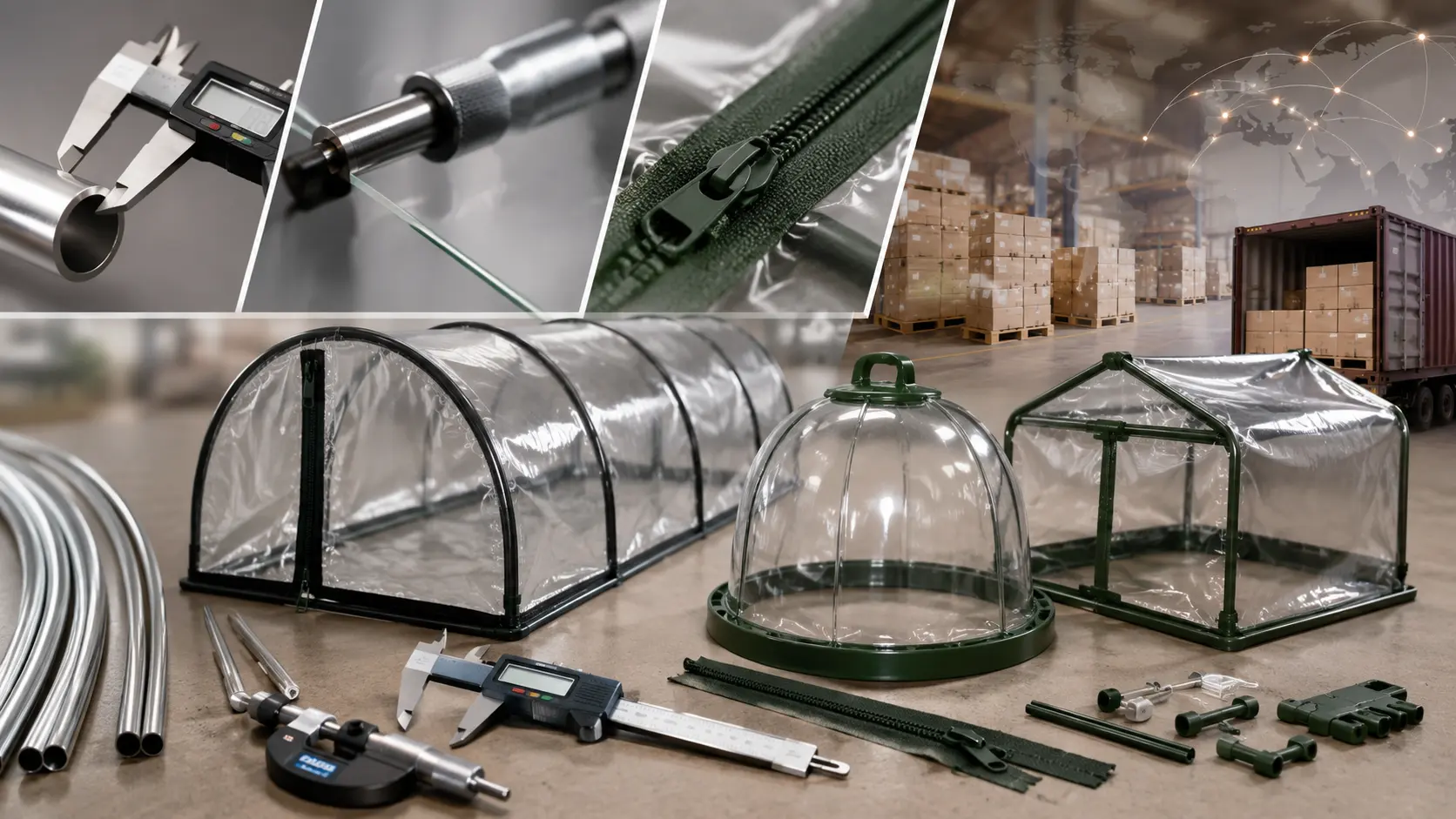
Helping you verify quotation specs: When a supplier quotes 0.5 mm tube walls and 2 mm PC covers, how do you know those numbers are real? Tube wall thickness, cover material thickness, and zipper grade are the three most commonly overstated specs on cloche quotation sheets. We help you turn these parameters into verifiable items — not “what the supplier says,” but “how to confirm at inspection.” Tube walls measured by caliper, covers by micrometer, zippers by open/close testing.
Managing integration risk: When a tunnel cloche’s hoops come from Hebei, its cover from Zhejiang, and its zippers from Guangdong — lead time coordination and quality consistency are the biggest challenges. We work with 200+ cooperating supplier partners, with eight people dedicated to managing supplier relationships. When one factory delays, we can find an alternative quickly — instead of leaving you waiting.
Handling mixed orders: If you need bell cloches + tunnel cloches + barn cloches in a mixed shipment — different factories, different lead times, different packaging standards — that is exactly what our warehouse is built for. Goods arrive, get inspected, repacked, and consolidated for shipment. One streamlined process.
This is not an “extra service.” It is what we believe must be done in cloche sourcing.
Next Step: Review Your Plant Cloche Sourcing Plan
If you are sourcing cloches for the Autumn 2026 and Winter 2026–27 protection season, here are five questions worth answering before you place an order:
1. What plants are your target customers protecting? Single plants (strawberries, seedlings) → Bell cloche; row crops (lettuce, radishes) → Tunnel/Barn cloche. Wrong type = wrong market.
2. What climate zone are your customers in? Windy areas → thicker tube walls + anchoring systems; heavy snow → taller hoops + snow-load design; coastal → salt-spray-resistant coating. Climate determines material specs.
3. What is your retail price band? £3–8 entry → PET Bell + PE Tunnel; £8–20 mainstream → PC Bell + Galvanized Tunnel; £20–50 premium → Glass Barn + PC twin-wall Tunnel. Price band determines material grade.
4. Do you have an inspection process? AQL 2.5 sampling, tube wall caliper measurement, cover micrometer thickness check, zipper open/close test ≥ 500 cycles, vent hinge test ≥ 200 cycles — these are not optional.
5. Have you allowed enough time on your sourcing calendar? Late start = compressed timeline = air freight fallback or missed season. Sample order in July, sample approval and production order in August, inspection and shipment in October — the window is narrow, and it closes fast.
If you are planning a plant cloche sourcing project, we can help with a few things:
- Quotation spec review: Send us the cloche quotes you have received — we will flag tube wall thickness, cover material, and zipper grade issues. No charge, just a second pair of eyes
- Sample verification: Tube wall caliper measurement, cover micrometer thickness check, QUV testing, zipper open/close testing — identify risks before you commit to production
- Sourcing calendar planning: Based on your target shelf date, we work backward to map out what needs to happen at each stage
Talk to Queenie about your plant cloche sourcing plan. She will help you figure out the types, specs, and timeline that match your market.
Retail price data in this article are market reference values. Wholesale prices vary by order volume, customization level, and supplier — for specific wholesale pricing, consult Scarecrow Garden. Frost lift data are industry experience reference values; actual performance depends on multiple factors.
FAQ
1. Which cloche type has the lowest return rate for garden centres? PC bell cloches with top ventilation and anchoring pegs. They combine display appeal, impact resistance, and wind security. PET bells look cheap on the shelf and blow away in wind — the two most common garden centre return triggers.
2. Can I source all four cloche types from one supplier? Most cloche suppliers are integrators, not manufacturers. They assemble components from specialized factories. One supplier can coordinate all four types, but lead times vary because each component has its own production cycle. Build in buffer time for mixed orders.
3. How do I verify UV stabilizer in PC panels if I cannot see it? You cannot see it — that is the problem. The only reliable method is QUV accelerated weathering testing (ASTM G154). After 500 hours, compare light transmission and yellowness index. Panels with and without UV stabilizer show a clear difference in test data, even though they look identical out of the box.
4. What is the minimum tube wall thickness for UK outdoor use? For most UK regions, 0.5 mm is the practical minimum for tunnel and barn cloche frames. In Scotland and coastal areas with higher wind loads, 0.6–0.8 mm is recommended. Anything below 0.5 mm risks deformation in the first season.
5. Are glass barn cloches worth the higher packaging and freight cost? It depends on your channel and customer base. Glass barn cloches carry the highest margins and attract premium buyers who value traditional aesthetics. But packaging cost can be 1.5–2× that of PC equivalents, and shipping breakage remains a risk even with proper packaging. If your channel is e-commerce, the breakage risk usually outweighs the margin advantage. For garden centres with controlled logistics, glass can be profitable.
6. How far in advance should I order cloches for the autumn season? Ideally, place sample orders in July, approve and confirm production in August, inspect and ship in October, arrive in November for December peak sales. If you are starting later than August, replenishment by sea may not reach in time — air freight becomes the fallback, significantly increasing landed cost.
Talk to us about your product list and target market.
Send your specifications, channel, quantity, packaging requirements, and delivery deadline—we’ll return a matched specification and sourcing proposal.
Written by
ScarecrowGarden
💡About Scarecrow Garden Supplier Co., Ltd.
Scarecrow Garden Supplier Co., Ltd. is a China-based sourcing and wholesale partner specializing in garden tools, landscaping equipment, and outdoor supplies for international wholesalers, distributors, contractors, and brands.
With hands-on experience rooted in real garden use scenarios, we focus on durable materials, functional design, and stable large-volume supply. Our product range covers pruning tools, watering systems, hand tools, outdoor hardware, and customized garden solutions to support both retail and professional landscaping markets.
Beyond products, we help our partners navigate supplier selection, quality control, compliance requirements, and long-term sourcing strategies in China. Through our blog, we share practical insights on product selection, material comparisons, industry trends, and cost-effective purchasing—helping global buyers build stronger, more competitive supply chains.