









Commercial Greenhouse Supplies: Ultimate Supplier Qualification Checklist | Scarecrow Garden Supplier
A supplier qualification checklist is not a certificate-counting exercise. It is a structured way to find out whether a factory can deliver the same product you approved — not just once, but batch after batch. This article walks through ten evaluation areas, from export capability to final approval level, so you can score candidates, record evidence, and make a defensible decision before placing a bulk order.
This checklist is built to be used, not just read. Each item has a score field and an evidence column — so when you are done, you have a record you can defend. For the full product selection and procurement workflow surrounding this checklist, begin with our commercial nursery supplies buying guide.
Want a ready-to-use version? Download the checklist and send us the specifications you are evaluating. We can help compare candidate suppliers and samples.
Here are the ten areas this checklist covers — and the one question that matters most in each.
| # | Area | Core Question |
| 1 | Company and Export Capability | Do they actually export to your market? |
| 2 | Product and Mold Capability | Do they make the product themselves? |
| 3 | Technical Documentation | Can they provide written data, not only photos? |
| 4 | Quality Control Process | How do they ensure sample-to-mass-production consistency? |
| 5 | Packaging and Labeling | Is the export packing and destination labeling correct? |
| 6 | Capacity and Lead Time | Can they deliver when they say they will? |
| 7 | Commercial Terms | Are the terms clear — or will surprise costs show up later? |
| 8 | Logistics and Customs Readiness | Can they support accurate customs compliance? |
| 9 | Business Continuity and Backup Supply | What happens if this product stops? |
| 10 | Final Score and Approval Levels | What is the overall verdict? |
When commercial terms and import costs are central to the decision, use our local-versus-overseas import cost guide to compare landed cost with current local pricing.
1. Company and Export Capability
Before you evaluate a supplier’s products, confirm they can actually ship to your market. A factory that has never exported outside its home country will struggle with documentation, packaging standards, and communication in ways that no product quality can compensate for.
Check three things first:
- Export track record. Have they shipped to your country or region before? Ask for a reference shipment — not a customer name, just confirmation that they have handled your destination market’s customs and labeling requirements.
- Communication window. Is there one person who responds in writing within one business day? If your emails go to a general inbox and you wait three days for a vague reply, that is what the entire order experience will look like.
- Business registration and export qualification. A valid business license and export authorization confirm they operate legally. But these documents do not tell you whether the company is organized, responsive, or capable of solving problems. Research on supplier pre-qualification criteria confirms this: the most important strategic-level factors are organizational capability — technical qualifications of staff, continuous improvement systems, and communication quality — not cost and price (Petricli & Emel, 2016).
A supplier with strong export experience and a responsive contact person is already ahead of one with a longer certificate list but slower replies.
2. Product and Mold Capability
When you ask a supplier, “Is this product yours?” the answer is not always straightforward. Many trading companies present a catalog as if they manufacture everything. That is not necessarily a problem — but you need to know what you are dealing with.
Key questions:
- Does the factory produce the item in-house, or is it sourced from a subcontractor? In-house production typically gives you more control over changes, lead times, and quality consistency.
- Who owns the mold? If the factory owns the mold, they control the product’s continuity. If the mold belongs to another buyer, the product could be discontinued without warning. Based on industry experience, injection molds for nursery trays typically last 500K to 1M shots — long enough for most commercial volumes, but not infinite.
- Can they work with the material you need? PP, PET, and PS each have different forming requirements. A factory that primarily does thermoforming may not be the right fit for a heavy-duty injection-molded tray.
If the supplier is a trading company, ask which factories produce which products. This is not an unusual question, and a transparent answer tells you more than a generic “we have 200 partner factories.”
3. Technical Documentation
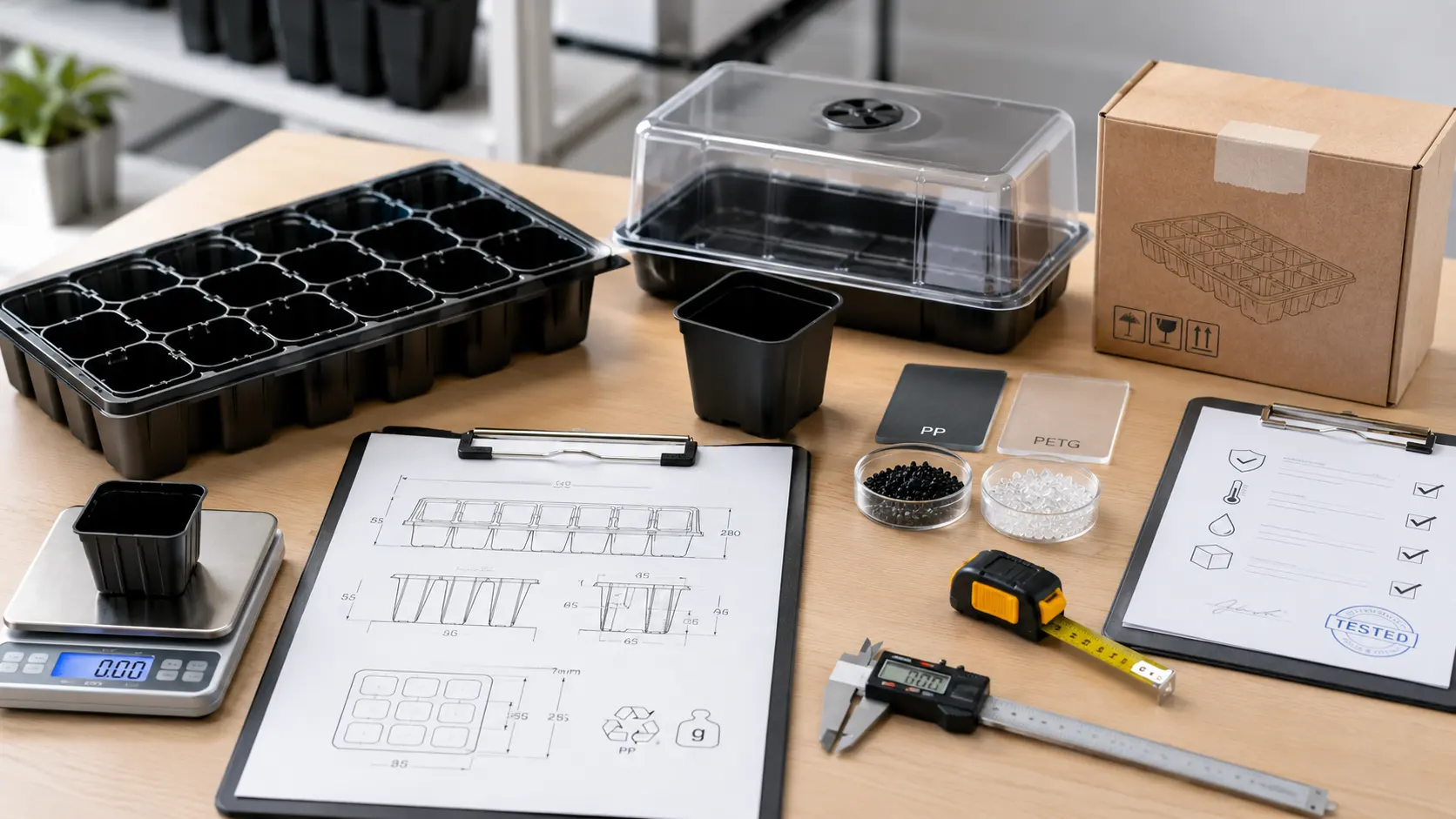
Photos are not specifications. A product photo tells you what something looks like. A specification sheet tells you what it measures, what it weighs, and what tolerances it was made to.
Documentation to request:
- Dimensional drawings with length, width, height, and critical fit dimensions
- Material designation (e.g., PP homopolymer, PETG) — not just “plastic”
- Unit weight and acceptable weight range
- Carton quantity, gross weight, and packed dimensions
- Any available test reports relevant to your market (e.g., UV resistance, food-contact compliance)
If a supplier cannot provide a basic specification sheet, that is a signal. It may mean they do not control the production closely enough to document it — or they are relaying someone else’s product without full technical knowledge.
4. Quality Control Process
This is where qualification checklists earn their value. A supplier who sends a perfect sample but ships inconsistent bulk production is a common and expensive problem. For the full sample-to-mass-production verification workflow, follow our step-by-step nursery supply manufacturer evaluation guide.
What to look for:
- Incoming material checks. Do they verify the resin batch before production starts? Color and weight variations often start here.
- In-process controls. Are production parameters (temperature, pressure, cycle time) documented? Is there a first-article check when a new batch begins?
- Outgoing inspection. Do they check dimensions, weight, and appearance before packing? Based on industry experience, one of the most widespread quality gaps in nursery supply production is sample-to-mass-production weight reduction — a tray that arrives 8 to 15 grams lighter than the approved sample, with thinner walls and less structural rigidity. That 8-gram difference? It shows up as a tray that flexes when you carry it wet.
- Sample retention. Do they keep a reference sample from each production batch? If there is a dispute later, a retained sample is the only objective baseline.
Two high-weight items that belong on every checklist:
Is the approved sample locked to mass production? This means the factory agrees — in writing — that the production batch will match the approved sample’s material, weight, dimensions, and color. If they cannot commit to this, the sample approval has no teeth.
Do they accept third-party pre-shipment inspection? If a supplier refuses independent inspection, ask why. Reputable factories are accustomed to this. It protects both sides.
Not sure what to ask? Send us the products you are evaluating. We can help compare candidate suppliers and samples before you commit.
5. Packaging and Labeling
You open a carton of humidity domes and find the top layer warped from stack pressure. The product meets specification — but the packing did not protect it. Or you receive a shipment with barcodes that do not match your system, and your warehouse team spends hours relabeling every carton.
A product that arrives damaged or with the wrong labeling is not a product you can use — even if the item itself meets specification.
Check these packaging and labeling items:
- Carton strength and stack height. Nursery trays and domes are volumetric — light but bulky. If cartons are too weak or stacked too high, edge crushing and dome warping are likely during transit.
- Barcode and shipping marks. Can the supplier print your SKU barcodes, PO numbers, and carton count on the outer carton? This matters for receiving efficiency at your warehouse.
- Retail packaging readiness. If you need printed retail boxes or header cards, confirm the supplier can produce them — or that you have a repacking step planned.
Export compliance. Wood pallets and solid wood packaging must comply with ISPM 15 requirements for your destination country. Verify that the supplier uses heat-treated or fumigated wood and can provide the compliance mark. Product descriptions on commercial invoices must be accurate (e.g., “plastic seedling propagation tray” — not “sample” or “plastic goods”). Declared values should be reasonable, even for samples.
6. Capacity and Lead Time
A factory tells you they can produce 50,000 trays a month. That is capacity. What you need to know is when your 5,000 will be ready — and that depends on their current order queue, material availability, and mold scheduling, not their total output.
Questions that separate capacity from commitment:
- What is the standard lead time for a repeat order of this product?
- How much longer does it take during peak season? Based on industry experience, lead times typically extend 50 to 100 percent during peak periods.
- Can they produce a small urgent order, or does every run require a full production MOQ?
- Do they keep raw material in stock, or does every order start with a new resin purchase?
Get the lead time in writing. A verbal “two weeks” is not a delivery commitment.
7. Commercial Terms
A quotation that looks straightforward can hide costs that surface only after you have committed. The unit price is one number. What sits behind it — packaging, inner cartons, palletization, labeling — can change the total significantly.
Clarify these terms before you approve a supplier:
- MOQ. Is it per SKU, per order, or per shipment? Can you mix multiple products to reach the threshold?
- Payment terms. What is the standard deposit and balance structure? Is the quote valid for a specific period?
- Pricing clarity. Does the price include packaging? Inner cartons? Palletization? If something is “not included,” it will show up as a surprise cost later.
If a supplier cannot give you a clear, itemized quote, that is not a negotiation problem — it is a qualification problem.
8. Logistics and Customs Readiness
A container of humidity domes arrives at port — and the customs broker asks for the correct HS code. Your supplier gave you a generic one. Now the shipment is held, and every day of delay costs you.
Logistics and customs readiness is where capable suppliers separate themselves from those who have never actually shipped to your market.
- Can the supplier provide a correct HS code for the product? Cross-check it against your country’s tariff schedule — do not rely solely on the factory’s classification.
- Do they offer door-to-door shipping, and if so, what does it include? Door-to-door describes the shipping route; it does not automatically mean duties and taxes are included. Confirm whether the quote is DAP (you handle import duties) or DDP (seller handles import duties), and verify that the seller can legally complete import clearance in your country if DDP is offered.
Are commercial invoices accurate and complete? Correct product description, reasonable declared value, and proper buyer information — even for samples.
9. Business Continuity and Backup Supply
If you build your nursery workflow around one supplier’s tray, what happens when that product disappears?
Risk scenarios to consider:
- Product discontinuation. If the mold belongs to the factory and they decide to stop making this item, how much notice would you get? Is there a compatible alternative from another factory?
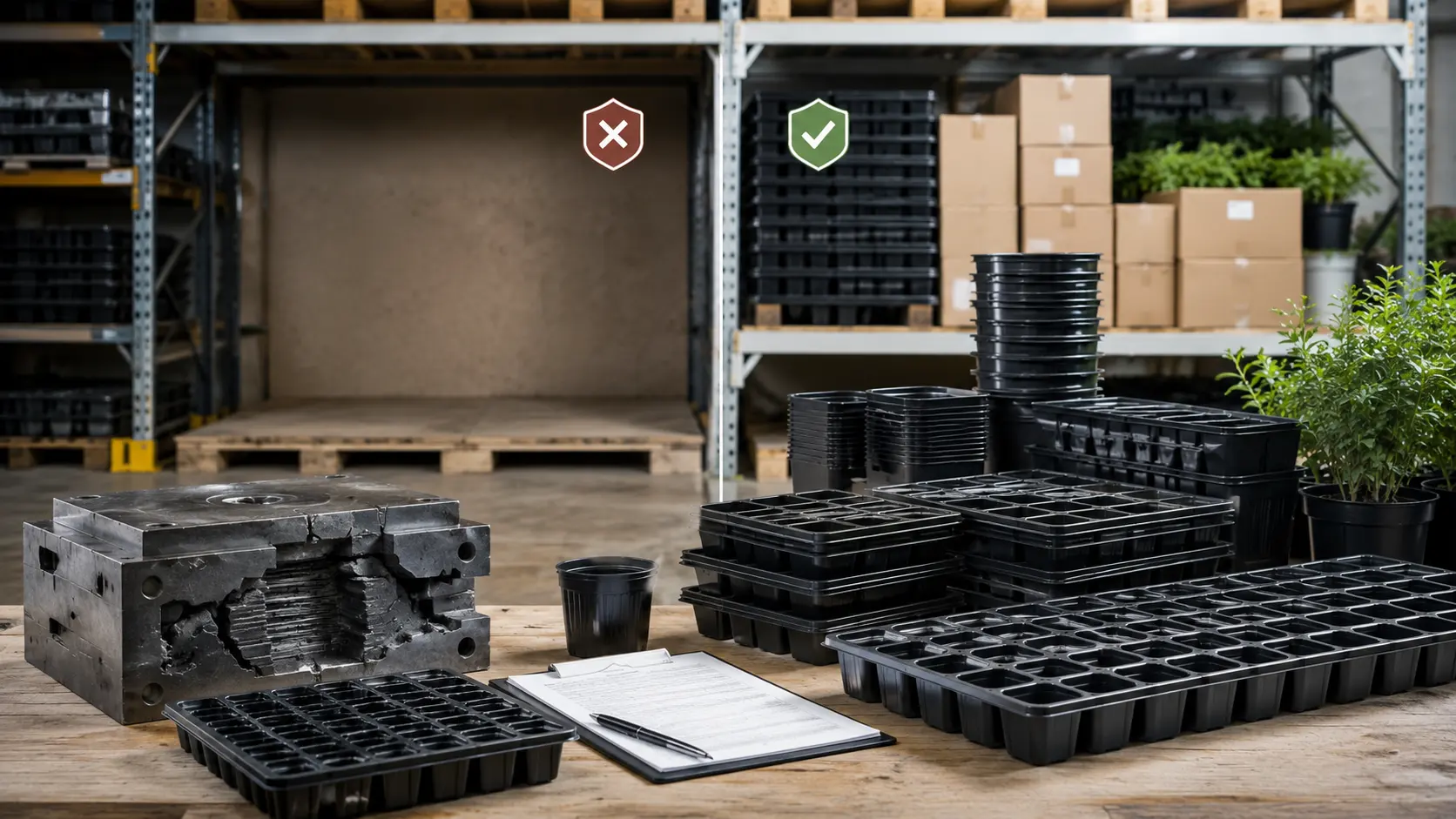
- Mold failure. Based on industry experience, injection molds for nursery products typically last 500K to 1M shots. If a mold fails mid-season, can the factory produce a replacement mold quickly, or will you face a multi-month gap?
- Single-source dependency. If this supplier is your only source for a critical SKU, you are exposed. Having a qualified backup supplier — even one you do not order from regularly — is a practical risk reduction step.
You do not need to source every product from two factories. But for the items that stop your production if they are missing, a pre-approved alternative is worth the sample cost.
10. Final Score and Approval Levels
After evaluating a supplier across all areas, you need a way to turn your findings into a decision. A scorecard does this.
Supplier Scorecard (TQRDC Model)
| Dimension | Weight | What It Measures |
| Quality | 40% | Sample-to-batch consistency, defect rate, specification adherence |
| Delivery | 25% | On-time rate, peak-season reliability, lead-time accuracy |
| Cost | 20% | Total cost — not just unit price, but packaging, freight, and rework |
| Service | 15% | Response speed, communication quality, problem resolution |
Weight allocation is based on industry experience, adapted from the TQRDC framework originally developed by 3M (original weights: Technology 10%, Quality 30%, Responsiveness 15%, Delivery 25%, Cost 20%).
That is the scoring framework. Now here is what the scores mean in practice.
Four Approval Levels
| Level | Definition | Action |
| Approved | All critical items passed | Can place orders directly |
| Conditionally Approved | Non-critical items have gaps, with a corrective plan | Can place trial orders; re-evaluate after corrections |
| Probationary | Some critical items below standard | Small quantities only; close monitoring required |
| Disqualified | Critical items severely below standard | No orders; may re-apply after six months |
A supplier who passes eight out of ten areas but fails on export documentation — that is a Probationary rating, not an Approved one. The disqualification triggers below are even more absolute.
Automatic Disqualification Triggers
In this framework, any one of these disqualifies a supplier regardless of other scores:
- No export experience to your target market
- Cannot provide a physical sample
- Refuses third-party pre-shipment inspection
- Product description is materially inaccurate
No quality control process of any kind
Required vs. Optional Documentation
Not every supplier needs to provide every possible certificate. Asking for documents unrelated to your product wastes time and can disqualify capable factories that simply do not hold irrelevant certifications.
Always request:
| Document | Purpose |
| Business license and export qualification | Confirm legal operation |
| Product catalog and specification sheets | Confirm product range |
| Physical samples | Verify material, dimensions, and fit |
| Carton data (CBM, gross weight, quantity per carton) | Plan logistics |
| Quality control process description | Understand QC system |
| Quotation with validity period | Confirm commercial terms |
| Shipping options and transit times | Plan delivery |
Request only when relevant:
| Document | When to Request |
| ISO 9001 certificate | Large-volume or long-term orders |
| Material test reports | Food-contact or UV-resistance requirements |
| Third-party inspection reports | First bulk order |
| Mold list and ownership details | Custom or proprietary products |
| Customer references | Evaluating for long-term partnership |
| ISPM 15 compliance certificate | When wood pallets are used |
FAQ
Does a supplier need ISO 9001 to be qualified?
Not necessarily. ISO 9001 confirms a documented quality management system. It is valuable for large or long-term orders, but many capable factories operate effective QC processes without formal certification. Evaluate the actual process — incoming checks, in-process controls, and outgoing inspection — rather than relying on the certificate alone.
How many suppliers should I qualify for the same product?
For critical items that would stop your production if unavailable, consider qualifying at least two. For lower-priority items, one qualified supplier with a known alternative is usually sufficient. The goal is risk reduction, not supplier proliferation.
What if a supplier scores well on quality but poorly on delivery?
Delivery problems affect your production schedule just as much as quality problems. A supplier who consistently ships late — especially during peak season — may need to be rated Conditionally Approved or Probationary until they demonstrate improvement. Track on-time delivery as a separate metric and give it real weight in your scorecard.
Can I use this checklist for a trading company, not only a factory?
Yes. Adjust your expectations: a trading company may not control production directly, but they should be able to provide technical documentation, arrange inspection, and manage logistics. Score them on what they actually deliver — communication, coordination, and problem resolution — not on whether they own the machines.
How often should I re-qualify an existing supplier?
A full re-evaluation is typically warranted when there is a significant change: new product, new material, ownership change, or a pattern of quality or delivery issues. For stable suppliers with consistent performance, an annual review of key metrics — on-time rate, defect rate, specification adherence — is usually sufficient, though the right frequency depends on how critical the supplier’s product is to your production.
Got a shortlist of suppliers? Talk to us. Send us the products you are evaluating, and we can help compare candidates, arrange samples, and build a pre-shipment inspection plan before your first bulk order.
Got a shortlist of suppliers? Talk to us.
Send us the products you are evaluating. We can help compare candidates, arrange samples, and build a practical pre-shipment inspection plan before your first bulk order.
- Compare Candidates
- Arrange Samples
- Plan Pre-Shipment Inspection
Make your first bulk order easier to verify.
Email your shortlist, product links, specifications, or quotations for an initial review.
Email Your Supplier Shortlistqueenie@gardentoolswholesale.com
Written by
ScarecrowGarden
💡About Scarecrow Garden Supplier Co., Ltd.
Scarecrow Garden Supplier Co., Ltd. is a China-based sourcing and wholesale partner specializing in garden tools, landscaping equipment, and outdoor supplies for international wholesalers, distributors, contractors, and brands.
With hands-on experience rooted in real garden use scenarios, we focus on durable materials, functional design, and stable large-volume supply. Our product range covers pruning tools, watering systems, hand tools, outdoor hardware, and customized garden solutions to support both retail and professional landscaping markets.
Beyond products, we help our partners navigate supplier selection, quality control, compliance requirements, and long-term sourcing strategies in China. Through our blog, we share practical insights on product selection, material comparisons, industry trends, and cost-effective purchasing—helping global buyers build stronger, more competitive supply chains.