







How to Evaluate a Nursery Supply Manufacturer Before Bulk Orders | Scarecrow Garden Supplier
You approved a sample. The bulk order arrives. The trays look the same — same color, same shape, same catalog photo. But when your team loads them with wet growing media, the center bows. You weigh one. It is 15 grams lighter than the sample you signed off on.
This is not a rare problem. In nursery plastics — trays, domes, base trays, inserts — the most widespread quality gap is not a visible defect. It is a silent reduction in material weight between the approved sample and mass production. The product looks identical. It performs differently.
Evaluating a nursery supply manufacturer before a bulk order means looking past the product photo and the factory tour video. It means confirming what the supplier actually makes versus sources, whether the mold that produces your tray is owned and stable, whether sample specifications carry into mass production, and whether the supplier can deliver on time when every other nursery is ordering for spring.
This article walks through eight evaluation steps — each tied to a real risk that commercial nursery buyers encounter when sourcing trays, pots, domes and propagation products from overseas manufacturers.
1. Confirm the Supplier’s Actual Product Scope
You ask a supplier: do you make this tray yourself? The answer is not always straightforward. In China’s nursery supply industry, there are three types of suppliers:
- Manufacturers — companies with their own injection molding or thermoforming machines. They control the production process directly, which makes batch consistency easier to verify.
- Trading companies — businesses that coordinate across multiple factories. Their advantage is breadth: they can offer a wider product range and source from different producers for price comparison.
- Hybrid operations — companies that manufacture some products in-house and source others externally. This is a common model.
The risk is not that a supplier uses external factories. The risk is when they do not tell you. A supplier who says “we make all of these” but actually sources three out of five products from external workshops creates a longer quality-control chain — and you will not know which products need extra verification unless you ask.
What to do: Ask the supplier to specify which products are made in-house (with workshop photos or videos that show the actual production line) and which are sourced externally. For externally sourced items, confirm whether the partner factory has been audited and whether there is a separate inspection process for those products.
2. Ask for Technical Data, Not Only Photos
A product photo tells you what a tray looks like. It does not tell you how much it weighs, what material it is made from, or whether it will fit the inserts and domes you already use. The same catalog photo can correspond to products with different weights, different materials, and different dimensional tolerances.
Before approving any product for bulk production, request the following technical data:
| Data Category | What to Request | Why It Matters |
| Dimensional drawing | Outer length, outer width, inner base dimensions, rim width, corner radius, height (with and without rim) | Confirms compatibility with your existing trays, inserts, domes, and bench systems |
| Material declaration | Resin type (PP / PET / PS / PE), recycled content percentage, UV stabilizer addition | Affects durability, flexibility, clarity, and suitability for your growing conditions |
| Unit weight | Target weight + acceptable tolerance range (e.g., 245 g ± 5 g) | The single most important metric for catching silent weight reduction in mass production |
| Packing data | Pieces per carton, net weight, gross weight, carton dimensions, CBM | Determines freight cost, storage requirements, and receiving workflow |
Want to see what a complete specification sheet looks like? Tell us the product and we can send a sample data card with real measurements — not just photos.
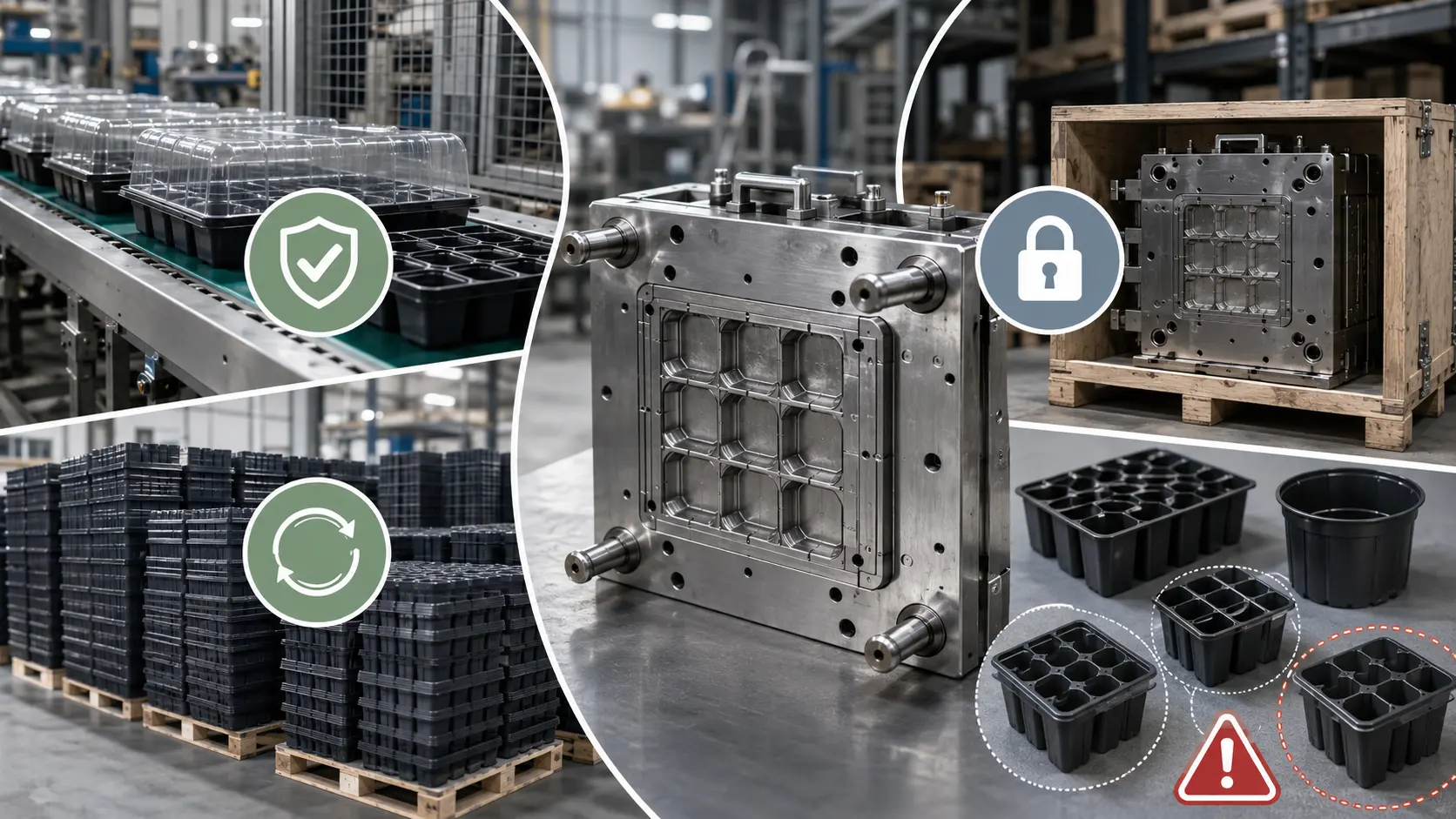
3. Check Mold Ownership and Product Continuity
This is the evaluation step most buyers skip — and the one that can cause the most disruption.
Every injection-molded nursery product — every tray, insert, dome, and pot — is produced from a mold. Who owns that mold determines what happens when you need to reorder, or when something goes wrong.
There are three common situations:
- Supplier-owned mold. The most common arrangement. The supplier invested in the mold and controls production. The risk: the supplier can discontinue the product at any time. If your nursery has standardized on that tray and it disappears, you face a full re-qualification process — finding a compatible replacement, testing it with your equipment, and transitioning your inventory.
- Buyer-paid mold. You funded the mold; you own it. But the mold is stored at the supplier’s facility. The risk: you need to confirm your right to transfer the mold to another factory, and you need to verify that the mold is being maintained properly. A mold that sits unused for a year may produce different results than one in regular service.
- Shared mold. Multiple suppliers use the same mold. This can create capacity competition during peak season — your order may wait while another buyer’s run finishes.
Mold lifespan matters too. Injection molds generally last 500,000 to 1,000,000 shots, depending on the steel grade and maintenance schedule. A mold nearing the end of its life may produce parts with subtle dimensional shifts — slightly different corner radii, slightly thinner walls.
What to ask: How long has this product been in production? What is the monthly output? Is there a discontinuation risk? For critical SKUs, is there a compatible alternative? If you pay for the mold, get the ownership terms, storage location, and transfer rights in writing.
4. Review Sample-to-Mass-Production Controls
Here is the risk that catches the most buyers: a sample passes every check — material, dimensions, fit, feel — but the mass-produced order arrives lighter, thinner, and less rigid.
How does this happen? Injection-molded products are produced by weight of material per shot. A supplier can reduce the material input slightly — enough to save on resin costs across thousands of units — while producing a part that looks almost identical to the approved sample. The tray is the same color and shape. But it flexes under load. The dome does not clip as firmly. The base tray warps after one season.
This is not always intentional. Material batch variation, ambient temperature changes during production, and normal mold wear can all cause weight drift. But whether the cause is cost-cutting or process drift, the result for your nursery is the same: a product that does not perform as expected.
How to prevent it:
Lock the unit weight at sample approval. When you approve a reference sample, record its weight precisely. Specify an acceptable range — for example, “base tray: 245 g ± 5 g” — and write it into the purchase order.
Weigh multiple pieces during inspection. Do not weigh one tray and assume the batch is consistent. Pull 5 to 10 pieces from different cartons and record the weight range. If the range is wide, the production process is not stable.
Compare against the reference sample at every inspection. Keep the signed reference sample in a controlled location. During pre-shipment inspection, weigh the reference alongside production pieces.
Make weight tolerance a contractual requirement. If the average weight of inspected pieces falls outside the approved range, the batch does not ship.
One sample can confirm material, dimensions, fit, and handling feel. It cannot confirm batch consistency or full service life. That is why sample approval is the beginning of quality control, not the end of it.
Need someone to weigh and measure your production batch against the approved reference? Send us the approved specs and we will build a pre-shipment inspection checklist around them.
5. Evaluate Packaging and Export Readiness
A product that passes inspection can still arrive damaged if the packaging is not right. For nursery plastics, packaging is not an afterthought — it is part of the product.
Physical protection. Clear humidity domes are the most fragile component in a nursery supply shipment. They need internal separation or correct nesting direction to prevent cracking under stack pressure. Verify the carton’s burst strength and the maximum stack height before loading. Every carton should carry: SKU identifier, quantity, gross weight, and country of origin — not just a customs requirement, but the difference between a smooth receiving process and a two-hour counting exercise on your dock floor. Palletized shipments are faster to unload and easier to inspect; floor-loaded containers save on pallet cost but increase unloading time and handling damage risk. Decide based on your receiving capability.
Then there is the compliance layer — the part that can stop a shipment at the port.
ISPM 15 compliance. If your shipment uses wooden pallets or solid wood packaging, it must comply with ISPM 15 requirements for your destination country — heat treatment or fumigation certification. Non-compliant wood packaging can result in shipment rejection at the port.
Export documentation. Any freight quotation must specify whether export customs clearance is included. Sample shipments must use accurate product descriptions and reasonable declared values — not simply “sample, no commercial value.”
One more thing that catches first-time buyers: the packing mismatch. Domes come 100 per carton. Base trays come 80 per carton. Plug inserts come 150 per carton. A 1,000-set order does not divide evenly into any of those numbers. This mismatch is normal for factory-original packing — each component is packed for its own production efficiency, not for your convenience. If you need matched sets, the components must be repacked. That changes the carton count, gross weight, and CBM. Final numbers should be confirmed after repacking, not estimated from individual component data.
6. Inspect Production and Finished Goods
A factory video shows you the production environment. It does not show you whether this specific batch meets your specifications. That is what pre-shipment inspection is for — and the difference matters.
Pre-shipment inspection (PSI) using the ANSI/ASQ Z1.4 AQL sampling standard is the practical way to verify batch quality before the goods leave the factory. When you receive an inspection report, these are the five things that actually matter for nursery plastics:
- Dimensions — outer length and width, inner base, rim width, corner radius, height
- Unit weight — 5 to 10 pieces weighed individually; the range tells you more than a single measurement
- Visual defects — flash (excess material at seams), short shots (incomplete filling), cracks, warping, stress whitening
- Functional tests — dome fit and retention, drainage hole clearance, vent valve operation
- Packing verification — carton count, quantity per carton, label accuracy, packaging integrity
Video inspection vs. on-site inspection. Video inspection is lower cost and faster to arrange, but it cannot verify weight, material thickness, or tactile qualities like surface feel and flexibility. For a first bulk order, on-site inspection — whether by your own team or a third-party service — typically provides more reliable data.
Third-party inspection services use standardized checklists and typically deliver a report within 24 hours. The key is to provide them with your approved specifications and reference sample data, so they are checking against your standard — not a generic one.
7. Check Capacity and Peak-Season Lead Time
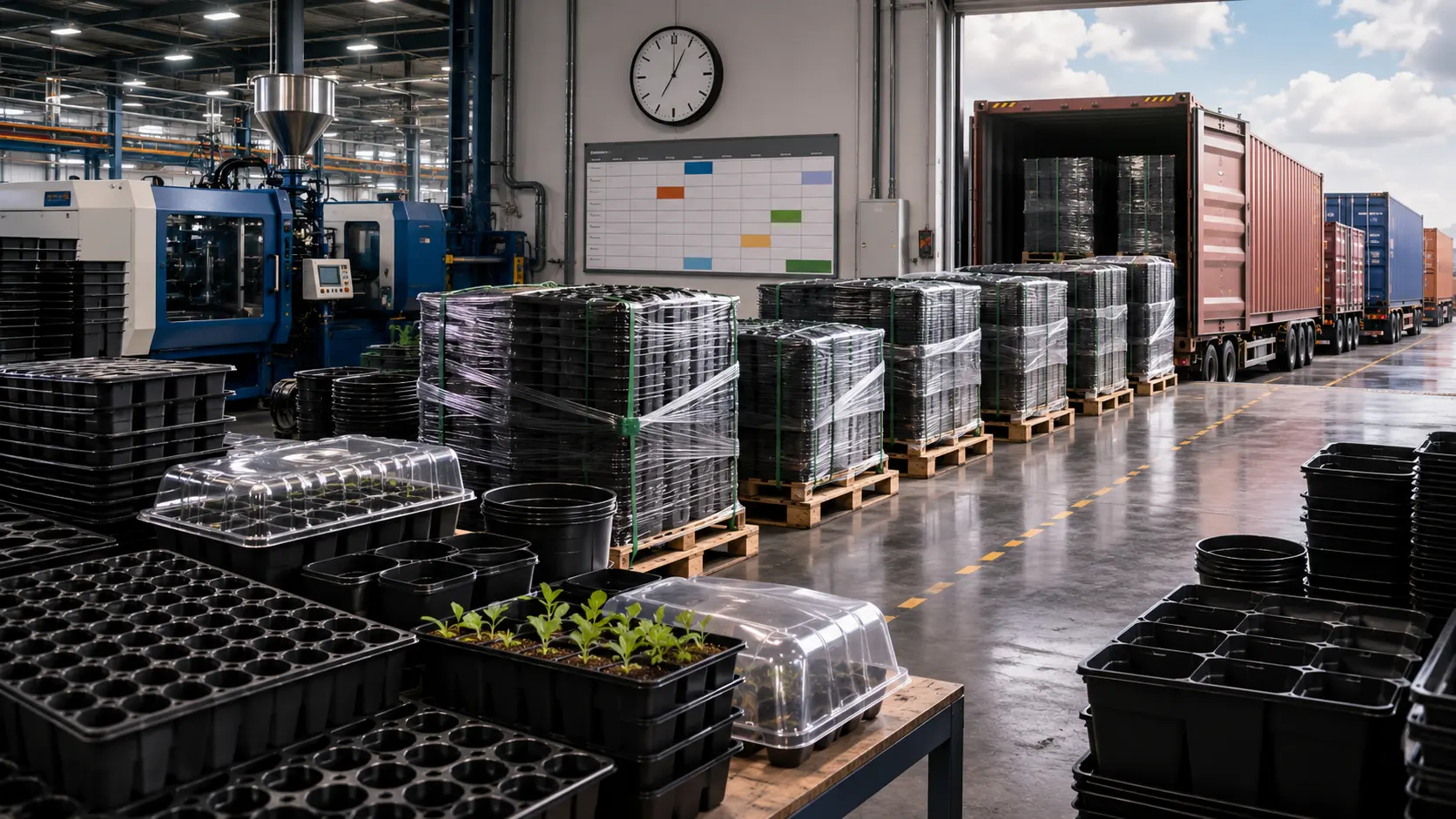
A factory that produces 100,000 trays a month sounds impressive. But if ten customers share that production line, your 5,000-piece order is waiting for a slot — and during peak season, that wait gets longer. Capacity is not the same as commitment.
During peak season — January through March for nursery supplies in China, when growers worldwide order for spring — lead times can extend 50 to 100 percent beyond off-season estimates, based on industry experience.
Understanding the MOQ structure helps you plan realistically:
| MOQ Type | Typical Range | What It Means |
| Carton MOQ | 80–150 pieces per carton | Minimum purchase in factory-original packing |
| Production MOQ | 1,000–10,000 pieces | Minimum quantity the factory will schedule for a production run |
| Custom MOQ | 5,000–50,000 pieces | Minimum for custom colors, logos, or packaging modifications |
Freight timing reference (based on industry experience):
- Courier: 3–7 days
- Air freight: 7–15 days
- Sea freight: 25–45 days
For a full explanation of carton, production and customization thresholds, see our detailed nursery supply MOQ guide.
These are transit estimates only. Full lead time includes sample approval, production scheduling, packing, export handling, customs clearance, and final-mile delivery — each of which adds days. To place every stage against your seasonal deadline, build an annual nursery supplies purchasing plan.
What to ask: What is the current monthly output for this product? How many active customers share this production line? What is the realistic lead time for a first order placed in peak season versus off-season? Get the answer in writing, not as a verbal promise.
For a first order, consider placing a trial order during the off-season. You will get a more realistic picture of the supplier’s actual lead-time performance — and you will not be competing with spring-season demand.
8. Use a Supplier Scorecard
Individual impressions are unreliable. A supplier who responds quickly to emails may deliver late. A factory with impressive floor space may produce inconsistent batches. A scorecard turns subjective impressions into trackable data. For a broader TQRDC-based review and final approval system, use the complete nursery supplier qualification checklist.
Based on the TQRDC framework (Technology, Quality, Responsiveness, Delivery, Cost) and adapted for nursery supply sourcing, here is a weighted scorecard:
| Dimension | Weight | What to Measure | Data Source |
| Quality | 40%* | Unit weight deviation rate, dimensional tolerance compliance, visual defect rate, functional test pass rate | Inspection reports |
| Delivery | 25%* | On-time delivery rate, peak-season lead-time stability, urgent order response time | Order records |
| Cost | 20%* | Unit price competitiveness, annual price stability, landed-cost advantage | Quotation history |
| Service | 15%* | Inquiry response speed, problem resolution time, corrective action report quality | Communication records |
Weights adapted from the TQRDC framework and AHP-based supplier evaluation research, adjusted for nursery supply sourcing based on industry experience.
You just received a batch that was five days late and eight grams light. Under this scorecard, quality takes a hit on the weight deviation, delivery takes a hit on the late arrival — and the overall score tells you whether this supplier is trending toward conditional status or still within acceptable range.
Scoring: Rate each metric on a 1–5 scale (1 = poor, 5 = excellent). Multiply by the dimension weight. Total score determines the supplier tier:
| Tier | Score | Action |
| A — Approved | ≥ 85 | Increase order share |
| B — Conditional | 70–84 | Approve with improvement targets |
| C — Watch | 60–69 | Limit new orders; require corrective actions |
| D — Exit | < 60 | Phase out; source alternative |
This is not a one-time exercise. Update the scorecard after every order cycle. A supplier who performed well on the first order may drift on the third — and the scorecard will show it before the problem becomes a crisis.
Got a supplier you are evaluating? Send us the product list — we can walk through these eight steps with you and compare what you find.
FAQ
Can a factory video replace a pre-shipment inspection?
No. A factory video shows the production environment and general capability. It does not verify that a specific production batch meets your approved specifications for weight, dimensions, defects, and packing. Only a batch-level inspection — using your reference sample data — can confirm that.
How do I know if a supplier is a manufacturer or a trading company?
Ask directly, then verify. Request photos or video of the production line for the specific product you are buying — not general facility footage. If the supplier sources some products externally, they should be able to tell you which ones and explain how those products are quality-controlled.
What is the most important specification to lock at sample approval?
Unit weight. In nursery plastics, weight reduction between sample and mass production is the most common and the hardest-to-detect quality issue. A tray that is 10–15 grams lighter than the approved sample may look identical but, based on industry experience, is more likely to flex under load, warp faster, and have a shorter service life. Lock the weight range in your purchase order and verify it at inspection.
Should I visit the factory before placing the first order?
A factory visit provides valuable context — you see the equipment, the organization, and the people. But a visit alone does not guarantee batch quality. The most effective approach is to combine a visit (or a third-party audit) with a controlled trial order and a pre-shipment inspection that checks against your approved specifications.
What happens if a supplier discontinues a product I depend on?
You need to find a compatible replacement, test it with your existing components and equipment, and transition your inventory. This process can take weeks — or longer if retooling or re-qualification is required. To reduce the risk, ask about product continuity before you standardize on any SKU, and consider approving a backup specification from a second source before you need it.
Turn your supply list into a practical shipping plan.
Got a supply list and a destination? Talk to us. We will figure out the sourcing, packing, and freight plan together.
Send the list first. Detailed specifications can be confirmed afterward.
Written by
ScarecrowGarden
💡About Scarecrow Garden Supplier Co., Ltd.
Scarecrow Garden Supplier Co., Ltd. is a China-based sourcing and wholesale partner specializing in garden tools, landscaping equipment, and outdoor supplies for international wholesalers, distributors, contractors, and brands.
With hands-on experience rooted in real garden use scenarios, we focus on durable materials, functional design, and stable large-volume supply. Our product range covers pruning tools, watering systems, hand tools, outdoor hardware, and customized garden solutions to support both retail and professional landscaping markets.
Beyond products, we help our partners navigate supplier selection, quality control, compliance requirements, and long-term sourcing strategies in China. Through our blog, we share practical insights on product selection, material comparisons, industry trends, and cost-effective purchasing—helping global buyers build stronger, more competitive supply chains.