









Local vs Overseas Wholesale Nursery Supplies: Cost & Import Guide | Scarecrow Garden Supplier
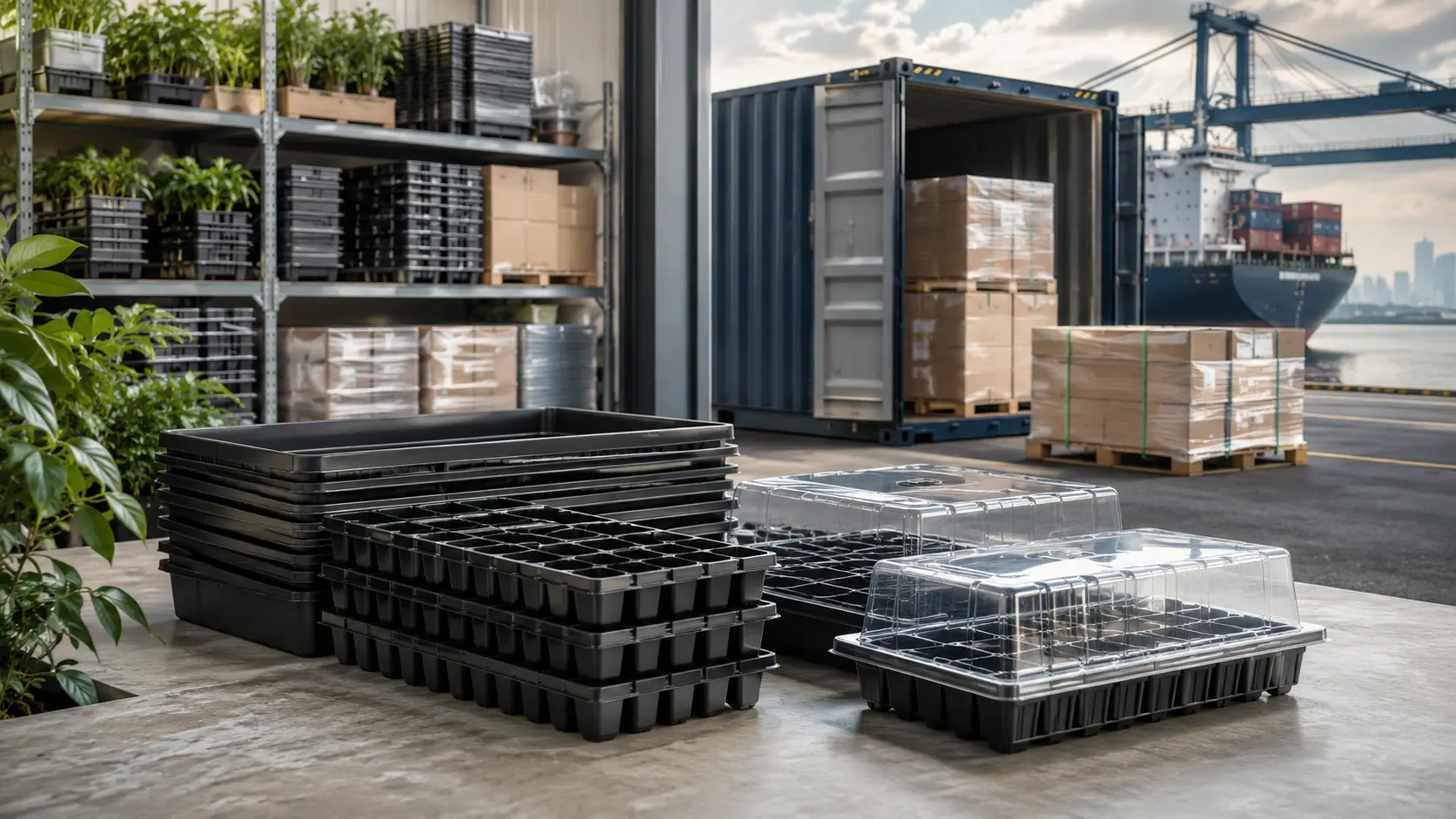
Most commercial nurseries buy locally because it is familiar, fast, and low-risk. But when you are reordering the same trays, domes, and inserts season after season, local pricing adds up. Importing from overseas manufacturers can reduce per-unit cost significantly—but only if your order volume is large enough to absorb shipping, duties, and the fixed costs of working with a distant supplier.
Why Nurseries Prefer Local Suppliers
Local distributors solve a real problem: you need it now, and they have it on the shelf. When a heat wave cracks your humidity domes mid-season, or a new crop requires a cell count you have not ordered before, the local supplier gets you through the week.
The advantages are straightforward. You can see and feel the product before you commit—and if something is wrong, returns and replacements are a phone call away. Delivery is measured in days, not weeks, and you are working with someone who understands your regional market—what crops are common, what sizes move fastest, what your growing season looks like.
For low-volume, unpredictable, or rush purchases, local supply is hard to beat. The question is whether it should also be your source for the predictable, high-volume products you order every single year.
Where Local Purchasing Becomes Expensive
Here is the part that creeps up on you. That same tray you buy from a local distributor for $2.50 may have left a factory at$0.60 FOB. That gap covers their warehouse, freight, returns, and margin. You are paying for convenience—and that is fair. Based on industry experience, the typical markup from FOB to what a nursery pays locally ranges from 2× to 5× the factory price. The question is whether you should pay for it on every single order.
That multiplier matters most on products you buy in bulk and buy repeatedly. Seedling trays, base trays, humidity domes, standard pots—these are not one-off purchases. They are consumables. If you are buying 5,000 trays a year through a local distributor at 3× FOB, the premium you pay over importing is substantial.
There are also hidden costs that do not show up on the invoice. Limited SKU selection means you might settle for a cell count or tray weight that is close enough rather than exactly right. Seasonal stockouts at the distributor level can delay your propagation schedule. And customization—your brand color, your logo, a specific packaging format—is usually not on the table.
Want to see the actual math for your operation? Share what you pay locally—and we will run a side-by-side comparison.
Which Products Travel Well and Which Do Not
Not every nursery product is a good candidate for overseas sourcing. Here is a quick way to sort your product list—ask one question: can this item survive 45 days in a container and still cost less than buying it down the road?
Suitable for planned overseas sourcing:
| Product Characteristic | Why It Works |
| Lightweight but voluminous (trays, domes) | Sea freight charges by CBM; these products fill space efficiently |
| Highly standardized (1020 system components) | Specifications are repeatable; less risk of miscommunication |
| Consumed in large, predictable quantities | Fixed import costs spread across more units |
| High local markup (2×–5× FOB, based on industry experience) | Wider gap to absorb import overhead |
| No live plant or quarantine restrictions | Customs clearance is straightforward |
Not suitable for overseas sourcing:
| Product Characteristic | Why It Does Not Work |
| Oversized or extremely heavy (large ceramic pots) | Freight cost may exceed product value |
| Fragile (glass cloches, thin ceramics) | Breakage risk inflates landed cost |
| Live plants, soil, or growing media | Phytosanitary restrictions complicate or block import |
| Urgent replenishment needs | Ocean transit alone is 25–45 days; add production and customs |
| Very low unit price with high volume-to-weight ratio | Shipping can cost more than the product itself |
The pattern is clear: standardized plastic nursery supplies that you order in quantity every year are the strongest candidates. Unique, fragile, or rush items are better left to local sources.
Five Cost Layers Beyond Unit Price
Comparing a factory quote to a local distributor price is not a fair comparison. You need to account for every cost layer between the factory gate and your nursery shelf. Here is what sits between FOB and landed cost:
| Cost Layer | What It Includes | Typical Range |
| 1. Product cost | FOB unit price × quantity | The baseline |
| 2. Packaging and preparation | Export cartons, pallets, corner protection, labeling | Varies by product and packing method |
| 3. International freight | Ocean (CBM-based), air (chargeable weight), or courier | Depends on volume, route, and season |
| 4. Duties, fees, and customs | Import duties (HTS-based), MPF (approximately 0.3464% of declared value, per U.S. CBP), HMF (approximately 0.125% for ocean, per U.S. CBP), broker fees | Duties vary by HTS code and trade policy; must be verified per shipment |
| 5. Damage, shortage, and capital cost | Broken units, missing pieces, rejected items; plus the opportunity cost of capital tied up in inventory during 6–8 weeks of transit | Typically 3–5% based on industry experience, varies by product and packaging; capital cost depends on order value and transit time |
Important notes on duties: Plastic nursery supplies commonly fall under HTS 3926.90 in the United States, with MFN base rates around 3.4%–6.5%. However, additional tariffs—including Section 301 surcharges on goods from China, and potentially IEEPA-related tariffs or other trade actions—can raise the effective rate significantly. Rates change. Trade policy changes. You must verify the applicable rate for your specific product and shipment date before making a cost decision. Do not rely on a fixed percentage from any article, including this one.
The formula for real unit cost is not complicated, but it is often overlooked:
Landed Cost per Usable Unit = (Product + Packaging + Freight + Duties & Fees + Damage Allowance) ÷ Usable Units
Notice that the denominator is usable units, not ordered units. If you order 1,000 trays and 40 arrive cracked, your real cost per unit is the total divided by 960—not 1,000.
The Break-Even Quantity Method
Importing has fixed costs that local purchasing does not: sample fees, inspection costs, minimum freight charges, customs brokerage. These costs exist whether you import 100 units or 10,000. The question is: how many units do you need to order before the per-unit savings from importing outweigh those fixed costs?
A simplified break-even formula:
Break-Even Quantity = Fixed Import Costs ÷ (Local Unit Price – Import Landed Cost per Unit)
If your fixed import costs are $800 (samples, inspection, brokerage, minimum freight), and the landed cost per tray is$0.90 versus $2.50 locally, the break-even point is:
$800 ÷ ($2.50 – $0.90) = 500 trays
Below 500 trays, local purchasing may still be cheaper. Above 500, importing starts to save money—and the savings grow with every additional unit.
Five variables shift where that line falls:
| Variable | Effect on Break-Even Quantity |
| Higher local markup | Lowers break-even (importing becomes attractive sooner) |
| Higher fixed import costs | Raises break-even (need more volume to absorb) |
| Lower product unit price | Raises break-even (small savings per unit need more units) |
| Higher tariff rates | Raises break-even (reduces the import price advantage) |
| Higher annual purchase frequency | Favors importing (repeat orders spread fixed costs over time) |
The point is not to calculate a precise number—it is to know whether your volume is in the right ballpark before you request a quote.
Share your current local price and annual volume. We can estimate your break-even point—and if the numbers look right, add a freight quote for your delivery address.
Planned Imports + Local Emergency Stock
The most practical approach for most nurseries is not an either-or decision. It is a dual-supply strategy: planned imports for predictable, high-volume products, and local suppliers for emergency replenishment, small-quantity needs, and new-product testing.
When a container of humidity domes is delayed two weeks at port, the nursery that has a local distributor on speed dial keeps propagating. The one that went all-in on imports stops. Operations that split their supply between a cost-focused overseas source and a speed-focused local source handle disruptions better than those relying on a single channel—this is not theory, it is what we see in practice.
How it works in practice:
- Overseas (primary): Annual quantities of standard trays, inserts, domes, and pots. Ordered in advance, shipped by sea, inspected before dispatch. These are products you know you will need, in quantities you can forecast.
- Local (backup): Emergency top-ups during peak season, small trial quantities for new crops, and any product that cannot wait 6–8 weeks for delivery.
This is not about replacing your local distributor. It is about reserving them for what they do best—speed and flexibility—while using planned imports to bring down the cost of your most repetitive purchases.
A few implementation points matter. Plan your import orders backward from the date you need the products in hand, not the shipping date. Maintain a safety stock buffer to cover overseas lead-time variability. And pre-approve one or two local substitute products so you are not scrambling if an overseas shipment is delayed.
Case Example: One Sample → 1,000 Matched Sets
Here is what the progression looks like from first contact to a trial order.
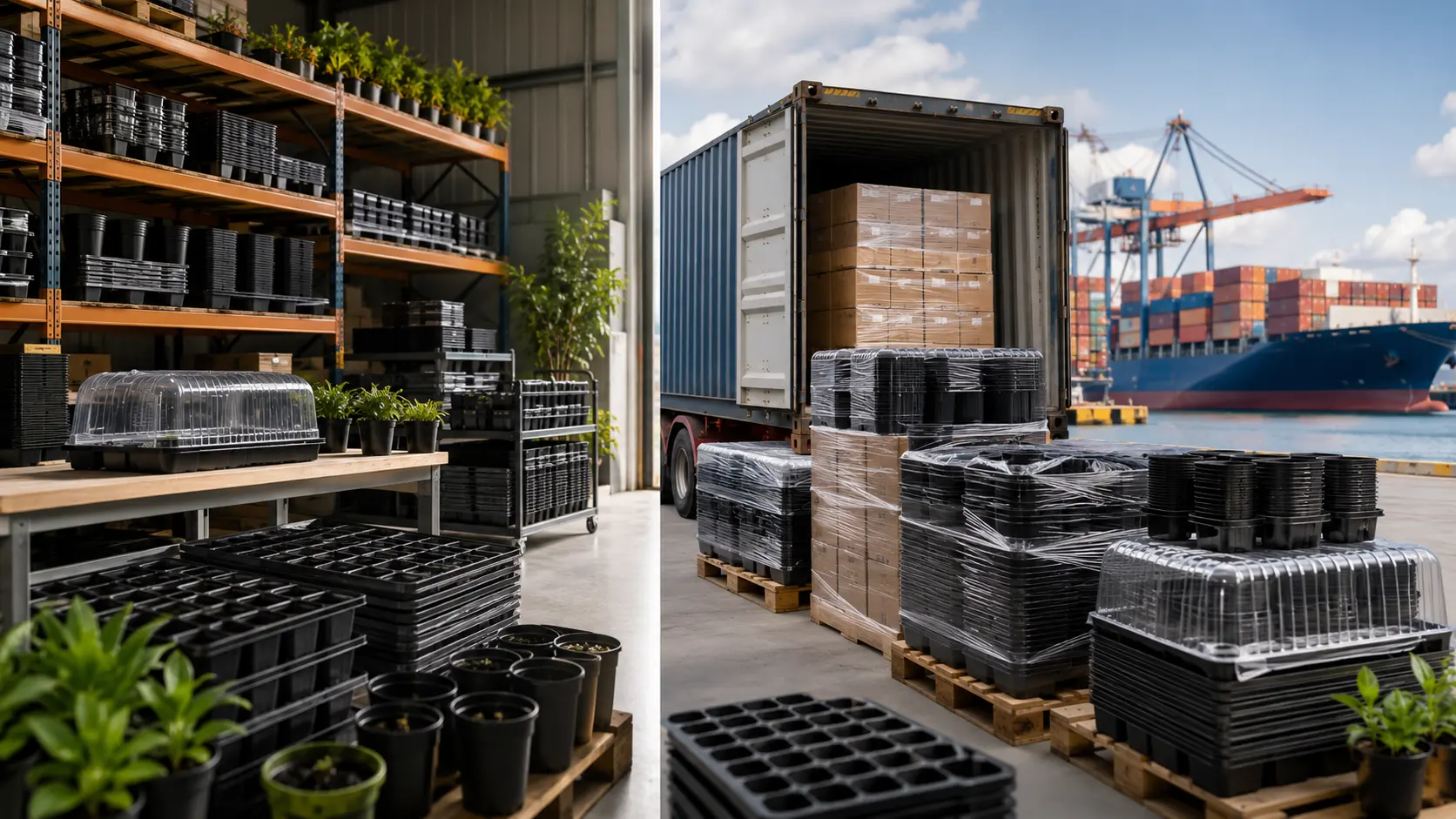
Step 1: One sample. A nursery owner requests one complete 1020 set—base tray, plug insert, humidity dome. The sample itself is inexpensive; most of the cost is express freight, which varies by destination. Expect roughly $30–$80 for door-to-door delivery to the U.S., based on industry experience. The sample confirms material feel, exact dimensions, and whether the three components fit together. It does not confirm batch consistency or long-term durability. One sample is a start, not a guarantee.
Step 2: The trial order. After the sample is approved, the nursery orders 1,000 matched sets. Here is what that means in practice:
| Component | Net Weight per Piece | Original Carton Quantity |
| Humidity dome | 0.230 kg | 100/carton |
| Base tray | 0.245 kg | 80/carton |
| Plug insert | 0.150 kg | 150/carton |
Total net product weight: 1,000 × (0.230 + 0.245 + 0.150) = 625 kg.
625 kg of product, three different carton counts—and one problem that catches almost every first-time buyer.
The problem is obvious: 100, 80, and 150 do not divide evenly into 1,000. If you accept factory-original cartons, you end up with mismatched component quantities—extra domes you cannot use, or not enough inserts to complete every set. This is where matched-set repacking matters. The components are unpacked, counted, and re-packed into complete sets so you receive 1,000 usable systems, not three piles of mismatched parts.
Final carton count, gross weight, and CBM must be measured after repacking—not estimated from factory packing data.
Step 3: Evaluate and plan. After receiving the trial order, the nursery assesses real-world performance: handling under load, breakage rate, compatibility with benches and equipment. If the product passes, the trial data feeds into an annual purchasing plan with staged deliveries.
Decision Checklist for Nursery Owners
Use this checklist when deciding whether to request an overseas quote for a product you currently buy locally:
- Is annual usage predictable and at least moderate? If you buy fewer than a few hundred units per year, the fixed costs of importing may not be worth it.
- Is the product standardized? Standard sizes, weights, and materials reduce the risk of miscommunication with a distant supplier.
- Is local markup 2× FOB or higher? The wider the gap, the faster importing pays off.
- Can you wait 6–8 weeks for delivery? If the product is needed this week, import is not the right channel for this order.
- Do you have a local backup source? A dual-supply strategy requires at least one local option for emergencies.
- Have you verified the applicable tariff rate? Duties can change. Check the current HTS classification and any applicable surcharges before committing.
- Can you start with a sample? Approving one physical sample before a bulk order eliminates the biggest risk of overseas sourcing—getting something different from what you expected.
- Is the product durable enough for shipping? Standard plastic trays and domes travel well. Fragile or oversized items may not.
If you checked most of these boxes, it is worth getting an overseas quote. If several are unchecked, local purchasing may still be your best option for that product.
FAQ
Does importing always save money? No. It depends on your volume, the product, the applicable tariff rate, and the local price you are currently paying. Below a certain quantity threshold, the fixed costs of importing make local purchasing cheaper. The break-even method in this article helps you estimate that threshold.
How do I find out the exact duty rate for my product? Look up the HTS (Harmonized Tariff Schedule) code for your product on the USITC website (hts.usitc.gov) and verify any additional tariffs that may apply. Rates change with trade policy, so check before each order. Your customs broker can also confirm the classification and rate.
What if the overseas shipment arrives with quality problems? For the full pre-order review, follow our manufacturer evaluation process before a bulk order. This is why sample approval and pre-shipment inspection matter. Approve a reference sample first, then use its specifications—dimensions, weight, material, fit—as the inspection standard for the production batch. If problems are found before shipping, they can be addressed at the factory. After delivery, the recourse depends on your commercial terms and the nature of the defect.
Can I mix different products in one overseas shipment? Yes. Consolidating multiple products—different cell counts, tray weights, dome heights—into one shipment is one of the main advantages of working with a supply team that has warehouse capability. It reduces per-unit freight cost and lets you test multiple SKUs without placing separate orders.
What does “door-to-door” actually include? Door-to-door describes the route—from the supplier’s location to your delivery address. It does not automatically mean duties and taxes are included. Always confirm in writing whether your quote covers export clearance, import duties, customs brokerage, and final-mile delivery. DAP and DDP (Incoterms® 2020) define who pays duties and handles customs along that route—door-to-door tells you where the shipment starts and ends; Incoterms tell you who pays for what in between.
Share your current local purchase price, annual volume, and delivery address. We can calculate an import break-even estimate so you can compare with real numbers—not assumptions.
Not ready for a full order? Request one reference sample first and decide with real dimensions, material, and fit in hand.
Compare Local Buying with Real Import Numbers
Share your current local purchase price, annual volume, and delivery address. We can calculate an import break-even estimate based on your actual figures—not assumptions.
Not ready for a full order? Request one reference sample first and check the real dimensions, material, and fit in hand.

Written by
ScarecrowGarden
💡About Scarecrow Garden Supplier Co., Ltd.
Scarecrow Garden Supplier Co., Ltd. is a China-based sourcing and wholesale partner specializing in garden tools, landscaping equipment, and outdoor supplies for international wholesalers, distributors, contractors, and brands.
With hands-on experience rooted in real garden use scenarios, we focus on durable materials, functional design, and stable large-volume supply. Our product range covers pruning tools, watering systems, hand tools, outdoor hardware, and customized garden solutions to support both retail and professional landscaping markets.
Beyond products, we help our partners navigate supplier selection, quality control, compliance requirements, and long-term sourcing strategies in China. Through our blog, we share practical insights on product selection, material comparisons, industry trends, and cost-effective purchasing—helping global buyers build stronger, more competitive supply chains.