







Updated 3 months ago
Wholesale Nursery Supplies Buying Guide: How Commercial Growers Source Trays, Pots, Domes and Propagation Products

ScarecrowGarden
💡About Scarecrow Garden Supplier Co., Ltd.
Scarecrow Garden Supplier Co., Ltd. is a China-based sourcing and wholesale partner specializing in garden tools, landscaping equipment, and outdoor supplies for international wholesalers, distributors, contractors, and brands.
With hands-on experience rooted in real garden use scenarios, we focus on durable materials, functional design, and stable large-volume supply. Our product range covers pruning tools, watering systems, hand tools, outdoor hardware, and customized garden solutions to support both retail and professional landscaping markets.
Beyond products, we help our partners navigate supplier selection, quality control, compliance requirements, and long-term sourcing strategies in China. Through our blog, we share practical insights on product selection, material comparisons, industry trends, and cost-effective purchasing—helping global buyers build stronger, more competitive supply chains.

Wholesale Nursery Supplies
If you run a commercial nursery, you already know the routine: order trays in January, scramble for replacement domes in March, and wonder by June why half your plug inserts came from three different suppliers with three different specs. Sourcing nursery supplies at scale is not the same as picking up a few trays at the local garden center — and the gap between “buying locally” and “buying smart” gets wider every year.
This guide is for commercial nursery owners, propagation managers, and purchasing teams who buy trays, pots, domes, and propagation products in quantities that make unit price, batch consistency, and freight efficiency matter. It walks through the full purchasing path — from understanding what your nursery actually consumes each year, to specifying products that fit your benches and equipment, to getting those products from a factory floor to your loading dock without surprises.
If your annual nursery supply spend is five figures or more, and you have ever wondered whether importing makes financial sense — or how to start with just one sample — this is where to begin.
Who This Guide Is For
Whether you run a propagation nursery that burns through plug trays by the thousand every season, a tissue culture operation that depends on high domes and vented lids for the critical flask-to-greenhouse transition, or a garden center that needs supplies that work on the bench and look right on the retail floor — if your annual nursery supply spend is five figures or more, this guide is for you.
It is also for online plant sellers who need compact propagation kits and damage-resistant shipping containers, and for container nurseries that buy pots, root-control bags, stakes, and ties in consistent sizes year after year.
If you are a home gardener looking for a few seed-starting trays, this guide will cover more ground than you need. But if getting the wrong size, weight, or batch has ever cost you time or money — keep reading.
What Commercial Nurseries Buy Throughout the Year
Nursery supply purchasing is not a one-time event. It follows the production calendar, and different products hit different urgency levels depending on the season and the crop.
The table below maps the main product categories by production stage, purchase frequency, and whether they are practical to import from overseas suppliers.
| Production Stage | Core Supplies | Purchase Frequency | Practical to Import? |
| Propagation / Seed Starting | Plug trays, base trays, humidity domes, heat mats, labels | Every season / annually | Yes — standardized plastic parts, high repeat consumption |
| Transplanting / Growing On | Nursery pots, root-control bags, stakes, ties, ground cover | Per season / as needed | Yes — standardized containers and accessories |
| Daily Operations | Gloves, spray bottles, pruners, marking tags | As needed | Partial — some items suit local purchase better |
| Shipping / Order Fulfillment | Transport trays, packaging materials, carton labels | Per shipment volume | Partial — custom packaging may require higher MOQ |
| Retail Display | Display racks, price cards, branded stickers | One-time / as needed | Partial — high customization may increase MOQ |
A few patterns stand out. Propagation supplies — trays, inserts, and domes — are the most import-friendly category: they are lightweight but bulky, highly standardized, consumed in large volumes every season, and based on industry experience, typically marked up 2–5× by local distributors. That markup is what makes overseas sourcing worth considering.
How big is the market behind these numbers? According to the 2019 USDA Census of Horticultural Specialties, U.S. horticultural product sales totaled $13.8 billion, with nursery stock alone accounting for$4.55 billion. Eighty-six percent of those sales were wholesale. The 2024 Census data is scheduled to be released in February 2026, so the 2019 figures remain the most recent verified baseline.
What does this mean for a nursery buyer? The industry is large and concentrated — the number of operations dropped 11% between 2014 and 2019 while total sales stayed flat — and heavily wholesale. Fewer operations are buying more supplies. That makes purchasing efficiency a competitive advantage, not just a cost line.
Local Purchasing vs Planned Overseas Sourcing
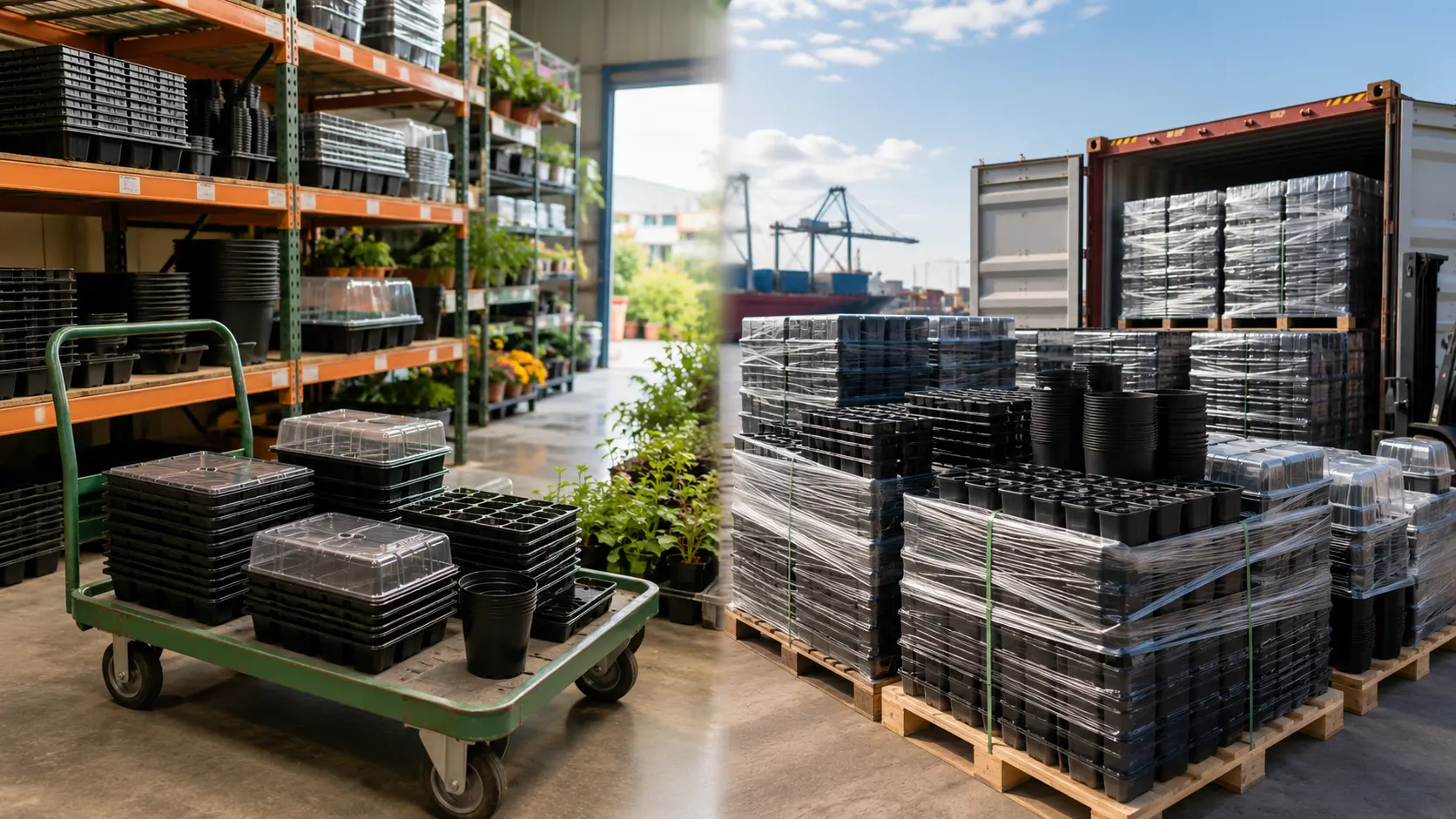
Here is the short version: importing does not replace your local supplier. It complements it.
Local distributors solve a real problem — you need 200 base trays by Friday, and they have them in stock. They handle returns, they carry the brands you know, and you can drive over and pick up what you need. That speed and convenience has a price, and for high-volume, repeat-purchase items, that price adds up.
Overseas sourcing solves a different problem — you know you will need 5,000 plug trays, 5,000 matching domes, and 5,000 base trays every spring, and you can plan for that. The unit cost is lower, the spec options are wider, and you can consolidate products from multiple factories into one shipment.
The practical approach is a dual-supply model:
- Planned purchases → overseas sourcing: Products you use in predictable volumes every season. Standardized plastic items — plug trays, base trays, humidity domes, nursery pots — where you can lock in specs, approve a sample, and schedule production and freight well in advance.
- Emergency replenishment → local suppliers: Sudden demand, small-quantity top-ups, new product tests, and anything where the lead time of overseas production and shipping does not fit your timeline.
This is not about choosing one over the other. It is about putting each purchase in the right channel. For a cost-based decision, use our local-versus-overseas nursery supplier cost comparison.
How to Decide: Local or Import?
| Factor | Local Distributor | Overseas Sourcing |
| Unit price | Higher (based on industry experience, typically 2–5× FOB) | Lower FOB, but add five cost layers |
| Minimum order | Flexible, often per-piece | MOQ applies (carton, production, or custom level) |
| Lead time | Same day to 3 days | Sample: 5–10 days; bulk: 30–60 days door-to-door |
| Spec variety | Limited to distributor stock | Wide — multiple factories, molds, and materials |
| Returns and exchanges | Straightforward | Cross-border returns are costly and slow |
| Freight | Included or low | Must be calculated separately |
| Damage risk | Low | Must be factored into landed cost |
| Batch consistency | Managed by distributor | Requires sample approval and pre-shipment inspection |
The key question is not “Is importing cheaper?” It is: “At what volume does the total landed cost of importing become lower than the local price — and can I plan far enough ahead to reach that volume?”
Want to see the math for your own operation? Tell us what you are paying locally, how much you buy per year, and where it needs to go. We will run the landed-cost comparison so you can decide with real numbers.
Which Nursery Supplies Are Suitable for Importing
Not everything belongs on a container. Some products travel well; others are better sourced locally.
Products that suit overseas sourcing are light but bulky, highly standardized, consumed in large volumes every season, based on industry experience marked up 2–5× by local distributors, and not subject to plant quarantine restrictions. Plastic trays, domes, and inserts check every box.
Products that usually stay local include oversized or heavy items (large ceramic pots), fragile goods (glass cloches), live plants and regulated substrates (quarantine complications), and anything you need this week.
Here is what this looks like in practice. A nursery in Oregon orders 1,000 complete propagation sets — base trays, plug inserts, and humidity domes. The domes come from one factory, the inserts from another, and the base trays from a third. Each factory packs in its own carton quantities. Someone has to receive all three products, verify the counts, check the quality, and either ship them as-is or repack them into matched sets.
That “someone” is the part most buyers do not think about until they are staring at 30 cartons of domes, 25 cartons of base trays, and 15 cartons of inserts — and none of the numbers divide evenly. This is where warehouse consolidation and matched-set repacking turn a logistics headache into a usable delivery.
How to Specify Trays, Inserts, Domes and Pots
You approved a 1020 dome on paper. When it arrives, it sits loose on your base tray and leaks humidity like a sieve. This is the compatibility problem — and it is more common than you think. Most sourcing problems trace back to one root cause: the buyer and the supplier were not talking about the same product.
The 1020 System: Three Parts That Must Work Together
The most common propagation setup in commercial nurseries is the 1020 tray system — a three-part assembly. Here is what the three parts look like on paper:
| Component | Common Name | Function | Typical Specs |
| Base tray | 1020 flat | Carries the insert; holds or drains water | Approx. 10“ × 20” (254 × 508 mm); available with or without drainage holes |
| Plug insert | Plug tray / plug flat | Holds growing media and seeds | 540 × 280 mm; 21 to 512 cells; PS or PP; 0.7–1.2 mm thickness |
| Humidity dome | Propagation dome / humidity lid | Retains moisture and heat during germination and rooting | Low dome (2–3”), medium (4–5”), or high (6–7“+); with or without adjustable vents |
Each part is simple on its own. The trouble starts when you assume that any “1020” dome fits any “1020” base tray. It does not — or at least, not always.
The Compatibility Warning
“1020” is a name, not a guarantee. Actual dimensions vary by ±0.25 to 0.5 inches across brands. Corner radius, rim width, lip design, and wall taper all affect whether a dome snaps onto a base tray securely or sits loose and leaks humidity. A plug insert that fits perfectly in one brand’s base tray may rattle around in another’s.
This is not a theoretical risk. It is the single most common complaint from nursery buyers who sourced trays and domes separately. The fix is straightforward but non-negotiable: test a physical sample set before ordering in bulk. Measure the outer dimensions, the rim width, the corner radius. Place the dome on the tray. Check the fit. Then approve the spec.
We cover this in detail in our 1020 tray compatibility guide, but the principle applies to every product: the name on the catalog page is not a substitute for a caliper and a test fit.
What to Specify Beyond the Name
When you request a quote or approve a sample, the basics matter — exact outer dimensions, material (PS, PP, or PET), cell count and depth, dome height and vent type, and whether you need standard or custom colors.
Two details deserve extra attention because they cause the most problems:
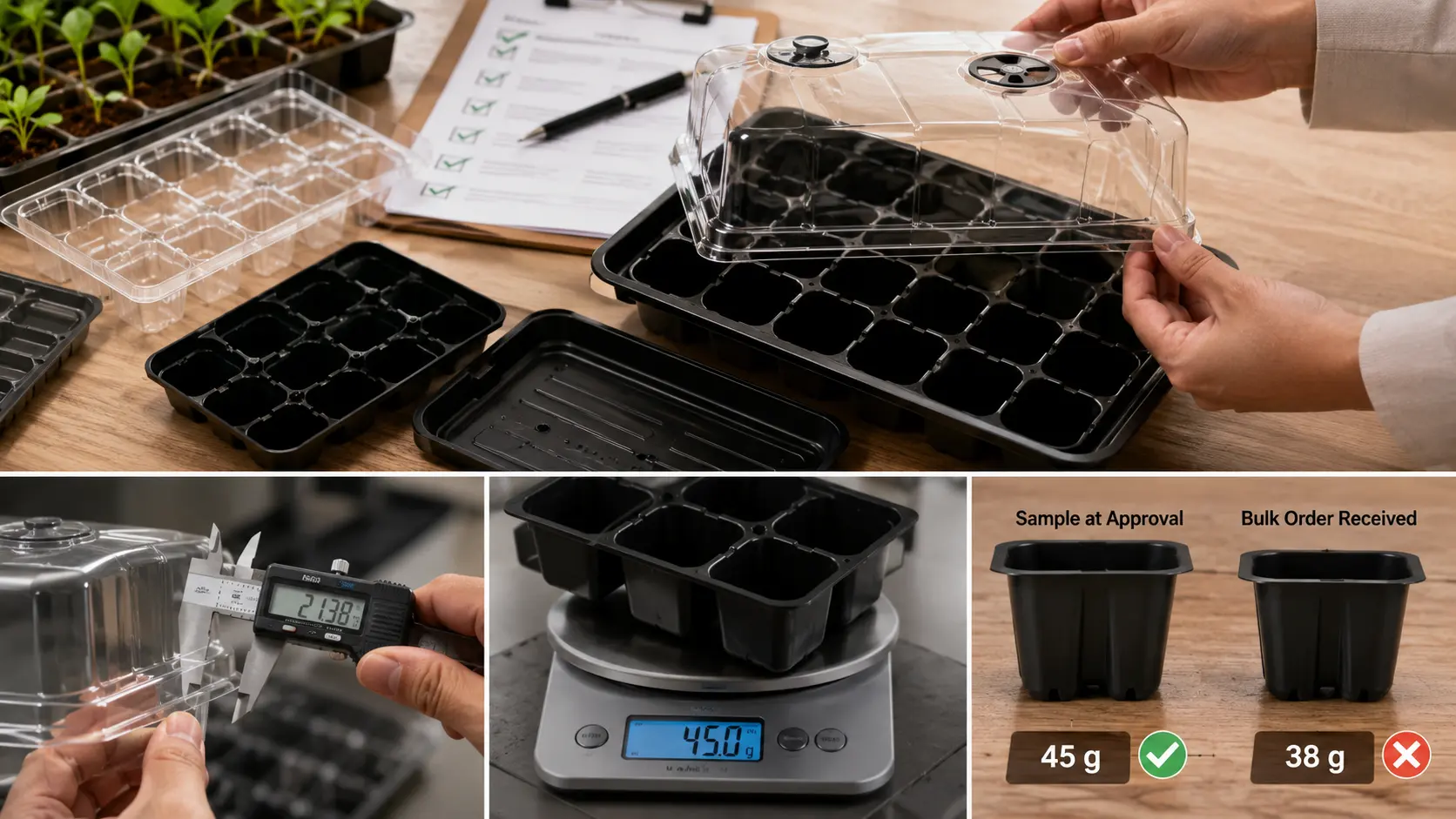
- Unit weight — specify a target range in grams, not just a nominal thickness. A factory can thin the walls and keep the same mold. Weight is harder to cheat. If your approved sample weighs 45 grams and the production batch comes in at 38, you know something changed — even if the tray looks identical.
- Drainage hole configuration — hole diameter, spacing, and whether holes are on the bottom only or the bottom and sides. Blocked or inconsistent drainage holes are one of the most common functional defects, and they directly affect root health and watering efficiency.
The more of these you lock down before production, the fewer surprises after delivery.
MOQ, Mixed Orders and Matched-Set Repacking
MOQ is where good sourcing plans go to die — unless you understand which type applies to your order. Our nursery supply MOQ and mixed-order guide explains carton MOQ, production MOQ, custom MOQ and matched-set repacking in more detail.
Three Types of MOQ
Not all MOQs are the same. The one that matters for your order depends on what you are buying and how:
| MOQ Type | What It Means | Typical Range |
| Carton MOQ | You buy in original factory carton quantities | 80–150 pieces per carton |
| Production MOQ | The factory’s minimum run for a standard product | 1,000–10,000 pieces |
| Custom MOQ | Minimum order for custom colors, logos, or packaging | 5,000–50,000 pieces |
For a first order, carton MOQ is usually the relevant threshold. You are not committing to a full production run; you are buying by the carton from existing stock or a scheduled production batch.
The Matched-Set Problem: A Real Example
Here is where MOQ meets reality. Say you order 1,000 complete propagation sets — one dome, one base tray, and one plug insert per set. Sounds simple. But each component ships in different carton quantities:
| Component | Unit Weight | Factory Carton Qty | 1,000 Pieces = |
| Humidity dome | 0.230 kg | 100/carton | 10 cartons |
| Base tray | 0.245 kg | 80/carton | 12.5 → 13 cartons |
| Plug insert | 0.150 kg | 150/carton | 6.67 → 7 cartons |
The net weight of 1,000 complete sets is 625 kg. But the carton counts do not divide evenly. If you order by original factory cartons, you end up with mismatched inventory — 10 cartons of domes, 13 cartons of base trays, 7 cartons of inserts — and no clean way to issue complete sets to your growing team.
This is the matched-set repacking problem, and it is more common than most buyers expect. The solution: have the warehouse break open the factory cartons and repack into matched sets. Every carton that leaves the warehouse contains the same number of complete, ready-to-use sets. No partial cartons. No “extra” base trays sitting in a corner.
The trade-off is that repacking adds labor and may change the final carton count, gross weight, and CBM. Those numbers must be measured after repacking — not estimated from the original factory packing. (For this reason, we do not publish a final CBM figure for the 1,000-set example until the repacked cartons are physically measured.)
What this means for you: when you order propagation sets, ask for matched-set packing. The alternative is receiving three separate pallets of components and doing the repacking yourself — which is exactly the kind of hidden labor cost that erodes the savings from importing.
That is one product. Now imagine ordering five different tray sizes from three factories, all going into one container.
You do not have to order one product at a time. Different items — different cell counts, different dome heights, even products from different factories — can be consolidated into one shipment. Products arrive at a central warehouse, get inspected, relabeled if needed, and repacked into a single container or LCL shipment headed for your address.
This is particularly useful for nurseries that need a range of tray sizes but cannot meet production MOQs for each one individually. By combining multiple SKUs into one order, you spread the fixed costs of freight and customs across more products.
The caveat: mixed packing may increase the per-unit handling cost, and not every factory’s packaging is designed to be broken down and reassembled. Confirm the packing plan before you confirm the order.
Sample Approval Before a Bulk Order
A sample is not a formality. It is the moment where you stop looking at photos and start holding the actual product. Get this right, and the bulk order has a measurable standard. Get it wrong — or skip it — and every dispute about weight, fit, or finish becomes a conversation without a reference point.
What One Sample Confirms — and What It Does Not
A single sample can confirm:
- Material and feel — Is it PS or PP? Rigid or flexible? Does the surface feel right?
- Dimensions and fit — Does the dome sit securely on the base tray? Does the insert drop in cleanly?
- Color and clarity — Is the dome clear enough for light transmission? Is the tray color consistent with what you expected?
- Functional operation — Does the vent open and close? Do the drainage holes actually drain?
That is what you can verify. Here is what you still cannot — and why the bulk order can still surprise you.
A single sample cannot prove:
- Batch consistency — one piece tells you that one piece is correct, not that the next 5,000 will match.
- Full service life — you cannot predict how many growing cycles a tray will survive from handling it once.
- That production will use the same material and weight — the sample is 45 grams; the bulk order arrives at 38. Same mold, thinner walls. This is the most common buyer complaint.
The prevention: lock the unit weight at sample approval, and use it as the inspection reference for every production batch.
One Sample or a Sample Pack?
If you know exactly what you need, a single sample confirms the fit. If you are still deciding — between a 72-cell and a 128-cell insert, or a low dome and a high dome — a multi-option sample pack lets you compare two to four variants side by side, on your bench, under your conditions. One shipment, one round of feedback, faster decision.
Not ready for a full order? Start with one sample or a mixed sample pack to compare sizes, weights, and configurations before committing to production quantities.
Packaging, Freight and Landed Cost
Unit price is where most conversations start. Landed cost is where they should end.
The difference between the two is five cost layers that many first-time importers underestimate — or discover only after the invoice arrives.
The Five Cost Layers Beyond Unit Price
1.Packaging — Export cartons, pallets, corner protectors, stretch wrap. If your products need repacking into matched sets, add that labor and material cost too.
2.Freight — Courier, air freight, or sea freight, calculated by chargeable weight or CBM depending on the method. Nursery plastics are often volume-sensitive — light but bulky — which means the freight cost per piece may be higher than you expect relative to the product cost.
3.Duties and taxes — Based on the HS code, declared value, and destination country. Rates change. Trade policies change. Do not use last year’s tariff as this year’s assumption.
4.Damage and loss — Cracked domes, warped trays, crushed cartons. A 3–5% damage allowance is a reasonable planning figure based on industry experience, but the actual rate depends on packing quality, transit conditions, and handling at destination.
5.Inventory and capital cost — Importing means buying in larger quantities and waiting longer for delivery. That ties up capital and requires storage space. Both have a cost.
The formula is straightforward:
Landed cost per usable unit = (Product cost + Packaging + Freight + Duties + Damage allowance) ÷ Usable units received
The denominator matters. If you ordered 1,000 trays and 30 arrived cracked, your landed cost per usable tray is based on 970 — not 1,000.
Three Shipping Methods, Three Use Cases
| Method | Best For | Typical Transit Time | Cost Basis |
| Courier (DHL, FedEx, UPS) | 1–2 samples or small trial orders | 3–7 days | Chargeable weight (actual or volumetric, whichever is higher) |
| Air freight | Trial orders, urgent replenishment | 7–15 days | Chargeable weight |
| Sea freight (LCL or FCL) | Bulk orders, annual supply | 25–45 days port-to-port; add customs and final-mile delivery | CBM (cubic meter) or per-container rate |
For samples, door-to-door courier is usually the simplest option. For bulk orders, sea freight offers the lowest per-unit cost — but only if you have enough volume to fill the space efficiently and enough lead time to accommodate the longer transit.
Door-to-Door ≠ DDP
This distinction matters, and it causes more confusion than almost anything else in cross-border purchasing.
- Door-to-door describes the service path — your order travels from the supplier’s location to your delivery address. It says nothing about who pays import duties or handles customs clearance.
- DAP (Delivered at Place) — the seller delivers to your address. You are responsible for import clearance, duties, and taxes.
- DDP (Delivered Duty Paid) — the seller takes maximum responsibility, including import clearance and duties. However, DDP requires the seller or their logistics partner to be legally able to complete import clearance in the destination country, which is not always possible.
Any freight quote you receive should state clearly:
- Is export customs clearance included?
- Is import customs clearance included?
- Are duties and taxes included?
- Is final-mile delivery included?
- Are there surcharges for residential delivery, remote areas, or liftgate requirements?
If a quote says “door-to-door” without answering those questions, ask before you approve it.
Quality Control and Supplier Risk
Approving a sample is not the end of quality management. It is the beginning. Before confirming mass production, follow this nursery supply manufacturer evaluation guide to verify product scope, technical data, mold continuity and production controls.
What to Inspect Before Shipment
When our inspectors open cartons at the warehouse, here is what they are looking for:
- Dimensions — outer length, width, height, rim width, corner radius. Compare against the approved spec.
- Unit weight — weigh 5–10 pieces from different cartons. Record the range. A 10% drop from the approved sample is a warning sign.
- Visual defects — flash, short shots, cracks, warping, stress whitening.
- Functional tests — dome fit, drainage flow, vent operation, insert-to-tray alignment.
- Packing and labeling — carton count, quantity per carton, shipping marks, label accuracy.
A proper PSI uses a sampling plan (such as ANSI/ASQ Z1.4 AQL standards) to select cartons and pieces from across the batch — not just the ones on top.
The “Sample Was Fine, Bulk Was Not” Problem
This usually comes down to one of two causes:
1.Weight reduction — same mold, less material. The tray looks identical but flexes more and cracks sooner. Lock the unit weight at sample approval and verify at inspection.
2.Material substitution — the sample was virgin PS; the production batch includes recycled content that changes color, flexibility, or durability. Specify the material grade in the purchase order and check at inspection.
Multiple Factories, One Standard
When domes, trays, and inserts come from different producers, inconsistency risk increases. The countermeasure is a single approved specification applied to every factory. The reference sample and measurement record become the shared standard. If Factory A’s base tray and Factory B’s dome are both approved against the same spec, they should work together — and if they do not, the spec is the reference point for resolution.
A backup supplier for critical SKUs is not paranoia. If your primary factory has a mold failure or a production delay, a pre-approved alternative means you are not starting from zero.
Nursery Supply RFQ Checklist
Before you request a quote — whether for one sample or a full container — having the right information ready makes the process faster and the quote more accurate. Here is what to prepare:
1.Product name and accurate description — e.g., “plastic seedling propagation tray, 72-cell, PS, 540 × 280 mm” — not just “tray”
2.Detailed specifications — dimensions, cell count, material, unit weight, drainage configuration
3.Quantity — by the piece, by the set, or by the carton; specify which
4.Full delivery address and postal code
5.Recipient information — name, company, phone number, email
6.Delivery type — business address, residential, remote area, or requires liftgate
7.Required delivery date — the date you need the product in your hands, not the shipping date
8.Duties and taxes — who is responsible: sender or receiver?
9.Pallet requirements — do you need ISPM 15-compliant wood pallets?
10.Existing product details — if you are matching a current product, send dimensions or photos so compatibility can be checked before production
The more complete your RFQ, the fewer rounds of clarification — and the more likely the first quote reflects the real cost.
Got a supply list and a destination? Talk to us. We will figure out the sourcing, packing, and freight plan together.
Frequently Asked Questions
Can I start with just one sample before a bulk order? Yes — a single piece or a complete matched set (dome + insert + base tray). For comparing options, a multi-variant sample pack is also available. See our first-time sourcing guide for the full process.
Does “door-to-door” include import duties? Not automatically. “Door-to-door” describes the delivery route, not the tax treatment. Your quote should specify whether duties, clearance, and final-mile delivery are included.
Why do trays, inserts, and domes come in different carton quantities? Each component is produced on different molds and lines, so factories pack in whatever quantity fits. Domes might pack 100/carton, base trays 80, inserts 150. Matched-set repacking solves this by breaking factory cartons into complete, ready-to-use sets.
How do I know if a dome from one supplier fits a tray from another? Test it. “1020” is a name, not a dimensional standard. Actual sizes vary by brand. Measure both components and do a physical fit test. Our 1020 tray compatibility guide covers the critical dimensions.
What if the bulk order does not match the sample? If weight, dimensions, or material deviate from the approved spec, the issue is documented in the inspection report and raised with the factory for resolution before shipment — though outcomes depend on the severity and the production timeline. This is why locking the spec at sample approval — and verifying at inspection — matters. Without a reference, there is no basis for a claim.
Got a supply list and a destination?
Talk to us. We will figure out the sourcing, packing, and freight plan together — from supplier coordination to consolidated shipping.
Written by
ScarecrowGarden
💡About Scarecrow Garden Supplier Co., Ltd.
Scarecrow Garden Supplier Co., Ltd. is a China-based sourcing and wholesale partner specializing in garden tools, landscaping equipment, and outdoor supplies for international wholesalers, distributors, contractors, and brands.
With hands-on experience rooted in real garden use scenarios, we focus on durable materials, functional design, and stable large-volume supply. Our product range covers pruning tools, watering systems, hand tools, outdoor hardware, and customized garden solutions to support both retail and professional landscaping markets.
Beyond products, we help our partners navigate supplier selection, quality control, compliance requirements, and long-term sourcing strategies in China. Through our blog, we share practical insights on product selection, material comparisons, industry trends, and cost-effective purchasing—helping global buyers build stronger, more competitive supply chains.