







Nursery Supply MOQ Explained: How to Order Trays Without Overstocking | Scarecrow Garden Supplier
You want 200 trays, but the factory says the MOQ is 1,000. You need three products for one propagation system, but each comes in a different carton quantity. You order what you think is a complete set—and end up with 40 extra base trays and 50 extra plug inserts you did not plan for. This is the MOQ problem for nursery buyers: the gap between what you need and what the supply chain forces you to take. This article explains three types of MOQ, shows why carton quantities rarely match across a tray system, and walks through how to buy multiple products in one shipment without filling your storage with parts you cannot use. For the wider product selection, specification, sampling and freight workflow, start with our complete wholesale nursery supplies buying guide.
Who This Applies To
If you run a small or mid-size nursery, manage purchasing for a propagation operation, or are placing your first order from an overseas supplier, MOQ is the number that decides whether the order happens at all. Large operations can absorb excess inventory. Smaller buyers cannot. This guide is written for the buyer who needs complete sets, not random surpluses. Before accepting a supplier’s MOQ or placing a first overseas order, run the candidate through this nursery supplier qualification checklist.
Why MOQs Differ by Product and Process
Every supplier has a minimum order quantity. But that number means different things depending on what you are buying and how it is made.
A plug insert that a factory already produces in large volumes may have a low MOQ—you might only need to buy by the carton. A custom-colored base tray requires a separate production run, which means a higher MOQ to cover the setup cost. A tray with your logo printed on it involves another step entirely, with its own minimum.
So when a supplier says “our MOQ is 1,000,” the next question is: 1,000 of what? By the carton, by the run, or by the custom order? The answer changes everything.
Carton MOQ vs Production MOQ vs Custom MOQ
Here are the three thresholds you will encounter. They typically stack on top of each other—the production MOQ is almost always higher than the carton MOQ, and the custom MOQ is almost always higher than both.
| MOQ Type | Typical Range | What It Means | What It Means for You |
| Carton MOQ | 80–150 pcs/carton | You buy by the factory’s standard carton; no breaking bulk | Easiest to reach, but different components pack in different quantities |
| Production MOQ | 1,000–10,000 pcs | Minimum run size for the factory to schedule production | You can often mix specifications (cell counts, weights) within one run to meet this |
| Custom MOQ | 5,000–50,000 pcs | Applies when you change color, add a logo, or modify material | Highest barrier; avoid customization on your first order unless volume justifies it |
Based on industry experience, most standard nursery trays fall in the 1,000–5,000 range for production MOQ. Custom colors typically push that to 5,000–20,000, and logo printing or material changes can require 10,000 or more.
A practical approach: start with standard products in stock colors. Use the first order to validate fit, weight and handling. Move to customization only after you have confirmed the product works in your operation and you have the volume to support the higher MOQ.
Why Tray, Insert and Dome Carton Quantities Do Not Match
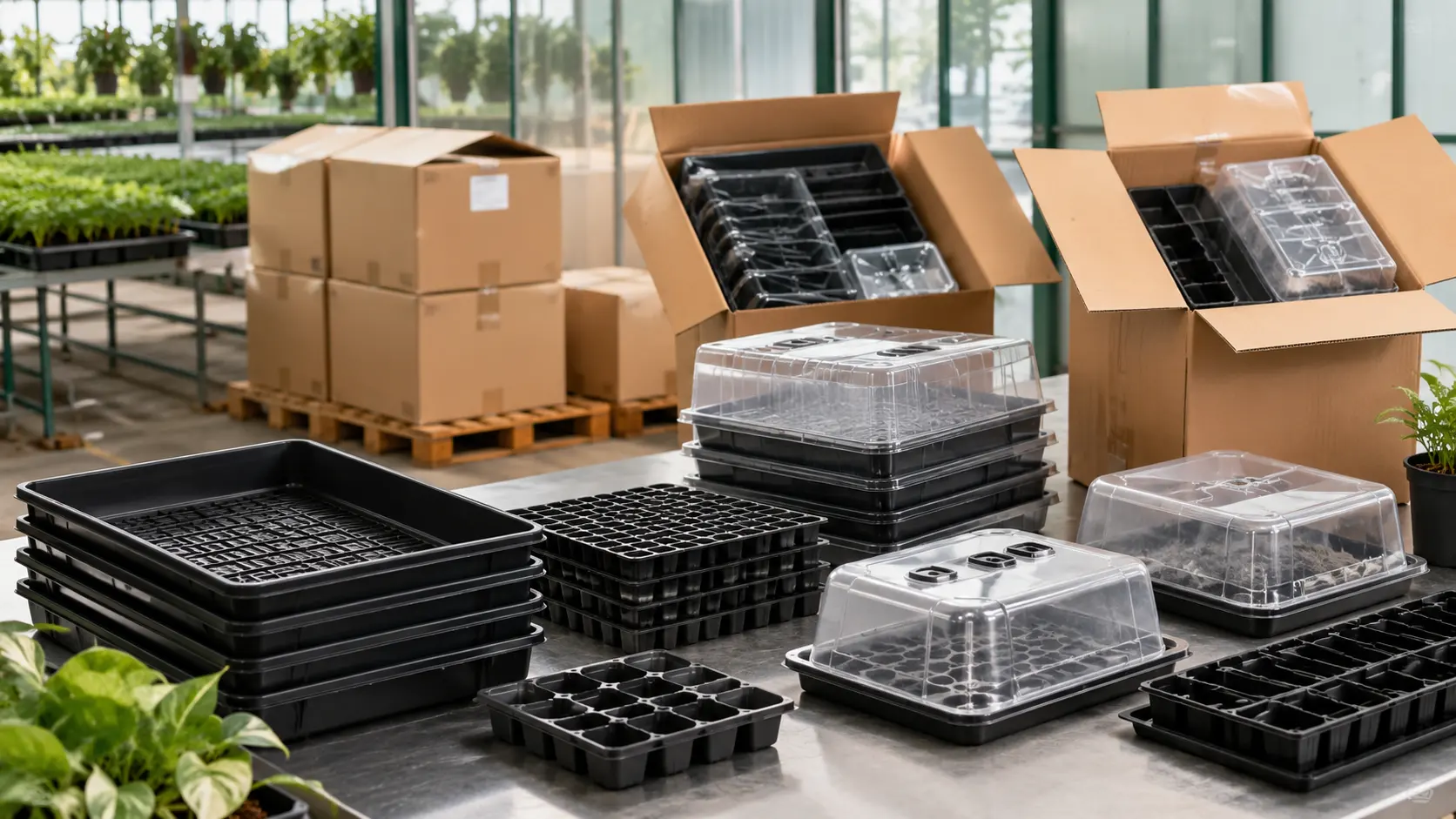
This is where MOQ turns into a real inventory problem. A 1020 propagation system has three components: a humidity dome, a base tray and a plug insert. Each is made on a different mold, has a different weight and nests differently. So each packs in a different quantity per carton.
Here is what that looks like for a standard 1020 system:
| Component | Unit Weight | Carton Qty | 1,000 Sets Needed | The Problem |
| Humidity dome | 0.230 kg | 100/carton | 10 cartons ✅ | 1,000 divides evenly |
| Base tray | 0.245 kg | 80/carton | 12.5 → 13 cartons ⚠️ | 40 extra base trays |
| Plug insert | 0.150 kg | 150/carton | 6.67 → 7 cartons ⚠️ | 50 extra plug inserts |
You need 1,000 complete sets. But if you order by the carton, you end up with 1,040 base trays and 1,050 plug inserts. Those 90 extra pieces are not free—they are inventory you paid for and now have to store, track and eventually use or discard. For a nursery buying five different tray sizes from three factories, the mismatch multiplies quickly.
This is not a defect in the product. It is a structural feature of how injection-molded and thermoformed products are packed. Each component has a different wall thickness, nesting depth and carton fill. The factory packs each one as efficiently as possible on its own. But nobody is looking at your complete set—until you open the boxes and count.
How Matched-Set Repacking Works
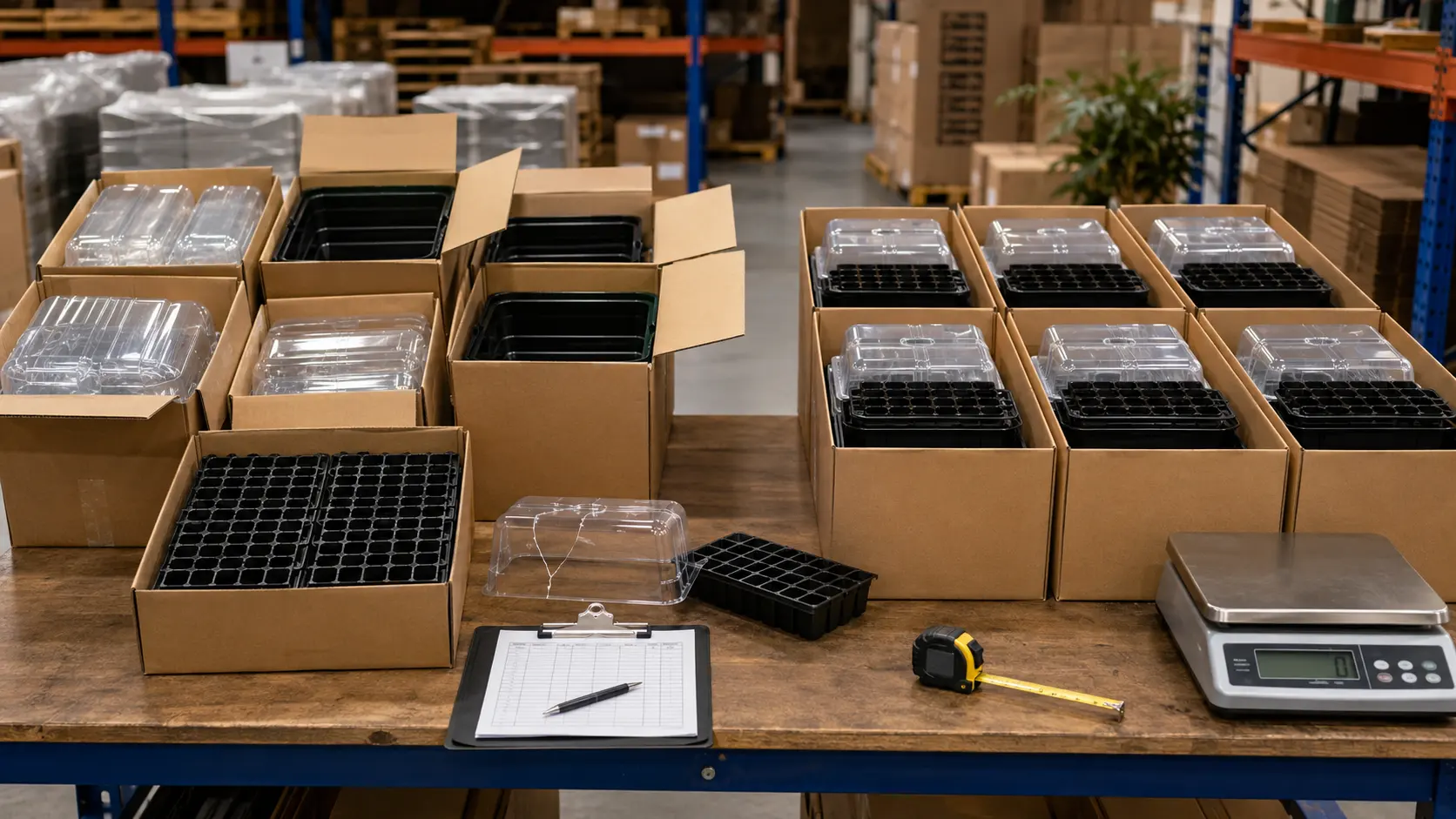
When your order arrives at the warehouse—10 cartons of domes, 13 of base trays, 7 of plug inserts—someone has to turn that into 1,000 complete sets. That is what matched-set repacking does.
Here is what happens in practice. The team opens every carton. They count each component against your order. They check for damage—a cracked dome or a warped tray is easier to spot when you are unpacking than when you are stacking sealed boxes. Then they repack: 10 complete sets per carton (or whatever quantity fits), with equal numbers of domes, trays and inserts in each box. The final carton count, gross weight and CBM are measured after repacking—not before.
This matters because the repacked shipment will have different carton dimensions and a different total carton count than the factory’s original packing. You cannot plan freight based on the factory’s packing list if the goods are being repacked. The freight quote must use the post-repacking measurements.
Two things to keep in mind about repacking. First, it involves labor: opening, counting, inspecting and re-packing all take time. Second, the new cartons may use different materials or configurations than the factory originals. Both of these affect cost. Repacking is not free, and it is not instant. But for most buyers ordering 1,000 sets or fewer, the cost of repacking is typically lower than the cost of storing and managing mismatched components for months, based on industry experience.
Want to see the math for your order? Tell us what you need and how many. We will check which items can be mixed, which ones need repacking, and what the whole shipment looks like.
Mixing Cell Counts, Weights and Accessories
You need three tray variants. The factory says each one needs 5,000 pieces. That is 15,000 trays you do not have room for. But if all three use the same mold and material, you may be able to combine them into one run—and meet the MOQ without overstocking a single variant.
Here is how it works in practice. A factory’s production MOQ for 1020 base trays might be 5,000 pieces. You need 2,000 trays with drainage holes and 2,000 without holes. If both use the same mold and material, the factory can often schedule them as one run—2,000 of each variant, totaling 4,000 pieces. That may not meet the 5,000 threshold. But add 1,000 trays in a different weight (a heavier gauge for a specific crop), and now you have 5,000 pieces across three variants. One production run. One shipping date. Three products you actually need.
This is where it gets practical—and where you need to ask before you commit. Not every factory allows mixing within a single run. Some require each variant to meet the production MOQ independently. Others are flexible but need advance notice to plan the mold changes. The same logic applies to plug inserts (different cell counts sharing a base tray footprint) and humidity domes (different heights on the same mold). The key question is always the same: can these variants share a run, or does each one need its own minimum?
When a 1,000-Set Trial Order Makes Sense
A 1,000-set trial order is not arbitrary. It sits at the intersection of what the supply chain can practically produce and what a first-time buyer can reasonably validate.
Here is the logic. Below roughly 1,000 sets, many factories will not schedule a production run—the setup cost per piece is too high. Above 1,000 sets, you are committing significant capital to a product you have not yet tested in your own operation. One thousand sets is enough to confirm fit on your benches, test handling with wet media, verify compatibility with your equipment and evaluate the supplier’s delivery performance. It is not enough to prove long-term durability or batch-to-batch consistency—that comes with repeat orders.
The weight of 1,000 complete 1020 sets: 625 kg net (0.230 + 0.245 + 0.150 = 0.625 kg per set × 1,000). This is a manageable shipment size—typically too expensive for courier, too light for a full container, well suited for air freight or LCL sea freight depending on your timeline.
After the trial, you have real data: actual breakage rates, actual consumption speed, actual handling feedback from your team. That data is what you use to build your annual purchasing plan—not a supplier’s catalog or a competitor’s review.
How Warehousing Supports Staged Delivery
Your annual plan calls for 10,000 sets. Your peak season is three months away. You do not need 10,000 sets sitting in your greenhouse next week—but you do need the per-unit price that comes with a 10,000-set production run. That is the two-sided problem: produce at volume to keep costs down, receive in stages to keep storage manageable.
Here is what staged delivery looks like. Your order is produced and packed. It arrives at the warehouse, where our team inspects it, counts it and stores it. You tell us when you need each batch—say, 3,000 sets in March, 4,000 in April, 3,000 in May. We ship each batch according to your schedule. You pay warehousing fees for the storage period, but you avoid the cost and disruption of receiving and storing a full year’s inventory at once.
There is a trade-off. Warehousing fees add cost. But compare that to the alternative: renting additional storage space at your nursery, or the risk of damage and deterioration from stacking cartons in a greenhouse for months. For most nurseries, staged delivery pays for itself in reduced handling and better cash flow, based on industry experience.
MOQ Questions to Ask Before Requesting a Quote
You have your product list ready. Before you hit send, these eight questions will tell you whether the order works—or whether you are about to buy parts you cannot use.
| # | Question | Why It Matters |
| 1 | Is this MOQ per carton, per production run, or per custom order? | The same number can mean very different commitments |
| 2 | Can I mix different specifications (cell counts, weights, hole patterns) within one production MOQ? | This is how you avoid overstocking a single variant |
| 3 | What is the MOQ for standard colors vs custom colors? | Custom colors typically require 5,000–20,000 pieces, based on industry experience |
| 4 | Can I buy less than a full carton? Is there an extra charge for breaking bulk? | Some suppliers allow it; most add a handling fee |
| 5 | Can multiple products be combined to meet a single MOQ threshold? | Useful when ordering trays, inserts and domes together |
| 6 | At what annual volume does the MOQ decrease? | Long-term planning can unlock lower thresholds |
| 7 | What happens to excess components if carton quantities do not match? | Determines whether you need matched-set repacking |
| 8 | Does the quoted price assume standard packing or repacked sets? | Freight calculations depend on which packing method is used |
Next Step: Review Your Product List
If you are planning a nursery supply order and want to avoid the mismatch problem, start by listing the complete sets you need—not individual components. Tell us how many sets, which products and when you need them. We can check which items can be mixed, which ones need repacking, and prepare a consolidated sourcing and packing plan.
Not ready for a full order? Start with standard colors and existing packaging to keep the first MOQ and risk lower. You can always move to custom specifications once the product is validated in your nursery.
FAQ
Can I order just 100 sets of a 1020 tray system? It depends on the supplier. Some factories may have stock available in smaller quantities, but availability is not guaranteed and varies by season and product. Others require a minimum production run. Even if 100 sets is possible, you will likely pay a higher per-unit price because the setup cost is spread across fewer pieces. Ask whether the factory has inventory available, or whether the order needs to be scheduled as a production run.
Why can’t I just order the exact number of each component I need? You can—but you may pay a premium for breaking cartons, or you may find that the factory simply will not split a carton for a small order. Carton quantities are set by the product’s nesting characteristics and the box dimensions. They are not adjustable per order.
Does matched-set repacking increase the total shipping cost? It can. Repacked cartons may have different dimensions than the factory originals, which changes the CBM. The total weight stays roughly the same, but volume-based freight charges (sea freight, LCL) may shift. Always request freight quotes based on the post-repacking measurements, not the factory packing list.
What if I need different cell counts in the same order? In many cases, different cell counts of plug inserts can be produced in the same run if they share the same base tray footprint. This allows you to meet the production MOQ by combining variants rather than ordering 1,000+ of each one separately. Confirm with the factory before committing.
How do I know if my order is big enough for a custom color or logo? Based on industry experience, custom colors typically require 5,000–20,000 pieces, and logo printing adds another 5,000–10,000 minimum on top. If your first order is 1,000 sets, start with standard colors and add customization later when your volume supports the higher MOQ.
Suggested internal links:
- How Mixed Packing Reduces Excess Inventory of Trays, Inserts and Domes — detailed repacking workflow and CBM changes
- Annual Nursery Supply Planning — how to build a purchasing plan that accounts for MOQ and seasonal demand
- From One Approved Sample to the First 1,000 Nursery Tray Sets — the step-by-step path from sample approval to trial order
Image card suggestions:
| Position | Purpose | Caption | ALT |
| After H3 “Carton MOQ vs Production MOQ vs Custom MOQ” table | Visualize the three-tier structure | Three-tier MOQ: carton, production and custom thresholds | nursery supply MOQ tiers diagram |
| After H3 “Why Tray, Insert and Dome Carton Quantities Do Not Match” table | Show the mismatch visually | 1020 system carton mismatch: 100/80/150 per component | 1020 tray system carton quantity mismatch |
| After H3 “How Matched-Set Repacking Works” | Show the repacking process | From factory packing to matched sets: unpack, count, repack | nursery tray matched-set repacking process |
| After H3 “MOQ Questions to Ask Before Requesting a Quote” checklist | Downloadable reference | MOQ questions to ask before requesting a quote | nursery supply MOQ checklist |
Claim ID mapping:
| Claim ID | Claim | Source | Notes |
| C103-01 | Carton MOQ 80–150 pcs/carton | C1-P research report | Factory data |
| C103-02 | Production MOQ 1,000–10,000 pcs | C1-P research report | Industry experience estimate |
| C103-03 | Custom MOQ 5,000–50,000 pcs | C1-P research report | Industry experience estimate |
| C103-04 | Dome carton qty 100/carton | C1-P research report | Factory data |
| C103-05 | Base tray carton qty 80/carton | C1-P research report | Factory data |
| C103-06 | Plug insert carton qty 150/carton | C1-P research report | Factory data |
| C103-07 | Dome unit weight 0.230 kg | C1-P research report | Measured data |
| C103-08 | Base tray unit weight 0.245 kg | C1-P research report | Measured data |
| C103-09 | Plug insert unit weight 0.150 kg | C1-P research report | Measured data |
| C103-10 | 1,000 sets net weight 625 kg | Calculation: 0.625 kg × 1,000 | Verified |
| C103-11 | Custom color MOQ 5,000–20,000 pcs | C1-P research report | Industry experience estimate |
| C103-12 | Logo printing MOQ 5,000–10,000 pcs | C1-P research report | Industry experience estimate |
Let’s build the plan behind your next order.
Got a supply list and a destination? Talk to us. We will figure out the sourcing, packing, and freight plan together.
What we can review
Written by
ScarecrowGarden
💡About Scarecrow Garden Supplier Co., Ltd.
Scarecrow Garden Supplier Co., Ltd. is a China-based sourcing and wholesale partner specializing in garden tools, landscaping equipment, and outdoor supplies for international wholesalers, distributors, contractors, and brands.
With hands-on experience rooted in real garden use scenarios, we focus on durable materials, functional design, and stable large-volume supply. Our product range covers pruning tools, watering systems, hand tools, outdoor hardware, and customized garden solutions to support both retail and professional landscaping markets.
Beyond products, we help our partners navigate supplier selection, quality control, compliance requirements, and long-term sourcing strategies in China. Through our blog, we share practical insights on product selection, material comparisons, industry trends, and cost-effective purchasing—helping global buyers build stronger, more competitive supply chains.