






Plant Cloche Material Specification Guide for Wholesale Buyers | Scarecrow Garden Supplier
A garden centre buyer switches from soda-lime to borosilicate glass bell cloches and wonders why the cost nearly triples. An e-commerce seller lists PET bell cloches for the European market—two seasons later, the reviews say “turned yellow in the sun.” A nursery grower buys PE tunnel film without checking the UV stabiliser grade; by midsummer, the film is brittle and tearing in light wind.
Same root cause every time: the material grade didn’t match the real requirement. Not a quality problem—a specification problem. The supplier delivered what was ordered. What was ordered was the wrong grade for the climate, the channel, or the expected service life.
This article explains the material choices behind every plant cloche type—cover materials, frame materials, coatings, and additives—and connects each choice to cost, lifetime, climate, and sales channel. More importantly, it tells you what to ask your supplier for, and what evidence you should expect back. If you need the scenario-based selection guide first, see our plant cloche choosing guide.
Not sure which material grade fits your market? Send your target climate, channel, and expected service life—we’ll return a matched material specification and price range. Get plant cloche material specification →
The Cover Material Landscape: Six Options, Three Real Decisions
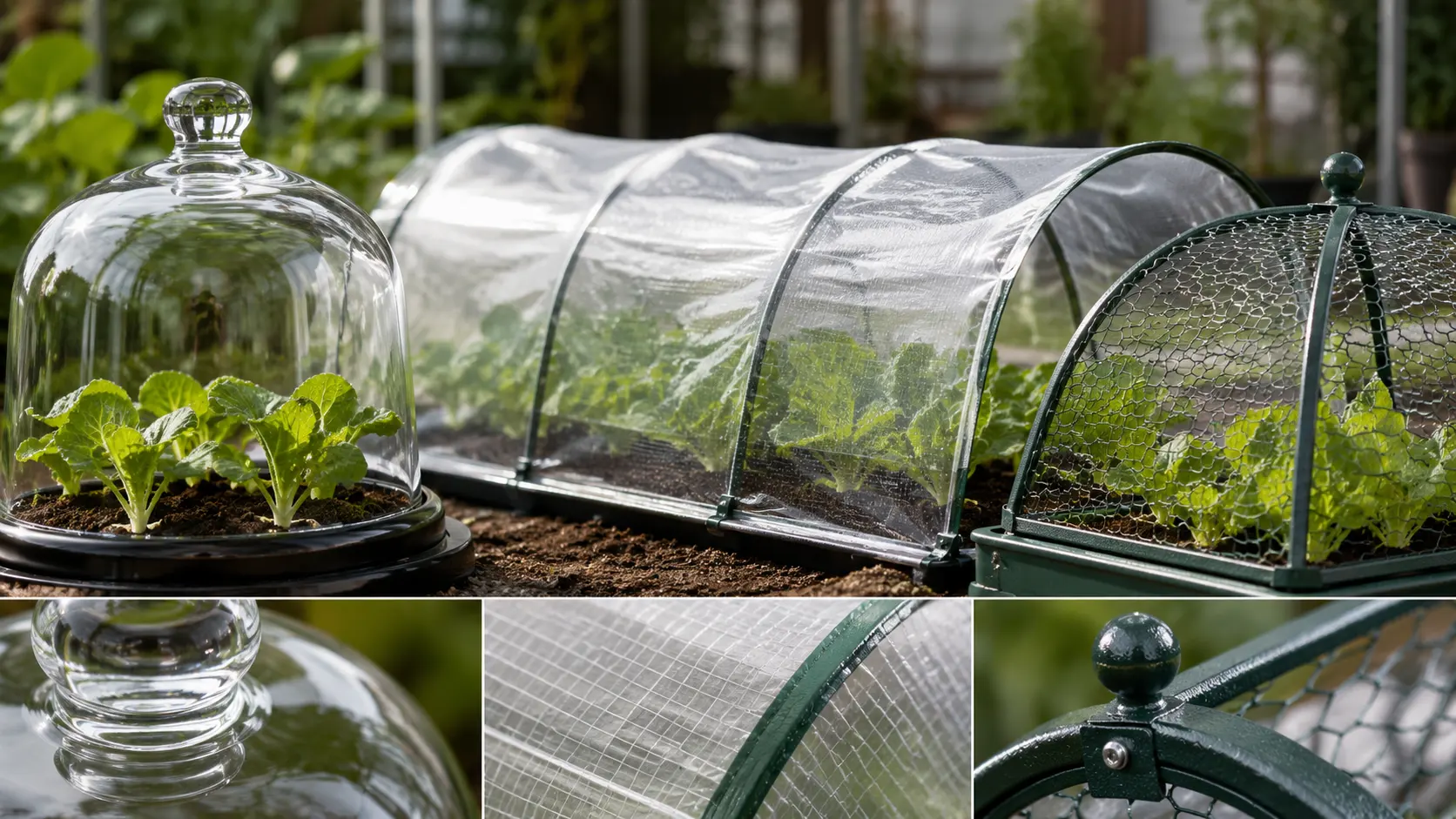
Plant cloche covers come in six material families. That sounds like a lot to juggle. But the real decisions boil down to three: insulation vs. durability, UV stability, and channel compatibility. Get those three right, and the material choice almost makes itself.
Material should not be selected in isolation; it must match the end customer, plant type, climate, and protection task, as explained in our guide to 【choosing plant cloches by customer and use case】.
Here is the landscape at a glance:
| Cover Material | Best For | Service Life | Key Trade-Off | Channel Fit |
| Soda-lime glass | Premium bell cloches, garden centre display | 20+ years (if unbroken) | Excellent insulation and clarity, but fragile in transit | Garden Centre, Distributor |
| Borosilicate glass | High-end bell cloches, markets with big temperature swings | 20+ years (if unbroken) | Same breakage risk as soda-lime, but survives thermal shock; 2–3× the cost | Garden Centre premium, E-commerce gift |
| PET / rigid plastic | Mass-market bell cloches, e-commerce | 3–5 years (UV-stabilised) | Shatterproof and light, but yellows without UV stabiliser | E-commerce, Garden Centre functional line |
| PE film | Tunnel cloches, nursery row protection | 1–5 years (grade-dependent) | Cheapest cover by area, but UV degradation is the hidden cost | Nursery / Grower, Distributor |
| Corrugated PVC | Durable tunnel systems, multi-season use | 3–5 seasons | Tough and wind-resistant, but higher cost per m² | Distributor, Nursery |
| Fleece | Short-term frost protection, early spring | 1 season | Cheapest and lightest, but UV-degrades in weeks | Nursery |
A distributor we work with stocks all six cover types. When a new buyer asks “which material should I choose?” the answer is never about the material alone—it is about what happens to that material in their customer’s garden. Three things to notice in that table. First, glass lasts the longest—but only if it survives shipping. A cloche that arrives in pieces has an infinite theoretical lifespan and a zero practical one. Second, the biggest hidden cost in this product family is not the material itself—it is the UV stabiliser (or lack of one) in plastics and films. Third, fleece and PE film look similar on a spec sheet but behave completely differently in the field; we will unpack that in the PE section below.
Glass: When “Glass Is Glass” Costs You Money

Most buyers treat glass bell cloches as a single category. They are not. The two glass types used in plant cloches—soda-lime and borosilicate—behave differently enough that specifying the wrong one is a real financial decision.
Soda-lime glass is what most cloche suppliers offer by default. It is standard float glass: roughly 73% silica, 15% sodium oxide, 7% calcium oxide. Good light transmission (90%+ for horticultural grade), excellent insulation, and inexpensive. The weakness is thermal shock. When the temperature changes fast—a cold cloche hit by direct morning sun, or a rinsing with warm water—soda-lime glass cracks. In our experience, repeated thermal cycling can cause failures in thinner soda-lime panels—even moderate hot-cold swings are enough. For a garden centre display piece that sits in a conservatory, this may never matter. For a cloche that goes from a cold greenhouse to outdoor spring sun every morning, it matters a lot.
Borosilicate glass replaces much of the sodium oxide with boron oxide (12–15% B₂O₃). The result: a thermal expansion coefficient roughly one-third that of soda-lime glass (approximately 3.3 × 10⁻⁶/°C, per published materials research). In practice, borosilicate survives thermal shocks that crack soda-lime—repeated cycling from –20°C to 100°C—suppliers report over 300 cycles without failure in laboratory testing. That is the difference between a cloche that cracks after a late frost and a cloche that does not.
But borosilicate costs 2–3 times more than soda-lime. And it is still glass—it shatters on impact just the same. The upgrade buys you thermal resilience, not drop resistance.
When to specify borosilicate: markets with large day-night temperature swings (continental Europe, mountain regions), and any product line marketed as premium or gift-grade. When soda-lime is fine: temperate maritime climates (UK, Pacific Northwest) where temperature swings are moderate, and the price point needs to stay competitive.
One more thing on glass. At the 2026 Chelsea Flower Show, TUFFX exhibited glass with 64% recycled content and a carbon footprint 42% lower than standard float glass. If your market is tracking sustainability credentials, recycled-content glass is moving from niche to mainstream. Ask your supplier whether recycled-content borosilicate or soda-lime is available—it may not cost more, but you need to ask.
The PE Film Trap: UV Stabiliser or No Stabiliser
This is where we see the most costly specification mistakes—not because PE film is complicated, but because the difference between “works for years” and “falls apart in weeks” is invisible on the product.
PE film for tunnel cloches comes in three grades—LDPE, LLDPE, and HDPE—varying in flexibility, tear resistance, and thickness (50–250 μm). That matters, but it is not the main event. The main event is whether the film contains UV stabiliser, and what type.
Here is the reality. PE film without UV stabiliser begins to degrade in 8–12 weeks of full sun exposure, based on industry experience. It becomes brittle, tears in light wind, and loses transparency. We have seen growers replace an entire tunnel’s worth of film mid-season because the UV stabiliser was either absent or below the effective dose. That is not a supplier defect—it is a specification gap.
The active ingredient is HALS—hindered amine light stabiliser. Two types matter for tunnel cloche film:
- HALS 770 (low molecular weight): effective but can migrate out of the film over time, especially in high-moisture or high-heat environments. Adequate for 1–2 season film.
- HALS 944 / UV-944 (high molecular weight, Mn >2000): resists extraction and migration. The standard for multi-year film. When a supplier guarantees 3–5 years of UV performance, HALS 944 (or an equivalent high-molecular-weight stabiliser) is typically what makes that guarantee possible.
Additive loading is usually 0.2–1.0% by weight, depending on the target service life and film thickness. Five-layer co-extrusion—where the HALS is concentrated in the outer layers—extends effective life further. A 2021 study on nanoparticle additives in PE film also found that nano-silica can slow HALS loss, preserving mechanical properties longer. That is a detail worth knowing if your buyer is specifying for high-UV markets like Australia or the Mediterranean.
What to specify on your order: UV guarantee period (years), HALS type (944 or equivalent for multi-year), and film construction (mono-layer, 3-layer, or 5-layer co-extruded). If the supplier cannot confirm the HALS type, assume it is a low-grade stabiliser and set expectations accordingly.
Want to see the difference before you commit? We have PE film samples with and without UV stabiliser, aged under controlled UV exposure. Get plant cloche material sample kit →
Frame Materials and the Galvanising Ladder
Cover material gets most of the attention. Frame material determines whether the cloche is still standing after two winters.
Steel tube: the frame standard
Most tunnel cloche frames are steel tube—16 mm diameter for standard tunnels, 16–20 mm for wide-span or permanent installations. What varies is the wall thickness, the galvanising grade, and whether a powder coat is applied on top.
| Frame Option | Tube / Wall | Zinc Coating | Service Life | Best Climate | Cost |
| Pre-galvanised steel | 16 mm / 0.3–0.8 mm | Z40–Z120 (5.6–16.8 μm) | 3–5 years | Dry / temperate | Low |
| Hot-dip galvanised steel | 16–20 mm / 0.8–1.5 mm | Z60–Z275 (8.4–19+ μm) | 10–20 years | Humid / coastal | Medium |
| Powder-coated over galvanised | 16 mm / 0.5–1.0 mm | Galvanised base + powder top | 7–15 years | Coastal / high-salt | Medium-high |
| PVC tube | 16–25 mm / 1.0–2.0 mm | None | 2–3 years | Sheltered / indoor | Lowest |
The numbers that matter most are in the zinc coating column. Here is how to read them.
The galvanising ladder: Z40 to Z275
Galvanising grades are expressed in grams of zinc per square metre of steel surface. Higher numbers mean thicker zinc, which means longer rust resistance.
Z40 (approximately 5.6 μm zinc): the entry level. Fine for indoor display or dry climates. In humid or coastal environments, rust can appear within 2–3 years. We have seen pre-galvanised tunnel hoops with Z40 coating develop surface rust after a single damp winter. The buyer’s customer opens the delivery carton and finds orange streaks on the hoops and rust residue on the PE film that was packed alongside them. That is not a product failure—it is a specification choice that could have been avoided. If your buyer is in the UK, northern Europe, or any coastal region, Z40 is a specification to avoid for outdoor use.
Z60 (approximately 8.4 μm): the minimum we would specify for general outdoor use. Gives 3–5 years of rust resistance in temperate climates. Acceptable for seasonal tunnel cloches that are stored indoors over winter.
Z275 / G90 (approximately 19+ μm): the professional grade. Ten to fifteen years of rust resistance, even in damp conditions. This is what you specify for permanent or semi-permanent tunnel installations, and for any product sold into coastal or high-rainfall markets.
One distinction that catches buyers out: electro-galvanised coatings are thin (5–15 μm) but uniform; hot-dip galvanised coatings are thick (50–150+ μm) but have a rougher surface. For cloche frames, hot-dip is almost always the better choice—the thickness matters more than the finish, since the frame is not visible in the final product.
Powder coat: when to add it
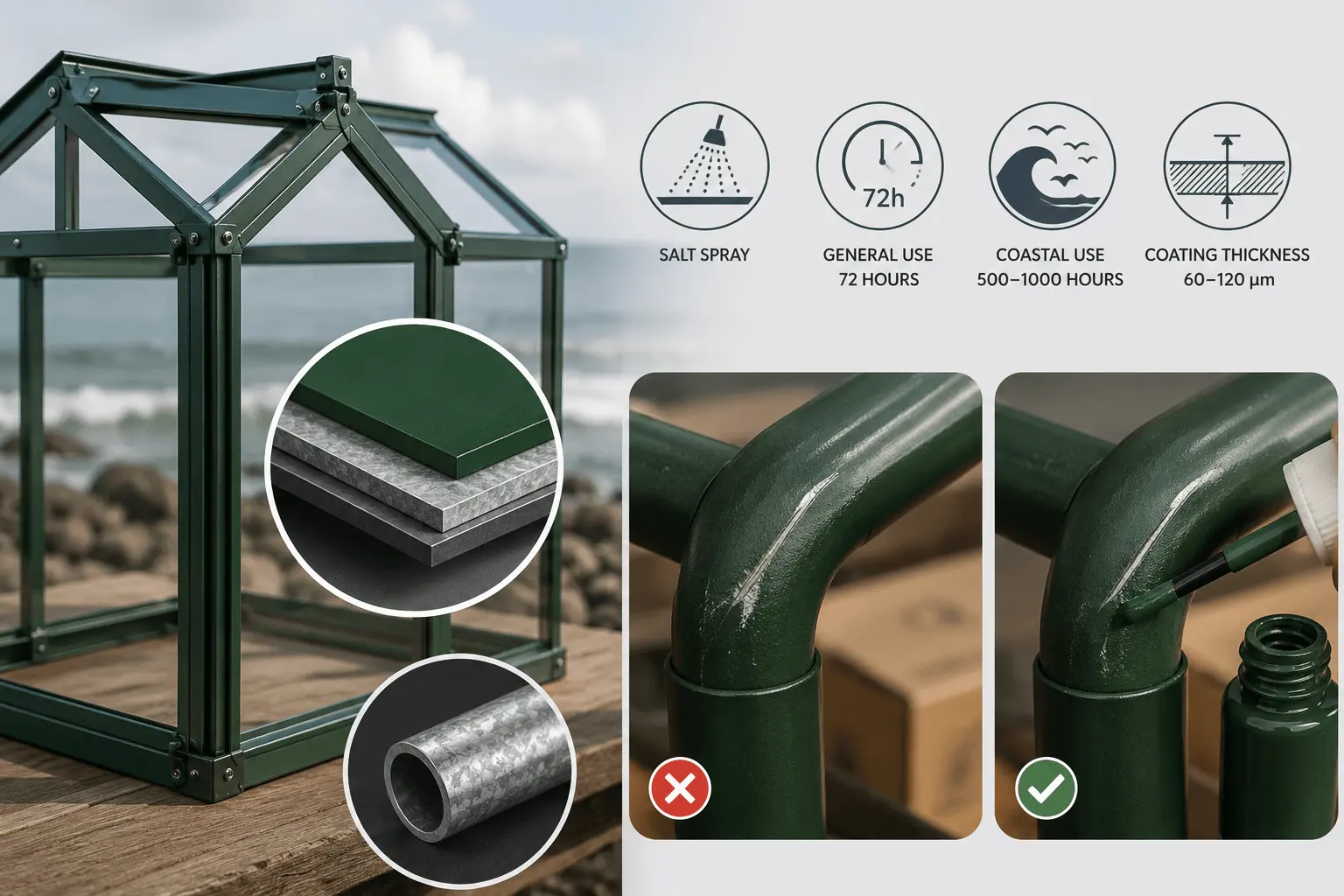
A powder coat over a galvanised base adds another layer of protection—and it adds colour, which matters for garden centre display. The relevant standard is ISO 9227 neutral salt spray testing. For general hardware powder-coated parts, 72 hours without oxidation is a common industry baseline. For coastal markets, look for 500–1000 hours. Coating thickness should be 60–120 μm.
The risk with powder-coated frames is not the coating itself—it is damage to the coating. Most coating damage happens in transit or during assembly: steel tubes rubbing against each other in the carton, or a wrench slipping during installation. A scratch through the powder coat exposes the galvanised layer underneath. In a coastal environment, that scratch becomes a rust starting point. If your buyer is specifying powder-coated frames for a coastal market, recommend touch-up paint in the accessory pack. It sounds small. It prevents returns.
What to Ask Your Supplier — and What They Should Show You
Material specifications are only as reliable as the evidence behind them. A supplier who claims “3-year UV guarantee” without a test report is making a promise, not providing proof. Here is what to ask for, and what each document actually tells you.
Material verification is only one part of supplier evaluation; buyers should also review product structure, quality risks, sample approval, packaging, MOQ, and sourcing execution through our 【complete wholesale plant cloche buyer’s guide】.
| What to Verify | Material | Document to Request | Relevant Standard |
| Glass composition | Soda-lime / borosilicate | Material composition report | ISO 3585 (borosilicate) / EN 572-1 (soda-lime) |
| Light transmission | All glass | Spectral transmittance test report | EN 410 |
| PE film UV guarantee | PE film | UV accelerated ageing test report | ISO 4892-2 / ASTM G154 |
| HALS type and loading | PE / PET | Additive formulation declaration | Supplier self-declaration |
| Zinc coating thickness | Steel tube / wire | Galvanised coating weight/thickness test report | ISO 1460 / ASTM A90 |
| Powder coat durability | Coated steel | Salt spray test report | ISO 9227 |
| BPA-free status | PET / polycarbonate | Food-contact compliance report | EU 10/2011 / FDA 21 CFR |
| REACH compliance | All plastics / coatings | SVHC screening report | EU REACH Annex XVII |
| Recycled content | PET / glass | Recycled content verification report | EU 2022/1616 (under revision) |
A few notes on what is realistic. Most factories will not provide a salt spray test report for a small order—that test costs money and takes days. What you can do: ask for a recent test report from a previous production run of the same coating system. If they have one, the coating process is likely consistent. If they have never tested, that is useful information too.
For recycled content, the regulatory landscape is shifting fast. If you sell into the EU, these changes affect your compliance obligations. Here is the short version. The EU 2022/1616 revision (submitted to WTO in April 2026) introduces two new declarations of compliance—DoC P and DoC C—requiring recycled plastic products to be traceable back to the recycling and decontamination source. Separately, a June 2026 EU rule change now allows chemical recycling to count toward recycled content using a mass-balance method. Ask your supplier now whether they can provide recycled-content verification under the new framework—even if the final rules are not yet enforced, the direction is clear.
B2B Material Specification Checklist: What to Specify, Sample, Test, or Confirm Next
Nine checks. We run every one of these on our warehouse line before a shipment leaves—because material grade mismatches are the returns you do not see coming until the customer opens the box.
- Cover material matched to climate and service life? Glass for premium insulation. UV-stabilised PET for e-commerce. HALS 944 PE film for multi-season tunnels. Fleece for short-term only.
- Glass type specified, not just “glass”? Borosilicate for big temperature swings and premium lines. Soda-lime for temperate markets at competitive price points. Never leave glass type unspecified—the supplier will default to soda-lime.
- PE film UV stabiliser confirmed by type, not just “UV-treated”? HALS 944 (or equivalent high-molecular-weight) for 3+ year guarantee. HALS 770 for 1–2 season film. “UV-treated” without specifying the stabiliser type is not a specification.
- Galvanising grade matched to the end market’s climate? Z275/G90 for coastal and high-rainfall. Z60 minimum for general outdoor. Z40 only for indoor or dry-climate use.
- Powder coat salt spray rating confirmed for coastal markets? 72 hours minimum (ISO 9227). 500+ hours for coastal. Include touch-up paint in the accessory pack.
- Rigid plastic UV stability verified? PET without UV stabiliser yellows in 2–3 seasons. Request yellowing acceleration test data for high-UV markets.
- BPA-free confirmation for food-display applications? If the cloche will be used for food presentation (common for glass bell cloches), request food-contact compliance documentation for PET or polycarbonate components.
- Recycled content documented for EU-bound shipments? EU 2022/1616 revision is moving toward mandatory traceability. Ask your supplier for recycled-content verification now, even before enforcement.
- Sample approved against specification before production? One sample per SKU. Check glass type with a thermal shock test (pour warm water on a cold sample—soda-lime cracks, borosilicate does not). Measure zinc coating thickness—a cheap coating gauge takes 10 seconds per tube. Expose a PE film strip to a UV lamp for 48 hours; that tells you more than any spec sheet promise. Do not trust the spec sheet alone.
Talk to us about your material requirements. Send your target market, channel, service-life expectations, and any compliance requirements—we will return a matched material specification with supplier evidence on file. Get your plant cloche material specification →
Talk to us about your product list and target market.
Send your specifications, channel, quantity, packaging requirements, and delivery deadline—we’ll return a matched specification and sourcing proposal.
Get your plant cloche sourcing proposal →
Written by
ScarecrowGarden
💡About Scarecrow Garden Supplier Co., Ltd.
Scarecrow Garden Supplier Co., Ltd. is a China-based sourcing and wholesale partner specializing in garden tools, landscaping equipment, and outdoor supplies for international wholesalers, distributors, contractors, and brands.
With hands-on experience rooted in real garden use scenarios, we focus on durable materials, functional design, and stable large-volume supply. Our product range covers pruning tools, watering systems, hand tools, outdoor hardware, and customized garden solutions to support both retail and professional landscaping markets.
Beyond products, we help our partners navigate supplier selection, quality control, compliance requirements, and long-term sourcing strategies in China. Through our blog, we share practical insights on product selection, material comparisons, industry trends, and cost-effective purchasing—helping global buyers build stronger, more competitive supply chains.