






wholesale-plant-cloche-sourcing-guide
A garden centre buyer orders 200 glass bell cloches for the spring display. An e-commerce seller lists a 20 cm plastic bell for “tomato protection.” A nursery grower covers an entire strawberry row with PE film tunnels—no anchor stakes included. Six months later, the glass cloches have a breakage rate in transit that we have seen reach double digits, the e-commerce listing attracts one-star reviews saying “too small for a tomato plant,” and the grower’s tunnels blew off in the first March gale.
Same root cause every time: the specification didn’t match the real use case. Not bad luck—bad matching. Cloche type, size, material, and ventilation chosen for the wrong plant, the wrong climate, or the wrong sales channel. When you source plant cloches for wholesale, the single decision that determines whether your stock sells through or comes back as returns is this: does the specification match the real use case?
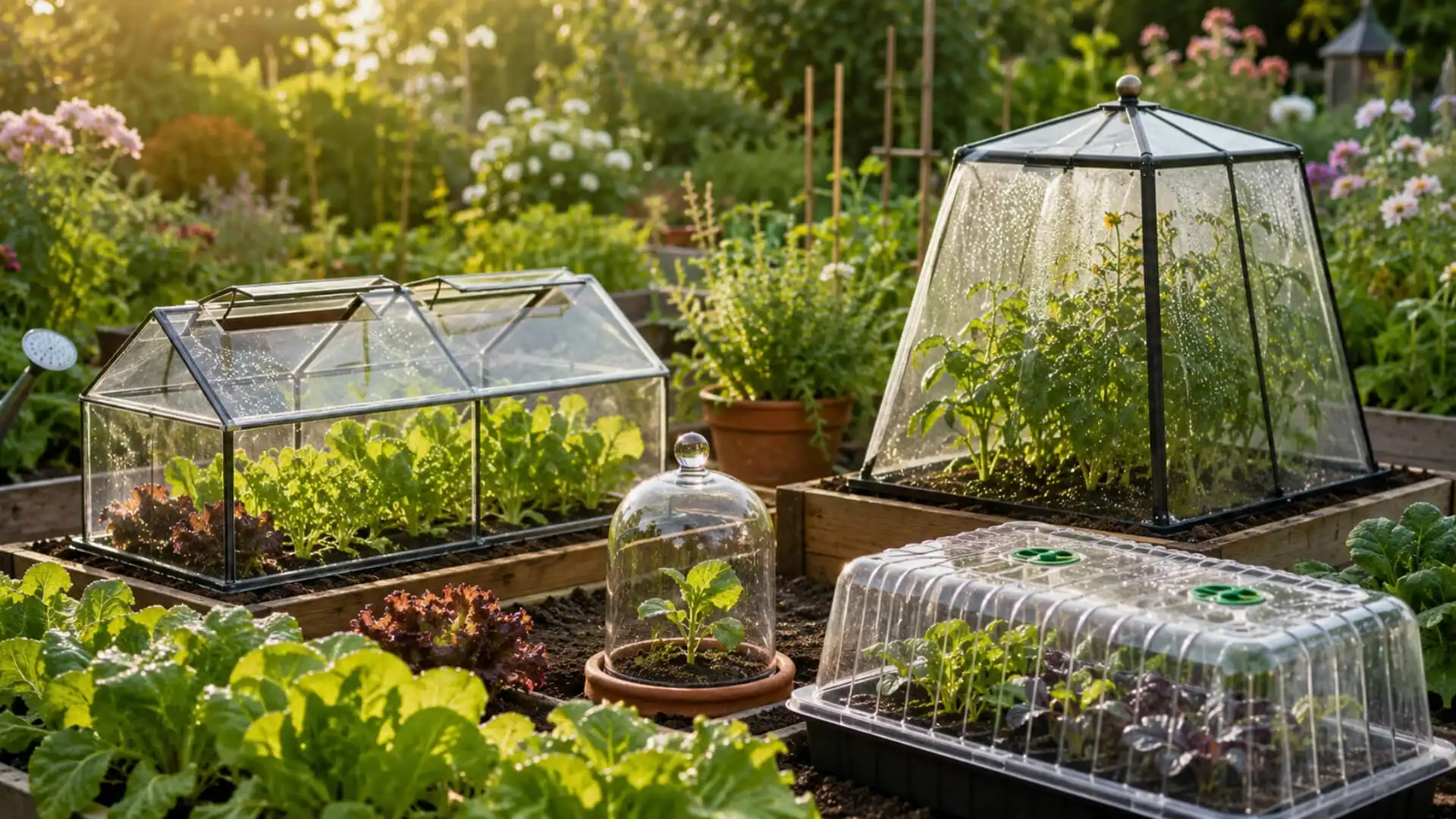
This article maps four cloche types—bell, tunnel, lantern, and wire—against the actual scenarios your customers face. We break down size, frame, cover material, and ventilation by plant type, climate zone, and sales channel, and we flag the combinations that generate the most complaints. If you need the full product family overview first, see our wholesale plant cloche buyer guide.
Need a quick spec match? Send your target market, channel, and quantity—we’ll return a matched model and price list. Get plant cloche model and price list →
Define the Customer, Plant, Climate, and Task Scenarios
Choosing the right cloche starts with four questions. Not “what’s the cheapest option?”—but who is using it, what they’re growing, where they’re growing it, and what the cloche actually needs to do.
These scenario-based decisions should also be considered alongside product types, quality risks, OEM options, packaging, MOQ, and lead time, which are covered in our 【B2B plant cloche sourcing guide】.
Customer type drives channel logic
A garden centre buyer thinks in display appeal and gift potential. Glass bell cloches with wooden bases sell as decorative objects that also protect seedlings—the function is a bonus, not the primary purchase reason. An e-commerce seller needs products that survive parcel delivery, fit in standard cartons, and look good in a thumbnail photo. A nursery grower cares about cost per metre of row covered and whether the tunnel holds up in wind. A landscaper wants large-format coverage and professional anchoring. These buyers should not be offered the same SKU.
Plant type drives size and access
Single-stem seedlings, cuttings, and prized specimen plants need individual covers—bell or lantern cloches with enough headroom for growth. Row crops—strawberries, salad greens, dwarf beans—need continuous tunnel protection. Climbing plants or organic gardens where pest exclusion matters more than frost protection call for open wire frames. The plant determines the shape, and the shape determines the specification chain that follows.
Climate zone drives material and ventilation
A distributor in northern Germany receives returns every April—sealed bell cloches that cooked seedlings during an unexpected warm spell. The climate didn’t change. The specification was wrong for the climate. In temperate and maritime regions (UK, northern Europe, Pacific Northwest), the main threats are late frost, cold rain, and wind. Cloches here need strong insulation—glass or thick PET—and reliable ventilation for the occasional warm day. In continental climates with bigger temperature swings, adjustable ventilation becomes critical. A sealed bell cloche in a warm spell will cook a seedling in hours. In milder, warmer zones, wire cloches for pest exclusion may be all that’s needed—frost protection is not the primary task.
“Frost protection” sounds like one job. It isn’t.
Early-spring seedling hardening is short-term and small-scale. Autumn crop extension is medium-term and row-scale. Winter overwintering of tender perennials is long-term and individual. Each task implies a different cloche type, a different material durability requirement, and a different price point your end customer is willing to pay.
Here is how the four cloche types map against these scenarios:
| Cloche Type | Best Customer | Best Plant Scenario | Best Climate | Primary Task |
| Bell Cloche | Garden Centre, E-commerce | Single-stem seedlings, cuttings, specimen plants | Temperate / Maritime | Frost protection + decorative display |
| Tunnel Cloche | Nursery / Grower, Distributor | Row crops: strawberries, salad, dwarf beans | Temperate / Continental | Season extension (several weeks) |
| Lantern Cloche | Garden Centre (premium line), E-commerce (gift) | Specimen ornamentals, decorative protection | Mild / Temperate | Frost + wind protection with display value |
| Wire Cloche | Garden Centre, E-commerce (organic line) | Organic gardens, climbing plants | Mild / Warm | Pest exclusion (rabbits, deer, birds) |
Source: RHS cloche guidance (rhs.org.uk); Scarecrow Garden product matching records.
The table gives you the starting point. The next two sections get into the specification details—the numbers that determine whether a cloche works in practice or becomes a return.
Match Size and Frame Material to Each Scenario
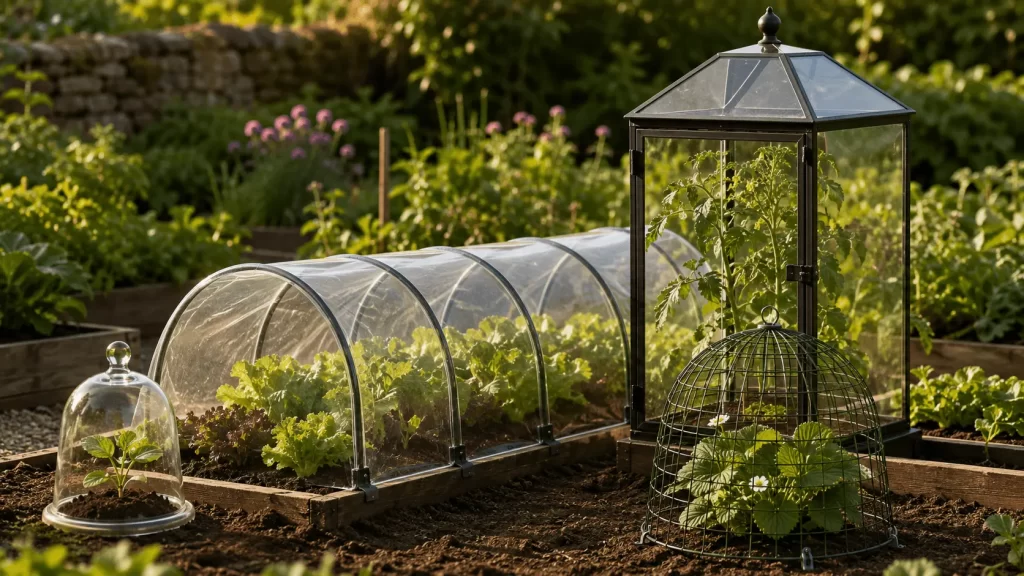
Size and frame specification are where most sourcing mistakes happen. The labelled dimensions on a supplier’s listing do not always tell you what the cloche can actually do in the field.
Bell cloche: the usable-height trap. We see this one constantly: a buyer sources 25 cm bell cloches for tomato protection, then wonders why customers say “too small.” The label says 25 cm. The usable height is 15–17 cm—because dome curvature eats roughly 30–40% of the stated height. A tomato seedling outgrows it in two weeks. For fruiting vegetables, specify 30–40 cm height (usable ~20–28 cm). For seedling hardening and cuttings, 20–25 cm is sufficient.
Tunnel cloche: span determines frame strength. Up to 75 cm wide, powder-coated steel hoops (16 mm tube, 0.3–0.5 mm wall) handle normal wind. Beyond 75 cm, move to 16–20 mm galvanised steel or add a centre ridge pole. PVC hoops (16–25 mm) are fine for lightweight fleece in sheltered gardens, but will not hold rigid PE or corrugated PVC under sustained wind. Height follows the crop: 30–35 cm for strawberries and salad, 45–60 cm for cucumbers and cut flowers.
Lantern cloche: frame integrity over size. The specification to watch is joint quality. Glass panels under wind load stress corner clips. A weak clip means a panel slides out and shatters. For garden centre lines, specify riveted or welded joints, not push-fit clips.
Wire cloche: gauge and coating. Standard wire is 3–5 mm. For outdoor use beyond one season, specify galvanised or powder-coated wire. Uncoated steel rusts—and rust stains on a garden centre display lose repeat orders.
Here is how those specifications map to the scenarios your customers actually face:
| Scenario | Cloche Type | Size | Frame Material | Tube / Wire Gauge | Why This Spec |
| Seedling hardening (early spring) | Bell | Ø 20–25 cm, H 20–25 cm | Steel wire | 3–5 mm | Portable; dome curvature not an issue short-term |
| Fruiting vegetable protection | Bell | Ø 30–40 cm, H 30–40 cm | Steel wire or PET shell | 3–5 mm / 1.5–3 mm wall | Usable height ~20–28 cm; room for growth |
| Row crop season extension | Tunnel | W 45–75 cm, H 30–45 cm | Powder-coated steel | 16 mm, 0.3–0.5 mm wall | Standard span; handles normal wind |
| Wide-row / tall-crop coverage | Tunnel | W 75 cm+, H 45–60 cm | Galvanised steel | 16–20 mm, 0.5 mm+ wall | Wider span needs stronger frame |
| Specimen plant display | Lantern | Ø 25–35 cm, H 25–35 cm | Metal frame, riveted joints | N/A (panel structure) | Frame integrity prevents glass panel loss |
| Pest exclusion / organic garden | Wire | Ø 30–40 cm, H 30–40 cm | Galvanised / powder-coated wire | 3–5 mm | Rust resistance for multi-season use |
Sources: RHS cloche guidance (rhs.org.uk); supplier specification records; Scarecrow Garden product matching records.
That gets the cloche into the right shape for the job. But the cover material and ventilation determine whether the plant underneath actually survives.
See the difference in person. We have side-by-side comparison videos of bell vs. tunnel vs. wire cloche frames under wind load. Get plant cloche material comparison video →
For detailed requirements covering glass quality, UV-stabilised plastic, mesh specifications, galvanised frames, and powder coating, review our guide to 【plant cloche materials wholesale buyers should specify】.
Match Cover Material, Thickness, and Ventilation to Each Scenario
A cloche that lets in light but traps too much heat is worse than no cloche at all. The cover material controls insulation, light transmission, and durability. Ventilation controls whether the plant cooks or thrives.
Cover material by scenario
Glass (2–3 mm) — best insulation (soil temperature can be significantly higher under glass, per RHS guidance), highest light transmission (90%+), longest life. Right for premium bell and lantern cloches in garden centres. Wrong for e-commerce unless crush-resistant packaging is guaranteed.
Rigid transparent plastic (PET / acrylic, 1.5–3 mm) — the mass-market workhorse. 85–90% light transmission, good insulation, no shatter. The safer specification for e-commerce and distributor channels. Trade-off: cheaper PET yellows after 2–3 UV seasons. Specify UV-stabilised PET for high-UV markets.
Polyethylene film (PE, 100–200 μm) — standard tunnel cover. Lightweight, inexpensive, extends the growing season by several weeks at each end per RHS guidance. Below 100 μm, expect wind tearing. Critical distinction: for nursery tree propagation, perforated PE outperforms solid PE and fleece. O’Reilly et al. (2005) found perforated PE cloches produced 53% of birch seedlings at plantable specification, versus only 35% under spunbond fleece. Results are from birch seedling trials; performance may vary by crop type. For nursery growers, prioritise perforated PE.
Corrugated PVC (0.8–1.5 mm) — the durable tunnel cover. Three to five seasons, 85–90% light transmission, resists moderate wind without tearing. Higher cost per square metre. Reserve for professional tunnel systems where buyers expect multi-year use.
Fleece (17–30 g/m²) — only about +2°C frost protection. Its real value is pest and wind exclusion early in the season. One-season life. A supplement, not a primary winter cover.
Mesh / net — for wire cloches, pest exclusion only. No insulation, 80–90% light transmission, multi-season durability. Confirm mesh aperture: standard anti-butterfly netting excludes cabbage white butterflies; finer mesh (approximately 0.5–1 mm) excludes more pests but reduces airflow.
Material and ventilation work as a pair. Get one wrong and the other cannot compensate.
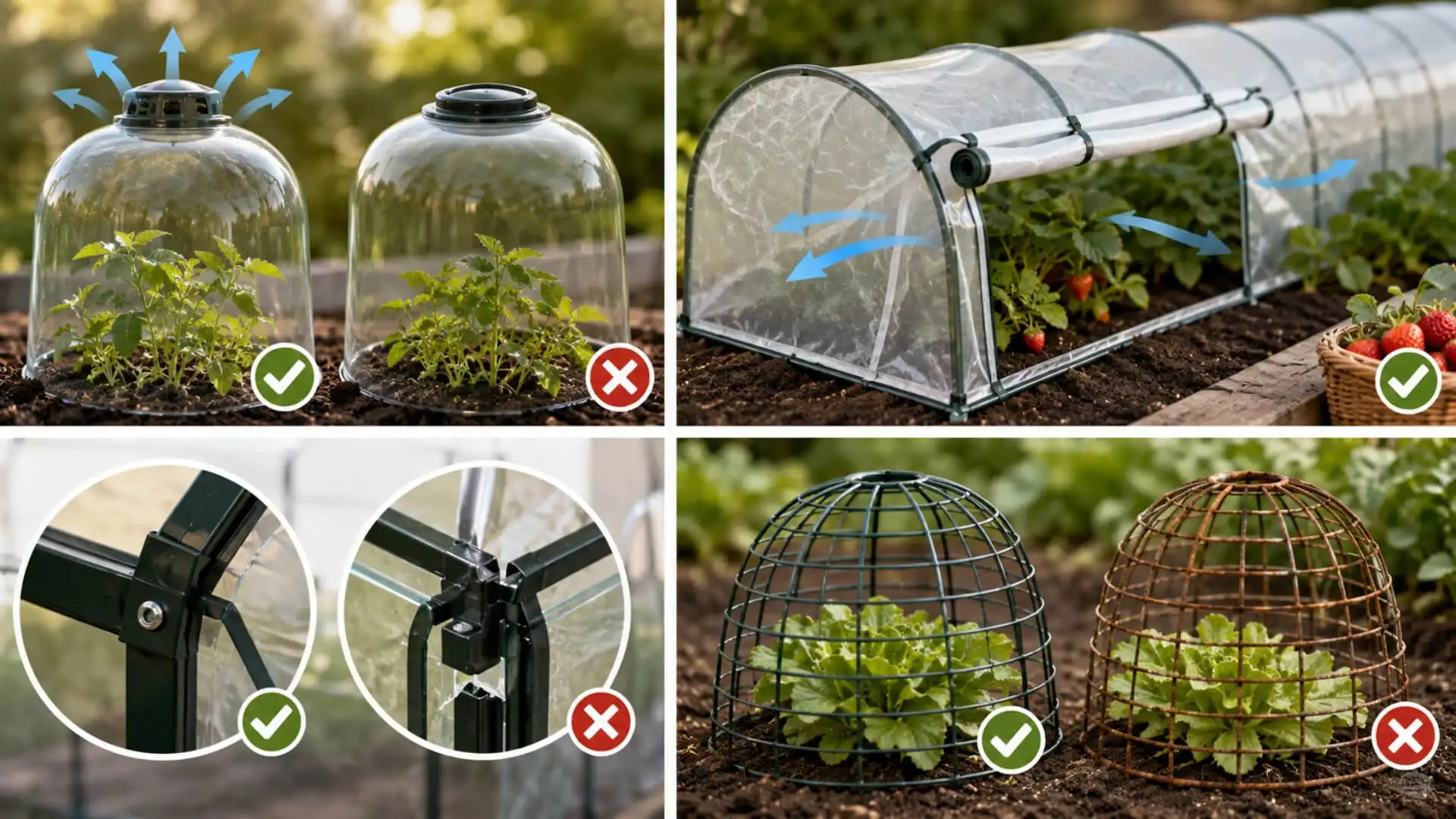
Poor ventilation is the most common cause of plant death under cloches—and the most common consumer complaint. Sealed humidity breeds grey mould (Botrytis) and downy mildew. A sealed bell in direct sun can overheat rapidly, scorching the plant it was meant to protect.
For bell cloches, the key choice is ventilation type. Fixed top vents work for early-spring seedling hardening but cannot close or adjust. Adjustable top caps cost slightly more but are essential for any market with spring temperature swings—most of northern Europe. A fixed-vent bell shipped to a continental climate generates “cooked my plants” reviews. For tunnel cloches, side-access ventilation (zip or roll-up panels) is critical for crops needing frequent harvesting. If the grower has to remove the entire tunnel to pick strawberries, they will not use it. Wire cloches need no ventilation—they are open frames by design.
Cover and ventilation specification table
| Scenario | Cover Material | Thickness | Ventilation | Rationale |
| Frost protection, premium single plant | Glass | 2–3 mm | Adjustable top cap | Best insulation; controllable airflow |
| Frost protection, mass-market single plant | PET (UV-stabilised) | 1.5–2 mm | Adjustable top cap | Shatter-resistant; good insulation |
| Nursery row propagation | Perforated PE | 150–200 μm | Perforation + side roll-up | 53% plantable rate in birch trials (O’Reilly et al.); built-in airflow |
| Season extension, row crops | Corrugated PVC | 0.8–1.5 mm | Side zip or roll-up | Durable 3–5 seasons; harvest access |
| Temporary spring frost cover | Fleece | 17–30 g/m² | No seal (laid loose) | +2°C; pest exclusion; remove when frost passes |
| Pest exclusion, organic garden | Mesh / net | N/A | Open frame | No insulation needed; maximum airflow |
Sources: RHS cloche guidance (rhs.org.uk); O’Reilly C et al. (2005), Irish Forestry 62:35–43; Scarecrow Garden supplier records.
The right material and ventilation keep the plant alive. The wrong combination does not just kill the plant—it creates a return, a complaint, and a customer who will not reorder. The next section maps those wrong combinations explicitly.
Unsuitable Combinations and Return Risks
After reviewing return reports across our channel partners, seven mismatches show up again and again. Not theoretical risks—these are the ones that actually generate complaints and reorders that don’t happen.
| Mismatch | Return Risk | What Happens | What to Specify Instead |
| Non-ventilated bell + warm climate / summer | High | Internal overheating scorches plants; “it killed my plant” reviews | Adjustable ventilation on every bell; restrict non-ventilated to early-spring marketing |
| Glass bell + e-commerce (no crush packaging) | Very High | Breakage rates in parcel networks can reach 10–15% in our experience; micro-cracks can appear days later | PET bell for e-commerce; or double-wall carton with foam cell dividers |
| PE tunnel + high-wind region (no anchors) | High | Film tears, hoops bend; “tunnel blew away” complaints | Include anchoring pegs, guy ropes, or ground staples as standard—not optional |
| Wire cloche + frost protection need | Moderate | No heat retention; “doesn’t protect from frost” returns | Clear “pest exclusion only” labelling on product and packaging |
| Fleece + full-season outdoor use | Moderate-High | UV degrades fleece in 8–12 weeks; shredded by midsummer | Corrugated PVC or perforated PE for full-season; fleece for short-term only |
| Small bell (Ø 20 cm) + tall fruiting plants | Moderate | Plant outgrows cover in weeks; “too small” complaints | Ø 30–40 cm bell for fruiting vegetable segment |
| Dark / black cover + spring seedling use | Moderate | Reduced light causes leggy, weak seedlings | Clear covers for propagation; dark covers for summer heat management only |
Every one of these mismatches turns a sourcing decision into an after-sales problem. The next section helps you avoid them at the channel level.
Channel-Specific SKU Recommendation Table
A garden centre buyer, an e-commerce seller, and a nursery grower walk into a trade show. They should not walk out with the same cloches. Different channels need different SKU mixes—not just different products, but different specifications within the same product type.
Garden centres carry a decorative line (glass bell) alongside a functional line (PET bell) and a pest-exclusion option (wire cloche)—Good, Better, Best on the same shelf. E-commerce sellers cannot ship glass safely without premium packaging, so PET bells and foldable tunnel kits dominate. Nursery growers need bulk row protection: PE tunnels for economy, corrugated PVC for durability. Distributors want a full-range assortment in standardised packaging. Landscapers buy large-format tunnels and wire cloches in bulk, with professional anchoring systems.
| Channel | Recommended SKU Mix | Key Risk Control |
| Garden Centre | Glass bell (decorative) + PET bell (functional) + Wire cloche | Display protection for glass; “pest only” labels on wire |
| Nursery / Grower | Perforated PE tunnel + Corrugated PVC tunnel + Fleece row cover | Anchoring hardware included; perforated PE for airflow |
| Distributor / Wholesaler | Full-range mixed assortment (Bell + Tunnel + Wire) | Standardised packaging to reduce mixed-order errors |
| E-commerce | PET bell + Folded tunnel kit + Wire cloche | No glass; reinforced carton; clear size diagrams in listing |
| Landscaper | Large-format tunnel + Wire cloche (bulk) | Professional anchoring system; bulk pricing |
This is a starting configuration. The exact SKU count and mix should be adjusted to your market, your price bands, and your lead times.
B2B Decision Checklist: What to Specify, Sample, Test, or Confirm Next
Eight checks. Miss one, and the mismatch reaches your customer. We know—because we’ve caught every one of these on our own warehouse line before shipping.
- Cloche type matched to end-use task? Frost protection → bell or tunnel. Pest exclusion → wire. Decorative + functional → lantern.
- Size matched to plant at maturity, not at planting? Bell usable height = 60–70% of stated height. Tunnel height = crop height at harvest.
- Frame material matched to wind load and span? Tunnel > 75 cm wide → galvanised steel, not PVC hoops.
- Cover material matched to climate and season? Perforated PE for nursery propagation. Corrugated PVC for multi-season tunnels. Glass for premium garden centre only.
- Ventilation matched to climate zone? Adjustable ventilation for any market with spring temperature swings. No sealed bells for warm-climate distribution.
- Packaging matched to channel? Glass → no e-commerce without crush-resistant cartons. All channels → include anchoring hardware with tunnels.
- Product description matched to real capability? Wire cloches labelled “pest exclusion only.” Small bells not marketed for tall plants. Fleece not marketed for full-season use.
- Sample approved before production? One sample per SKU. Check dimensions with a ruler—do not trust the spec sheet alone. Confirm ventilation opens and closes. Drop-test a packed carton if shipping glass.
Talk to us about your product list and target market.
Send your specifications, channel, quantity, packaging requirements, and delivery deadline—we’ll return a matched specification and sourcing proposal.
Written by
ScarecrowGarden
💡About Scarecrow Garden Supplier Co., Ltd.
Scarecrow Garden Supplier Co., Ltd. is a China-based sourcing and wholesale partner specializing in garden tools, landscaping equipment, and outdoor supplies for international wholesalers, distributors, contractors, and brands.
With hands-on experience rooted in real garden use scenarios, we focus on durable materials, functional design, and stable large-volume supply. Our product range covers pruning tools, watering systems, hand tools, outdoor hardware, and customized garden solutions to support both retail and professional landscaping markets.
Beyond products, we help our partners navigate supplier selection, quality control, compliance requirements, and long-term sourcing strategies in China. Through our blog, we share practical insights on product selection, material comparisons, industry trends, and cost-effective purchasing—helping global buyers build stronger, more competitive supply chains.