






Updated 3 months ago
Light Transmission and UV Stability in Plastic Mini Greenhouses Explained

hqt
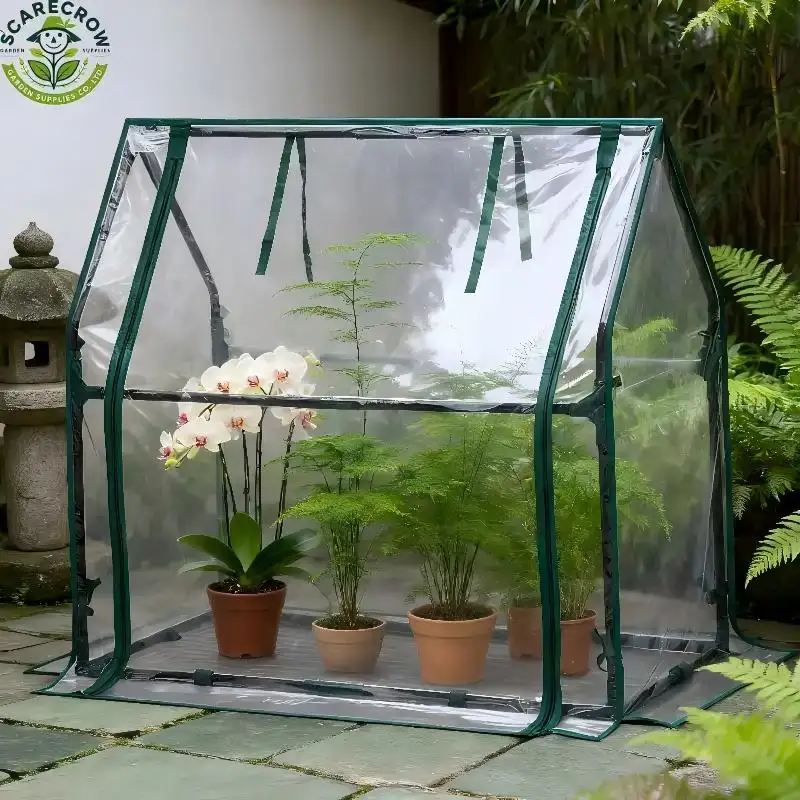
Plastic Mini Greenhouse
Garden wholesalers, distributors, and garden centers do not simply compare dimensions, packaging, and cost when choosing a Plastic Mini Greenhouse. The transparent cover impacts how much light is available, how much humidity is retained, the durability of the product, and how easy it is for the user to monitor their seedlings.
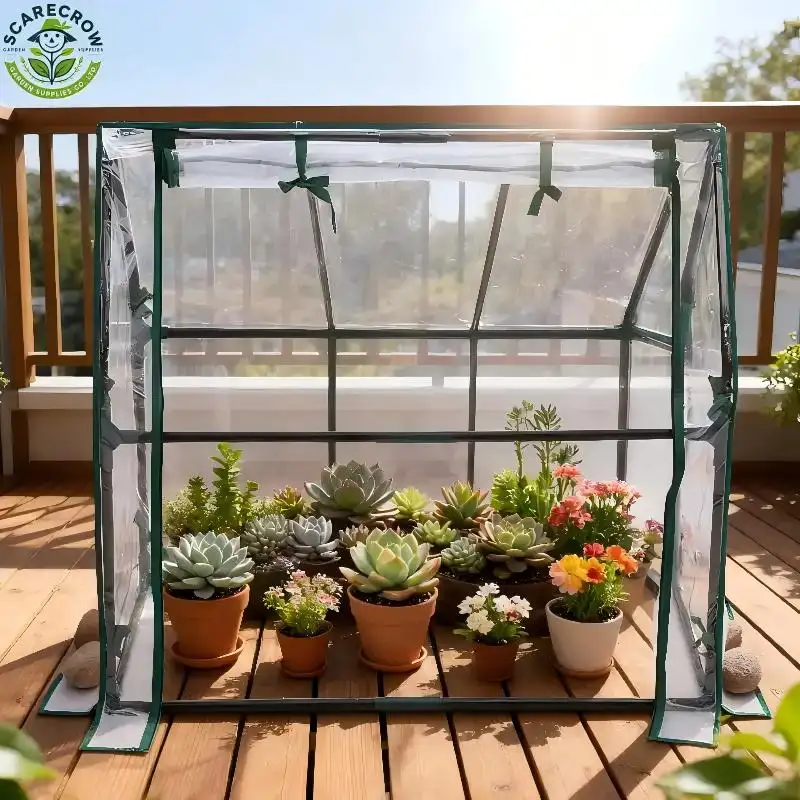
Two relevant characteristics may include the following:
•Light transmission: the degree to which usable light is allowed to pass through a cover.
•UV Stability: The ability of a plastic material to retain its initial characteristics after exposure to sunlight.
Well-designed plastic Mini Greenhouses incorporate flexibility of design and materials, as well as the elements of weather, ventilation, and the life design resistance.
The Importance of Light Transmission
Light transmission, in the case of transparent and translucent materials, is the percentage of the total light incident on the material that can pass through it. For young, developing plants, the presence of adequate light supports the growth of a compact and healthy plant with well-developed leaves.
Light useful for photosynthesis, called photosynthetically active radiation (PAR), is roughly in the 400–700 nanometer wavelength region.
It is important to note that when evaluating a Plastic Mini Greenhouse cover, a single value of light transmission is not the only value that should be considered. Performance may vary based on the type of material, the thickness, the condition of the surface, any additives, and the age of the product.
Factors Influencing Light Transmission
1. Polymer Type: Different common polymers exhibit modified optical properties. For example, polycarbonate, PVC, polyethylene, and EVA exhibit such changes.
2. Cover Thickness: Light permeability and cover durability are inversely related to cover thickness.
3. Surface Texture: Light scattering and surface visibility are directly correlated to the surface texture. A smooth surface will be less visible.
4. Condensation: Light will be scattered and thus become less visible when collected in droplets.
5. Dust and Residue: Exposure of the cover to the elements plus repeated watering will make the cover lose clarity.
6. Material Additives: Covers may be modified by light in the presence of anti-fog, infrared control additives, UV stabilizers, and pigments.
7. Folding and Handling: Frequent folding and handling adversely affect the appearance of the product and its light-diffusing ability.
The plastic mini greenhouse has a transparent cover designed to serve two functions. It allows natural light to come through and reach the plants. It also reduces the rate at which moisture in the growing media and plant trays evaporates.
Clear Light vs. Diffused Light
Maximum transparency may not be the primary goal. Some coverings allow very direct light to pass through, while others scatter light throughout the growing area.
| Optical Property | Clear Cover | Diffusing Cover |
| Plant visibility | High | Moderate |
| Light direction | More direct | More evenly distributed |
| Retail presentation | Strong visual access | Softer appearance |
| Potential benefit | Easy plant monitoring | May reduce concentrated bright spots |
| Typical placement | Indoor or sheltered areas | Bright balconies and outdoor areas |
Which to choose really depends on the intended use. Maximum plant visibility, as with a plastic tabletop greenhouse, may not be as important in an outdoor propagation gazebo, where some combination of light diffusion, UV protection, and weather defense may be preferable.
Understanding UV Stability
Ultraviolet radiation may cause some plastics to slowly lose their structural integrity and strength through a transparent cover as sunlight may transmit it.
Some common visible signs of UV degradation are the following:
•Cracks in surfaces
•Yellowing or clouding
•Brittleness with seams
•Tear near zippers or connection areas
•Lower light transmission
•Lessened resistance to repeated breakage
Plastic Mini Greenhouses maintain their importance and function through UV stability, particularly when placed along sunlit balconies, patios, and terraces.
How Manufacturers Improve UV Resistance
Some plastic formulations allow protection through the use of several additive protector systems.
UV protection
UV protection systems contain or absorb UV radiation before they reach and interact with the polymer structure.
Hindered Amine Light Stabilizers
HALS work to stop some of the reactions that cause photo-oxidation. These stabilizers are used to extend the performance of plastic films when exposed to the weather.
Antioxidants
Antioxidants work to slow down the deteriorating effects that heat and oxidation cause during processing and throughout use.
Combined Stabilizer Systems
Most plastic products that are used outdoors contain some combination of UV absorbers, HALS, and antioxidants. The correct combination depends on the type of polymer used, thickness of the cover, local climate conditions, the anticipated duration of exposure, and where the product is located.
Weathering tests such as ISO 4892 and ASTM G154 can be used to evaluate the effects of exposure on a product with respect to color, clarity, and loss of flexibility and strength. These tests support material comparison but should not be interpreted as an exact prediction of outdoor service life.
Comparison of Common Cover Materials
| Material | Optical Characteristics | UV Considerations | Common Applications |
| PE | High initial light transmission and low weight | Usually requires UV stabilization for outdoor use | Greenhouse films and tunnel covers |
| PVC | Good clarity, flexibility, and visibility | Can be formulated with UV-resistant additives | Portable and compact greenhouses |
| EVA | Good flexibility and low-temperature performance | Stabilization varies by formulation | Specialty greenhouse films |
| Polycarbonate | Strong impact resistance and dimensional stability | Outdoor grades usually include UV-protective layers | Rigid greenhouse panels |
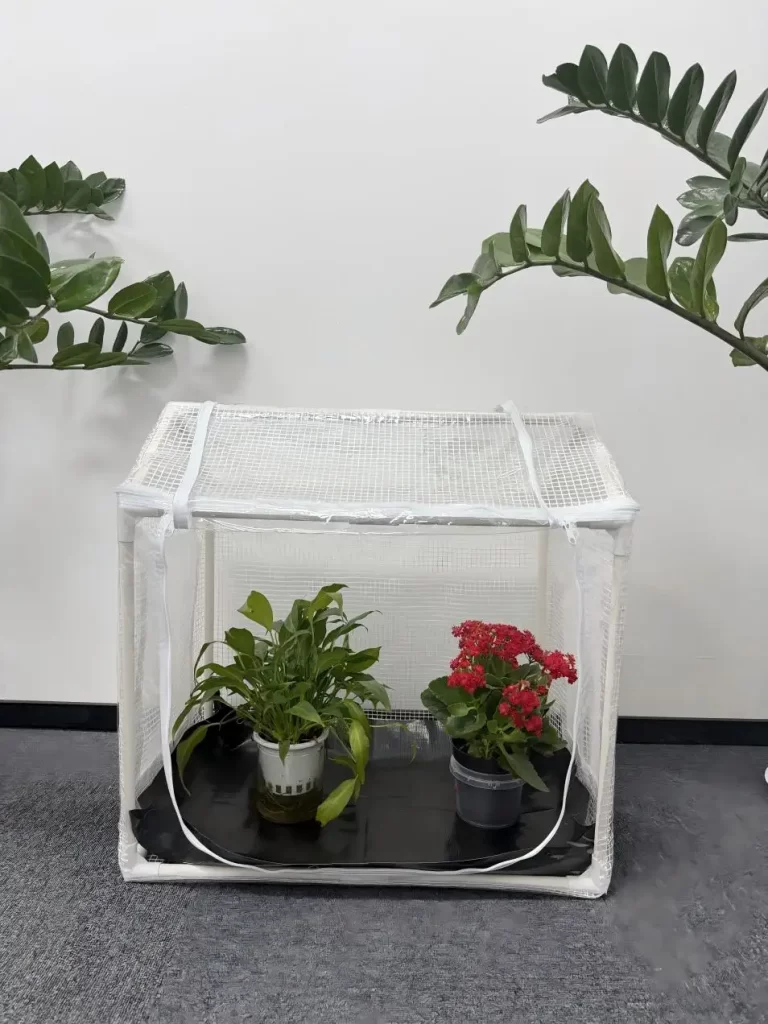
PVC is frequently used for a portable Plastic Mini Greenhouse because it combines transparency with flexibility. It can easily be zipped, folded, or rolled and corresponds well with lightweight frame greenhouses.
Scarecrow Plastic Mini Greenhouse Design
Scarecrow Garden Supplier Co., Ltd. supplies their model SKU2509063, the Plastic Mini Greenhouse with a waterproof pad and humidity dome. This model incorporates a variety of features, including storage space, surface protection, rapid access, and quick drying.
| Feature | Scarecrow Plastic Mini Greenhouse | Basic Model |
| Cover Material | UV protection, PVC, transparent film | Stiff or absent plastic film |
| Access | Heavy-duty zipper + roll-up door | Basic flap or removable cover |
| Base | Waterproof pad (integrated waterproofing layer) | Waterproofing layer often absent |
| Frame | Electrophoretic coated iron metal | Painted or unpainted iron metal |
| Security | Built-in straps for secure fastening | Basic ties or loose cover assembly |
| Connectors | Tool-free assembly | Screws or lightweight joints |
| Application | Versatile (tables, balconies, patios, sheltered outdoor areas) | Usually limited to one application |
The cover is a transparent, UV-resistant PVC. It allows light to come through and helps to maintain humidity. The frame is rust-resistant and supports the cover. The door is roll-up for easy access and to help water and inspect the plants.
This Plastic Mini Greenhouse is waterproof, portable, and holds up to multiple uses, and therefore, provides more benefits than a basic enclosure.
Final Words
Plastic Mini Greenhouses would not function without their transparent cover. The clear cover helps greenhouse plants receive natural light through the cover while UV stability prolongs the lifespan of the cover by maintaining clarity and flexibility.
For wholesalers and distributors, the best mini greenhouse is not the one with the clearest cover, but the one that successfully balances the following:
•Optimal Light Exposure
•UV Resistance
•Humidity Retention
•Ventilation Control
•Cover Flexibility
•Structural Stability
•Ease of Cleaning and Storage
Considering these features will enable buyers to choose a Plastic Mini Greenhouse that has consistent performance, better retail value, and higher appropriateness for improving the germination process of seeds and for protecting small plants.
FAQs
Q1: How does the humidity dome help with seed germination, and can I adjust the airflow?
A: The humidity dome creates a greenhouse-like environment by trapping moisture and warmth, which is essential for high germination rates. Our dome features adjustable top vents, allowing you to fine-tune the airflow and humidity levels based on the specific growth stage of your seedlings to prevent damping-off.
Q2: Is the waterproof base sturdy enough to be moved when filled with soil or water?
A: Absolutely. We use heavy-duty, reinforced plastic for the base to ensure it remains rigid and leak-proof. Unlike flimsy disposable trays, our base is designed to support the full weight of moist soil and seedlings without cracking or bending when carried.
Q3: Can this mini greenhouse fit standard 1020 seedling trays or peat pellets?
A: This unit is designed with versatility in mind. The interior dimensions are optimized to accommodate most standard-sized seed starting cells and peat pellets. It provides ample vertical space (High-Dome design) for seedlings to grow taller before needing to be transplanted.
Q4: Is the material heat-resistant, and can I use it with a seedling heat mat?
A: Yes, the base is made of heat-resistant materials specifically designed to be compatible with standard seedling heat mats. It can safely withstand the constant low heat required to warm the root zone without warping or emitting any odors.
Q5: Is the plastic BPA-free, and can these be reused for multiple seasons?
A: As a professional garden supplier, we prioritize safety. Our greenhouses are made from high-quality, BPA-free PET/PVC plastic, making them safe for starting vegetables and herbs. The thickened material is UV-resistant and highly durable, allowing for easy cleaning and reuse for many growing seasons.