









Updated 2 months ago
Types of Garden Rakes: A Complete Selection Guide for Garden Centers, Landscapers, and Tool Distributors
SCARECROW GARDEN SUPPLIER

Types of Garden Rakes: A Complete Selection Guide for Buyers | Scarecrow Garden Supplier
Key Takeaways
- Garden rakes are not a single product. The first difference comes from the task: leveling soil requires rigid steel tines; collecting leaves requires flexible, fan-shaped tines.
- Seven common rake types serve different jobs — bow rake, level head rake, leaf/lawn rake, shrub rake, landscape rake, thatching rake, and hand rake. Each has a distinct tine behavior, head width, and limitation.
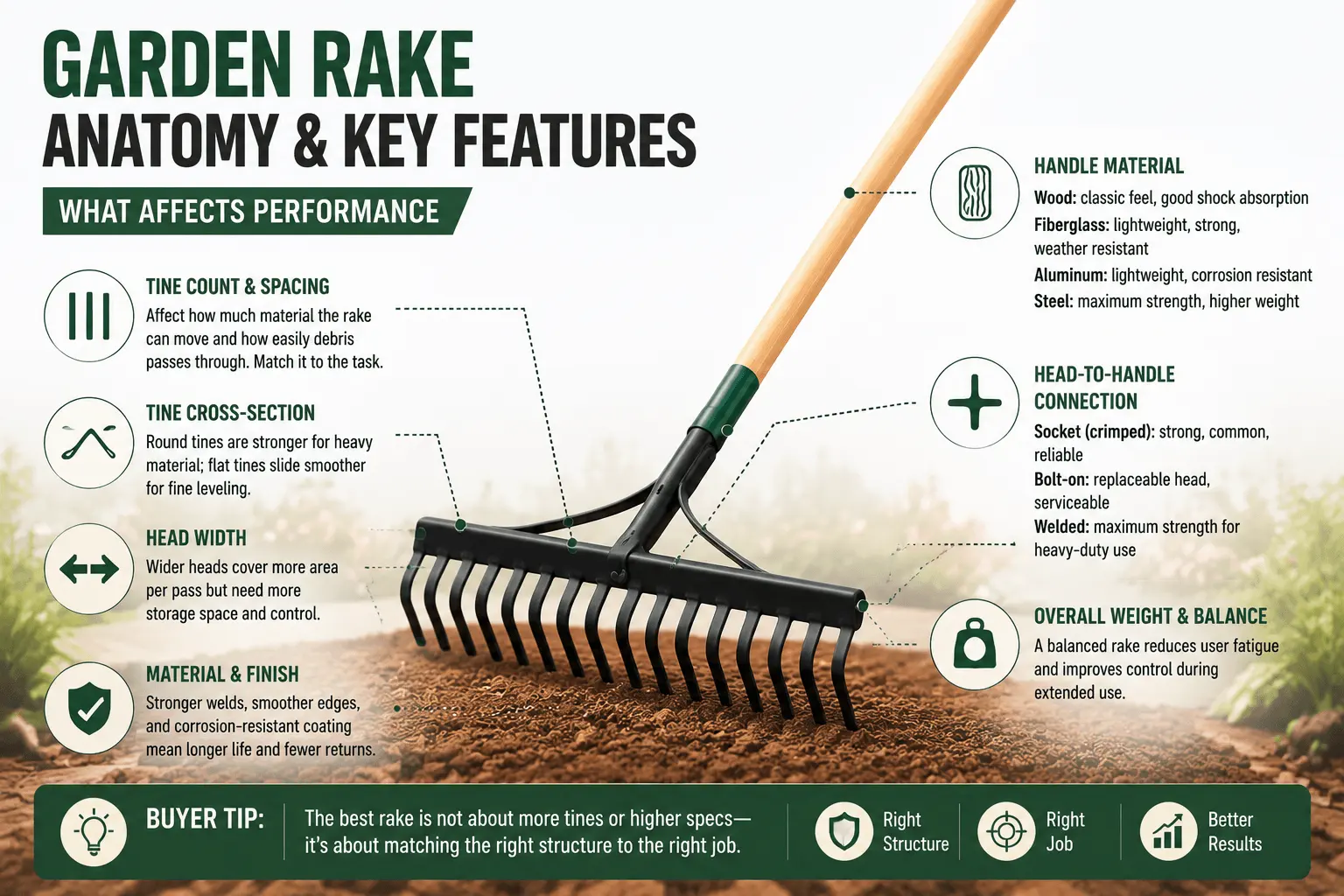
- Tine count, spacing, cross-section, head width, and head-to-handle connection all change how a rake performs — more tines does not automatically mean better.
- Handle material (wood, fiberglass, aluminum, steel) affects weight, durability, repairability, and price positioning — no single material is universally “best.”
- For B2B buyers, the key is building a range that covers core tasks without overlapping SKUs. A focused selection sheet beats an oversized catalogue.
If you sell garden tools, you already know the problem. A customer asks for “a rake,” and that word could mean seven different tools. A bow rake for breaking up soil. A leaf rake for autumn cleanup. A shrub rake for tight flower beds. A thatching rake for lawn care. They all share a name, but they do not share a purpose — and stocking the wrong type leads to returns, complaints, and dead inventory.
Garden rakes differ first by task, then by tine stiffness, head width, and handle material. This guide breaks down every common type, explains how structural parameters change performance, and gives B2B buyers a framework for building a rake range that serves real customers without redundant SKUs.
Who this guide is for: Garden center buyers, hardware distributors, landscape supply companies, private-label brands, and e-commerce sellers who need to source rakes from manufacturers and want to understand what they are buying before they place an order.
Garden Rake Types at a Glance
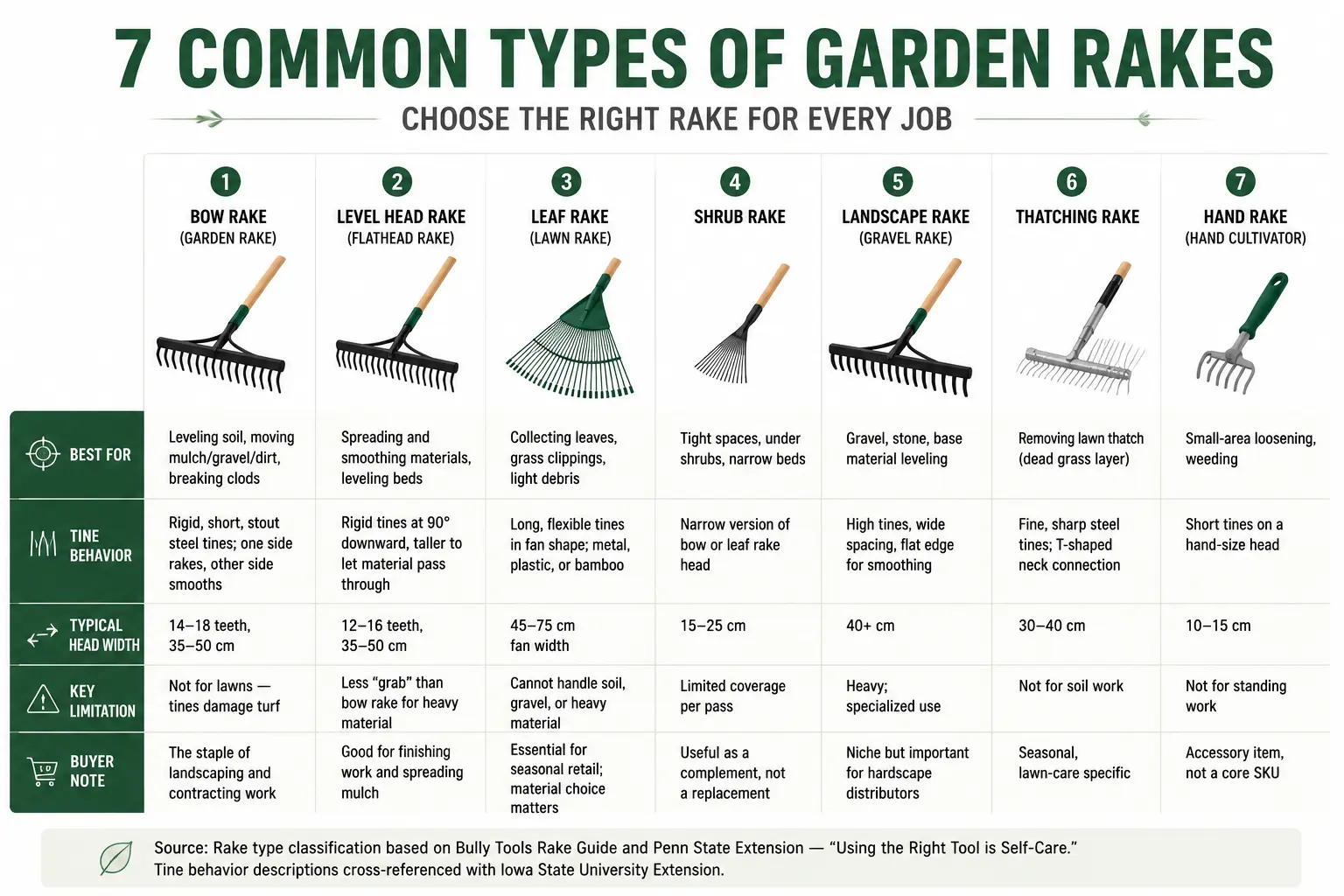
Before diving into details, here is a comparison table covering the seven most common rake types you will encounter in the market. Each type is defined by what it does, how its tines behave, and where it falls short.
| Rake Type | Best For | Tine Behavior | Typical Head Width | Key Limitation | Buyer Note |
| Bow Rake (Garden Rake) | Leveling soil, moving mulch/gravel/dirt, breaking clods | Rigid, short, stout steel tines; one side rakes, other side smooths | 14–18 teeth, 35–50 cm | Not for lawns — tines damage turf | The staple of landscaping and contracting work |
| Level Head Rake (Flathead Rake) | Spreading and smoothing materials, leveling beds | Rigid tines at 90° downward, taller to let material pass through | 12–16 teeth, 35–50 cm | Less “grab” than bow rake for heavy material | Good for finishing work and spreading mulch |
| Leaf Rake (Lawn Rake) | Collecting leaves, grass clippings, light debris | Long, flexible tines in fan shape; metal, plastic, or bamboo | 45–75 cm fan width | Cannot handle soil, gravel, or heavy material | Essential for seasonal retail; material choice matters |
| Shrub Rake | Tight spaces, under shrubs, narrow beds | Narrow version of bow or leaf rake head | 15–25 cm | Limited coverage per pass | Useful as a complement, not a replacement |
| Landscape Rake (Gravel Rake) | Gravel, stone, base material leveling | High tines, wide spacing, flat edge for smoothing | 40+ cm | Heavy; specialized use | Niche but important for hardscape distributors |
| Thatching Rake | Removing lawn thatch (dead grass layer) | Fine, sharp steel tines; T-shaped neck connection | 30–40 cm | Not for soil work | Seasonal, lawn-care specific |
| Hand Rake (Hand Cultivator) | Small-area loosening, weeding | Short tines on a hand-size head | 10–15 cm | Not for standing work | Accessory item, not a core SKU |
Source note: Rake type classification based on Bully Tools Rake Guide and Penn State Extension — “Using the Right Tool is Self-Care.” Tine behavior descriptions cross-referenced with Iowa State University Extension. Hand rakes are short-handled tools included here for completeness but are outside the scope of long-handled agricultural rakes covered in this guide.
One important naming note: “garden rake” and “soil rake” often refer to the same tool as a bow rake, but not always. In some markets, “garden rake” means any rigid-tine rake used in garden beds. When sourcing, always confirm the specific head design — the bow (curved reinforcement connecting tines to the socket) is the defining feature of a bow rake, not the name on the box.
Choosing Rakes by Task: What the Tool Actually Does
Understanding rake types means understanding the jobs they perform. Here is a task-based breakdown that helps you decide which models belong in your range.
Leveling Soil and Preparing Seedbeds
This is the core job of a bow rake or level head rake. Penn State Extension describes bow rake heads as “wider than draw hoes and shallower, with short, stout steel tines used for leveling and moving heavy materials like soil and rocks.” The rigid steel tines break up clods, and the flat back of the head smooths the surface for planting.
Iowa State University Extension is direct about the distinction: “Garden rakes are used to level and prepare seedbeds for planting. They are not meant for lawn areas. Garden rakes may damage the turf and their tines often become plugged with debris.”
If your customers grow vegetables, prepare garden beds, or work in landscaping, they need at least one rigid-tine rake in this category.
Collecting Leaves and Lawn Debris
This is the domain of the leaf rake (also called a lawn rake). Penn State Extension notes: “Long-tined leaf rakes flex, which allows you to collect lightweight materials around fixed objects without catching on them.” Their heads can be metal, bamboo, or plastic.
Iowa State University Extension separates the two clearly: “Every gardener needs at least two rakes — a steel garden rake and a lawn rake. Garden rakes are used to level and prepare seedbeds for planting. Lawn rakes handle lawn debris such as grass clippings and leaves.”
For retail, leaf rakes are seasonal high-volume items. The material choice (plastic vs. metal vs. bamboo) affects price point, durability, and climate suitability — we cover this in detail in Leaf Rake vs. Garden Rake: Tine Flexibility, Head Width, and Material Selection Explained.
Moving Gravel, Stone, and Base Material
A landscape rake or gravel rake handles this. These rakes feature high tines with wide spacing that lets small stones pass through, and a flat edge for smoothing. They are heavier and more specialized — important if your customer base includes hardscape contractors or driveway installers.
Working in Tight Spaces
A shrub rake is simply a narrow-headed rake — either a mini bow rake or a narrow leaf rake — designed to fit between plants and under shrubs. It is a complement to the main rake, not a replacement. For garden centers, it is an upsell item alongside a bow rake or leaf rake purchase.
Lawn Thatch Removal
A thatching rake has fine, sharp steel tines mounted on a T-shaped neck. It is designed specifically to cut into the dead grass layer (thatch) that builds up on lawns. This is a seasonal, lawn-care-specific tool — relevant if your customers include homeowners with maintained lawns or professional lawn care services.
How Structural Parameters Change Performance
Once you understand rake types by task, the next level is understanding how specific structural parameters affect performance. This is where B2B buyers can distinguish between similar-looking products from different suppliers.
Tine Count and Spacing
More tines do not automatically mean a better rake. Tine count interacts with head width and task:
- Bow rakes typically have 12–16 tines. More tines on the same head width means tighter spacing — better for fine soil leveling, but more likely to clog with debris.
- Gravel rakes use fewer, taller tines with wider spacing — material needs to pass through, not get caught.
- Leaf rakes use many flexible tines (often 20+) spread in a fan — maximizing coverage area for lightweight material.
When sourcing, always ask for the tine count and the head width together. A 14-tine rake with a 40 cm head performs differently from a 14-tine rake with a 50 cm head.
Tine Cross-Section and Stiffness
Rigid rakes (bow, level head, gravel) use steel tines that are stamped or forged into shape. The cross-section — round, flat, or rectangular — affects stiffness and how the tine interacts with material. Flat tines are common in stamped construction; round or square tines are typical of forged heads.
Flexible rakes (leaf rakes) use spring steel wire, plastic, or bamboo. Spring steel provides the best flex-and-return for metal leaf rakes. Plastic offers lower cost and lighter weight but may become brittle in cold conditions — verify the specific plastic grade if your market includes cold-climate regions.
Head-to-Handle Connection
This is one of the most common failure points in garden rakes. Penn State Extension describes several connection types:
- Socket and wrap: The back of the head flares to wrap around the handle, sometimes reinforced with a bolt.
- Tang extension: A full or partial tang extends from the head through the center of the handle.
- Metal band reinforcement: The juncture of tang and handle is reinforced with a metal band wrapping both.
For riveted tine rakes (where individual tines are riveted to a crossbar), the rivet diameter, count, and placement determine whether tines stay secure under load. Loose rivets are a common defect that leads to bent or missing tines.
Penn State Extension also notes: “If made of differing materials, heads usually outlast handles. A tool with an easy-to-replace handle is desirable.” This matters for B2B buyers — if your market has a repair culture (common in professional landscaping), replaceable handles are a selling point.
Head Width and Working Efficiency
Wider heads cover more ground per pass but are harder to use in tight spaces. For bow rakes, head widths of 35–50 cm are common. For leaf rakes, fan widths of 45–75 cm are typical. The choice depends on your customer’s working environment — open garden beds vs. narrow borders.
Handle Materials and Length: A Quick Overview
Handle material affects weight, durability, shock absorption, repairability, and price. We cover this in depth in Wood, Fiberglass, Aluminum, or Steel Rake Handles: A Buyer’s Comparison, but here is the summary:
| Handle Material | Strengths | Weaknesses | Typical Use |
| Wood | Good strength, shock absorption, durability; replaceable | Needs maintenance to prevent drying and cracking; absorbs moisture | Traditional garden/agricultural tools |
| Fiberglass | Light and strong; durable | Surface can develop glass splinters with age and weather exposure | Long-term outdoor use; premium retail |
| Aluminum | Lightweight; does not rust | Can snap under heavy lateral force | Light-duty rakes; aluminum-handled garden rakes |
| Steel | Very durable | Heavy; poor shock absorption; more tiring | Heavy industrial use |
Penn State Extension summarizes: “Wooden handles such as ash, oak, and hickory are known for their strength, shock absorption, and durability. Fiberglass is light and strong. Metal handles are durable but heavy and less shock-absorbent.”
Utah State University Extension adds the ergonomic dimension: “Use rakes and shovels with height-appropriate handles that help you maintain a straight back and avoid hunching over.” Handle length is not just a preference — it affects user safety and fatigue. Common wooden rake handle lengths in agricultural-grade tools typically range from approximately 1,240 mm to 1,770 mm, with D-grip, long, and mid-length options available.
For wood handles, FSC (Forest Stewardship Council) Chain of Custody certification may be relevant if your market requires timber traceability — particularly for EU markets under EUTR regulations. FSC certification should only be claimed when actual certificates and transaction chains are valid.
Build a Complete Rake Product Line
From entry-level to professional-grade
We organize compatible rake models into clear price and quality tiers, then create a mixed-model sourcing plan tailored to your target market— helping you offer the right products at every price point.
Or email us at queenie@gardentoolswholesale.com
B2B Selection: Building a Rake Range That Sells
This is where most catalogues go wrong. A supplier sends you a 200-page product book with 40 rake models, and you try to stock them all. The result: three models do the same job, two more are too similar for customers to distinguish, and the whole range becomes confusing.
The Core Range Principle
For most garden centers and distributors, a functional rake range needs to cover these tasks without overlap:
One bow rake (rigid tine, soil leveling) — 14-tine, mid-range head width
One leaf rake (flexible tine, leaf collection) — metal or plastic, depending on climate
One shrub rake (narrow head, tight spaces) — optional but useful as an upsell
One specialty rake if your market demands it — gravel rake for hardscape, thatching rake for lawn care
That is a core of 3–4 SKUs. You can expand to opening, mid-range, and professional tiers within each type, but the types themselves should not overlap.
Avoiding Duplicate SKUs
Two rakes with slightly different head widths and the same tine type are not “more choice” — they are confusion. If you stock a 14-tine bow rake at 40 cm and a 14-tine bow rake at 45 cm, most customers will not know the difference. Pick one. Use the other slot for a different task type or a different quality tier.
Price Tiers Within a Type
Within each rake type, you can offer quality tiers — but they need to be genuinely different in construction, not just in label. An opening-price bow rake might use stamped steel with a painted finish and a basic wooden handle. A professional version might use heavier-gauge steel, a longer socket, and a premium handle. The difference should be visible and structural, not just a different color.
```htmlNot Sure Which Rake Types Belong in Your Range?
Tell us three simple details about your market. We will prepare a focused rake selection sheet instead of sending you an oversized catalogue.
Direct email: queenie@gardentoolswholesale.com
Common Quality Risks in Garden Rakes
Understanding failure modes helps you specify better products and set up effective QC checks. Here are the most common issues:
| Failure Mode | What Happens | Root Cause | How to Check |
| Bent tines | Tines deform under normal use | Insufficient tine thickness or material; no heat treatment | Visual inspection; sample bending test |
| Loose head | Head wobbles on handle | Short socket; inadequate rivet/bolt; poor fit | Twist test; pull test |
| Rivet failure | Individual tines come loose | Undersized rivets; insufficient rivet count; poor riveting | Check rivet diameter and count against spec |
| Coating failure | Paint chips or peels, exposing bare steel | Thin or poorly adhered coating; no edge coverage | Visual; tape adhesion test (ASTM D3359) |
| Handle cracking | Wood handle splits along grain | Wet wood; poor grain orientation; knots at stress points | Visual; moisture content check |
| Packaging damage | Tines scratch each other; handles bend in transit | No inter-leaving; insufficient carton rigidity | Carton inspection; ISTA transit test |
Important: Coating performance should be described by what it is — “painted finish” or “powder-coated finish” — not by unverified claims about salt spray hours or outdoor lifespan. ASTM B117 salt spray testing provides a standardized environment for comparison, but hours of salt spray exposure do not translate directly to years of outdoor service.
```htmlNeed Evidence Before a Bulk Order?
Ask for a sample inspection and test-video plan before confirming your rake order.
We can organize a focused inspection plan covering product appearance, assembly quality, functional details and packaging, then provide clear photos and test videos for your review.
What to Ask a Supplier Before Ordering Rakes
When evaluating a garden rake supplier, the questions that matter are structural, not promotional. Here is a checklist:
Head construction:
- Are tines stamped, forged, or riveted to a crossbar?
- What is the tine cross-section (flat, round, square)?
- How many rivets secure each tine? What diameter?
Head-to-handle connection:
- How deep is the socket? Is there a through-bolt or tang?
- Can the handle be replaced if it breaks?
Handle:
- What material? What length range is available?
- For wood: what species? Is FSC certification available?
- For fiberglass: what wall thickness? What grip material?
Coating:
- Is it painted, powder-coated, or epoxy-coated?
- What color options are available?
- Is edge coverage (cut edges of stamped parts) addressed?
Packaging:
- How are heads protected from mutual contact?
- What is the per-carton quantity?
- What is the estimated 20-foot container loading quantity?
Customization:
- Can you mix head and handle types within one order?
- Can you request custom colors or private-label packaging?
- What is the realistic minimum order for each customization?
These questions prevent the most common sourcing mistake: ordering based on a photo and a price, then discovering structural differences only when the goods arrive.
```htmlBuild Your Own Garden Rake Brand
Looking for private-label garden rakes?
Share your preferred models, branding method, quantities and destination market. We will confirm what can be customized using practical existing options—without adding unnecessary tooling.
Email us directly: queenie@gardentoolswholesale.com
Wrong Selection Examples: What Not to Do
Real-world mistakes that lead to returns and dead stock:
Mistake 1: Stocking only a leaf rake. A garden center stocks a plastic leaf rake as its only rake because it is the cheapest. Customers who need to prepare soil beds leave empty-handed — or buy the leaf rake, try to use it on soil, break the tines, and return it.
Mistake 2: Calling all rigid-tine rakes “bow rakes.” A distributor labels every steel-tine rake as a “bow rake,” including level head rakes without the bow reinforcement. Customers who specifically want the bow design (for its flex and spring in material) receive a different structure and complain.
Mistake 3: Assuming more tines = better. A buyer chooses a 16-tine rake over a 14-tine rake assuming more is better. On a narrow head, the tighter spacing clogs with debris faster and is harder to clean. The 14-tine version would have performed better for the same task.
Mistake 4: Ignoring handle length for the target market. A buyer sources rakes with 1,240 mm handles for a market where the average user height makes 1,500+ mm more appropriate. The result: users hunch over, fatigue quickly, and associate the brand with poor ergonomics.
```htmlCompare Rake Structures Before Comparing Prices
Send us two or three reference photos.
We can compare key structural differences, explain how they may affect performance and durability, and identify likely quality risks before you choose a model or confirm a bulk order.
Is a garden rake the same as a bow rake? Often, but not always. “Garden rake” is sometimes used as a general term for any rigid-tine rake used in garden beds. A true bow rake has a specific feature: a curved bow-shaped reinforcement connecting the tine row to the handle socket. If you need the bow design specifically, confirm the head structure — not just the name.
Can I use a bow rake for leaves? You can, but it is not designed for it. Bow rakes have short, rigid tines meant for soil and heavy material. For leaves, a leaf rake with flexible fan-shaped tines covers more area and does not dig into the lawn surface. Using a bow rake on leaves is like using a shovel to sweep — it works, but inefficiently.
How many tines should a bow rake have? It depends on head width and task. Most bow rakes have 12–16 tines. On a standard head width (35–45 cm), 14 tines is a common and versatile configuration. More tines on the same width means tighter spacing — better for fine leveling but more prone to clogging with debris.
Wood or fiberglass handle — which is better? Neither is universally better. Wood offers good shock absorption and is replaceable. Fiberglass is lighter and very durable, but can develop surface fiber splinters over time. The choice depends on your target user, price point, and market expectations. See our detailed comparison in Rake Handle Material Comparison.
Can I do private-label garden rakes? Yes. Customization options typically include handle type, handle length, coating color, and packaging design. The realistic customization scope depends on the specific model and factory capability. Share your preferred models, branding method, quantities, and destination market, and we can confirm what is feasible without unnecessary tooling costs.
What is the difference between a painted finish and a powder-coated finish? Painted finish is a liquid paint applied to the metal surface — it is the most basic surface treatment. Powder coating uses dry powder that is electrostatically applied and cured under heat (typically 180–200°C), creating a thicker, more uniform, and more durable layer. Both have their place: painted finishes are common on agricultural-grade tools where cost matters; powder coating is typical on retail-grade and premium tools where appearance and durability are selling points.
Before confirming bulk orders, distributors should also review product inspection points. See our checklist: How to Inspect Garden Rakes Before a Wholesale Order: A Practical QC Checklist.