








OPTION A
Plastic Rakes
- Lightweight handling
- Suitable for leaves and lawn debris
- Lower shipping weight
- Multiple colors available

Making Wholesale Garden
Buying Easier

Making Wholesale Garden
Buying Easier


Updated 2 months ago
SCARECROW GARDEN SUPPLIER

Leaf Rake vs. Garden Rake: Tine Flexibility, Head Width, Materials | Scarecrow Garden Supplier
A customer walks into your store in October and asks for “a rake.” Do you hand them a leaf rake or a garden rake? The answer depends entirely on what they plan to do — and most customers do not know the difference until they use the wrong tool for the job.
The leaf rake and the garden rake are not variations of the same tool. They use fundamentally different tine systems designed for fundamentally different tasks. Understanding the distinction — and the material options within each type — is essential for building a rake range that serves customers through every season.
This guide is for retail buyers, garden center managers, and e-commerce sellers who need to source both types and want to avoid the most common stocking mistakes.
Iowa State University Extension puts it plainly: “Every gardener needs at least two rakes — a steel garden rake and a lawn rake. Garden rakes are used to level and prepare seedbeds for planting. Lawn rakes handle lawn debris such as grass clippings and leaves.”
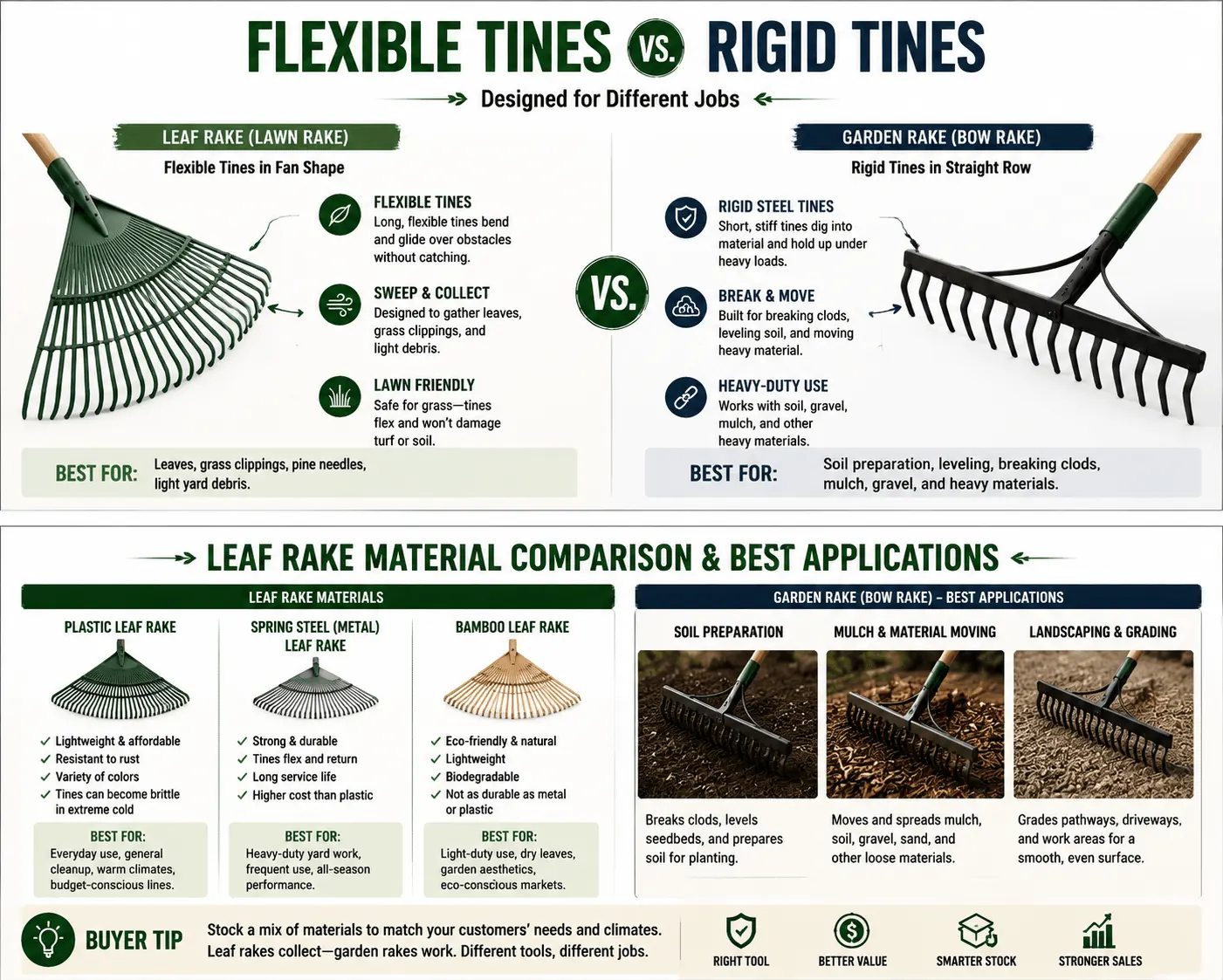
Here is what that means structurally:
| Feature | Leaf Rake (Lawn Rake) | Garden Rake (Bow Rake) |
| Tine behavior | Long, flexible tines in fan shape | Short, rigid steel tines in straight row |
| Tine material | Plastic, spring steel, bamboo | Steel (stamped or forged) |
| Head shape | Fan-shaped, spreading outward | Straight bar with tines pointing down |
| Typical head width | 45–75 cm (fan spread) | 35–50 cm (bar width) |
| Primary task | Collecting leaves, grass clippings, light debris | Leveling soil, breaking clods, moving heavy material |
| Ground interaction | Sweeps surface — tines flex over obstacles | Digs into surface — tines engage material |
| Lawn safety | Safe — flexible tines do not damage turf | Not safe — rigid tines dig into and damage turf |
Beyond leaf and garden rakes, buyers may also need different head designs for soil preparation and landscaping work. Read Bow Rake vs. Level Head Rake: Which Head Design Fits Soil Preparation and Landscaping?
Penn State Extension adds: “Long-tined leaf rakes flex, which allows you to collect lightweight materials around fixed objects without catching on them. Their heads can be metal, bamboo, or plastic.”
This is the key insight: flexibility is the design feature, not a limitation. A leaf rake’s tines are supposed to bend. That flex lets them glide over garden edges, raised bed corners, and uneven lawn surfaces without snagging. A garden rake’s rigid tines are supposed to stay stiff — that stiffness lets them break up soil and move heavy material.
Give every model a clear reason to exist.
We can help separate the essential use cases and prevent visually similar rake models from competing with each other in your catalogue.
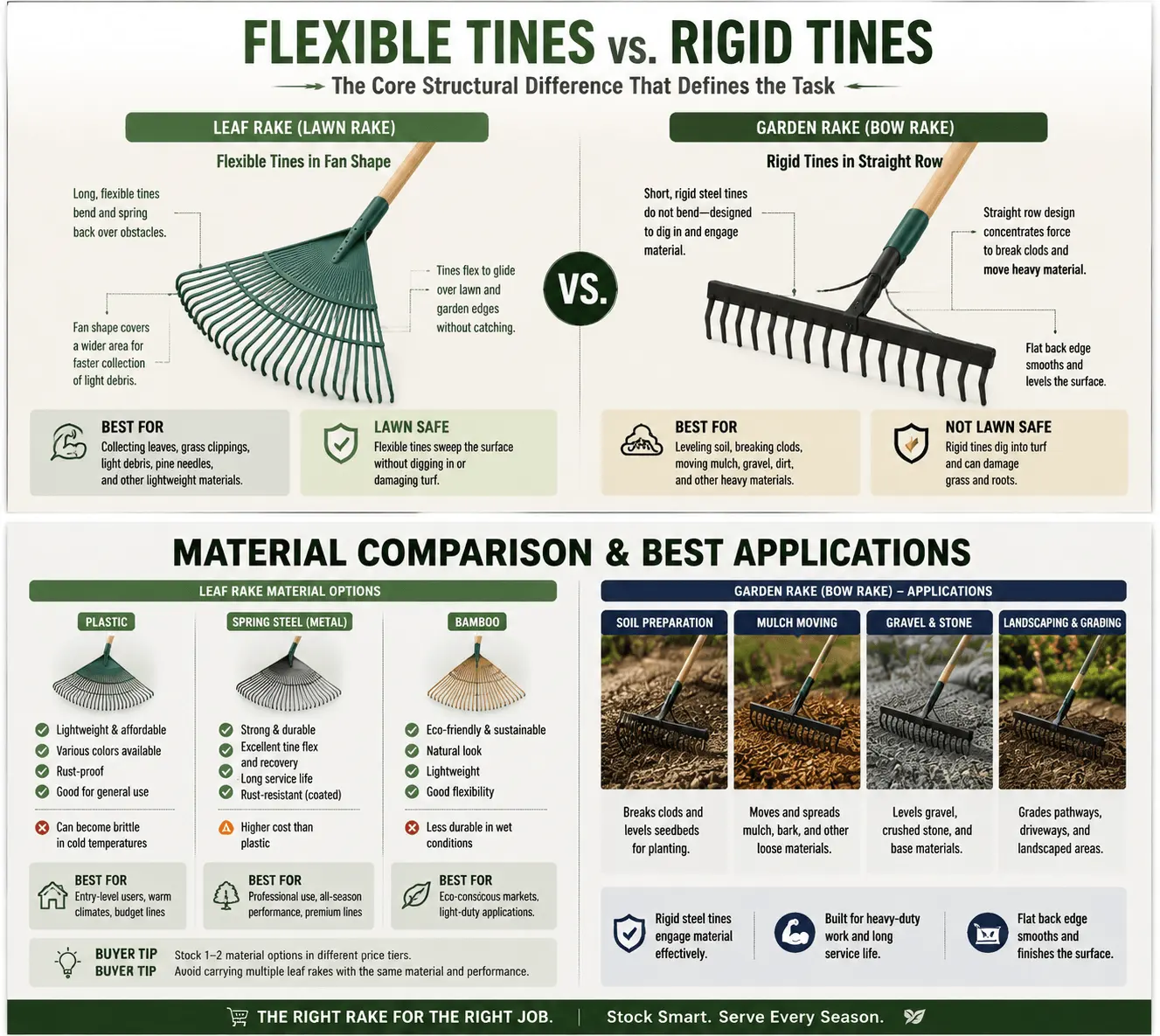
Within the leaf rake category, material choice creates significant differences in price, durability, and climate suitability. This is where B2B buyers need to make informed decisions.
Plastic is the most common material for entry-level leaf rakes. Advantages include low cost, light weight, and availability in various colors. The tines are typically molded as part of the head or attached as individual plastic fingers.
Considerations for buyers:
Metal leaf rakes use spring steel wire or flat spring steel tines. These are different from garden rakes — the tines are thin and designed to flex, not rigid steel bars.
Bully Tools describes metal leaf rake design: the curved tine shape is designed to prevent piercing through leaves while the curve collects and holds as much material as possible. The metal construction provides better durability than plastic and performs more consistently across temperature ranges.
Considerations for buyers:
Bamboo tines offer a traditional, lightweight option. They are naturally flexible and biodegradable. However, bamboo has durability limitations — it can split, dry out, and degrade faster than steel or quality plastic. Bamboo rakes are typically a niche or premium-positioned product, not a high-volume SKU.
| Material | Price Level | Durability | Cold Climate | Best For |
| Plastic | Entry | Moderate | Verify grade — some plastics become brittle | Seasonal retail, budget-conscious buyers |
| Spring steel | Mid-range | Good | Consistent performance | Regular-use gardeners, multi-season durability |
| Bamboo | Premium/niche | Lower — splits and dries | Acceptable | Eco-conscious buyers, traditional gardeners |
Important: Do not claim that “all plastic rakes fail in cold weather” without material-specific evidence. Different polymer formulations have different low-temperature performance. If you cannot verify the specific plastic grade, describe the rake as “plastic” without making climate performance claims.
Compare materials based on your real market requirements.
Send us your climate, target price level and packing requirement. We will prepare a material-based comparison and recommend the more suitable rake options for your market.
Head width affects two things: coverage area per pass and maneuverability in tight spaces.
Wide leaf rake fans cover maximum ground per pass — ideal for open lawns and large yards. The trade-off: a 75 cm fan is difficult to maneuver between shrubs, along fence lines, or in narrow garden paths. Wide fans also require more storage space and may not fit in standard retail shelving.
Narrower fans sacrifice coverage speed for maneuverability. They work better in suburban gardens with mixed planting, tight borders, and limited storage. For markets where the typical user has a small-to-medium yard, a 50 cm fan may be more practical than a 70 cm fan.
For garden rakes (rigid tine), tine spacing interacts with head width:
Iowa State University Extension notes that garden rake “tines often become plugged with debris” when used in the wrong context — a reminder that tine spacing should match the intended task.
Understanding why customers return rakes helps you stock the right products and set correct expectations.
| Return Reason | What Happened | Root Cause | Prevention |
| Broken plastic tines | Customer used plastic leaf rake on soil or gravel | Wrong tool for task — plastic tines are for leaves only | Clear labeling; staff education; dual-type stocking |
| Bent metal tines (leaf rake) | Customer used leaf rake to dig or move soil | Metal leaf rake tines flex but are not designed for soil work | Explain the difference between flex tines and rigid tines |
| Garden rake damaging lawn | Customer used rigid-tine garden rake on grass | Wrong tool — garden rakes are not for lawns | Clear signage separating “lawn” and “garden” categories |
| Loose head | Head wobbles after normal use | Poor head-to-handle connection; short socket; inadequate fastener | Pre-order QC check on socket depth and fastener type |
| Handle snapped | Wood handle split at stress point | Wet wood; poor grain orientation; knot at stress area | Check handle quality at incoming inspection |
Check the failure points before confirming your rake order.
Ask for a pre-order checklist focused on tine recovery, head attachment, handle finish and carton protection. We can help you review the details most likely to affect product performance and customer satisfaction.
For garden centers and retailers, leaf rakes and garden rakes have different demand patterns:
Spring (March–May): Garden rakes are the primary seller — customers preparing beds, leveling soil, and mixing compost. Leaf rakes sell at moderate volume for spring cleanup.
Autumn (September–November): Leaf rakes are the primary seller — leaf collection season. This is typically the highest-volume period for leaf rake sales. Garden rakes sell at moderate volume for fall bed preparation.
Summer (June–August): Lower rake sales overall. Garden rakes for ongoing bed maintenance; leaf rakes for grass clippings after mowing.
Winter (December–February): Minimal rake sales in cold-climate markets. In warm-climate markets, garden rakes maintain steady sales for year-round gardening.
B2B implication: If you import rakes, your ordering cycle should reflect these seasonal patterns. Leaf rake inventory should arrive before September; garden rake inventory should arrive before March. Ordering both types simultaneously without considering seasonal demand leads to overstock of one and stockouts of the other.
```htmlGive your buyers clearer material before they make a decision.
We can organize sample-level photos and practical-use videos around the exact rake models you shortlist, helping your buyers review structure, finish, packaging and real working performance.
RHS guidance on tool care applies to both rake types: clean tools after use, dry them before storage, and protect metal surfaces from moisture to prevent rust. For wood handles, the RHS notes that wood absorbs moisture — storing wood-handled rakes in dry conditions prevents swelling, splitting, and handle degradation.
For plastic leaf rakes, store out of direct UV exposure when not in use to slow material degradation. For spring steel leaf rakes, a light wipe of oil on metal tines before seasonal storage prevents surface rust.
For distributors building a complete rake product range, our article Types of Garden Rakes: A Complete Selection Guide for Garden Centers, Landscapers, and Tool Distributors provides a broader product overview.
Is a metal leaf rake the same as a steel garden rake? No. A metal leaf rake uses thin, flexible spring steel tines designed to bend and return — they collect leaves by sweeping. A steel garden rake uses thick, rigid steel tines that do not bend — they break up soil and move heavy material. The word “metal” or “steel” in both names causes confusion, but the tine behavior is completely different.
Can I use a leaf rake for soil? Not effectively. Leaf rake tines are designed to flex and sweep lightweight material. In soil, they will either skip over the surface or bend under resistance. For soil work, you need a garden rake with rigid steel tines.
How wide should a leaf rake be? It depends on the user’s yard. Wide fans (60–75 cm) cover more ground per pass on open lawns. Narrower fans (45–55 cm) are more maneuverable in gardens with shrubs, paths, and tight borders. For general retail, a mid-width fan (50–60 cm) is the most versatile single option.
Do plastic leaf rakes break in cold weather? Some plastics become brittle at low temperatures, but performance varies by polymer type. If your market includes cold-climate regions, ask the supplier to confirm the plastic grade and request low-temperature performance information. Do not assume failure — and do not assume durability — without material-specific data.
Should I stock both leaf rakes and garden rakes? Yes, if you serve customers who do both lawn maintenance and garden bed work. The two types are not interchangeable — stocking only one means sending customers to a competitor for the other task. The key is stocking one model of each type that covers the core task, rather than multiple models of the same type that overlap.