









Updated 2 months ago
Bow Rake vs. Level Head Rake: Which Head Design Fits Soil Preparation and Landscaping?
SCARECROW GARDEN SUPPLIER

Bow Rake vs. Level Head Rake: Head Design Comparison for Buyers | Scarecrow Garden Supplier
Key Takeaways
- Both bow rakes and level head rakes are rigid-tine tools for soil and heavy material — but their head structures create different performance characteristics.
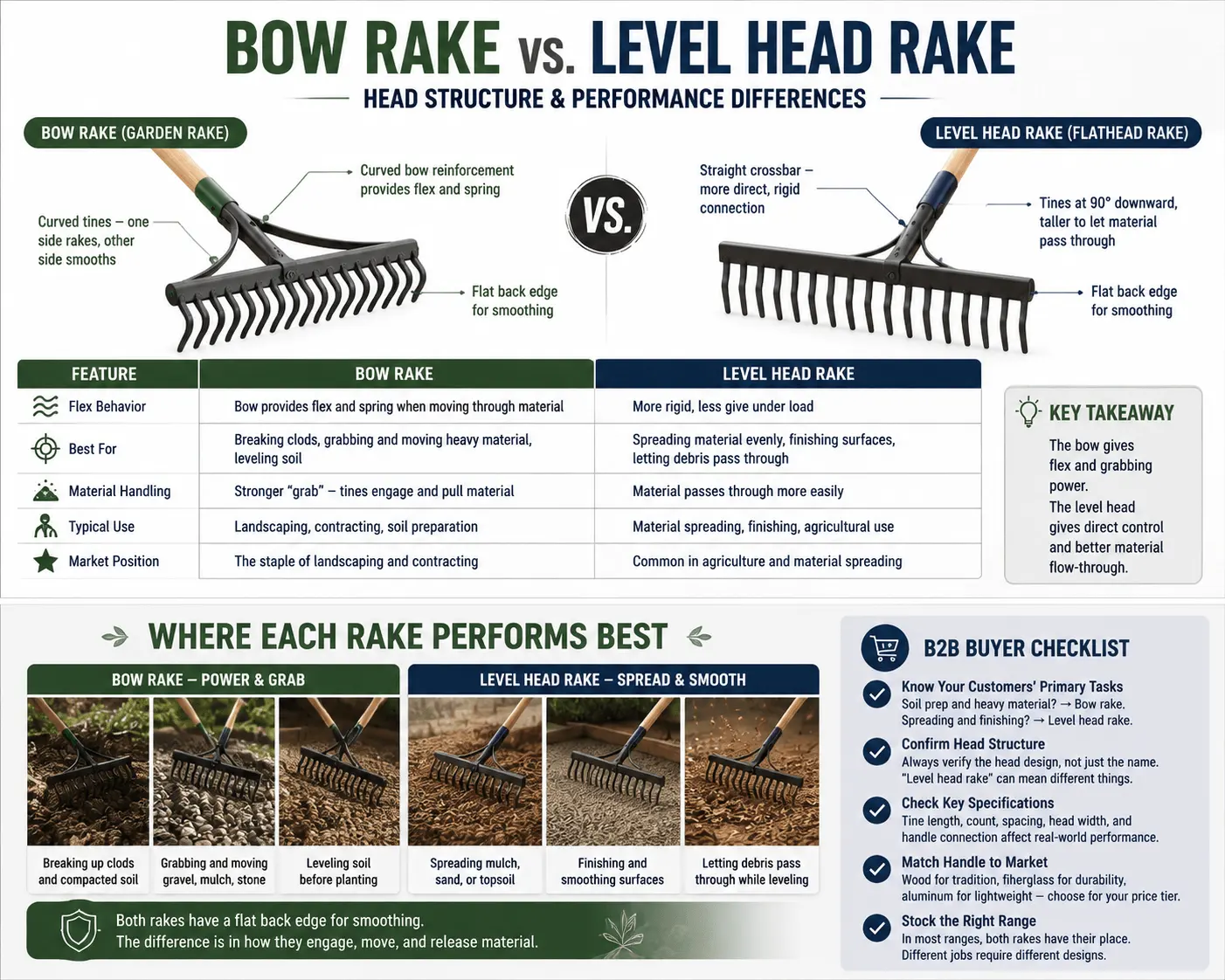
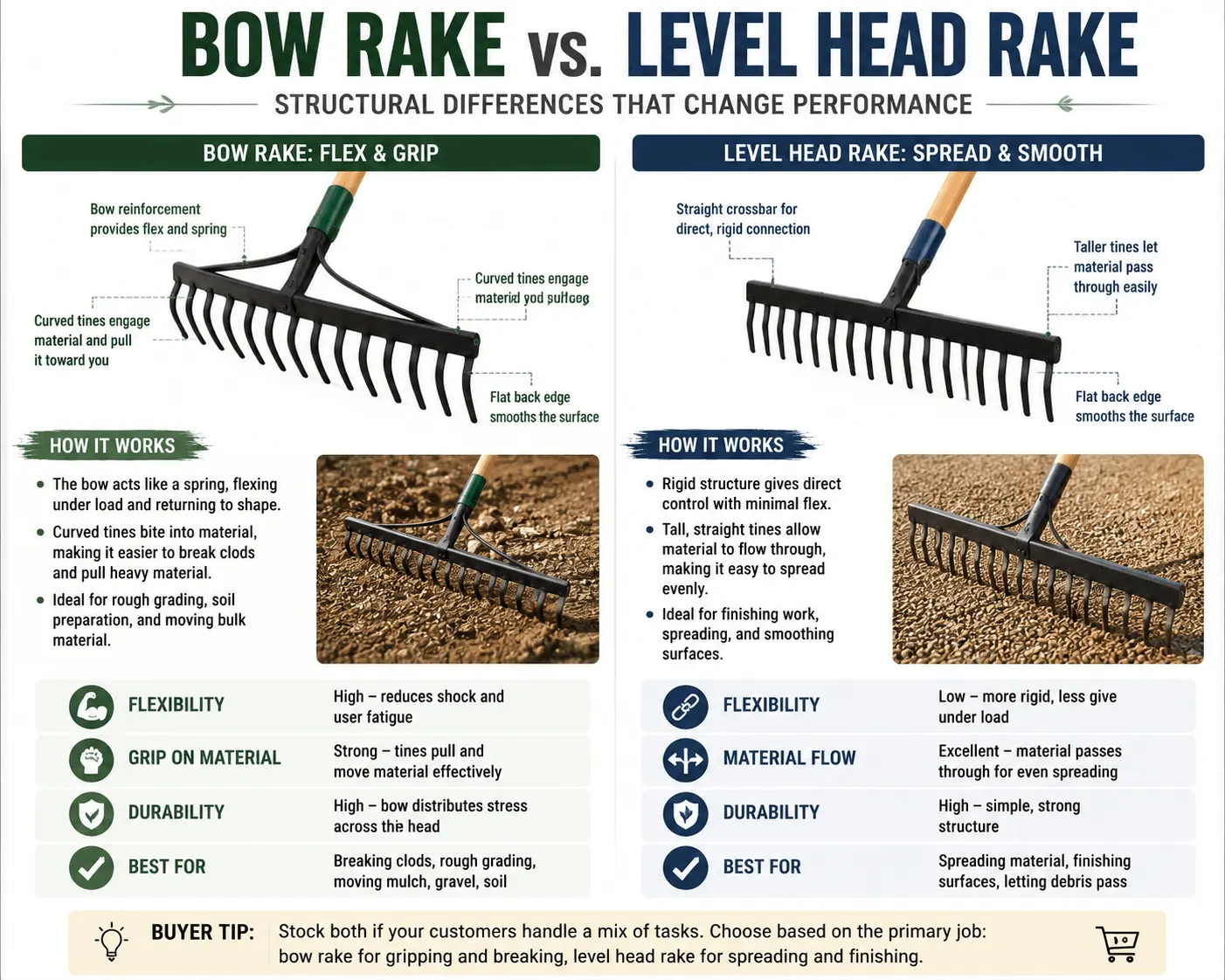
- The bow rake’s curved reinforcement (the “bow”) provides flex and spring when moving through material; the level head rake has a more direct, rigid connection.
- Both have a flat back edge for smoothing, but the level head rake’s taller tines allow more material to pass through — better for spreading, less effective for grabbing.
- “Level head rake” can mean different things across brands and markets — always confirm the head structure, not just the name.
- For B2B buyers, the choice between the two should be driven by your customers’ primary tasks, not by which one sounds more “professional.”
If you are sourcing rigid-tine rakes, you will encounter two head designs that look similar in a catalogue photo but perform differently on the job. The bow rake and the level head rake (also called a flathead rake) are both steel-tine tools used for soil preparation and material spreading — but their structural differences affect how they handle soil, gravel, mulch, and debris.
This guide is for garden center buyers, landscape supply companies, and tool distributors who need to decide which head design belongs in their range — or whether both belong.
The Quick Answer
Both rakes can level soil, break up clods, and move loose material. The difference is in how the tines connect to the handle socket:
- A bow rake uses a curved bow-shaped reinforcement that connects the tine row to the socket. This bow provides flex and spring — the rake gives slightly as it moves through material, then returns to shape. It is the standard tool for landscaping and contracting work.
- A level head rake connects tines directly to a straight crossbar at a 90° downward angle. The tines are typically taller, allowing material to pass through. There is no bow reinforcement — the structure is more direct and rigid.
Here is a side-by-side comparison:
| Feature | Bow Rake | Level Head Rake |
| Head structure | Curved bow connects tine row to socket | Tines attach directly to straight crossbar |
| Tine angle | Curved tines, one side rakes / other side smooths | Tines at 90° downward, taller to let material pass |
| Flex behavior | Bow provides flex and spring in material | More rigid; less give under load |
| Best for | Breaking clods, grabbing and moving heavy material, leveling soil | Spreading material evenly, finishing surfaces, letting debris pass through |
| Flat back | Yes — smooths surface | Yes — smooths surface |
| Market position | “Staple” of landscaping and contracting | Common in agriculture and material spreading |
| Typical tine count | 12–16 | 12–16 |
Source note: Classification based on Bully Tools Rake Guide and Penn State Extension — “Using the Right Tool is Self-Care.” Bully Tools describes the bow rake as a staple among landscaping and contracting businesses, used for raking and spreading loose material like mulch, stone, gravel, asphalt, and dirt.
Head Structure: What the Bow Actually Does
The bow is not decorative. It is a structural element that changes how the rake performs under load.
The Bow Reinforcement
On a bow rake, the tine row connects to the handle socket through a curved piece of steel — the bow. This curved shape acts like a spring. When you push the rake through heavy soil or pull it through gravel, the bow flexes slightly, absorbing shock and then returning to its original position. Bully Tools describes this as providing an excellent amount of flex and spring.
This flex has practical consequences:
- Less jarring on the user’s arms and shoulders when hitting a rock or root
- Better material engagement — the flex lets tines work into material rather than skipping over it
- More durable at the tine-to-head junction — the bow distributes stress across a curved path rather than concentrating it at a single weld or rivet point
The Direct Crossbar (Level Head)
On a level head rake, tines attach directly to a straight crossbar. There is no curved reinforcement. The structure is simpler and more rigid. Tines are typically taller — Penn State Extension and Bully Tools both note that the taller tines “allow material to flow through” the rake head.
This means:
- Better for spreading — material passes through rather than piling up
- Less “grab” — the rake does not pull material toward you as effectively as a bow rake
- More direct force transfer — what you push is what moves, with no flex to absorb energy
What This Means for Your Customers
If your customers are landscapers preparing soil beds, breaking up clods, and moving heavy material — the bow rake is the better choice. The flex helps work into compacted soil, and the grab action moves material efficiently.
If your customers are spreading mulch evenly, finishing a prepared surface, or working with loose material that needs to pass through the rake — the level head rake’s taller tines and through-flow design serve that task better.
Task-by-Task Comparison
Here is how each design performs on specific jobs:
| Task | Bow Rake | Level Head Rake | Winner |
| Breaking up soil clods | Bow flex absorbs impact; curved tines dig in | Rigid tines can break clods but less efficiently | Bow rake |
| Leveling seedbeds | Flat back smooths effectively; tines prepare surface | Flat back smooths effectively; taller tines let fine material pass | Both — level head slightly better for finishing |
| Moving gravel/stone | Grab action pulls material; bow absorbs shock of hitting stones | Through-flow lets small stones pass — good for spreading, not gathering | Bow rake for gathering; level head for spreading |
| Spreading mulch | Can spread but tines may pile material | Taller tines let mulch flow through for even distribution | Level head rake |
| Smoothing surface (flat side) | Flat back works well | Flat back works well | Tie |
| Working in compacted soil | Bow flex helps tines work in | Rigid structure can be harder to push through | Bow rake |
| Light material spreading (compost, sand) | Effective but can over-grab | Through-flow design excels | Level head rake |
Different applications require different rake structures. You can compare more rake categories in Types of Garden Rakes: A Complete Selection Guide for Garden Centers, Landscapers, and Tool Distributors.
Important: This table shows “better fit,” not “only option.” Both rakes can perform all these tasks — the difference is efficiency and user fatigue, not capability.
Naming Confusion: What “Level Head” Actually Means
Here is where sourcing gets tricky. “Level head rake” and “flathead rake” are not standardized terms across all markets and brands. In some catalogues, “level head” refers to any rake with a flat back edge for smoothing — which would include bow rakes (since bow rakes also have a flat back). In other catalogues, “level head” specifically means the design without a bow reinforcement.
When sourcing, do not rely on the name. Ask for:
Is there a bow reinforcement connecting the tine row to the socket? (Yes = bow rake; No = level head)
What is the tine angle? (Curved tines = typically bow; 90° downward = typically level head)
How tall are the tines? (Shorter, stout tines = bow; taller tines = level head)
Penn State Extension describes bow rake heads as “wider than draw hoes and shallower, with short, stout steel tines.” If the tines are tall and the head has no bow, you are looking at a level head design — regardless of what the catalogue calls it.
```htmlChoosing Between Two Similar Rake Heads?
Tell us the application and your target users.
We will identify the specifications that actually matter before recommending a suitable rake model for your market.
Weight, Balance, and User Fatigue
The bow reinforcement adds steel to the head, which means a bow rake of the same head width and tine count is typically slightly heavier than a level head rake. This is not a major difference — usually a few hundred grams — but it affects two things:
Center of gravity: The bow shifts weight slightly forward in the head, which can help with downward pressure when breaking up soil. A level head rake’s weight is more concentrated at the crossbar, which can feel more balanced for spreading tasks.
Fatigue over time: For users doing repetitive spreading work (mulch, compost, sand), the lighter level head rake may reduce arm and shoulder fatigue. For users doing heavy soil work (breaking clods, moving gravel), the bow rake’s flex reduces shock transmission to the user’s body — which may matter more than the slight weight difference.
Utah State University Extension emphasizes handle length and tool selection as injury prevention factors: “Use rakes and shovels with height-appropriate handles that help you maintain a straight back and avoid hunching over.” The rake head design is one factor; handle length and material are equally important.
B2B Selection: Which Design for Which Customer?
For Landscape Contractors and Professional Gardeners
Recommend: Bow rake. The flex, grab action, and durability under heavy use make it the standard tool for soil preparation and material moving. Most professional landscapers expect a bow rake in the range.
For Garden Centers and Retail Hardware
Recommend: Bow rake as the primary rigid-tine option. It is the more recognized design in retail — customers asking for a “garden rake” usually expect a bow rake. If you want to add a second option, a level head rake offers differentiation for customers who specifically want a spreading tool.
For Agricultural Supply and Farm Stores
Recommend: Both. Agricultural users often work with both tasks — breaking up soil (bow rake) and spreading material (level head). Stocking both gives them a genuine choice rather than a redundant one.
For Hardscape and Construction Material Distributors
Recommend: Level head rake (or a gravel rake variant). The through-flow design works better for spreading base material, gravel, and sand. A bow rake’s grab action is less useful when the goal is even distribution, not gathering.
Test Both Designs on the Same Material
Compare real performance—not just product photos.
We can arrange a side-by-side sample video using soil, mulch, gravel, or another material you specify, so you can see how both rake designs perform under the same test conditions.
Common Failure Points in Both Designs
Both bow rakes and level head rakes share similar failure modes — the differences are in where stress concentrates:
| Failure Point | Bow Rake | Level Head Rake |
| Tine bending | Less common — bow distributes stress | More common at tine base — direct force transfer |
| Head-to-handle loosening | Similar risk — depends on socket depth and fastener | Similar risk |
| Weld/rivet failure at tine junction | Bow reinforcement adds an extra stress path | Crossbar-to-tine junction takes full load directly |
| Bow deformation | Possible under extreme load — bow can flatten | N/A — no bow to deform |
For riveted tine construction (where individual tines are riveted to the crossbar), the rivet diameter and count are the critical spec — regardless of bow or level head design. Always verify rivet specifications with the factory.
For a full breakdown of construction and failure modes, see What Makes a Durable Garden Rake?.
```htmlTest Both Designs on the Same Material
Compare real performance—not just product photos.
We can arrange a side-by-side sample video using soil, mulch, gravel, or another material you specify, so you can see how both rake designs perform under the same test conditions.
Packaging and Shipping Considerations
Both rake types present the same packaging challenge: long handles and steel heads need protection from mutual contact during transit. Key points:
- Head protection: Steel tines can scratch each other if heads touch in carton. Inter-leaving or individual wrapping (such as hessian cloth) prevents coating damage.
- Handle length: Handles of approximately 1,370–1,770 mm require full-length cartons. Mixed head-and-handle orders need cartons that accommodate the longest configuration.
- Container loading: Estimated 20-foot container loading for rakes with handles is 450–500 dozen, depending on model and packaging configuration.
These packaging factors are the same for both designs — the head structure does not change shipping requirements.
```htmlNeed a Mixed Rake Order?
Select the rake head designs you need.
We will check compatible handle and packaging options across the range, helping you combine multiple rake models into one practical sourcing plan.
FAQ
Is a level head rake the same as a flathead rake? Often yes, but not always. “Flathead” and “level head” are sometimes used interchangeably to describe a rigid-tine rake without a bow reinforcement. However, some brands use “flathead” to describe the flat back of any rake (including bow rakes). Always confirm the head structure — specifically whether a bow reinforcement is present.
Which rake is better for beginners? For general garden use, a bow rake is more versatile. The flex makes it forgiving — it works in soil, moves material, and the flat back smooths surfaces. A level head rake is better as a second tool for someone who already has a bow rake and wants a dedicated spreading tool.
Can I use the flat side of either rake for smoothing? Yes. Both bow rakes and level head rakes have a flat back edge designed for smoothing and leveling surfaces. This is a standard feature of rigid-tine garden rakes.
Are bow rakes always heavier? Typically yes, but only slightly. The bow reinforcement adds a small amount of steel. The weight difference between a bow rake and a level head rake of the same head width and tine count is usually a few hundred grams — not enough to be a deciding factor on its own.
Should I stock both designs in my garden center? If your customer base includes both general gardeners and professional landscapers, a bow rake covers most needs. Adding a level head rake gives serious gardeners a second option for spreading tasks. If your space and budget are limited, start with a bow rake — it is the more widely recognized and versatile design.