









Updated 2 months ago
What Makes a Durable Garden Rake? Tines, Head-to-Handle Connections, Steel, and Coatings
SCARECROW GARDEN SUPPLIER
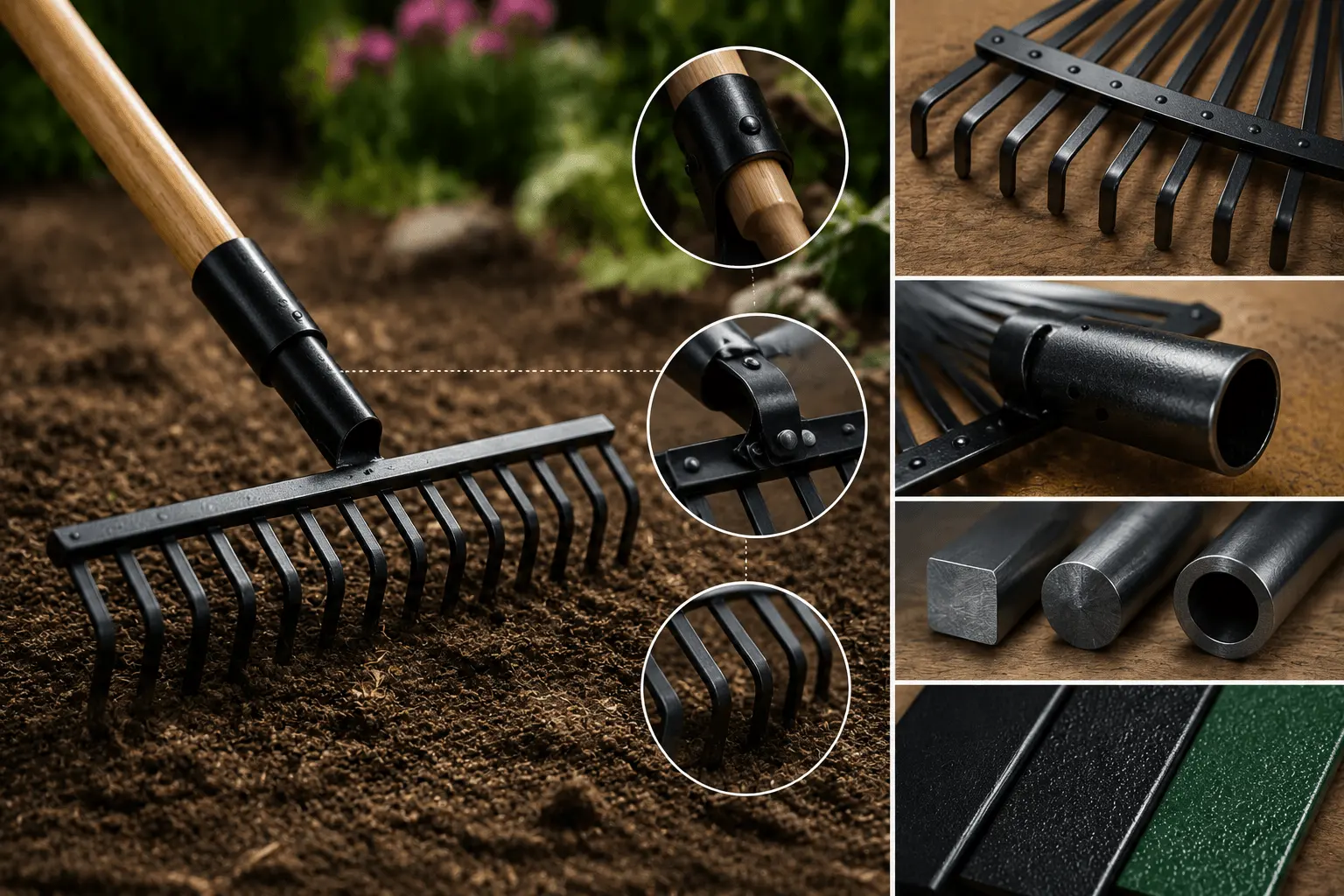
What Makes a Durable Garden Rake? Construction, Materials, Coatings | Scarecrow Garden Supplier
Key Takeaways
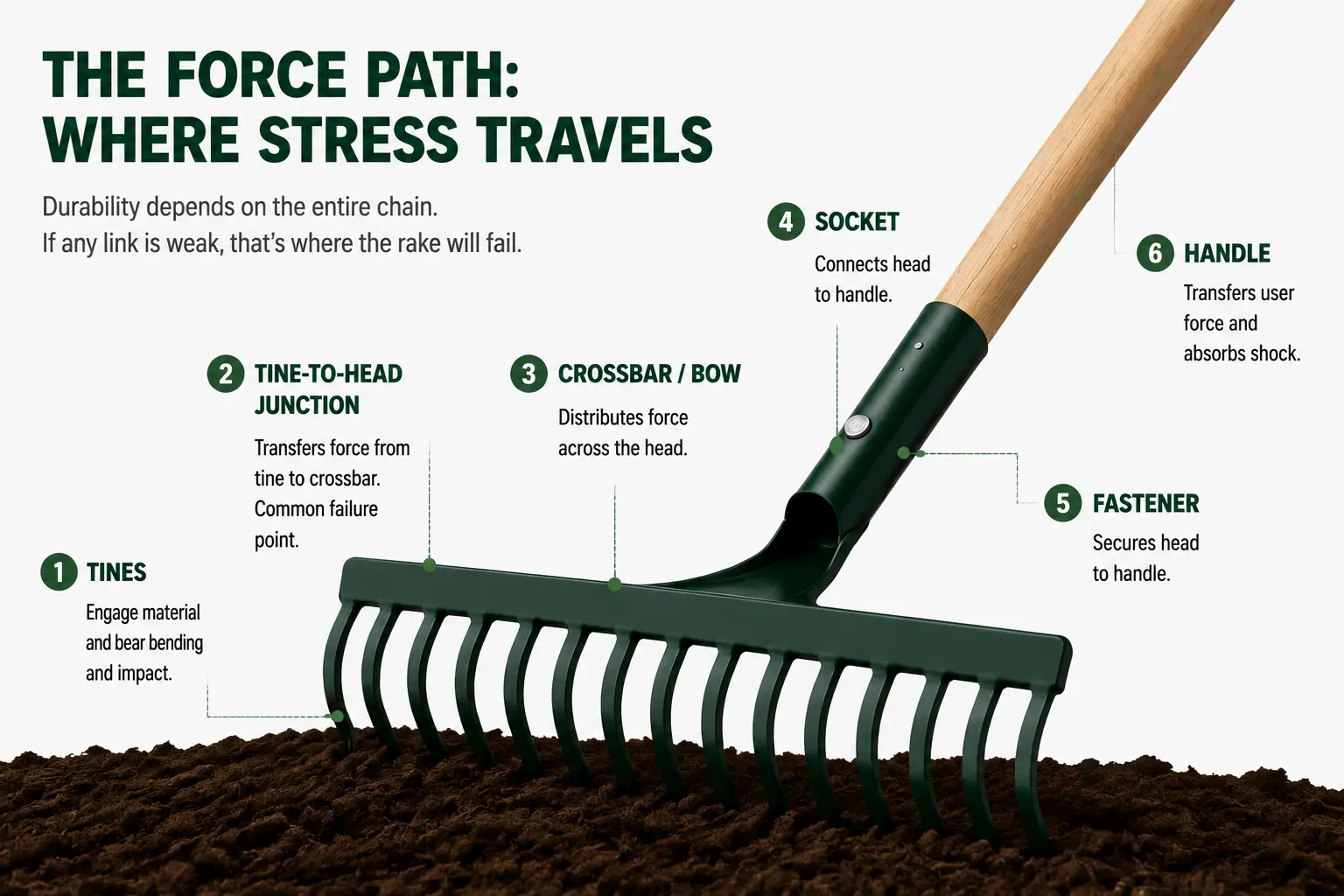
- Durability is not a single material label. It is the result of the entire force path: tines → crossbar/bow → socket → fastener → handle. Weakness at any point compromises the whole tool.
- Tine construction methods — stamping, forging, or riveting — create different strength characteristics at the tine-to-head junction, which is the most common failure point.
- Coating type (painted, powder-coated, epoxy) affects corrosion resistance, but coating performance should be described by what it is, not by unverified salt spray hour claims.
- A good specification sheet goes beyond “steel + wooden handle” — it records tine count, cross-section, rivet diameter, socket depth, coating type, and connection method.
- Buyers can verify construction quality through physical inspection and functional testing without needing laboratory reports for every order.
When a buyer asks “is this rake durable?” the honest answer is: it depends on where you look. A rake with thick steel tines can still fail if the rivets are undersized. A powder-coated head can still rust if the cut edges are bare. A forged head can still loosen if the socket is too short.
Durability in garden rakes is not about any single component — it is about the force path. When a user pushes tines into soil, pulls them through gravel, or leverages the head against a root, stress travels from the tine tip through the tine body, into the crossbar or bow, through the socket, across the fastener, and into the handle. If any link in that chain is weak, that is where the tool fails.
Different rake types are designed for different working conditions. Before selecting models, buyers can compare our guide Leaf Rake vs. Garden Rake: Tine Flexibility, Head Width, and Material Selection Explained.
This guide breaks down each link in the force path and explains what to look for, what to verify, and what claims to question.
Who this guide is for: Importers, private-label buyers, quality teams, and professional tool distributors who need to evaluate rake construction before placing bulk orders.
The Force Path: Where Stress Travels
Think of a rake as a chain. The user applies force to the handle, which transfers through the socket and fastener to the head, which distributes it across the crossbar or bow to the individual tines, which engage the material. Every junction in this path is a potential failure point.
| Force Path Link | What It Does | Common Failure Mode | What to Check |
| Tines | Engage material; bear bending and impact | Bending at tine base; tip deformation | Tine cross-section, thickness, material category |
| Tine-to-head junction | Transfers force from tine to crossbar | Rivet loosening; weld cracking; tine pull-out | Rivet diameter and count; weld quality |
| Crossbar / bow | Distributes force across head width | Bow deformation; crossbar bending | Bow dimensions; crossbar thickness |
| Socket | Connects head to handle | Socket cracking; short socket = loose head | Socket depth; wall thickness |
| Fastener | Secures head to handle | Bolt shearing; rivet loosening | Fastener type, diameter, count |
| Handle | Transfers user force; absorbs shock | Splitting (wood); surface splintering (fiberglass) | Material, grain orientation, wall thickness |
Tines: The First Point of Contact
Tine Material
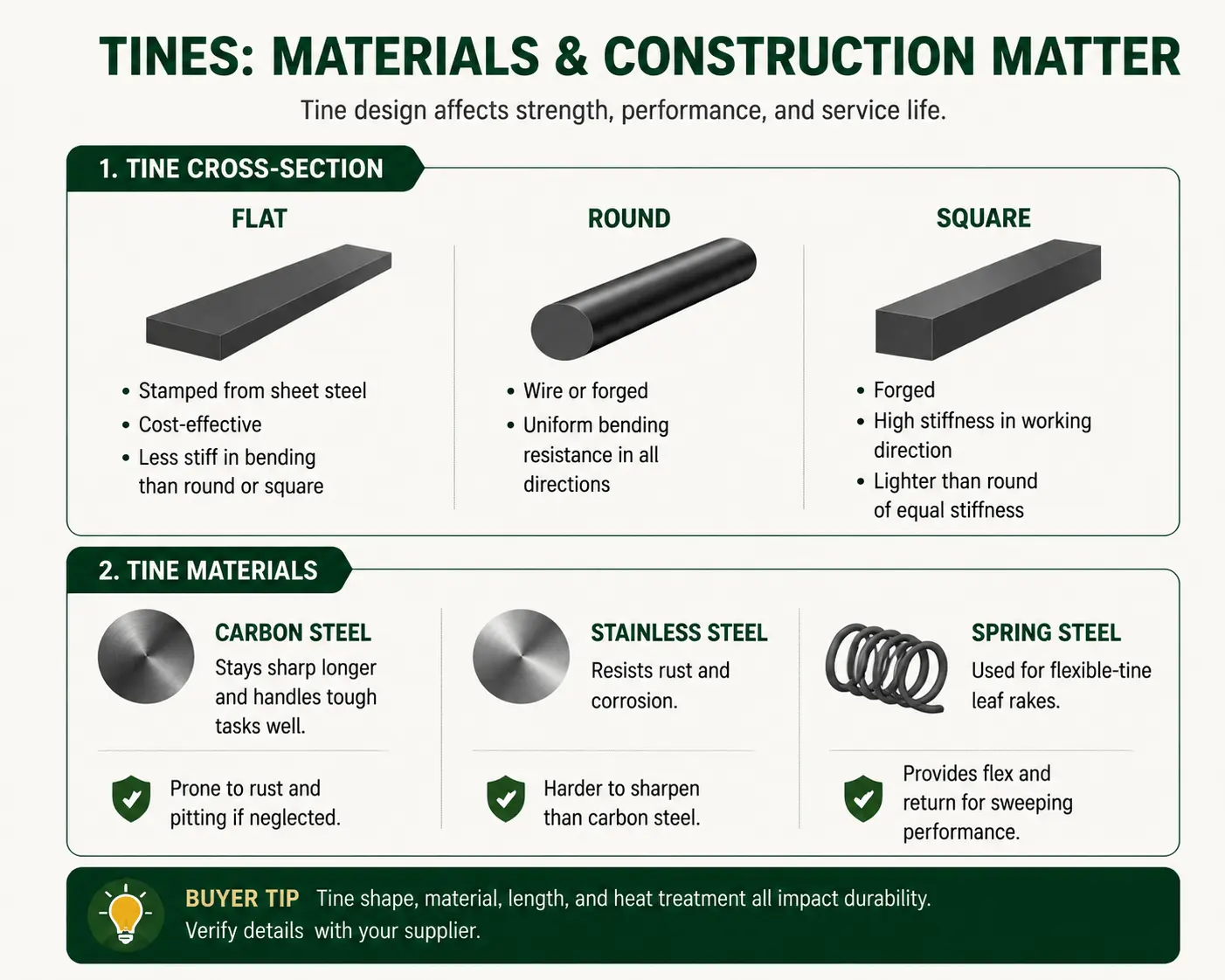
Penn State Extension identifies the most common materials: “Carbon steel stays sharp longer but is prone to rust and pitting if neglected. Stainless steel doesn’t rust easily, but it is harder to sharpen.” Spring steel is used for flexible-tine leaf rakes — it provides the flex-and-return characteristic needed for sweeping.
For rigid-tine garden rakes, carbon steel is the most common material. The specific steel grade is not always available from product catalogs — when it is not, describe the material as “steel” without specifying a grade. Do not assume a specific carbon content or alloy without factory confirmation.
Tine Cross-Section
The shape of the tine cross-section affects stiffness:
- Flat tines (stamped from sheet steel): Common in mid-range rakes. Flat cross-section is less stiff than round or square in bending, but cost-effective to produce.
- Round tines (wire or forged): More uniform bending resistance in all directions. Common in forged heads and higher-end stamped construction.
- Square tines (forged): Combine stiffness with material efficiency. The square cross-section resists bending in the working direction while being lighter than a round tine of equivalent stiffness.
Tine Length and Bending Radius
Longer tines engage deeper into material but are more prone to bending. The bending radius at the tine base (where the tine meets the crossbar) is a critical point — a sharp transition creates a stress concentration that can lead to fatigue cracking. A gradual curve distributes stress more effectively.
Heat Treatment
Heat treatment can significantly improve tine stiffness and resistance to permanent deformation. However, specific heat treatment processes (quenching, tempering temperatures, hardness values) are not typically listed in product catalogs. If the factory cannot provide heat treatment details, do not claim specific hardness or treatment — describe the tine as “steel” and note that heat treatment details should be confirmed with the factory for critical applications.
Compare Rake Construction — Not Just Product Photos
Choosing the right rake supplier requires more than checking appearance. Send us the rake models you are considering. We will compare the tine, head, socket, fastener, and handle structure side by side, helping you evaluate quality, durability, and sourcing options.
Head Construction: Crossbar, Bow, and Tine Attachment
Stamped and Riveted Construction
In riveted tine construction, individual tines are stamped from sheet steel and attached to a crossbar using rivets. This is a common and cost-effective method. The critical quality factors are:
- Rivet diameter: Undersized rivets are the most common cause of tine loosening. Verify the rivet diameter against the tine hole diameter — the fit should be tight.
- Rivet count per tine: Most designs use one rivet per tine. Some heavier designs use two. More rivets distribute load better but increase manufacturing complexity.
- Rivet placement: Rivets should be centered on the tine-to-crossbar junction. Off-center rivets create asymmetric stress.
Forged Construction
In forged construction, the tine row and crossbar are formed from a single piece of steel. The Forging Industry Association explains the advantage: the grain flow in a forging follows the shape of the part, providing strength at critical stress points. Forged heads have no riveted or welded junctions at the tine-to-crossbar connection — the metal flows continuously from tine to crossbar.
However, forging is not automatically superior in all cases. The Forging Industry Association notes that forging eliminates the metallurgical discontinuities of welding and the defects of casting — but a well-executed stamped-and-riveted head can still perform adequately for its intended use. The question is whether the construction method matches the expected use case and price point.
Welded Construction
In welded construction, tines are individually welded to a crossbar or T-shaped neck. Bully Tools describes this method in thatching rakes: “Each tine is individually welded to a ‘T’ shaped neck.” Welded construction can be strong but depends on weld quality — a poor weld creates a brittle junction that can crack under repeated load.
Socket and Head-to-Handle Connection
Penn State Extension describes several connection types and offers a key insight: “If made of differing materials, heads usually outlast handles. A tool with an easy-to-replace handle is desirable.”
Socket Depth
The socket is the cylindrical or tapered fitting where the handle inserts into the head. A deeper socket provides more contact area and better force transfer. A short socket concentrates stress at the socket rim, leading to cracking and head loosening. There is no universal “correct” depth — but when comparing two similar rakes, the one with the deeper socket is generally the better construction.
Fastener Types
- Through-bolt: A bolt passing through the socket and handle. Secure and replaceable — the user can tighten or replace the bolt. Common on mid-range and professional rakes.
- Rivet: Permanent fastener. Cannot be tightened by the user. Common on entry-level and mid-range rakes. Rivet quality (diameter, material, setting) determines long-term security.
- Press fit / adhesive: The handle is pressed into the socket with adhesive. Lighter construction; less common on rakes that bear heavy loads.
- Tang extension: A partial or full tang extends from the head through the handle, sometimes reinforced with a metal band. Penn State Extension notes this as a traditional, robust connection.
Replaceability
For professional markets where tool repair is expected, through-bolt connections are preferable — the user can replace a broken handle without replacing the entire tool. For consumer markets where replacement means buying a new rake, riveted connections are acceptable.
Have A Recurring Rake Failure Problem?
Share a photo of the bent tine, loose head, cracked handle, or coating issue you have experienced. Our team can analyze the failure point and help define a more relevant sample test before your next order.
Coating: Painted, Powder-Coated, and Epoxy
Coating protects steel from corrosion. The type of coating affects appearance, durability, and price. Here is what each term means — and what it does not mean.
Painted Finish
Painted finish is liquid paint applied to the metal surface. It is the most basic surface treatment. Common colors include red and black. Painted finishes are typical on agricultural-grade tools where cost efficiency matters more than premium appearance.
What to verify: Painted finishes can chip and scratch, exposing bare steel. Check edge coverage — stamped parts have cut edges that may not receive adequate paint coverage. These exposed edges are where rust starts.
Powder Coating
Powder coating is a dry finishing process in which electrostatically charged powder is applied and cured under heat (typically 180–200°C). The result is a thicker, more uniform coating than liquid paint.
What to verify: Powder coating is generally more durable than painted finish, but it is not indestructible. Impact can chip powder coating just as it can chip paint. The advantage is uniform thickness and better edge coverage if the application process is done correctly.
Epoxy Coating
Epoxy coating is used by some brands for corrosion resistance. It provides good chemical resistance but can be more brittle than powder coating under impact.
What Coating Claims to Question
Do not accept salt spray hour claims as outdoor lifespan predictions. ASTM B117 is the standard salt spray test practice — it provides a controlled corrosive environment for comparing coatings. But the relationship between salt spray hours and real-world outdoor performance is not linear. A coating that lasts 500 hours in salt spray does not “last 500 hours outdoors” — the test environment is more aggressive than most real conditions, but it does not account for UV exposure, mechanical abrasion, or temperature cycling.
Do not claim that any single coating guarantees rust prevention. All coatings can be compromised by scratches, impacts, and edge exposure. The question is how well the coating is applied — including edge coverage and surface preparation — not just what type it is.
ASTM D3359 is the standard for testing coating adhesion by tape test. It provides a method for evaluating whether coating is properly bonded to the substrate. This is a more practical test for B2B quality verification than salt spray hours — if the coating does not adhere, it will fail regardless of type.
Handle Material and Durability
Handle material is covered in detail in Rake Handle Material Comparison. For durability purposes, the key points are:
- Wood handles can split along the grain if the wood is wet, poorly selected, or has knots at stress points. Grain orientation and moisture content are the critical quality factors.
- Fiberglass handles are light and strong but can develop surface glass splinters with age and weather exposure. Wall thickness and outer layer quality determine long-term performance.
- Steel handles are the most durable but heaviest. The coating on steel handles must be intact to prevent rust.
For all handle types, the connection to the head is the weak point — a durable handle with a loose socket is a failed tool.
Turn Quality Concerns Into A Clear Test Plan
Before production approval, we can help prepare a practical sample inspection list, define the agreed quality checks, and record the inspection process on video. This gives your team clearer quality confirmation before moving into bulk production.
How to Write a Rake Specification Sheet
A specification sheet that reads “steel head, wooden handle” is not a specification — it is a label. A useful spec sheet records the following:
| Field | Why It Matters |
| Tine count | Determines coverage and spacing |
| Tine cross-section (flat/round/square) | Affects stiffness and bending behavior |
| Tine material category (steel) | Baseline for material expectations |
| Tine attachment method (riveted/forged/welded) | Determines failure mode at tine-to-head junction |
| Rivet diameter and count (if riveted) | Critical for tine security |
| Bow dimensions (if bow rake) | Determines flex behavior |
| Socket depth | Determines head-to-handle stability |
| Fastener type (bolt/rivet/press fit) | Determines repairability |
| Handle material | Affects weight, durability, repairability |
| Handle length | Affects ergonomics and user fit |
| Coating type (painted/powder/epoxy) | Affects corrosion resistance |
| Coating color | Relevant for retail and brand consistency |
| Packaging method | Affects transit damage risk |
| Carton quantity | Affects shipping cost and inventory management |
This level of detail is what separates a professional sourcing process from ordering from a photo.
Build Different Quality Levels Under One Brand
Need different quality levels for different customers? We can separate opening, mid-range, and professional structures without treating every model as the same. Create a product range that matches different markets, price points, and customer expectations.
FAQ
Is a forged rake head always better than a stamped one? Not necessarily. Forging provides continuous grain flow and eliminates junction weaknesses, which is advantageous at high-stress points. But a well-executed stamped-and-riveted head can perform adequately for its intended use case and price point. The question is whether the construction method matches the expected load and service life — not whether one method is universally superior.
Does powder coating prevent rust? Powder coating provides a thicker, more uniform barrier than liquid paint, which slows corrosion. But any coating can be compromised by scratches, impacts, and exposed cut edges. Powder coating slows rust; it does not make steel “rust-proof.” Proper edge coverage and surface preparation matter as much as the coating type.
What is the most common failure point in garden rakes? The tine-to-head junction is the most common failure point. In riveted construction, loose rivets lead to bent or missing tines. In welded construction, poor weld quality leads to cracking. In forged construction, the junction is inherently stronger, but the socket or fastener becomes the next weakest link.
Can I request salt spray test data from a supplier? You can request it, but salt spray testing (ASTM B117) is not a standard factory QC step for garden tools unless specifically arranged. If test data is not available, do not claim it exists. Instead, describe the coating type accurately and note that specific testing can be arranged if required.
How do I test rake quality without a laboratory? Practical quality verification does not require a lab. Inspect tine alignment visually, check rivet diameter and count, measure socket depth, test head-to-handle connection by twisting and pulling, examine coating coverage on cut edges, and perform a functional test in the intended material. A detailed inspection framework is available in How to Inspect Garden Rakes Before Wholesale.