






Updated 2 months ago
Wood, Fiberglass, Aluminum, or Steel Rake Handles: A Buyer’s Comparison
SCARECROW GARDEN SUPPLIER

Rake Handle Materials Compared: Wood, Fiberglass, Aluminum, Steel | Scarecrow Garden Supplier
Key Takeaways
- No single handle material is universally “best” — the right choice depends on target user, price point, climate, repair culture, and brand positioning.
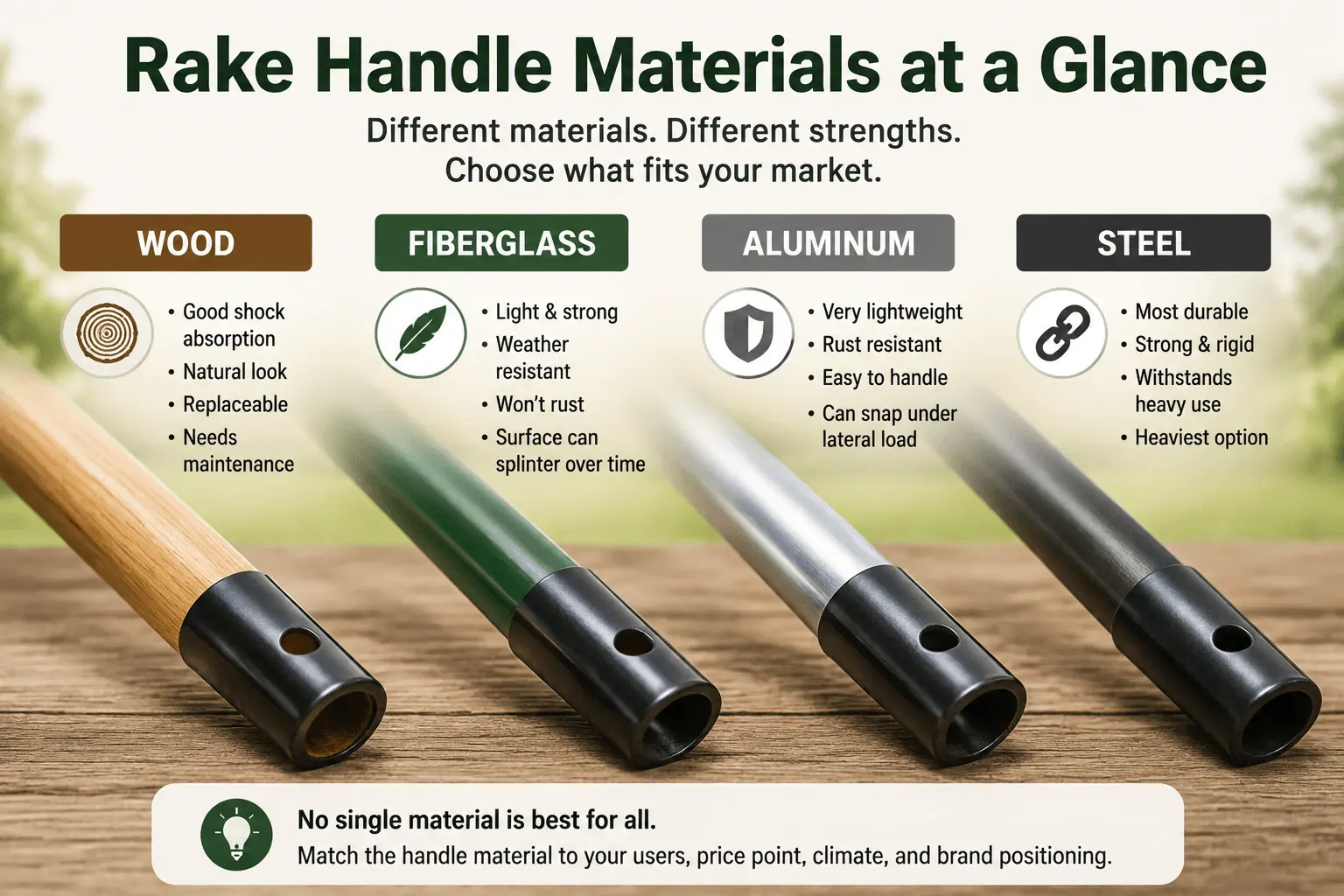
- Wood handles offer good shock absorption and are replaceable, but require maintenance and are susceptible to moisture.
- Fiberglass handles are light and strong, but can develop surface glass splinters over time — and “insulation safety” is not a valid selling point without specific product design and testing.
- Aluminum handles are lightweight and rust-resistant but can snap under heavy lateral force.
- Steel handles are the most durable but heaviest — more tiring for extended use.
- FSC certification applies to wood handles only, and only when actual certificates and transaction chains are valid — it is a chain-of-custody claim, not a material performance claim.
The handle is half the tool. A perfectly constructed rake head with the wrong handle — too heavy, too short, too brittle, or too expensive for the target market — is a failed product. Yet many buyers treat handle material as an afterthought, defaulting to whatever the supplier offers without considering how it affects the user experience, the retail price point, and the long-term brand reputation.
This guide compares wood, fiberglass, aluminum, and steel rake handles across the dimensions that matter to B2B buyers: weight, stiffness, shock absorption, weather resistance, repairability, packaging, and cost. The goal is not to declare a winner — it is to help you choose the right material for your specific market.
However, handle quality is only one part of rake durability. The tine design, steel quality and connection method are also critical factors. Read our guide on What Makes a Durable Garden Rake? Tines, Head-to-Handle Connections, Steel, and Coatings.
Quick Comparison Table
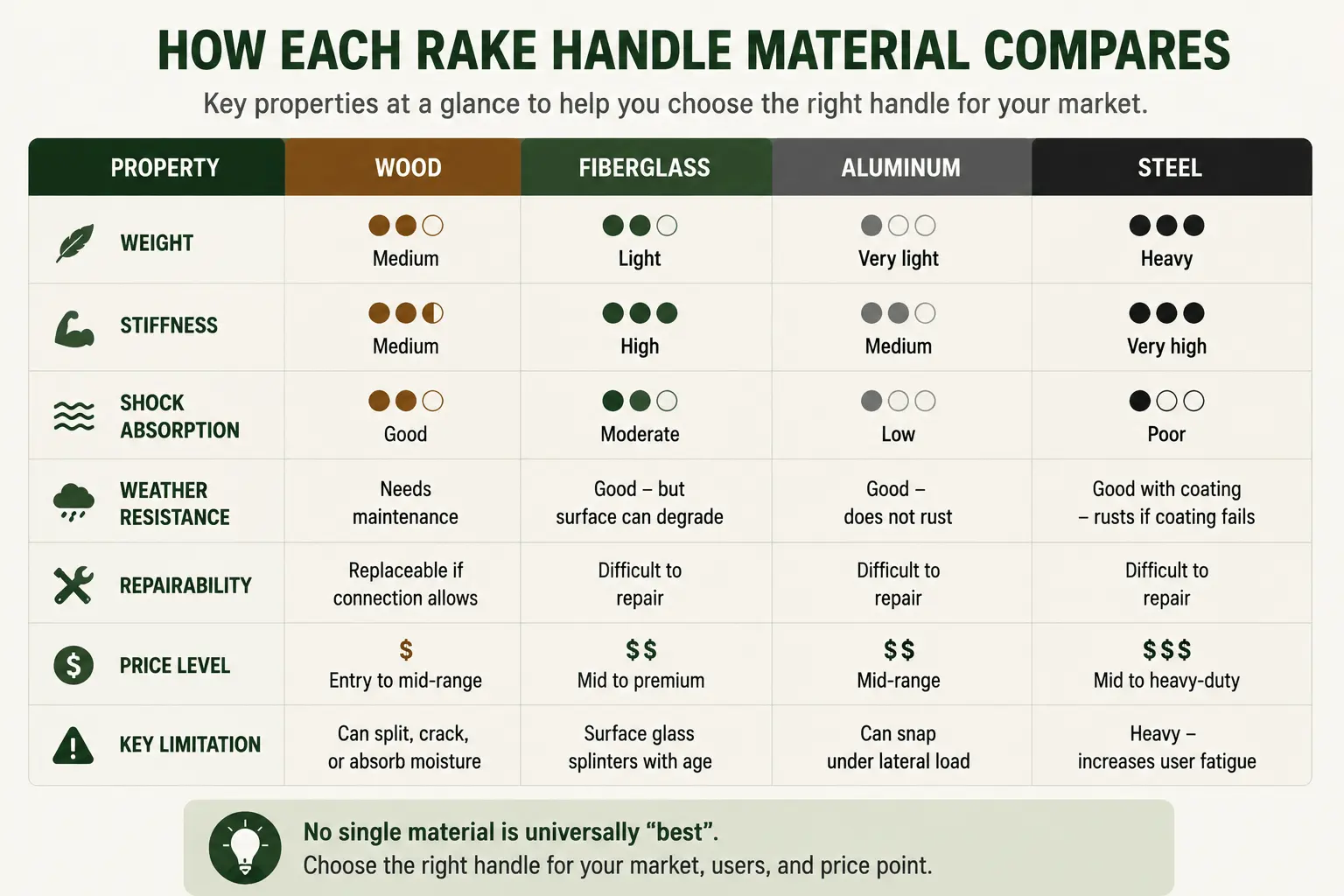
| Property | Wood | Fiberglass | Aluminum | Steel |
| Weight | Medium | Light | Very light | Heavy |
| Stiffness | Medium | High | Medium | Very high |
| Shock absorption | Good | Moderate | Low | Poor |
| Weather resistance | Needs maintenance — absorbs moisture | Good — but surface can degrade | Good — does not rust | Good with coating — rusts if coating fails |
| Repairability | Replaceable if connection allows | Difficult to repair | Difficult to repair | Difficult to repair |
| Typical price point | Entry to mid-range | Mid to premium | Mid-range | Mid to heavy-duty |
| FSC relevant? | Yes — for timber traceability | No | No | No |
| Key limitation | Can split, crack, or absorb moisture | Surface glass splinters with age | Can snap under lateral load | Heavy — increases user fatigue |
Source note: Material characteristics based on Penn State Extension — “Using the Right Tool is Self-Care,” and Bully Tools Rake Guide. Ergonomic principles from Utah State University Extension and NIOSH/CDC hand tool selection guide.
Choose The Right Handle For Your Market — Not By Habit
The best handle choice depends on your customers, pricing strategy, and selling environment. Tell us your target price level, user group, climate conditions, and preferred product look. We will compare viable handle options and help build a suitable product range.
Wood Handles
What Penn State Extension Says
“Wooden handles such as ash, oak, and hickory are known for their strength, shock absorption, and durability. Regular maintenance keeps them from drying and cracking.”
Strengths
Wood is the traditional handle material for garden and agricultural tools. It provides good shock absorption — the natural cellular structure of wood dampens vibration, reducing fatigue during extended use. Wood is also repairable: if the handle breaks and the head-to-handle connection allows replacement (such as a through-bolt socket), the user can install a new handle without replacing the entire tool.
For B2B buyers, wood handles offer cost advantages at entry and mid-range price points. They are widely available from manufacturing clusters and are compatible with a range of head designs.
Weaknesses and What to Check
- Moisture absorption: The RHS notes that wood handles absorb moisture, which can cause swelling, warping, and eventual splitting. Store and display wood-handled tools in dry conditions.
- Grain orientation: Handles should have straight grain running along the length. Cross-grain or diagonal grain creates weak points where splitting occurs under load.
- Knots at stress points: A knot at the socket junction or mid-handle is a structural defect that can lead to failure.
- Surface finish: A quality wood handle should have a smooth finish (varnish, wax, or oil) that seals the surface against moisture. Rough or unfinished wood absorbs moisture faster.
- Drying and cracking: Wood that is too dry becomes brittle. The USDA Forest Products Laboratory Wood Handbook documents wood’s hygroscopic behavior — wood adjusts moisture content to ambient humidity, which means storage conditions matter.
FSC Certification
FSC (Forest Stewardship Council) Chain of Custody certification verifies that wood materials are traceable from certified forests through the supply chain. Founded in the mid-1990s, FSC certifies over 165 million hectares of forest globally (as of recent FSC reports).
FSC certification matters for markets with timber regulations:
- EU: The EUTR (European Union Timber Regulation, effective March 2013) requires timber product risk assessment. FSC CoC certification is the most straightforward compliance path.
- US, Australia, Japan, South Korea: These markets also have timber regulations that may require proof of legal sourcing.
Important boundary: FSC certification is a chain-of-custody claim about timber sourcing — it is not a material performance certificate. An FSC-certified wood handle is not automatically stronger, lighter, or more durable than a non-certified one. FSC tells you where the wood came from, not how well the handle was made.
Only claim FSC certification when actual certificates and transaction chains are valid and verifiable. Do not use FSC as a generic marketing claim.
Get Accurate Wood Handle Details For Your Exact Model
Need verified wood-handle information? We can confirm wood species, finish, dimensions, and available certification for the exact model — without relying on generic material claims.
Fiberglass Handles
What Penn State Extension Says
“Fiberglass is light and strong. Age and weather can produce irritating glass splinters on the surface.”
Strengths
Fiberglass handles offer the best strength-to-weight ratio among the four materials. They are lighter than wood and steel, and stronger than aluminum under bending loads. Fiberglass does not absorb moisture, does not split along grain lines (because it has no grain), and does not rust.
For premium retail positioning, fiberglass handles signal modern construction and durability. They are common on professional-grade and mid-to-premium consumer tools.
Weaknesses and What to Check
- Surface degradation: Over time and with weather exposure, the outer resin layer can degrade, exposing glass fibers. These exposed fibers can cause skin irritation — Penn State Extension describes them as “irritating glass splinters.” Check the quality of the outer coating or sleeve.
- Brittle failure mode: Fiberglass does not bend permanently like wood — it either holds or snaps. When it fails, the failure is sudden and complete, not gradual.
- Wall thickness: Fiberglass handles are typically tubular. Wall thickness determines strength. A thin-walled fiberglass handle may be lighter but will fail under less load than a thick-walled one.
- Connection method: The head-to-handle connection on fiberglass handles often uses adhesive or press-fit methods, which may not be user-replaceable. Check whether the connection allows handle replacement.
- Grip material: The grip (D-grip, end cap, or over-mold) is usually a separate component. Check the grip material, attachment method, and whether it can loosen over time.
The “Insulation” Myth
Some marketing materials claim that fiberglass handles provide “electrical insulation safety” — implying the tool is safe to use near power lines. Do not use this claim unless the specific product has been designed and tested for electrical insulation. A fiberglass handle is not automatically an insulating tool. Electrical safety requires specific design, testing, and certification. Making this claim without evidence is a safety risk and a liability.
Aluminum Handles
What Penn State Extension Says
“Aluminum is lightweight and does not rust.”
Strengths
Aluminum handles are the lightest option. They do not rust, which makes them suitable for humid or coastal markets. The lightweight characteristic reduces user fatigue during extended use — particularly for leaf rakes, where the user makes many repetitive sweeping motions.
Aluminum handles can be positioned as premium lightweight tools — major brands such as Fiskars offer aluminum-handled garden tools, demonstrating market acceptance of this material in the garden tool category.
Weaknesses and What to Check
- Lateral force vulnerability: Aluminum can snap under heavy side loads. A user leveraging the rake against a root or rock may apply lateral force that exceeds aluminum’s bending capacity. Aluminum is best suited for lighter tasks — leaf raking, soil leveling, and material spreading — not for heavy prying or breaking compacted ground.
- Cross-section and wall thickness: Aluminum handles are typically tubular. The cross-section (round, oval, or shaped) and wall thickness determine strength. Verify both when comparing suppliers.
- Temperature sensitivity: Aluminum conducts temperature — in cold weather, an aluminum handle feels cold to bare hands. This is a comfort issue, not a structural one, but it matters in cold-climate markets.
- Connection point: The head-to-aluminum-handle connection often uses rivets or adhesive. Check the method and verify it can withstand the intended load.
Confirm The Right Rake Structure Before Finalizing Your Range
Review length, diameter, and balance on samples before making your final decision. We can provide measured sample photos and handling videos to help your team evaluate product feel, structure, and suitability for your target market.
Steel Handles
What Penn State Extension Says
“Metal handles are durable but heavy and less shock-absorbent. They can be more tiring to use.”
Strengths
Steel is the most durable handle material. It does not split like wood, does not develop surface splinters like fiberglass, and does not snap like aluminum. A steel-handled rake can withstand heavy use, prying, and impact that would damage other materials.
Steel handles are typically found on heavy-duty, industrial, or contractor-grade tools — not on consumer garden rakes. They are most relevant for markets where tools are used intensively and replacement is costly.
Weaknesses and What to Check
- Weight: Steel is the heaviest handle material. A steel-handled rake is significantly heavier than the same rake with a wood or fiberglass handle. This weight increases user fatigue, particularly during extended use or repetitive tasks.
- Shock absorption: Steel transmits vibration directly to the user’s hands and arms. When a steel-handled rake hits a rock or root, the shock travels through the handle without dampening. Over extended use, this can contribute to hand and arm fatigue.
- Coating dependency: Steel rusts. The handle must be coated (painted, powder-coated, or galvanized) to prevent corrosion. If the coating is damaged, rust will develop at the damage site.
- Hollow vs. solid: Most steel handles on garden tools are hollow tubes — lighter than solid steel but still heavier than other materials. Wall thickness and tube diameter determine strength.
Ergonomics: Handle Length and Diameter
Material is one variable. Length and diameter are equally important — sometimes more so.
Handle Length
Utah State University Extension emphasizes: “Use rakes and shovels with height-appropriate handles that help you maintain a straight back and avoid hunching over.” A handle that is too short forces the user to bend forward, straining the lower back. A handle that is too long may be awkward to control.
Common wooden rake handle lengths range from approximately 1,240 mm to 1,770 mm. The appropriate length depends on the user’s height and the task:
- Long handles (1,500–1,770 mm): Better for tall users and for tasks where the user stands upright (raking soil, leveling beds).
- Medium handles (1,240–1,500 mm): Better for shorter users or for tasks where the user needs more control (working in raised beds, tight spaces).
- D-grip handles: Provide a second grip point for directional control. D-grip handles are common on garden rakes and allow the user to apply downward pressure more effectively.
Handle Diameter
The NIOSH/CDC “Guide to Selecting Non-Powered Hand Tools” provides ergonomic principles for hand tool design: grip diameter should allow the hand to comfortably encircle the handle without over-stretching or pinching. The guide also recommends maintaining a neutral (straight) wrist position and avoiding sharp edges on grip surfaces.
For two-handed long-handled tools like rakes, the grip diameter at the end of the handle matters for comfort, but the primary ergonomic factor is handle length — it determines whether the user can maintain an upright posture.
Create A Flexible Rake Collection With Multiple Handle Options
Mix different handle materials within one collection. We can check whether compatible rake heads can be paired with wood, fiberglass, aluminum, or steel handles while maintaining a consistent brand system and product positioning.
B2B Selection: Matching Handle to Market
| Market Type | Recommended Handle | Why |
| Budget retail / seasonal | Wood (painted finish) | Lowest cost; acceptable durability for seasonal use |
| Mid-range retail | Wood (varnished) or fiberglass | Better finish and durability; justifies higher price |
| Premium retail | Fiberglass | Signals modern construction; best strength-to-weight |
| Professional landscaping | Wood (through-bolt, replaceable) or fiberglass | Repairability (wood) or durability (fiberglass) |
| Heavy-duty / industrial | Steel | Maximum durability under abuse |
| Coastal / humid markets | Fiberglass or aluminum | No moisture absorption, no rust |
| Cold-climate markets | Wood or fiberglass | Aluminum feels cold; verify plastic head performance if applicable |
| EU market (timber regulations) | Wood with FSC CoC | FSC certification provides compliance path for EUTR |
Packaging and Shipping
Handle material affects packaging and shipping:
- Wood handles: Can bend slightly if stored under weight. Pack straight to prevent warping during transit.
- Fiberglass handles: Rigid and dimensionally stable. Less prone to transit deformation but can be damaged by impact.
- Aluminum handles: Lightweight, reducing shipping cost per unit. Can dent if impacted.
- Steel handles: Heaviest, increasing shipping cost. Very resistant to transit damage.
For all handle types, the critical packaging issue is protecting the head-to-handle junction from impact and preventing steel tines from scratching each other during transit. Estimated 20-foot container loading for rakes with handles is 450–500 dozen, depending on model and packaging configuration.
If you are selecting different rake models for your wholesale range, our guide Types of Garden Rakes: A Complete Selection Guide for Garden Centers, Landscapers, and Tool Distributors can help you compare different applications.
FAQ
Is fiberglass always better than wood? No. Fiberglass is lighter and does not absorb moisture, but wood offers better shock absorption and is replaceable if the connection allows. The “better” choice depends on the target user, price point, and market. A professional landscaper who repairs tools may prefer wood; a premium retail customer may prefer fiberglass.
Can I claim fiberglass handles are electrically insulated? Not without specific product design and testing. A fiberglass handle is not automatically an insulating tool. Electrical safety requires specific design, certification, and testing. Do not make this claim unless the product has been tested and certified for electrical insulation.
What wood species are used for rake handles? Common tool handle woods include ash, oak, and hickory, as noted by Penn State Extension. However, the specific wood species used in any given product should be confirmed with the factory. If the species is not confirmed, describe the handle as “wooden” without specifying the species.
Do I need FSC certification for wood handles? It depends on your market. EU markets under EUTR require timber risk assessment, and FSC Chain of Custody is the most straightforward compliance path. US, Australia, Japan, and South Korea also have timber regulations. If your market requires timber traceability, FSC certification is relevant. If it does not, FSC is a marketing advantage but not a requirement. Only claim FSC when actual certificates are valid.
How long should a rake handle be? It depends on the user’s height and the task. Common lengths range from 1,240 mm to 1,770 mm. Taller users and upright tasks benefit from longer handles. The goal, as Utah State University Extension notes, is maintaining a straight back without hunching. For retail, offering a mid-length handle (around 1,500–1,600 mm) covers the widest range of users.