










Smart Irrigation for Wholesale Buyers: Why Soil Moisture Monitoring is the Key to Efficiency
Abstract
Water shortages in the world and an increasing number of smart irrigation systems for agriculture, landscaping, and efficient management of water make the use of water better for plants. As the core part, soil moisture monitoring gives us real, precise data for each drop of water. The supporting role of soil moisture monitoring in smart irrigation practice is explored.
The exploration includes four dimensions: water conservation, crop yield increase, operational efficiency improvement, and sustainable development promotion. Soil moisture data supplies the scientific evidence for precise irrigation decision-making. The data drives the transformation of agricultural and landscape management modes.
The mode shifts from a fixed-time irrigation schedule to a demand-based watering scheme, and it supplies proper water demand in critical growth stages of plants. That is to say, paying attention to the efficiency of resource utilization makes soil moisture monitoring climb to a higher level. Soil moisture monitoring becomes the focus of the component, promoting the development and advanced level of sustainable cultivation and greening practices in the world.
1. The Limitations of Traditional Irrigation Practices
To see how soil moisture monitoring plays a part in smart irrigation, first you have to know about the old way of watering. Farmers and landscapers have long relied upon the watering-at-fixed-intervals method (watering regularly regardless of whether the ground really needs it), or looking around with their own eyes to see whether something is right or wrong.
Manual operation is also prone to making mistakes on both overwatering and underwatering. Overwatering wastes water. It causes soil compaction and nutrient leaching, and it raises the chance of plant diseases by over-saturating the soil and suffocating the roots. Underwatering leads to slow plant growth and lower crop yields, and it can kill a plant during a drought.
Traditional irrigation cannot adapt to changing environments, such as rainfall and temperature. It changes the humidity, thus making the inefficiency worse and causing economic losses as well as environmental damage in water-scarce areas. So, smart irrigation with soil moisture monitoring is an innovation.
2. Soil Moisture Monitoring: The Foundation of Smart Irrigation
Smart irrigation systems are built to automate and optimize watering by using real-time data and advanced technology that adjust watering to match what plants and soil actually need, with soil moisture monitoring as the main source of data for this adaptability.
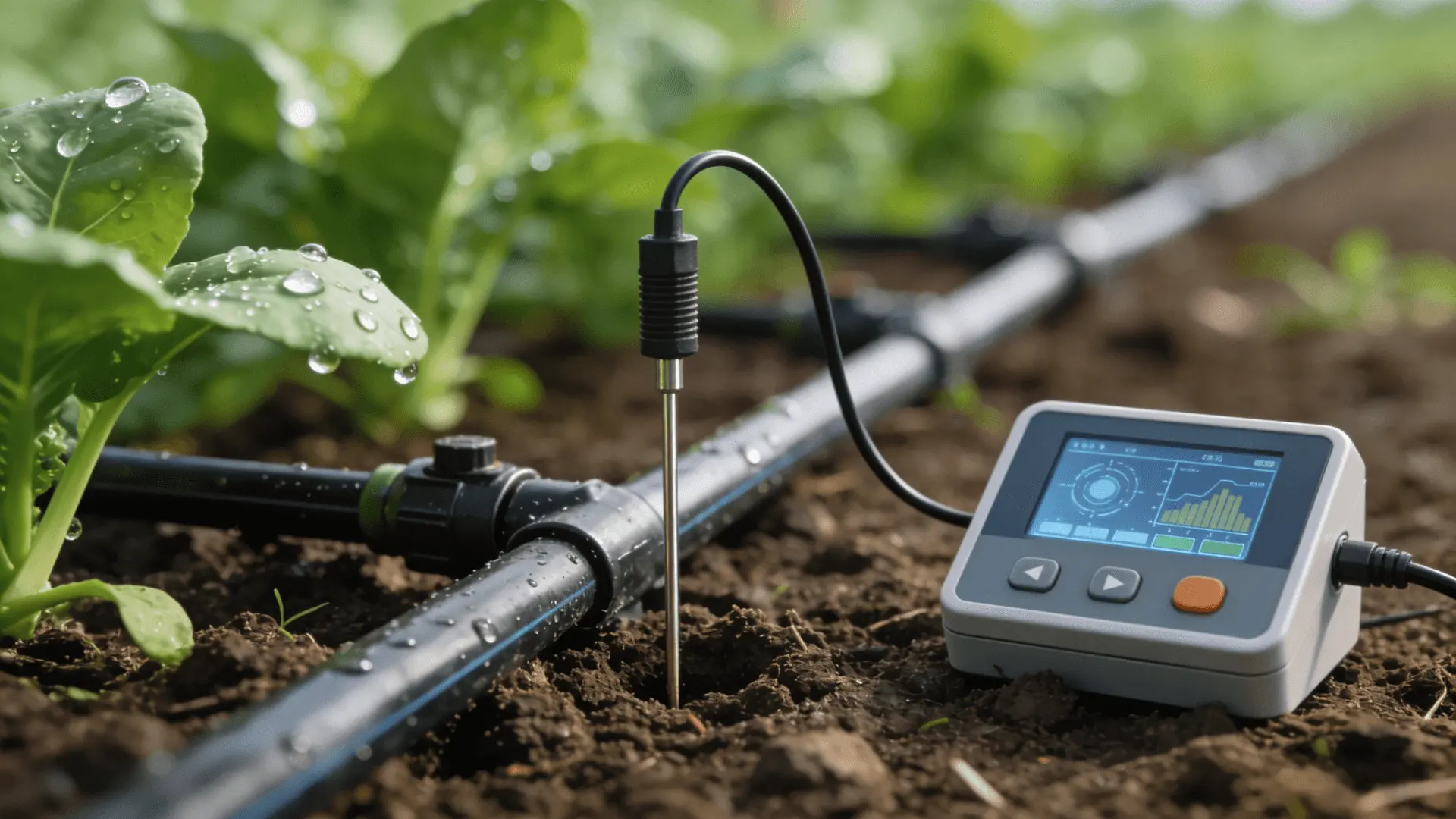
Soil moisture monitoring uses sensors at different depths within the soil to measure the volumetric water content (VWC). It measures the amount of water in a given volume of soil. The data can be sent via wired or wireless means to a central control unit or a mobile device so as to have the soil moisture continuously updated. This real-time data removes the guessing game out of when to irrigate and allows the system to turn on only when soil moisture is at or below a pre-set value (watering trigger point), as well as turning it off when it reaches ideal moisture levels.
Using soil moisture data to water ensures water will be used only when it is needed, fixing the old, inefficient way. A merger of soil moisture sensing into the development of smart irrigation systems is more than a technology swap. However, it is the upgrade that moves away from its former uniform irrigation stand-alone structure to the smarter and more customer-satisfying watering when it is needed for the particular situation of a plant’s circumstances.
3. Core Advantages of Soil Moisture Monitoring Applied to Smart Irrigation Systems
3.1 Water Conservation and Resource Efficiency
Water conservation is one of the most important advantages. The advantage comes from soil moisture monitoring practices that are used in the operation of smart irrigation systems. The Environmental Protection Agency (2018) states that traditional methods of irrigation waste up to 50% due to overwatering, but smart systems that use soil moisture sensors can save 20% - 50%, depending on what kind of application you are using.
Only when the soil has reached a certain level of dryness will there be irrigation. If the soil moisture exceeds the ideal range due to light rain or a sudden shower, the irrigation system will automatically postpone or cancel the planned irrigation, in this way completely stopping water waste.
At this level of irrigation efficiency, it has quite a bit of importance in arid and semi-arid areas. Those regions have a very significant water shortage. It also matters in urban areas that operate under tight municipal water supply constraints. Soil moisture monitoring brings improvement in energy efficiency as well. Lessened water pumping frequency means lower overall energy use, and the lesser energy usage leads to a smaller carbon footprint of irrigation.
3.2 Improved Plant Health and Crop Yields
Plants have a certain soil water content to promote their healthy growth. When the water supply is too much or too little, it will affect the absorption ability of plants for nutrients. The impaired ability also prevents plants from performing normal physiological functions. The monitoring of soil moisture can lead to the formation of smart irrigation systems to maintain the moisture content of the soil at an appropriate level, directly benefiting plant growth and thereby improving the rate of crop yield.
Producing more and better quality crops increases the economic benefit for the farming person. A dedicated study about the growth of tomatoes recorded that the main results included soil moisture monitoring in smart irrigation practice. The practice improved the yield of tomatoes by 15-20% compared to conventional irrigation, and it also reduced the occurrence of crop diseases.
Soil moisture monitoring takes place in landscaping projects. The monitoring will prevent watering that is too much or too little, both of which result in brown patches, wilting, and root rot. The prevention keeps a lush lawn and garden plants. Supplying plants with an exact quantity of water corresponds to an optimization of the plant’s growth and development.
Creating a strong root system improves a plant’s tolerance to drought, pests, and extreme weather. Enhancing the tolerance increases the aesthetic quality of landscape areas, reduces the use of pesticides and fertilizers, and ensures healthy plants have stronger natural defense capabilities to resist pests and diseases effectively.
3.3 Cost Savings for Farmers and Landscapers
Operational efficiency is improved through the practice of soil moisture monitoring and smart irrigation applications. Such operational efficiency improvements lead to direct cost reduction of operations, which means concrete cost savings for the relevant parties.
For farmers, the largest part of the savings comes from having lower water and energy bills plus more crop per drop; in areas where they are metered for water or pay by volume, using less water cuts costs significantly. Less frequent pumping cuts down on electricity or fuel costs.
For landscape artists and property managers, putting in a simple fix of smart irrigation and smart soil measurements can help save on water bills and manual labor needs. Better plant health further reduces costs in replacing dead plants, applying pesticides, and repairing soil damage from overwatering.
Continuous cost savings accumulate over a long period of time. These savings will pay off the costs incurred in purchasing and installing soil moisture sensors and smart control devices. The accumulated savings demonstrate the economic feasibility of the technology, which can be applied to large-scale agricultural production and professional landscaping management projects.
3.4 Improved Sustainability and Strengthened Environmental Stewardship Practices
People’s growing concerns about climate change and environmental sustainability make soil moisture monitoring a main part of eco-friendly irrigation. Smart irrigation systems have a soil moisture monitoring function. This kind of system can reduce the total amount of water usage, and the decreased use of water protects the freshwater resources needed for humans and ecosystems.
Reduced overwatering limits nutrient leaching, which is the process where extra water carries fertilizer and other nutrient substances away from the soil into groundwater sources, rivers, and lakes. Nutrient leaching is the main reason for the pollution of water, such as algal blooms and many other harmful environmental effects.
Keeping the soil moisture at a good level keeps the fertilizer in the plant root area. The retained fertilizer can be used by the plant instead of being washed away. This reduces pollution and raises fertilizer utilization efficiency, lowering operating costs and reducing the overall environmental burden. Organic farmers and sustainable landscaping professionals use soil moisture monitoring as a tool that can maintain soil health and aid in the retention of natural ecosystem services.
4. Real-World Applications of Soil Moisture Monitoring in Smart Irrigation
Soil moisture monitoring for smart irrigation is used in different fields, from large-scale farms to residential gardens. On large farms growing corn, wheat, or fruit, soil moisture sensors are laid out on the fields according to different types of soil and terrain. Sensor data integrated with complementary meteorological parameters like temperature, rainfall, and wind speed create a complete irrigation timetable that is applied to automated sprinkling or drip irrigation.
This precision drives water distribution to target field zones, helping achieve maximum output and minimizing resource waste. Soil moisture sensors combined with smart controllers keep lawns, flower beds, and ornamental plants healthy in residential and commercial landscapes.
Homeowners are able to get real-time soil moisture information and remote irrigation operation authorization. If low soil moisture causes a mobile prompt, they will be able to perform remote control or fully automatic irrigation.
Golf courses need to use lots of water to keep their greens and fairways alive; using soil moisture checking uses less water and helps maintain good turf grass quality. These real-life applications are quite diverse and effective when it comes to soil moisture checking with smart watering.
5. Conclusion and Call to Action
Soil moisture monitoring is not an additional part but the basic premise for smart irrigation systems to achieve their goal of improving operational efficiency, environmental sustainability, and promoting plant health. By reducing operational inefficiencies and the loss of irrigation resources thanks to real-time and reliable soil moisture data, the traditional ways are no longer applicable. This will decrease the quantity of water wasted while increasing the amount of crops grown and reducing the cost to operate. Smart irrigation systems have become a key means for farmers, landscape designers, and property managers—from large farmers wanting to increase harvests to households aiming at saving water expenses and reducing their footprint on earth—all of which can be achieved through soil moisture monitoring-enabled smart irrigation systems.
For overseas buyers sourcing garden tools from China for the first time, supplier selection plays a critical role in controlling cost and risk.
As a professional garden tools sourcing partner, Scarecrow Garden Supplier supports buyers with product matching, supplier coordination, and flexible sourcing options tailored to different market needs.
If you would like to better understand suitable products or sourcing approaches for your business, our team is ready to discuss your project and provide practical recommendations.

Written by
ScarecrowGarden
💡About Scarecrow Garden Supplier Co., Ltd.
Scarecrow Garden Supplier Co., Ltd. is a China-based sourcing and wholesale partner specializing in garden tools, landscaping equipment, and outdoor supplies for international wholesalers, distributors, contractors, and brands.
With hands-on experience rooted in real garden use scenarios, we focus on durable materials, functional design, and stable large-volume supply. Our product range covers pruning tools, watering systems, hand tools, outdoor hardware, and customized garden solutions to support both retail and professional landscaping markets.
Beyond products, we help our partners navigate supplier selection, quality control, compliance requirements, and long-term sourcing strategies in China. Through our blog, we share practical insights on product selection, material comparisons, industry trends, and cost-effective purchasing—helping global buyers build stronger, more competitive supply chains.
Related Articles

Lithium-Ion vs Lead-Acid Batteries in Electric Sprayers: Weight, Runtime, Charging and Shipping Trade-Offs
Timer Accuracy and Power-Loss Memory in Automatic Irrigation Controllers: A Buyer Test
