










Seedling Tray Drainage Holes Guide: Prevent Root Rot B2B Sourcing | Scarecrow Garden Supplier
You sourced the trays. The cells are the right size, the material is what your growers asked for, and the price works. Your first order lands, and within three weeks the complaints come back — seedlings damping off, root rot spreading across whole trays, transplant survival rates nowhere near what your customers expected.
The trays have drainage holes. You checked that before ordering. So what went wrong?
Here is what most wholesale buyers miss: drainage holes are not a binary feature. Having holes is not the same as having effective drainage. The position of those holes, their diameter, whether the tray sits flat or on raised feet, and how many holes per cell — all of these determine whether roots get oxygen or drown. And when roots drown, Pythium is never far behind.
This article breaks down what the research actually says about drainage hole design in seedling trays, and what you should specify when placing your next bulk order.
Why Drainage Holes Are Not Just “Holes”
Drainage holes do one thing: they let water out. But letting water out does three things that matter to root health:
- Water exits → air enters. When excess water drains from a cell, air fills the pore spaces in the growing media. Roots need oxygen for respiration — not just leaves. Based on industry experience, root tips typically begin sustaining damage within hours of oxygen deprivation — the exact timeframe varies by species and temperature.
- Water exits → roots grow down, not around. A downward moisture gradient created by bottom drainage holes guides roots by positive gravitropism. Without effective drainage, water pools at the bottom, roots lose their directional cue, and you get circling roots along container walls instead of a structured root system.
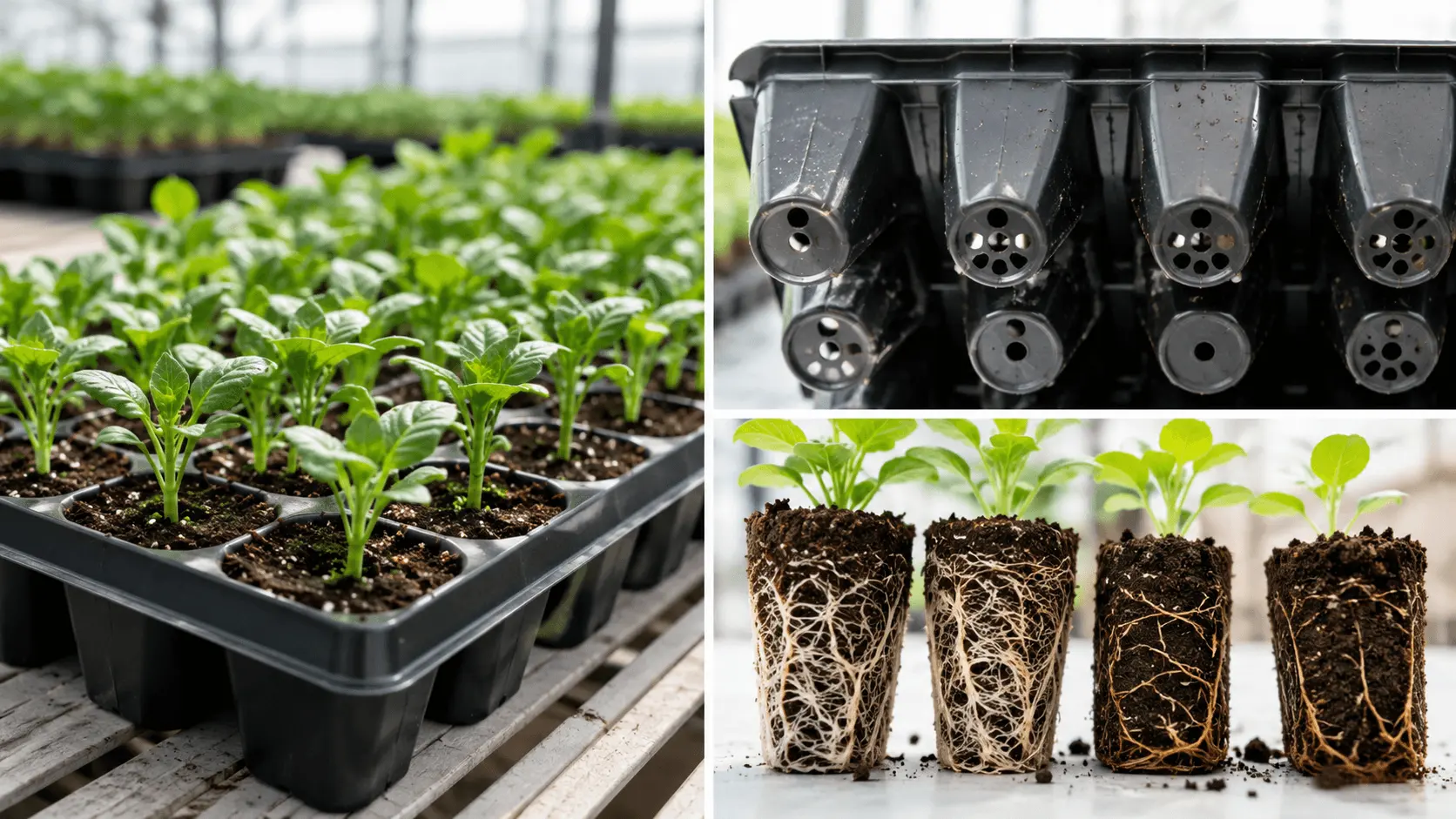
- Water exits → root tips air-prune at the hole. When a root tip grows out through a drainage hole and contacts dry air, the tip desiccates and dies. This triggers lateral root branching back inside the cell — the basic mechanism of air pruning. More branching means a more fibrous root system, which means better nutrient uptake and faster establishment after transplanting. But this only works if the hole is actually exposed to air — which brings us to a problem many buyers never see coming.
The takeaway: drainage holes are not a “check-box” feature. They are the primary interface between the root zone and the environment outside the cell. Get them wrong, and everything downstream — root structure, disease pressure, transplant performance — gets worse.
Drainage Hole Position: Bottom, Side, or Both?
Where the holes sit on the cell wall changes what happens to the roots inside. This is not theoretical — it has been measured.
Bottom Drainage: The Standard Design
Most seedling trays have one drainage hole at the bottom of each cell. This is the most common design for a reason: it creates the simplest, shortest drainage path. Water flows down and out. The moisture gradient pulls roots downward.
But bottom-only drainage has a weakness. When roots reach the hole and grow through it, they encounter the surface below the tray. If that surface is solid — a plastic bench, a concrete floor — the root gets crushed or the hole gets plugged. Either way, drainage degrades over time.
Side Drainage: More Living Roots
Research on pine seedling containers found that trays with side drainage holes (in addition to bottom holes) produced significantly more living root tips. In one study, Pinus greggii seedlings in containers with side holes had 220.3 living root tips versus 167.2 in bottom-only containers (p = 0.002). For Pinus oaxacana, it was 372.8 versus 246.5 (p = 0.006).
Living root tips correlate with active root apical meristems — the growing points that drive root elongation and branching. More living tips mean a root system that is actively growing, not just surviving. After transplanting, that activity translates directly into faster establishment.
But there is a tradeoff. The same study found that bottom-only containers produced taller plants, larger stem diameters, more total biomass, and larger root volumes. So: side drainage gives you more fibrous, active roots; bottom-only gives you bigger plants. For seedling trays where the goal is transplant survival, the fibrous root advantage usually matters more.
The Research on Hole Position
If you have ever wondered whether hole position really makes a measurable difference — not just in theory, but with real plants in real containers — the research answers that directly. Merritt et al. (1996) tested five drainage configurations on four wetland plant species: no holes, bottom 4 holes, mid-wall 4 holes, upper-wall 4 holes, and pot-in-pot (bottom 4 holes inside an outer sleeve with no holes). Hole position significantly affected plant growth and root ratings, particularly for smooth cordgrass. The pot-in-pot configuration — which maintains drainage while reducing temperature fluctuation — produced the highest growth indices and root scores for several of the species tested. The takeaway for your trays: where you put the hole is not a detail. It is a design decision with measurable consequences.
What This Means for Seedling Trays
For commercial seedling trays:
- Bottom drainage holes are essential — this is the baseline, not optional
- Side-wall micro-perforations are a meaningful upgrade for crops where fibrous root systems matter (vegetables, herbs, ornamentals destined for transplant)
- For tree and shrub seedlings with longer nursery periods (6–12 months), side drainage becomes more valuable because root structure quality directly affects field performance
If you are sourcing trays for vegetable transplants, ask whether the manufacturer offers a version with side-wall perforations. It is a small design difference that changes root architecture.
If you are comparing seedling tray specifications across suppliers, send us your product list and target crops — we can help you identify which drainage configurations match your growers’ needs. [Talk to Scarecrow Garden about your seedling tray sourcing requirements]
The Sealing Problem: When Your Drainage Holes Stop Working
Here is a scenario that catches many buyers off guard: the trays have drainage holes, the media is right, the watering is controlled — and still, the cells stay too wet.
The problem is not the tray. It is what the tray is sitting on.
This problem is often caused by mismatched components rather than the hole itself, especially when buyers overlook 1020 tray compatibility problems between the insert and the base tray.
The Surface Sealing Effect
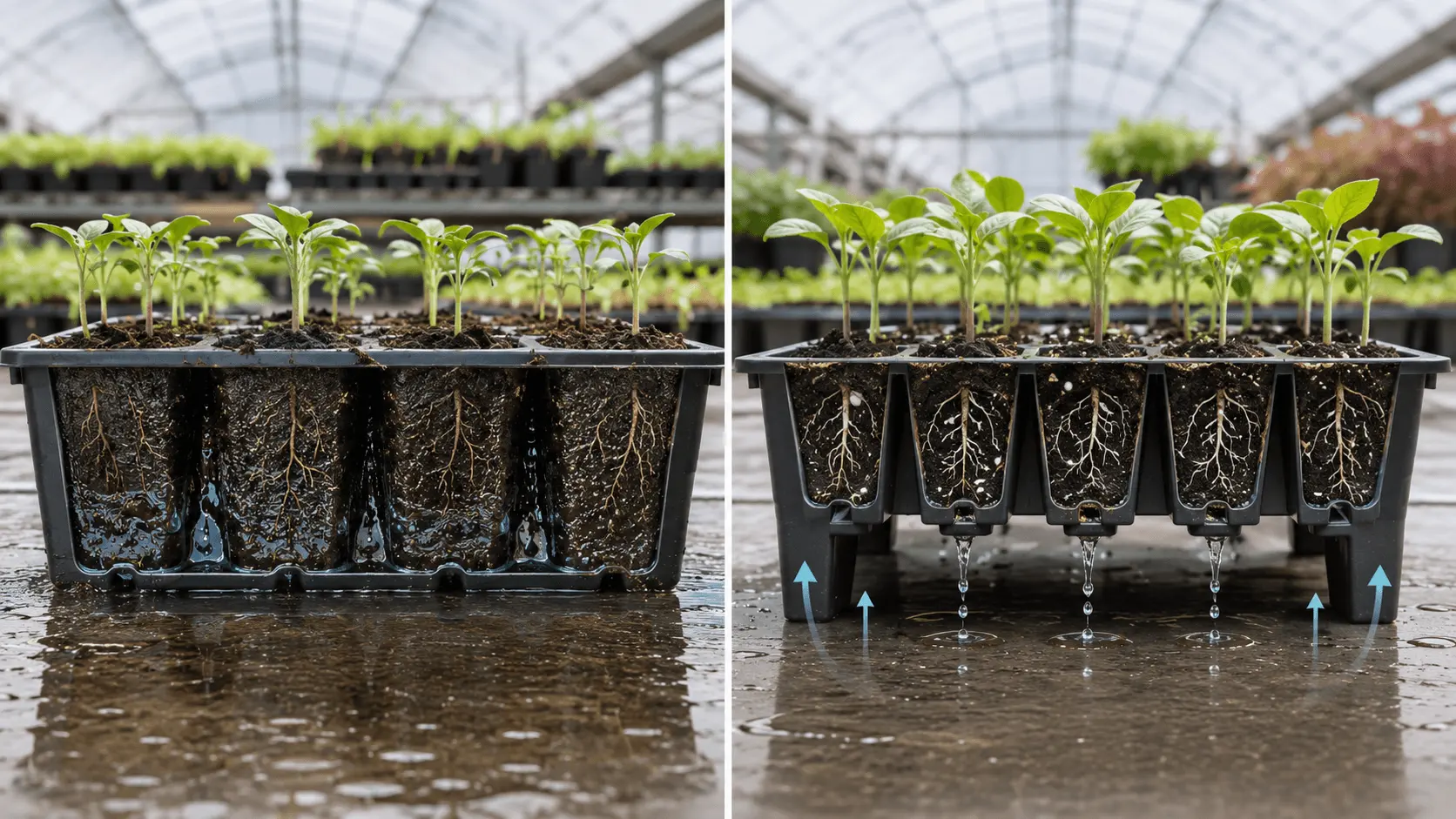
Packett et al. (1996) measured what happens when containers sit on different surfaces. Containers placed on a plastic surface retained 15–23% more water than the same containers placed on a gravel surface. The reason: the plastic surface sealed the bottom drainage holes. Water could not exit because there was no gap between the hole and the surface.
This is not a minor effect. Retaining 15–23% more water in a cell that is already near field capacity can push the root zone into anaerobic conditions. For a cell that holds 50 ml of media, that is an extra 7.5–11.5 ml of water with nowhere to go.
The Solution: Raised Feet
This is why commercial-grade seedling trays have raised feet or an elevated base — small protrusions on the bottom of the tray that, based on industry experience, lift the drainage holes 3–8 mm above the surface below. That gap is all it takes. Water can exit freely, and air can enter from below.
When you are evaluating trays, look for this feature specifically. A tray with drainage holes but no raised feet is missing a critical functional element — it works on wire benches or gravel beds, but fails on solid surfaces. Since many commercial greenhouses use solid-bottom flood-and-drain benches or plastic ground covers, the raised-foot design is not optional; it is typically necessary.
When you are looking at product listings, here is what to look for: descriptions that mention “elevated base,” “raised bottom,” “raised feet,” or “stand-off design.” If a tray is described only as “with drainage holes” — without any mention of raised feet — assume it sits flat.
Drainage Hole Size: What Diameter for What Crop?
Hole diameter matters for two reasons: too small and the cell drains too slowly; too large and the growing media falls out.
The Industry Range
Based on industry practice and product specifications:
| Cell Type | Typical Cell Volume | Drainage Hole Diameter | Holes per Cell | Rationale |
| Small cells (200/288-cell) | < 20 ml | 3–5 mm | 1 | Small media volume — larger holes cause media loss through the bottom |
| Medium cells (72/105/128-cell) | 25–120 ml | 5–10 mm | 1 | Balance between drainage speed and media retention |
| Large cells (32/50-cell) | > 100 ml | 8–10 mm | 1–4 | More media needs faster drainage; multiple holes improve uniformity |
| Rice nursery trays | ~15 ml per cell | 3 mm | ≥ 300/tray | High density, small cells; specification includes ≥ 95% aeration rate |
| Kaylite ProGrow (commercial) | Varies | Micro-perforations | Bottom + perimeter channel | Based on manufacturer specifications: dual-layer design with bottom micro-holes for drainage, perimeter channel for overflow |
The numbers in that table come from industry practice, but here is why they work the way they do — and why getting them wrong is easier than you think. Note: Cell volumes, hole diameters, and hole counts for small, medium, and large cells are based on industry practice and product specifications; actual values vary by manufacturer.
The Logic Behind Hole Sizing
- Small cells hold less media. Less media means less water-holding capacity, which means the cell reaches saturation faster and needs to drain faster. But it also means there is less media to hold in place. A 10 mm hole in a 200-cell tray is too large — you will see media washing out during the first watering. A 3–5 mm hole drains adequately while keeping the media in.
- Large cells hold more media. More media means more water storage, but also more water that needs to exit. A single 5 mm hole in a 50-cell deep tray may not drain fast enough during heavy irrigation or flood-and-drain cycles. Two to four holes distributed across the cell bottom provide more uniform drainage and reduce the risk of localized saturation.
- Rice trays are a special case. Rice nursery trays operate in a fundamentally different regime — often in flooded or semi-flooded conditions. Based on industry experience, the 3 mm hole diameter with high hole density (≥ 300 per tray) is designed to maintain aeration even under these conditions, with a specified aeration rate of ≥ 95%.
Hole diameter should also be evaluated together with cell depth and volume, so buyers should match cell count and volume to crop type before finalizing the drainage specification.
Media Type Interacts with Hole Size
The hole diameter you need also depends on what growers fill the cells with:
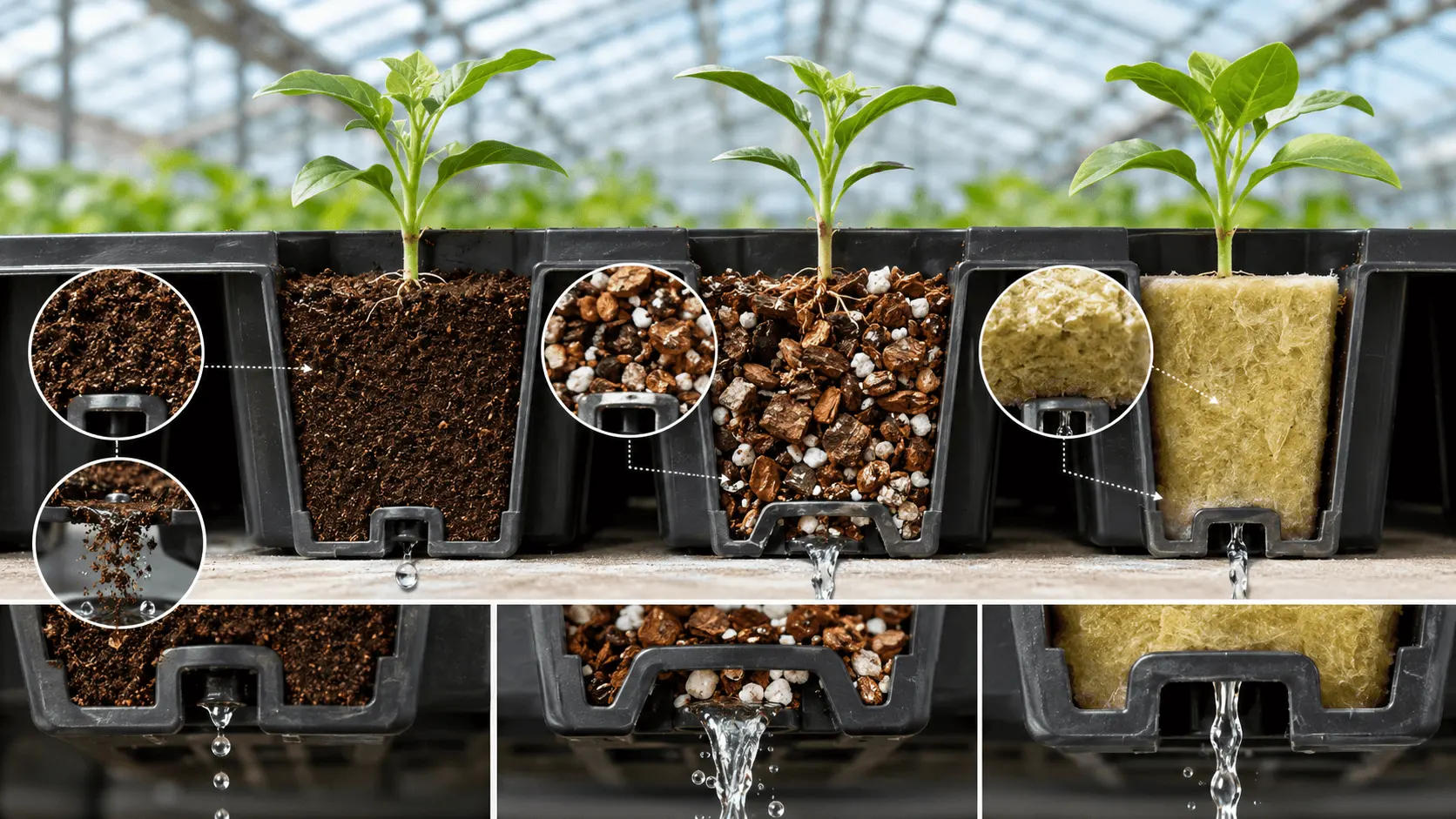
- Fine media (peat-based, particle size typically < 2 mm): Smaller holes (3–5 mm) — fine particles wash out easily through larger openings
- Coarse media (perlite-heavy, bark-based, particle size approximately 2–5 mm): Larger holes (5–10 mm) acceptable — coarse particles bridge over the hole and stay in place
- Rockwool or foam media: Hole size matters less for media retention but still matters for drainage speed
When specifying trays for a customer, ask what growing media they use. The same tray with 8 mm holes works well with coarse bark media but will lose fine peat through the bottom.
When Drainage Fails: Pythium and Root Rot
Poor drainage does not just slow growth. It creates conditions for disease outbreaks that can wipe out entire trays — and the economic loss from a Pythium event can exceed the cost of the trays by orders of magnitude.
The Causal Chain
Here is what happens when drainage fails:
- Water cannot exit the cell — because holes are too small, holes are sealed by the surface below, or holes are plugged with media or roots
- The root zone becomes saturated — pore spaces fill with water instead of air
- Roots are deprived of oxygen — root respiration requires O₂; based on industry experience, anaerobic conditions damage root tips within hours
- Root defenses weaken — oxygen-deprived roots cannot mount effective defense responses
- Pythium zoospores swim through the water — Pythium produces motile zoospores that actively swim in free water to find and infect root tissue
- Root rot spreads — infected roots decompose, releasing more zoospores; the disease amplifies in the saturated environment
This is a compounding failure. Waterlogging weakens the host, and the same water that caused the weakness provides the medium for the pathogen to spread.
The Evidence
Research on soybean drainage and root rot demonstrated that drainage conditions significantly affected seedling disease severity. Treatments with no drainage (ND) and shallow drainage (SD) had significantly higher root rot severity than conventional drainage (CvD) — p < 0.01. In greenhouse experiments, watering intensity also significantly affected root rot: more water meant more rot (p < 0.01).
Research on Pythium–waterlogging interactions in common bean showed that eight Pythium species caused more severe root and hypocotyl rot under waterlogged conditions. The combination of waterlogging and Pythium was described as a “double hit” — oxygen deprivation compromised host resistance while Pythium thrived and spread in the free water.
In 2016, a widespread wheat stunting event in North Carolina was traced to prolonged soil waterlogging that triggered a Pythium root rot outbreak. Three Pythium species (P. irregulare, P. spinosum, P. vanterpoolii) were identified. The extended anaerobic period made the wheat unusually susceptible.
What This Means for Tray Buyers
A tray with properly sized holes, raised feet, and good drainage uniformity is not just a better growing container — it is disease prevention infrastructure. Many buyers treat drainage design as a feature: nice to have, upgradeable later. But in practice, it functions as infrastructure. Without it, everything else — the right media, the right watering schedule, the right variety — sits on a foundation that can fail without warning.
A Pythium outbreak in a commercial greenhouse proves this. Based on industry experience, a single event can cause losses worth thousands of dollars of inventory — far more than the cost difference between a tray with adequate drainage and one without. When you evaluate trays, think about disease risk, not just drainage speed.
Drainage design is one of several factors that determine seedling tray performance. If you want to compare drainage configurations across different tray models, send us the specifications — we can walk you through the trade-offs for your specific crops and growing conditions. [Talk to Scarecrow Garden about seedling tray drainage specifications]
What to Specify When Ordering Seedling Trays
When you send an RFQ or place an order, “with drainage holes” is not a specification. Here is what to define — and what not to leave to the factory’s default.
Drainage Specification Checklist
- Hole diameter — Specify in millimeters (e.g., “5 mm drainage holes”). Do not accept “standard holes” without a number.
- Holes per cell — Usually 1 for small/medium cells, 1–4 for large cells. Specify if your application needs multiple holes.
- Hole position — Bottom center is standard; specify if you need distributed holes (center + edges) or side-wall perforations.
- Raised feet / elevated base — Yes or no. If yes, specify minimum height (3–8 mm is typical). This is critical for solid-surface benches.
- Side-wall drainage — Present or absent. If present, describe the design (micro-perforations, slot design, etc.).
- Compatibility with growing media — Tell the supplier what media your customers use (fine peat, coarse bark, rockwool). This affects the appropriate hole size.
Drainage performance is only one part of lifetime value; buyers should also compare the total cost of reusable and disposable trays before confirming material and wall thickness.
Drainage Design Comparison by Application
| Application | Cell Size Range | Hole Diameter | Holes/Cell | Raised Feet | Side Drainage | Priority Risk |
| Vegetable transplants (tomato, pepper, brassica) | 72–128 cell | 5–8 mm | 1 | Yes | Optional | Pythium in humid conditions |
| Herb and ornamental transplants | 128–288 cell | 3–5 mm | 1 | Yes | Beneficial | Media loss through oversized holes |
| Tree and shrub seedlings | 32–50 cell | 8–10 mm | 1–4 | Yes | Recommended | Circling roots without air pruning |
| Rice nursery | 200+ cell | 3 mm | High density | Varies | No | Aeration under semi-flooded conditions |
| Microgreens | 200–288 cell | 3–5 mm | 1 | Optional | Not needed | High density amplifies risk if waterlogging occurs; short cycle limits exposure time |
Common Specification Mistakes
- Not specifying hole diameter. “With holes” tells the factory nothing. Different factories default to different hole sizes. Specify the number.
- Ignoring raised feet. A tray with holes but no feet works on wire benches but fails on solid surfaces. If your customers use flood-and-drain benches, raised feet are mandatory.
- Oversized holes for fine media. An 8 mm hole in a 200-cell tray filled with fine peat will lose media from the first watering. But even a 6 mm hole in a 128-cell tray can lose fine peat during flood-and-drain cycles — the water pressure pushes particles through openings that seem small enough. Match hole size to media type.
- One hole in a deep cell. A 50-cell deep tray with a single 5 mm hole may not drain fast enough. Consider multiple holes or larger diameter.
Frequently Asked Questions
Do all seedling trays need drainage holes? For commercial nursery use, yes. There are specialized applications (e.g., flood-and-drain benches where the tray is briefly flooded then drained) where the tray itself may not need holes, but even in these systems, holes provide a safety margin against over-watering and improve aeration between flood cycles. For any application where the grower controls watering, drainage holes are essential.
What happens if the holes are too small? Drainage is too slow. During heavy irrigation or flood events, water cannot exit the cell fast enough, leading to temporary saturation. Repeated saturation events compound into the same problems as chronic poor drainage: oxygen deprivation, reduced root growth, and increased Pythium risk.
Can drainage holes be added after manufacturing? Technically yes — you can drill holes in plastic trays. But this is not practical at commercial scale, and hand-drilled holes lack the clean edges of molded holes. Rough edges can damage roots that grow through the hole. If you need a specific drainage configuration, order it from the factory.
Are more holes always better? No. More holes drain faster, but they also create more openings for media to escape and more points where roots can grow out of the cell and be damaged. The right number of holes balances drainage speed against media retention and root containment.
Why do some trays have side-wall holes? Side-wall holes or micro-perforations promote root branching through air pruning. When root tips contact air at a side-wall opening, they branch rather than circle. This creates a more fibrous root system with more active growing points, which improves transplant establishment. Side drainage is most valuable for crops with longer nursery periods and for species where root circling is a known problem.
How do I know if raised feet are necessary? If in doubt, default to raised feet. Most commercial operations use at least some solid-surface benches. Ask your customers what their trays sit on — if they use wire mesh benches, gravel beds, or raised rails, flat-bottom trays work. If they use solid-surface benches (plastic, concrete, flood-and-drain tables), or if trays sit directly on the ground (which is often covered with plastic weed barrier), raised feet are typically necessary.
Next Step: Review Your Seedling Tray Drainage Specifications
If you are sourcing seedling trays for multiple crop types, drainage configuration is one of the specifications most likely to be overlooked — and one of the most likely to cause problems when it is wrong. The difference between a tray with 5 mm holes on raised feet and a tray with unspecified holes on a flat base is not just a design preference. It is the difference between roots that get oxygen and roots that drown.
Before your next order, review the drainage specifications against the growing conditions your customers actually use. And if you need help comparing configurations across suppliers or matching drainage designs to specific crops and media types, we can walk through it with you.
You focus on selling. We help you source, verify, organize, and ship.
[Talk to Scarecrow Garden about your seedling tray product list and drainage requirements] — we will help you compare specifications across 200+ cooperating supplier partners and identify the right drainage configuration for each crop in your range.
Let Us Build a Tray Sample Set Around Your Crop
Tell us what you grow and what is not working with your current trays. We will put together a sample set so you can test the fit before you commit.

Written by
ScarecrowGarden
💡About Scarecrow Garden Supplier Co., Ltd.
Scarecrow Garden Supplier Co., Ltd. is a China-based sourcing and wholesale partner specializing in garden tools, landscaping equipment, and outdoor supplies for international wholesalers, distributors, contractors, and brands.
With hands-on experience rooted in real garden use scenarios, we focus on durable materials, functional design, and stable large-volume supply. Our product range covers pruning tools, watering systems, hand tools, outdoor hardware, and customized garden solutions to support both retail and professional landscaping markets.
Beyond products, we help our partners navigate supplier selection, quality control, compliance requirements, and long-term sourcing strategies in China. Through our blog, we share practical insights on product selection, material comparisons, industry trends, and cost-effective purchasing—helping global buyers build stronger, more competitive supply chains.