








Plug Tray Cell Count vs Volume: Seedling Quality & Yield Guide | Scarecrow Garden Supplier
A grower calls you and says: “I need 128-cell trays for my tomato crop.” You quote 128-cell trays. The order ships. Three months later, the grower tells you their tomato transplants were undersized and the early yield was disappointing.
What went wrong? The grower asked for 128 cells. You supplied 128 cells. The problem is that “128 cells” does not tell you what matters. On a standard 54 × 28 cm tray, a 128-cell tray from one manufacturer might give each cell 28 cc of growing media. Another manufacturer’s 128-cell tray might give 38 cc. That difference — 10 cc, roughly two teaspoons — can change the quality of a tomato transplant enough to affect field yield.
Cell count is what buyers ask for. Cell volume is what determines transplant quality. This article explains why those are different things, what the research says about how cell volume affects yield, and how to match the right cell count to the right crop — by looking at the variable that actually matters.
If you are building a product list for a new season, send your crop mix and target market to Scarecrow Garden — we can cross-reference cell counts, volumes, and dimensions across 200+ cooperating supplier partners so you order trays that match what your customers actually grow.
Cell Count vs Cell Volume: Why the Number on the Tray Misses the Point
On a standard 54 × 28 cm nursery tray, cell counts range from 32 to 512. That sounds like a wide range. The real range is wider than you think — because the volume inside each cell varies far more than the cell count suggests.
| Cell Count | Cell Volume (cc) | Cell Depth (cm) | Cell Opening (mm) | What It Is Used For |
| 512 | ~7 | ~2.5 | ~15 | Annual flower plugs, microgreens |
| 288 | ~12 | ~3.5 | ~20 | Lettuce, herbs, fast-turn leafy crops |
| 200 | ~20 | ~4.5 | ~25 | Leafy greens, basil, quick-turn herbs |
| 128 | ~35 | ~5.0 | ~30 | Tomato, pepper, vegetable transplants |
| 72 | ~55 | ~5.5–6 | ~38 | Cucumber, melon, longer-cycle vegetables |
| 50 | ~85 | ~7 | ~45 | Woody ornamentals, large vegetable plugs |
| 32 | ~120+ | ~8+ | ~50+ | Forestry seedlings, root trainer stock |
A 512-cell tray gives each plant about 7 cc of media. A 32-cell tray gives each plant 120 cc or more. That is a 17× difference in root zone volume on the same footprint. Cell count moves in steps of tens. Cell volume moves in multiples.
Here is why this matters for sourcing: two suppliers can both sell you a “128-cell tray” with different cell volumes. One makes the cells 4.5 cm deep with 28 cc. Another makes them 5.5 cm deep with 38 cc. Same cell count, same tray footprint, 36% more root zone volume in the second tray. If you are buying for a customer growing 6-week tomato transplants, that 10 cc difference can be the difference between a transplant that establishes quickly and one that stalls in the field.
When you specify a tray order, cell count alone is not enough. You need cell volume too. If a supplier cannot tell you the cell volume, ask for cell depth and cell opening diameter — you can estimate volume from those two numbers.
What Cell Volume Actually Does to Your Transplants
This is not guesswork. Researchers have measured the effect of cell volume on transplant quality and field yield across multiple crops. The results are consistent: cell volume has a direct, measurable impact on how plants perform after they leave the tray.
Muskmelon: From Zero to 40% Early Yield
A study by Maynard et al. (HortScience, 1995) tested muskmelon transplants grown in cell volumes ranging from 7 cm³ to 100 cm³. The results were dramatic:
- 7 cm³ cells: Early yield was zero — no harvestable fruit in the early picking window at all. The plants from these tiny cells were so stunted that they missed the early market entirely.
- 100 cm³ cells: The first three harvests accounted for 40% of total yield. These plants hit the ground running and produced marketable fruit while the small-cell plants were still recovering from transplant shock.
For the ‘Superstar’ cultivar, total yield increased with cell volume in 3 out of 4 trials. For the ‘Mission’ cultivar, early yield increased with cell volume in 3 out of 4 trials. Fruit size was not consistently affected — the main effect was on timing. Bigger cells did not necessarily produce bigger fruit. They produced fruit earlier, which is where the money is in commercial melon production.
Think about what that means for a grower’s revenue. In a market where the first melons of the season command premium prices, a grower who buys 288-cell trays for their muskmelon crop — because they are cheaper per tray — may lose the entire early harvest window. The tray savings? Cents per cell. The yield loss? Dollars per acre.
Tomato: The Most Economical Cell Is Not the Biggest
A study on soilless-media-grown tomato seedlings compared four cell sizes and shapes. The 68.2 cm³ round cell produced the best seedling by every measured parameter — but the researchers rated the 18.4 cm³ inverted-pyramid cell as “most suitable and most economical”, not the biggest one.
| Cell Volume & Shape | Seedling Dry Weight (mg) | Stem Diameter (mm) | Leaf Area (cm²) | Root Fresh Weight (g) | Cost per 100 Seedlings |
| 68.2 cm³, round | 156 | 3.1 | 25.6 | 5.2 | Rs. 65.3 |
| 8.6 cm³, inverted pyramid | Lowest of all | Lowest | Lowest | Lowest | Lowest |
The cost per 100 seedlings was Rs. 41.4 for the 8.6 cm³ cell — the cheapest option, but also the poorest quality. The 68.2 cm³ cell cost Rs. 65.3. The 18.4 cm³ cell cost less than the 68.2 cm³ cell, and the quality difference between those two sizes did not justify the cost step-up for commercial production — which is why the researchers rated 18.4 cm³ as the most economical choice. Based on the study’s conclusion that 18.4 cm³ was most cost effective, the 20.5 cm³ round cell likely fell between the two — better than 18.4 cm³ but not enough to justify the step up in cost. The study did not report individual growth parameters or costs for the 18.4 and 20.5 cm³ cells.
The 8.6 cm³ cell, however, produced consistently poor seedlings across all parameters. There is a floor below which “economical” becomes “false economy.” The 18.4 cm³ cell was above that floor. The 8.6 cm³ cell was below it.
Basil and Asparagus: Volume and Shape Both Matter
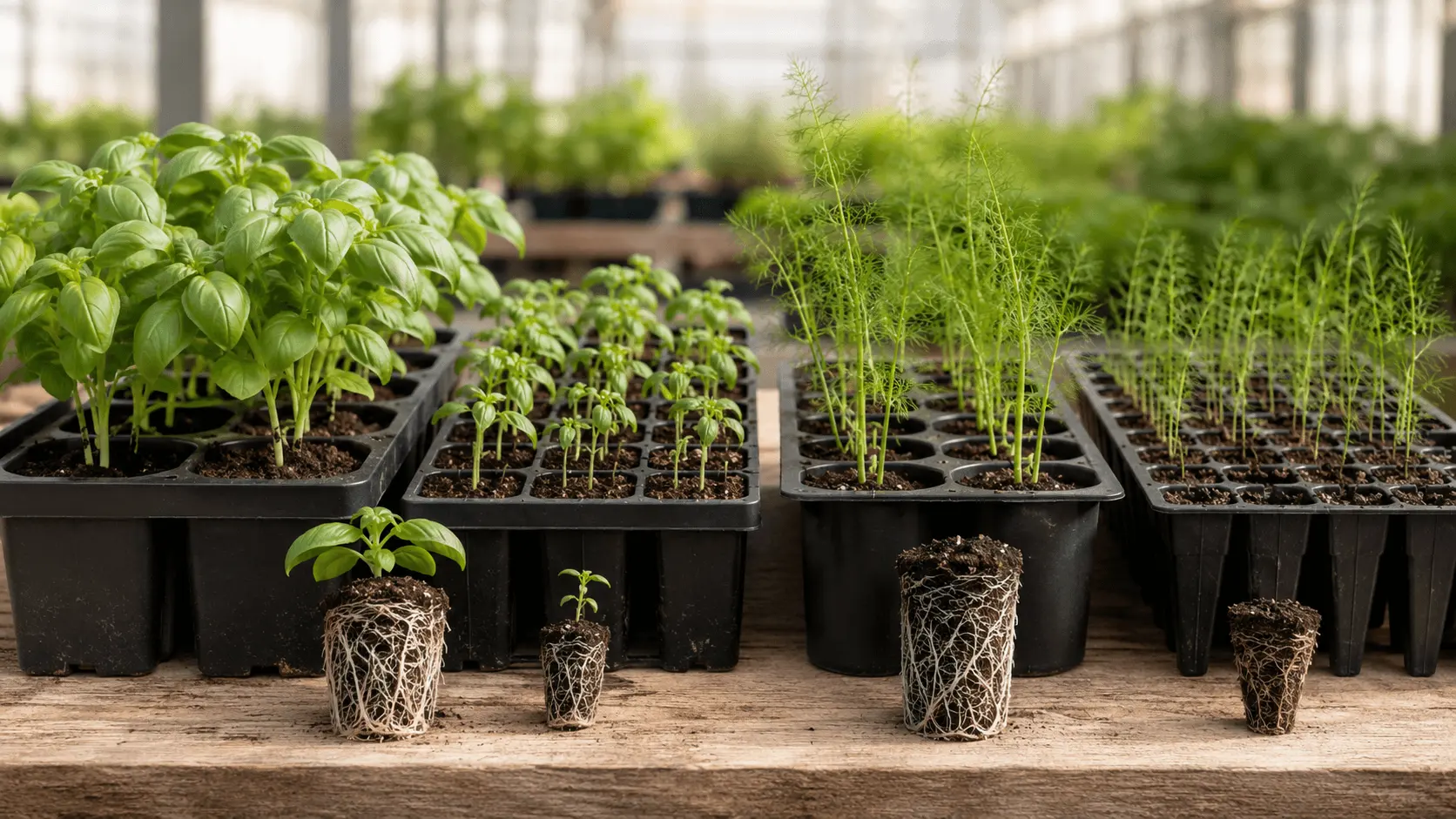
A basil study tested cell count × transplant date interactions. The highest yield came from 32-cell trays (98.1 cm³) transplanted at 14 days. The lowest yield came from 162-cell trays (16.3 cm³) transplanted at 28 days. The pattern is clear: larger cells plus earlier transplanting produces the best results. Smaller cells force longer holding times, and longer holding times in small cells produce root-restricted, low-yielding plants.
An asparagus study (Fisher & Benson, 1984) found that seedling growth increased as cell volume increased from 20 to 32 to 50 cm³ — but planting density (983 to 2,440 plants/m²) had no significant effect. The cell volume was the driver, not how many cells were on the tray. The same study also found that cylindrical cells produced larger seedlings than inverted-pyramid cells, even though the cylindrical cells held 20% less media. The shape of the cell influenced plant growth independently of the volume.
That finding is worth pausing on. A cell with less media produced a better plant — because the shape of the cell affected how roots grew. We will come back to cell shape in a later section.
The “Bigger Is Better” Trap: Why Maximum Volume Is Not Always the Answer
If cell volume improves transplant quality, then the biggest cell must be the best choice — right?
Not always. The tomato study showed that 18.4 cm³ was the most economical option even though 68.2 cm³ produced the best seedling. The muskmelon study showed a dramatic jump from 7 to 100 cm³ — but that was an extreme comparison. Between moderate volumes, the returns diminish.
Research on Hiko trays in forestry applications (referenced in industry literature) found that 150 cc cells produced better field performance than 300 cc cells. The 300 cc cells grew larger seedlings in the nursery — but after field planting, the 150 cc seedlings had more compact root systems and established faster. More media in the nursery did not translate to better survival in the field.
Here is the cost-volume trade-off in practical terms:
- Larger cells → fewer cells per tray → more media cost per plant → more greenhouse bench space per plant → higher per-plant cost
- Smaller cells → more cells per tray → less media per plant → higher density → but risk of root restriction if the crop stays too long
The question is not “what is the biggest cell I can afford?” The question is “what cell volume does this crop actually need for the length of time it will be in the tray?” A lettuce crop that turns over in 3 weeks does not need 55 cc cells. A pepper crop that sits for 8 weeks will suffer in 20 cc cells.
If you are quoting trays for a customer and they ask for “the cheapest 128-cell option,” that is the moment to ask what they are growing and how long the crop stays in the tray. The cheapest 128-cell tray may have 28 cc cells — fine for a 4-week herb crop, inadequate for a 7-week tomato crop. Send your customer’s crop list and growing schedule to Scarecrow Garden and we can match each crop to the right cell volume across our supplier network.
Cell Shape: The Independent Variable Most Buyers Ignore
We noted earlier that cylindrical asparagus cells produced larger seedlings than inverted-pyramid cells with 20% more media. That finding challenges the assumption that more media always equals better plants. Cell shape affects root architecture, and root architecture affects transplant quality — independently of cell volume.
If you have ever watched a transplanter line stop because a root ball stuck in the cell, you have seen the case for inverted-pyramid (tapered) cells. The taper angle — typically 10–15° — allows the root ball to slide out cleanly when a mechanical plunger pushes up from the bottom. No sticking, no jamming, no line stoppage. Tapered cells are the standard for operations running automated transplanters, and if your customer uses one, this is not a preference — it is a compatibility requirement. The cell layout (rows × columns) must also match the seeder needle spacing and transplanter gripper width. Two different 128-cell trays with different cell layouts — say, 8 × 16 versus 4 × 32 — will not run on the same seeder. Same cell count, different machine.
If your customer hand-transplants grafted tomatoes at $1.50 each, ejection speed is not the bottleneck — plant quality is. Cylindrical cells have no taper. The root ball holds firmly, which makes ejection harder. But the vertical walls give roots more surface area to grow against, and the uniform cross-section distributes root growth more evenly. The asparagus study showed that this shape produces larger seedlings per unit of media. For hand-transplanted crops where every gram of transplant quality translates to field performance, cylindrical cells can deliver better results.
Some tray designs add internal vertical walls (IVW) — vertical ribs or grooves inside the cell. These increase wall surface area, which guides roots downward instead of allowing them to circle. Research on IVW designs, based on industry reports, suggests improved biomass and root surface area compared to smooth-walled cells. IVW is a middle ground: it does not eliminate circling the way air-pruning designs do, but it reduces it without requiring open cell walls.
What this means for sourcing: If your customer runs automated transplanters, specify tapered cells with an appropriate taper angle (typically 10–15°). If your customer hand-transplants high-value crops, cylindrical or IVW cells may produce better plants. If your customer grows forestry seedlings, air-pruning designs with open cell walls are the functional requirement — circling roots in tree seedlings are not an inconvenience, they are a mortality risk after outplanting.
Crop-Cell Matching: A Practical Framework by Crop Type
This framework matches cell count and volume to crop type, based on growing cycle length, root system requirements, and common industry practice. Use it as a starting point — then adjust for your customer’s specific varieties and schedules.
| Crop Category | Example Crops | Cell Count | Cell Volume | Growing Cycle | Key Design Requirements |
| Leafy greens | Lettuce, spinach, kale | 200–288 | 12–20 cc | 2–4 weeks | Shallow cells, fast turnover, automation-compatible |
| Solanaceous crops | Tomato, pepper, eggplant | 72–128 | 35–55 cc | 5–8 weeks | Medium depth, good drainage, reusable grade |
| Cucurbits | Cucumber, melon, squash | 50–72 | 55–85 cc | 6–8 weeks | Deep cells, large volume, thick walls |
| Herbs | Basil, thyme, mint | 200–288 | 12–20 cc | 3–4 weeks | Shallow cells, high density |
| Annual flowers | Bedding plants | 288–512 | 7–12 cc | 2–4 weeks | High density, precision seeding |
| Woody ornamentals | Large container stock | 32–50 | 85–120 cc+ | 8–12 weeks | Deep cells, air pruning |
| Forestry seedlings | Tree seedlings | 32–50 (deep) | 120 cc+ | 8–12 weeks+ | Deep plug containers, root trainer design |
| Tissue culture | Orchids, foliage plants | 72–128 | 35–55 cc | 4–8 weeks | Shallow cells paired with tall humidity domes |
A few things to notice in this table:
- Leafy greens and herbs share the same cell range (200–288, 12–20 cc) because both are fast-turn crops with shallow root systems. The difference is that herbs like basil often benefit from slightly larger cells if they will be held past 4 weeks — the basil study showed a clear yield penalty for small cells held too long.
- Solanaceous crops span a wide range (72–128 cells). A 4-week tomato crop in a warm greenhouse can use 128-cell trays. A 7-week pepper crop in a cooler climate may need 72-cell trays. The cell count depends on the growing cycle, not just the crop name.
- Forestry and woody ornamentals both need 120 cc+ cells — but forestry trays are typically deeper and narrower (root trainer design), while ornamental trays are wider and shallower. Same volume, different shape.
A distributor who stocks 128-cell trays for both lettuce and tomato customers runs into this problem all the time. The lettuce grower gets 35 cc cells and is fine — the crop turns over in 3 weeks. The tomato grower gets the same 35 cc cells and calls back in week 6 with root-bound complaints. Same cell count, different cycle length. That is what the next variable determines.
Growing Cycle Length: The Hidden Constraint on Cell Selection
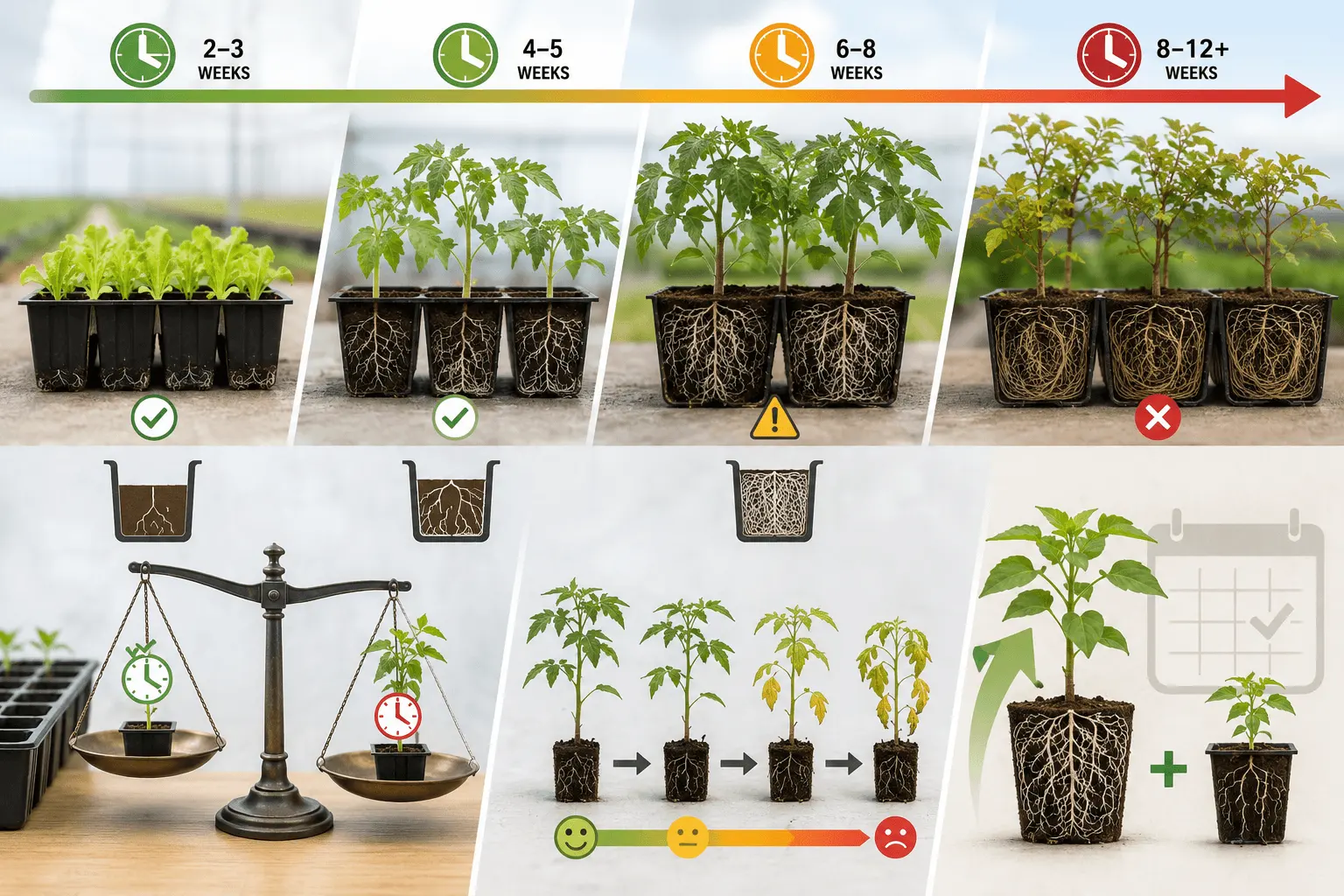
A lettuce grower fills 288-cell trays and transplants in 21 days. Everything works fine. A tomato grower fills the same 288-cell trays and plans to transplant in 6 weeks. By week 4, the roots have filled every cell. By week 5, the plants are root-bound, nutrient-stressed, and losing leaves from the bottom up. By week 6, the transplants are poor quality and field establishment is slow.
Same tray. Different outcome. The variable that changed was the growing cycle length.
Here is the matching logic:
| Growing Cycle | Cell Volume Range | What Happens If You Go Smaller |
| 2–3 weeks (lettuce, microgreens) | 7–12 cc | Roots will not fill the cell; no restriction risk |
| 4–5 weeks (short-cycle tomato, cucumber) | 20–35 cc | Roots begin to approach cell walls; acceptable if transplanted on time |
| 6–8 weeks (long-cycle tomato, pepper, melon) | 55–85 cc | Roots will fill the cell; restriction risk is real if transplanting is delayed |
| 8–12 weeks+ (tree seedlings, woody ornamentals) | 120 cc+ | Air pruning is not optional — it is the only way to prevent circling roots |
Longer growing cycles also increase handling and reuse demands, so buyers should compare tray cost per growing cycle rather than choosing only by the initial unit price.
The key insight: cell volume is not just about plant size — it is about time. A small cell can grow a good plant if the plant leaves the cell on time. The same cell produces a bad plant if the schedule slips.
⚠️ Risk Alert: The Overstay Problem
If seedlings remain in their cells beyond the designed growing cycle — even by 7 days — root restriction can cause irreversible quality decline. Research on pre- and postharvest transplant practices confirms that delayed transplanting leads to root circling, reduced relative growth rate (RGR), and lower net assimilation rate (NAR). These effects do not reverse after field planting.
If your customer’s operation is prone to schedule delays — weather-dependent field access, labor shortages, or greenhouse space bottlenecks — specify a cell volume one step larger than the minimum for their crop. The extra volume buys buffer time.
Root Restriction: What Happens When the Cell Is Too Small
When a root system fills its cell and has nowhere to go, it does not simply stop growing. It adapts — and the adaptations are all bad for transplant quality.
Research on Impatiens wallerana compared plants grown in 50-cell trays (large cells) versus 288-cell trays (small cells). In the small-cell treatment:
- Relative leaf area expansion rate (RLAE) declined
- Relative growth rate (RGR) declined
- Net assimilation rate (NAR) declined
- Glucose content decreased
- Water retention increased (because air-filled porosity in the media dropped)
Cell volume is not the only factor affecting root quality; drainage-hole design and root development must also be evaluated because saturated media can produce similar transplant symptoms.
All of these growth parameter declines correlated positively with reduced root dry weight. The plant was not just smaller — it was metabolically impaired. The researchers hypothesized that endogenous cytokinins, produced in the roots and transported to the shoots, were involved in the signaling pathway. When roots are restricted, cytokinin production drops, and shoot growth slows.
What does this look like in practice? Walk down a greenhouse aisle in week 6. Pick up a 288-cell tray that should have been transplanted in week 4. The plants are shorter than expected, the lower leaves are yellowing, and when you push a root ball out, the roots are a tight coil against the cell wall with no visible lateral branching. That is root restriction — and circling roots do not correct themselves after transplanting. They continue to circle in the field, which limits the root system’s ability to explore soil for water and nutrients. The transplant may survive, but it will not thrive.
Air-pruning designs — open cell walls or slots that expose root tips to air — reduce this problem. When a root tip reaches an opening and is exposed to dry air, the tip desiccates and stops elongating. The root then branches behind the tip, creating a denser, more distributed root system. Research indicates that air-pruning designs can significantly reduce coarse root defects compared to closed-wall cells, based on industry experience.
For a wholesale buyer, this has a direct product-selection implication: if your customer grows crops with long cycles (6+ weeks), closed-wall cells are a liability. Air-pruning designs cost more per tray but they produce transplants with functional root systems. The cost difference is measured in cents per cell. The root quality difference is measured in field survival rates.
Next Step: Match Your Crop List to the Right Cell Volume
Cell count is what buyers ask for. Cell volume is what plants need. The gap between those two things is where transplant quality gets lost.
Before you place your next tray order, do two things:
- Map each crop in your product line to its actual growing cycle length — not the ideal schedule, but the realistic one including delays. Then match that cycle to the cell volume ranges in this article.
- Confirm cell volume with your supplier, not just cell count. Two “128-cell trays” can have different volumes. Ask for cell depth and opening diameter if volume is not listed.
Send your crop list, growing schedules, and target market to Scarecrow Garden. We will match each crop to the right cell count and volume across 200+ cooperating supplier partners — so you order trays that produce transplants your customers want to buy again.
Or request a cell volume comparison chart showing 72-, 128-, and 288-cell trays from different manufacturers side by side, or start with a sample order to verify cell dimensions before committing to volume.
For crops started under a clear cover, cell selection should also be paired with the right humidity dome height for germination, cutting propagation or acclimatization.
FAQ
Does a higher cell count always mean smaller plants?
Not necessarily — it depends on growing cycle length. A 288-cell tray with 12 cc cells can produce excellent lettuce transplants in 3 weeks because the roots do not have time to become restricted. The same tray will produce poor tomato transplants if held for 7 weeks. Cell count is a proxy for cell volume, but the real variable is whether the cell volume matches the time the plant spends in the tray.
How do I calculate cell volume if the supplier only gives cell depth and opening diameter?
For a roughly cylindrical cell, volume ≈ π × (diameter ÷ 2)² × depth. For a tapered (inverted-pyramid) cell, use the average of the top and bottom opening diameters. These are approximations — for precise volumes, ask the supplier to fill a cell with water and measure, or check the manufacturer’s spec sheet.
Is it better to use a larger cell and transplant earlier, or a smaller cell and transplant on time?
Between those two options, a larger cell transplanted earlier is usually better — the plant gets more root zone volume and spends less time under restriction. But the real answer is a third option: match the cell volume to the crop’s actual growing cycle, then transplant on schedule. The basil study found that 32-cell trays (98.1 cm³) transplanted at 14 days outperformed all other combinations — not because the cells were huge, but because the cell volume matched the time in the tray and the plant moved to the field before restriction set in.
Do all 128-cell trays have the same cell volume?
No. On a standard 54 × 28 cm tray, 128-cell volumes typically range from about 28 to 38 cc depending on cell depth and wall design. That 36% difference in root zone volume can significantly affect transplant quality for longer-cycle crops. Always confirm cell volume — or at minimum, cell depth and opening diameter — when comparing suppliers.
What is the minimum cell volume for a specific crop?
There is no universal minimum — it depends on the variety, the growing cycle, and the grower’s quality standards. However, the research in this article provides clear benchmarks: muskmelon below approximately 7 cm³ produced zero early yield; tomato at 8.6 cm³ produced the lowest-quality transplants; asparagus growth increased from 20 to 50 cm³. Use these as reference points, then adjust for your specific crop and conditions.
Test the Tray Fit Before Your Bulk Order
Tell us what you grow and what is not working with your current trays. We will put together a sample set so you can test the fit before you commit.

Written by
ScarecrowGarden
💡About Scarecrow Garden Supplier Co., Ltd.
Scarecrow Garden Supplier Co., Ltd. is a China-based sourcing and wholesale partner specializing in garden tools, landscaping equipment, and outdoor supplies for international wholesalers, distributors, contractors, and brands.
With hands-on experience rooted in real garden use scenarios, we focus on durable materials, functional design, and stable large-volume supply. Our product range covers pruning tools, watering systems, hand tools, outdoor hardware, and customized garden solutions to support both retail and professional landscaping markets.
Beyond products, we help our partners navigate supplier selection, quality control, compliance requirements, and long-term sourcing strategies in China. Through our blog, we share practical insights on product selection, material comparisons, industry trends, and cost-effective purchasing—helping global buyers build stronger, more competitive supply chains.