







Heavy-Duty vs Disposable Seedling Trays: Real Cost Analysis | Scarecrow Garden Supplier
You have done the math. A heavy-duty PP tray costs $0.70. A disposable PS tray costs$0.20. The heavy-duty one lasts eight seasons. The disposable one lasts one. Simple division tells you the heavy-duty tray costs $0.09 per cycle — less than half. Case closed, right?
Not quite. That calculation only counts what you pay at the invoice. It does not count the bleach, the steam, the storage shelf space, or the Pythium outbreak that cost you $8,000 in lost seedlings last spring. When you add those numbers, the gap between “heavy-duty saves money” and “heavy-duty costs more” can be as thin as one or two reuse cycles.
This article walks through the real cost per growing cycle — not just purchase price, but total cost of ownership. We will look at why the material matters more than the thickness, where the crossover point sits, and three scenarios where buying disposable is actually the smarter business decision.
If you are comparing suppliers or building a tray budget for next season, talk to us about your product list and target volumes — we can pull FOB quotes for both PP and PS options so you see the real numbers side by side.
The Material Is the Root — Not the Thickness
Most buyers assume the difference between a heavy-duty tray and a disposable one comes down to wall thickness. It does not. Walk through any nursery supply warehouse and you will see the same pattern: thick PS trays marketed as “reusable,” thin PP trays that outlast them three times over. The label says heavy-duty. The material says otherwise. The difference starts at the molecular level.
Heavy-duty trays are almost always PP (polypropylene). Disposable trays are mostly PS (polystyrene). The material dictates everything that follows — how many seasons a tray survives, whether it can be steam-sanitized, and how it holds up under UV exposure in a greenhouse.
Here is what each material brings to the table:
| Property | PP (Heavy-Duty) | PS (Disposable) |
| Structure | Semi-crystalline — flexible, fatigue-resistant | Amorphous — rigid, brittle |
| Elongation at break | 100–600% | 1.2–3.6% |
| Melting point | ~160–170 °C | ~80–100 °C (glass transition) |
| UV resistance | Good (with HALS stabilizers) | Poor — yellows and cracks under UV |
| Steam sanitization | Yes | No — deforms at sanitization temps |
| Typical reuse cycles | 5–15 seasons (based on industry experience) | 1–3 seasons (based on industry experience) |
Sources: AskDifference [1]; ScienceDirect [2]
Material and wall thickness should not be specified in isolation; the complete seedling tray specification framework also includes cell volume, drainage, crop duration and system compatibility.
That table tells you most of what you need to know. But the number that should really catch your eye is elongation at break. PP can stretch 100 to 600 percent before it snaps. PS typically breaks at 1.2 to 3.6 percent. That is not a minor difference — it is the difference between a tray that survives a worker pressing the cell bottom to pop out a plug, and a tray that cracks at the drain hole on the first removal.
Think about what happens during transplanting. Your crew presses the cell floor, the root ball slides out, and the cell wall flexes. With PP, the wall bends and returns. With PS, the wall bends and micro-cracks form at the stress concentration points — the drain holes, the cell corners. Those cracks are invisible on day one. By season two or three, they are structural failures.
Then there is UV. PS undergoes photo-oxidative degradation under UV exposure. Research shows that under accelerated aging conditions, visible surface cracks appear on PS within approximately 20 days, based on accelerated UV testing [3]. Greenhouse glass filters some UV, but the cumulative effect over two or three seasons is significant. A PS tray that felt sturdy in January feels brittle by the following October.
High-impact PS (HIPS) — PS blended with polybutadiene rubber — improves impact resistance and can extend reuse to 2–4 seasons [2]. Some suppliers market “thicker PS” trays that are actually HIPS. But even HIPS does not match PP’s 5–15 season range (based on industry experience), and it still cannot be steam-sanitized.
Wall Thickness: The Second Dividing Line
Material sets the ceiling. Wall thickness determines how close you get to it.
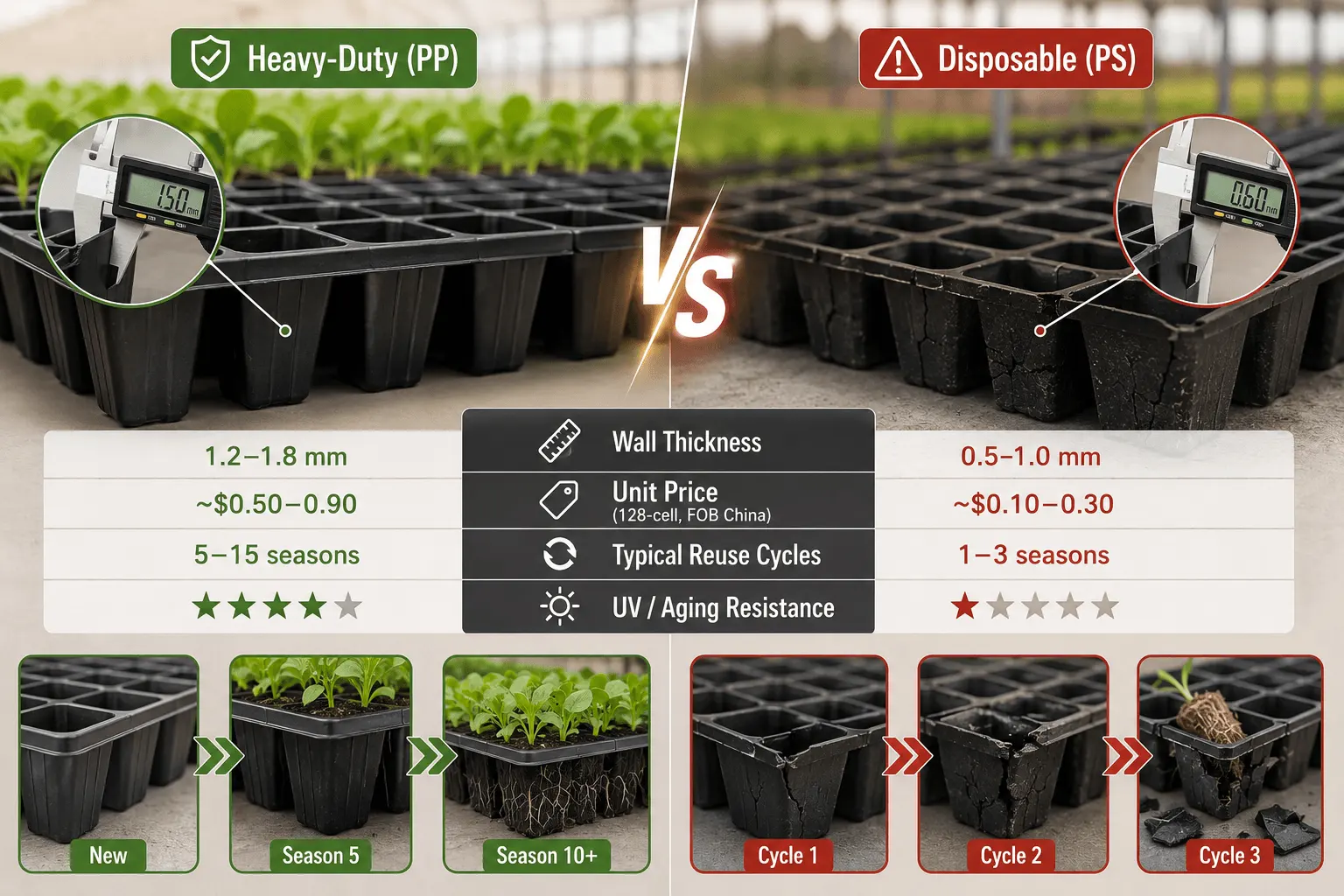
| Parameter | Heavy-Duty (PP) | Disposable (PS) |
| Wall thickness | 1.2–1.8 mm (based on industry experience) | 0.5–1.0 mm (based on industry experience) |
| Unit price (128-cell, FOB China) | ~$0.50–0.90 (based on industry experience) | ~$0.10–0.30 (based on industry experience) |
| Typical reuse cycles | 5–15 seasons (based on industry experience) | 1–3 seasons (based on industry experience) |
| UV/aging resistance | Good (with stabilizers) | Poor |
Source: C2-P research report; supplier data [4][5]
A 0.5 mm PS tray may show micro-cracks after the first transplant cycle. A 1.0 mm PS tray can handle one to three seasons — but UV aging accelerates embrittlement with each cycle. A 1.5 mm PP tray, with proper sanitization and storage, can stay structurally sound for five to ten seasons or more.
Here is what that looks like in practice: a nursery buys 1,000 PS trays at $0.20 each for spring lettuce. After the first cycle, 200 trays already have visible cracks at the cell bases. After the second cycle, 400 more are cracking. By the third cycle, the remaining trays are so brittle that transplanting damages the root balls. The “1–3 season” reuse range is not a marketing claim — it is a physical limit.
The price gap is real. On a per-unit basis, a heavy-duty PP tray costs three to four times more than a disposable PS tray. The question is whether that upfront cost gets amortized over enough cycles to pay off. That depends on your hidden costs — which we will get to shortly.
The Simple Math — And Where It Misleads You
Let us start with the calculation most buyers do.
Scenario: 1,000 trays per year, 128-cell format
| Disposable PS | Heavy-Duty PP | |
| Unit price | $0.20 | $0.70 |
| Reuse cycles | 1 | 8 |
| Cost per cycle (purchase only) | $0.20 | $0.09 |
| Annual purchase cost | $200 | $125 (amortized) |
Purchase cost per cycle: heavy-duty PP is 56% lower. The math looks decisive — and that is exactly the calculation most buyers do when they are staring at a supplier quote sheet.
But this calculation ignores three things:
- Sanitization cost — every reuse cycle requires disinfection
- Storage cost — trays occupy shelf space between seasons
- Disease risk cost — reused trays carry pathogen exposure
When you factor those in, the 56% advantage shrinks fast. How fast? That depends on how many times you actually reuse the tray.
The crossover point: approximately 3 cycles (based on the TCO model above). If a heavy-duty PP tray only gets reused three times before damage or contamination forces retirement, its cost per cycle becomes higher than a disposable PS tray. The upfront premium does not amortize, and you still pay for sanitization.
This is not theoretical. Nurseries without a structured sanitization protocol — or those that store trays in damp, unventilated areas — routinely see PP trays fail after two or three seasons. The material can handle ten cycles, but the operation cannot.
Here is what that looks like in real terms: you buy 5,000 heavy-duty PP trays at $0.70 each — a$3,500 investment. You plan to reuse them eight times. But without a proper sanitization setup, disease contamination forces you to discard them after three cycles. Your actual cost per cycle: $0.23 per tray. That is more expensive than the$0.20 disposable option you were trying to beat.
Three Hidden Costs That Eat Your Savings
Sanitization
A nursery manager we work with in Oregon switched from chemical to steam sanitization last year. Per-cycle cost dropped from roughly $0.04 to$0.02 per tray — but only after the $3,500 equipment investment paid for itself midway through season two. That is the sanitization equation in a nutshell: the per-cycle number looks small, but the infrastructure behind it is not free.
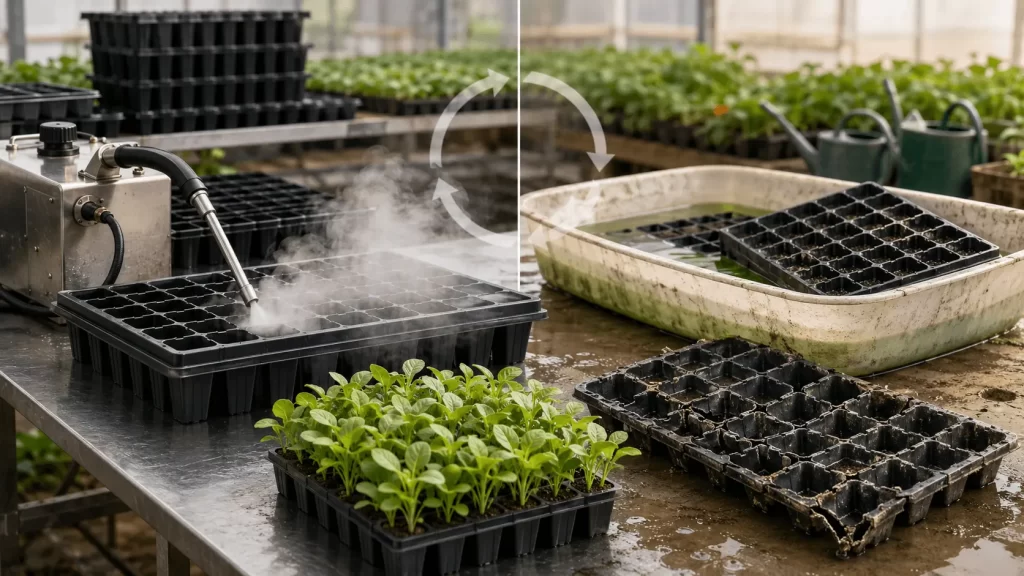
Every reused tray needs to be disinfected between cycles. There are two main approaches:
- Chemical sanitization (bleach or peracetic acid soak): approximately $0.02–0.05 per tray per cycle, covering disinfectant and labor [based on industry experience]
- Steam sanitization: requires dedicated equipment (initial investment $2,000–5,000), then approximately$0.01–0.03 per tray per cycle for energy and depreciation [based on industry experience]
PS trays cannot be steam-sanitized — their glass transition temperature (~80–100 °C) is too close to sanitization temps. Chemical sanitization works, but it has limited penetration into the micro-cracks that form in PS after the first use cycle. Pathogens can survive in those crevices.
PP trays, with their smoother surfaces and higher heat tolerance, sanitize more reliably — especially with steam.
This matters more than most buyers realize. A nursery that cannot reliably sanitize its trays is a nursery that cannot reliably reuse them. And a tray you cannot safely reuse is an expensive tray, regardless of what the invoice says.
Cleaning performance is also affected by hole geometry and trapped water, so the drainage specifications that affect root health should be reviewed before choosing a reusable tray.
Storage
Heavy-duty trays need to be stored dry and ventilated between seasons. For a nursery running 10,000 trays, that means roughly 15–20 m² of shelf or rack space. For a small or seasonal operation, that space may not exist — or it may come at a cost that does not show up on the tray budget.
Reusable trays only reduce storage costs when they nest and stack correctly, which is why buyers should confirm 1020 tray dimensions and fit before placing a repeat order.
Disease Risk
If you have ever watched a Pythium outbreak sweep through a 10,000-tray greenhouse in 48 hours, you know this cost is not theoretical. Reused trays are potential vectors for soilborne pathogens — Pythium, Fusarium, Rhizoctonia [6]. A single Pythium outbreak in a 10,000-tray operation can cause crop losses of $5,000–15,000, based on industry experience.
PS trays with micro-cracks are particularly risky — the cracks create “refuge zones” where chemical sanitizers cannot reach, and pathogens survive to infect the next crop.
PP trays are not immune to contamination, but their crack-resistant surfaces make sanitization more effective, reducing (not eliminating) disease risk.
When Disposable Trays Are Actually Cheaper
“Heavy-duty always saves money” is a myth. Here are three scenarios where the total cost of ownership favors disposable PS trays.
Short-Cycle, Low-Margin Crops
Crops like lettuce run 3–4 week turnarounds, meaning 8–10 cycles per year. At that frequency, sanitization costs accumulate fast. If the crop margin is thin (commodity lettuce, not specialty varieties), the sanitization cost per cycle can exceed the purchase-price difference between PP and PS. A clean disposable tray every cycle — no bleach, no steam, no labor — becomes the lower-cost option.
High-Disease-Pressure Environments
If your nursery has a history of Pythium or Fusarium outbreaks, or operates in a humid climate where damping-off is a constant threat, the disease-risk cost of reusing trays can outweigh the purchase savings. One outbreak can wipe out a season’s worth of per-cycle savings. In this context, a $0.20 disposable tray is not an expense — it is a clean slate, and that has measurable value.
Small-Scale or Seasonal Operations
A nursery using fewer than 500 trays per year faces two structural disadvantages with heavy-duty trays: the upfront investment takes too long to amortize, and the per-unit cost of sanitization equipment and storage space is too high. Consider a community nursery buying 300 trays at $0.70 each — a$210 upfront investment that takes three or more seasons to amortize. But they only run one crop cycle per year. At that rate, the $0.70 tray costs$0.70 per cycle, while the $0.20 disposable costs$0.20. No sanitization protocol can close that gap.
⚠️ Risk Alert: The “Reuse PS Anyway” Trap Some small nurseries try to reuse disposable PS trays for 2–3 cycles to save money. Based on industry experience, this is a false economy. PS micro-cracks harbor pathogens that chemical sanitizers cannot fully reach. The $0.10–0.20 saved per tray is not worth the disease exposure — one infected batch can cost hundreds of dollars in lost plants and re-seeding labor.
The Full TCO Model: All Costs on the Table
Total Cost of Ownership per Cycle = (Purchase cost + Cumulative sanitization cost + Cumulative storage cost + Expected disease loss) ÷ Reuse cycles
Here is what the numbers look like for a 5,000-tray-per-year nursery over eight years:
| Cost Item | Heavy-Duty PP (8-season reuse) | Disposable PS (1-season) |
| 8-year purchase cost | $3,500 ($0.70 × 5,000) | $8,000 ($0.20 × 5,000 × 8 yr) |
| 8-year sanitization | $800–2,000 | $0 |
| 8-year storage | $800–1,500 | $0 |
| 8-year expected disease loss | $500–2,000 | $200–500 |
| 8-year TCO | $5,600–9,000 | $8,200–8,500 |
| TCO per cycle | $0.14–0.23 / tray / season | $0.20–0.21 / tray / season |
At 5,000 trays per year with 8-season reuse, heavy-duty PP has a 5–25% TCO advantage over disposable PS. But notice: the advantage is nowhere near the 56% that purchase-price-only math suggests. Hidden costs consume most of the savings.
This is the part that catches buyers off guard. They run the simple division, see a 56% advantage, and commit to heavy-duty. Then the sanitization labor adds up. The storage shelf needs expanding. A Pythium flare-up hits in year two. By the time they recalculate, the per-cycle savings have evaporated — or turned negative.
Some manufacturers are already addressing the waste side of this equation. Pöppelmann’s PÖPPELMANN blue® program takes back used PP products — primarily packaging — and reprocesses them into new materials, demonstrating a closed-loop approach for PP [7]. Extending this model to nursery trays would require separate logistics, but the infrastructure exists. And that only works if you are buying PP in the first place — another reason the material choice matters beyond the invoice.
Sensitivity analysis — how the math shifts under different real-world conditions:
| Scenario | TCO Result |
| PP reused 8 seasons | PP is 5–25% cheaper per cycle |
| PP reused 5 seasons | PP advantage shrinks to ~0–10% |
| PP reused 3 seasons | PP is 10–20% more expensive per cycle |
| High disease-loss risk (> $1,000/yr) | Disposable PS may be cheaper |
The pattern is clear: reuse cycles are the lever. Everything else follows.
The takeaway is simple: heavy-duty trays only save money if your operation can actually reuse them enough times. If your sanitization protocol is inconsistent, your storage is suboptimal, or your disease pressure is high, the crossover point moves — and disposable becomes the better call.
How to Decide for Your Nursery
Before you place that next order, here is a quick way to think through the decision for your own operation.
First, can your operation actually support reuse?
- Annual tray volume: Over 5,000? Heavy-duty PP is likely worth the investment. Under 1,000? Disposable PS keeps costs simple.
- Crop margin: High-value crops (perennials, specialty ornamentals) justify PP investment. Low-margin commodity crops may not.
- Sanitization capability: Do you have — or can you invest in — steam sanitization or a structured chemical protocol? If not, PP reuse cycles will be shorter than advertised.
- Storage space: Can you store 5,000–10,000 trays dry and ventilated between seasons? If space is tight, factor in the cost of shelving or off-site storage.
Then, what risks might tip the balance?
- Disease history: Have you had Pythium, Fusarium, or Rhizoctonia outbreaks in the past two years? If yes, the disease-risk cost of reusing trays may outweigh the purchase savings.
- Turnaround speed: Crops with 3–4 week cycles (lettuce, basil) generate 8–10 uses per year. The sanitization cost at that frequency can tip the scale toward disposable.
- Workforce consistency: Can you ensure trays are cleaned and stored correctly every cycle? One skipped sanitization can negate a season of savings.
- Environmental compliance: Are you in a region with restrictions on PS disposal or requirements for plastic waste reduction? If so, the long-term regulatory cost of disposable PS may increase.
Next Step: Run the Numbers for Your Operation
The difference between “heavy-duty saves money” and “heavy-duty costs more” comes down to your specific operation — volumes, crops, sanitization capacity, and disease pressure. Generic advice will not get you the right answer.
Share your product list and annual volumes with us — we will pull FOB quotes for both PP and PS options from verified suppliers, so you can compare real numbers before you commit.
If you want to see how different wall thicknesses and materials perform side by side, ask us for the seedling tray comparison video — it covers PP, PS, and HIPS options from the factories we work with.
You focus on growing. We help you source, verify, organize, and ship.
FAQ
Can I reuse a disposable PS tray for 2–3 cycles to save money? Technically yes, but it is a false economy. PS develops micro-cracks after the first transplant cycle. Those cracks harbor pathogens that chemical sanitizers cannot fully reach. The small per-tray savings are not worth the disease exposure.
What is HIPS, and is it a good middle ground? High-impact polystyrene (HIPS) adds polybutadiene rubber to PS, improving impact resistance. HIPS trays can survive 2–4 seasons — better than standard PS, but still far below PP’s 5–15 season range (based on industry experience). They also cannot be steam-sanitized. HIPS is a reasonable option for medium-cycle use, but do not expect heavy-duty performance.
How much does steam sanitization equipment cost? Based on industry experience, a basic steam sanitization setup for a nursery runs $2,000–5,000. The per-cycle cost drops to approximately$0.01–0.03 per tray — cheaper than chemical sanitization over time. If you are running more than 5,000 trays per year and using PP trays, the equipment pays for itself within two to three seasons.
Does UV exposure really matter in a greenhouse? Yes. Greenhouse glass filters some UV, but not all. Over two or three seasons, the cumulative UV exposure in a typical greenhouse is enough to significantly embrittle PS trays. PP trays with HALS (hindered amine light stabilizer) additives resist this degradation far more effectively.
What if I only use trays for one season — should I still buy PP? If you genuinely use a tray for only one cycle and then discard it, there is no cost advantage to PP. The PP premium only pays off when the tray is reused enough times to amortize the higher purchase price. For single-cycle use, PS is the lower-cost option.
Are there environmental considerations beyond cost? Yes. Over eight years at 5,000 trays per year, disposable PS sends 40,000 trays to the waste stream. Heavy-duty PP generates 5,000–10,000 trays (including replacements). PP is also more widely recyclable — some manufacturers, such as Pöppelmann with their PÖPPELMANN blue® program, offer closed-loop PP recycling for packaging products [7]. PS recycling rates remain low due to sorting and reprocessing challenges [1].
What about thin-wall PP trays — are they a viable middle option? Some suppliers offer PP trays at 0.8–1.0 mm wall thickness, priced between heavy-duty PP and disposable PS. These can be a reasonable compromise for medium-volume nurseries — they offer PP’s crack resistance and sanitization compatibility at a lower upfront cost, though their reuse range (typically 3–6 seasons) falls short of heavy-duty PP. If your operation can commit to a structured sanitization protocol but cannot justify $0.70+ per tray, thin-wall PP is worth evaluating.
Tell Us What Your Current Trays Get Wrong
Tell us what you grow and what is not working with your current trays. We will put together a sample set so you can test the fit before you commit.
Written by
ScarecrowGarden
💡About Scarecrow Garden Supplier Co., Ltd.
Scarecrow Garden Supplier Co., Ltd. is a China-based sourcing and wholesale partner specializing in garden tools, landscaping equipment, and outdoor supplies for international wholesalers, distributors, contractors, and brands.
With hands-on experience rooted in real garden use scenarios, we focus on durable materials, functional design, and stable large-volume supply. Our product range covers pruning tools, watering systems, hand tools, outdoor hardware, and customized garden solutions to support both retail and professional landscaping markets.
Beyond products, we help our partners navigate supplier selection, quality control, compliance requirements, and long-term sourcing strategies in China. Through our blog, we share practical insights on product selection, material comparisons, industry trends, and cost-effective purchasing—helping global buyers build stronger, more competitive supply chains.