










1020 Tray Dimensions & Compatibility: Prevent Costly Sizing Errors | Scarecrow Garden Supplier
You order “1020 trays” from a new supplier. The price is right, the samples looked fine, and the delivery shows up on time. Then you put a dome on the tray — and it doesn’t fit. The flange catches on the rim at an angle, leaving a gap that lets all the humidity escape. You try another dome from a different brand. Same result. You set the tray on your bench grid — it’s 5mm too wide to slide in. You run it through your transplanter — the gripper arms miss the plug cells by half a cell width, crushing seedlings instead of picking them up.
This is not a hypothetical. It happens more often than most growers like to admit. And the root cause is almost always the same assumption: that all 1020 trays are the same size.
They are not. Not even close.
The “1020” name suggests a tray measuring 10 × 20 inches. In reality, the typical 1020 tray measures closer to 10½ × 21 inches — and the exact dimensions vary by 5 to 10mm between manufacturers. That gap sounds small on paper. On a greenhouse bench, in a transplanter, or under a dome that won’t seal, it is not small at all.
This article walks through where these size differences come from, which compatibility problems they create, and what you can do to prevent them before you place your next bulk order. If you have ever wondered why a dome that fit perfectly last season does not fit the “same” tray from a new supplier, the answer starts here.
The “1020” Name Trap: Nominal vs. Actual Dimensions
“1020” is a nominal size, not an actual measurement. It likely originated as a rough description of the usable growing area or the inner dimensions, not the outer footprint. But over the years, the name stuck — and with it, the assumption that every tray called “1020” is interchangeable.
Here is what the actual dimensions typically look like:
| Parameter | Nominal | Typical Actual | Variation |
| Length | 20 in (508mm) | ~21 in (525–535mm) | +17–27mm |
| Width | 10 in (254mm) | ~10½ in (265–270mm) | +11–16mm |
| Global standard | — | 54 × 28cm | European norm |
The variation comes from three sources. First, different manufacturers use different mold designs — the rim width, edge thickness, and corner radius all affect the outer dimensions. Second, the injection molding process itself introduces variation: polystyrene (PS) shrinks about 0.5–0.8% after molding, while polypropylene (PP) shrinks 1.0–2.5%. That means the same mold can produce slightly different parts depending on the material and processing conditions. Third, there is no industry-wide standard that defines what “1020” actually means in millimeters.
Chinese manufacturers commonly label their products as 540 × 280mm (54 × 28cm), but actual production pieces range from about 525–545mm in length and 265–285mm in width. North American brands like TO Plastics and Landmark Plastics have their own molds with dimensions that do not always match Asian products. European brands such as Pöppelmann/Teku and Desch Plantpak follow the 54 × 28cm standard but use different edge designs — and that European standard is about 3–5mm larger in each dimension than the typical North American “1020.” The trays look identical side by side on a bench, but they are not fully interchangeable in a three-component system or an automated line. If your operation runs equipment calibrated for one standard, do not assume the other will work — even if the product listing says “1020 equivalent.” Test it.
The practical takeaway: when a supplier quotes “1020 tray,” you still do not know the actual size. You need the engineering drawing.
Not sure if your current trays match a new supplier’s dimensions? Share the engineering drawing or a sample — we will measure and compare before you commit to an order. Talk to our team about compatibility verification
The Three-Component System Problem
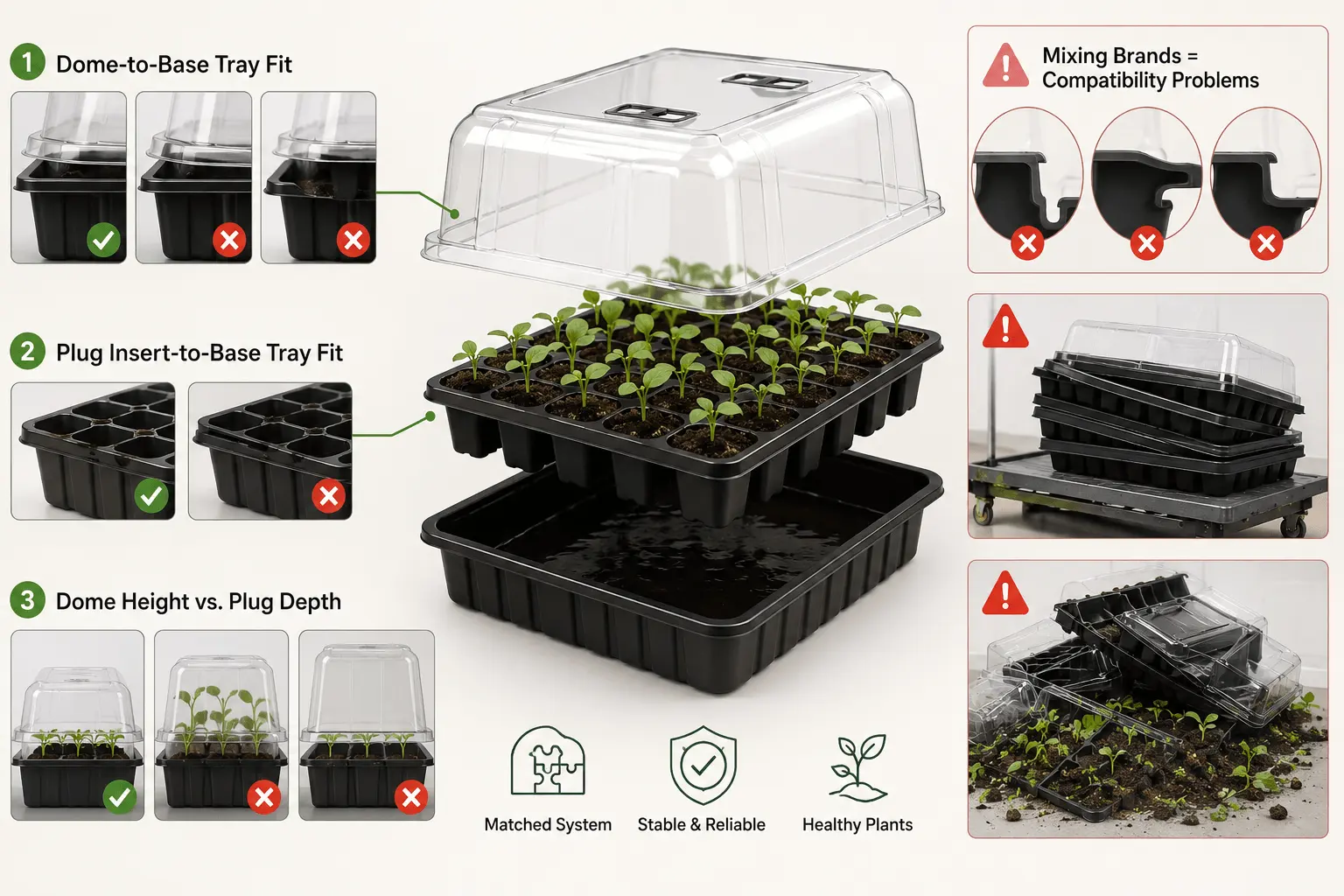
A 1020 tray is not just one product. In most commercial nursery setups, it is part of a three-component system: a base tray (the flat, solid bottom), a plug insert (the cell tray that sits inside), and a humidity dome (the clear cover that snaps on top). The compatibility problem is not just about the tray itself — it is about how all three parts fit together.
Here is where it breaks down across brands:
Dome-to-base-tray fit. You snap the dome on. It clicks — but only on two corners. The other two lift off the rim, and you can feel the humid air escaping already. That is what happens when a dome designed for one rim profile meets a base tray built with a different one. Some flanges grip the outside of the base tray rim; others tuck inside. The flange depth and angle vary too. When you mix brands, one of three things happens: the dome does not snap on at all, it snaps on loosely (leaving gaps that let humidity escape and defeating the purpose of the dome), or it fits so tightly that removing it damages the dome or disturbs the seedlings.
Fit is only the first requirement; buyers must also match dome height to the propagation stage so that the cover provides enough headspace without creating unnecessary humidity volume.
Plug insert-to-base-tray fit. The plug insert sits inside the base tray, so the base tray’s inner dimensions must be slightly larger than the plug insert’s outer dimensions. If the base tray comes from one supplier and the plug insert from another, the insert may not fit — or it may rattle around inside, shifting during watering and making automated operations less reliable.
Even when the insert fits inside the base tray, poor clearance underneath can interfere with seedling tray drainage hole size and position and leave water trapped below the cells.
Dome height vs. plug depth. A short dome (5–7cm) works fine with shallow plug inserts (like 200-cell or 288-cell trays). But pair that same short dome with a deep plug insert — a 32-cell or 50-cell tray — and your tomato seedlings will press against the dome before they are ready to be hardened off. Conversely, a tall dome (15–25cm+) on a shallow plug insert raises the center of gravity, making the assembly top-heavy and potentially unstable when you move trays on the bench.
Even within a single brand, compatibility requires attention. When Desch Plantpak redesigned its NexTray series, the primary complaint from growers was not about the tray itself — it was about compatibility issues between the carrier and the Y-base pot. Even established manufacturers have to iterate on these interfaces.
The bottom line: treat your base tray, plug insert, and dome as a matched system. If you change one component, verify the others still fit.
When 5mm Breaks Your Automation
For growers who fill trays by hand, a 5mm size difference is an annoyance. For growers running automated equipment, it can stop a production line.
Automated seeders, transplanters, and watering booms are built to precise tolerances. The needle array on a seeder must align with the cell openings. The gripper arms on a transplanter must reach each plug cell at the exact center. When a tray is even a few millimeters wider, narrower, or differently spaced than what the machine expects, things go wrong fast.
| Equipment Type | Key Compatibility Parameter | Typical Tolerance | What 5–10mm Deviation Does |
| Seeder | Cell center-to-center distance, cell opening diameter | ±1mm | Needle misses cell → skipped seeding or double-seeding |
| Transplanter | Tray outer dimensions, cell layout | ±1–2mm | Gripper misaligns → crushed or missed plugs |
| Watering boom | Tray positioning on bench | ±2–3mm | Uneven water distribution |
| Labeler | Tray edge position | ±2mm | Misaligned labels |
Consider what happened at an Oregon wholesale nursery. They had been running the same plug trays from Supplier A through their transplanter for three seasons without issues. When they switched to a lower-cost “1020” tray from Supplier B, the transplanter’s gripper arms no longer aligned with the cell centers. Based on industry experience, the misalignment rate was significant — typically in the range of 10–20% of plugs being either crushed or missed entirely during the first run. The fix was not simple: recalibrating the transplanter took two to three days of downtime, or they had to go back to Supplier A and absorb the cost of the unused inventory from Supplier B.
In markets with high automation adoption — the Netherlands and Japan, where among large commercial greenhouse operations, transplanter adoption rates can reach 40% or higher in some segments — this kind of compatibility failure is well understood. Automation-compatible trays are a premium category, often co-developed with equipment OEMs like Visser Horti Systems, ISO Group, and Urbinati. These trays carry a higher unit price because the molds are designed to tighter tolerances and tested against specific machine models.
If you run automated equipment, the “1020” name tells you nothing useful. You need the cell layout coordinates, the outer dimensions with tolerances, and ideally a test run on your specific machine before you commit to a bulk order.
Stacking: The Hidden Compatibility Problem
Stacking compatibility gets less attention than dome fit or automation alignment, but it matters — especially when you are shipping or storing 1,000+ trays at a time.
Here is the issue. When you stack trays from the same manufacturer, the nesting is predictable: each tray adds 8–15mm of height depending on cell depth and wall thickness, and the stack stays stable because the rim designs are consistent. But when you mix trays from different manufacturers, the rim profiles clash. Some trays have outward-flipping rims, others have inward-tucking rims, and others have flat edges. Mixed stacks do not nest cleanly — the rims catch, slide, or leave gaps.
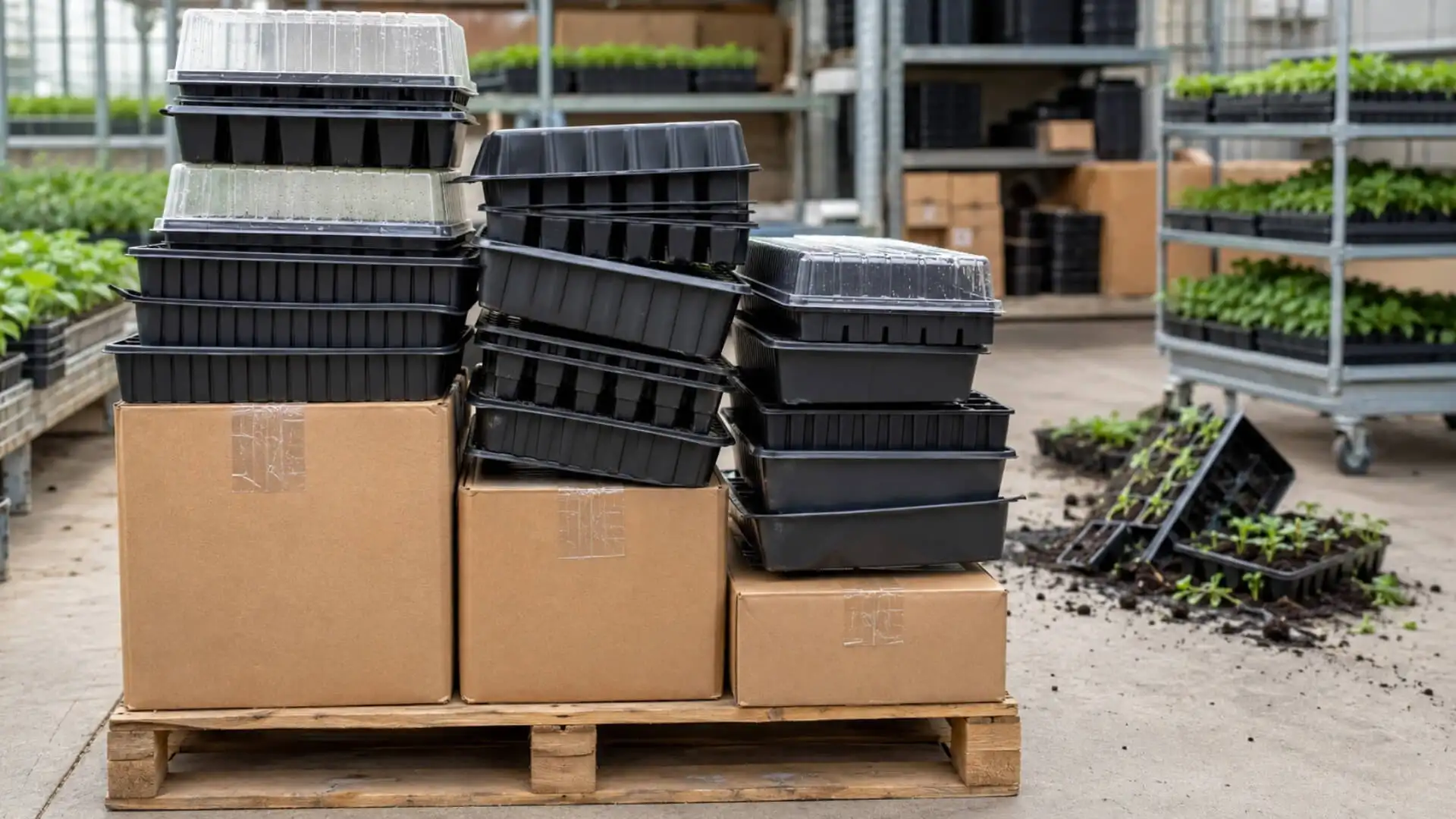
Now picture a shipment of 1,000 tray sets heading to your facility. Each set includes a base tray, a plug insert, and a dome. The empty trays alone weigh around 625kg total, packed into cartons — typically three carton sizes for the three components, each with different stacking heights. Because the three carton sizes are not the same height, stacking them on a pallet creates an uneven surface that shifts during transit. If the trays inside those cartons are from mixed sources and the stacking is unstable, the shifting weight can deform the trays or collapse the stack entirely. And once those trays are filled with plants — a planted tray typically weighs 2–4kg — a toppled stack of 200 wet plug trays does not just damage product. It creates a mess that takes hours to sort out, and the plants in those trays are usually unsalvageable.
This is one of those problems that does not show up in a product spec sheet. You only discover it when you open the carton — or when a stack tips over in your storage area.
The Cost of Getting It Wrong
Compatibility problems are not just inconvenient. They cost real money and real time. Based on industry experience, here is what the most common failures typically cost:
| Problem Type | Direct Cost | Indirect Cost |
| Dome does not fit base tray | Re-order domes ($0.50–$2.00 each) | Delayed sowing window by 1–2 weeks |
| Automation incompatibility | Recalibration ($2,000–$5,000+ plus downtime) | Or switch suppliers (absorb MOQ loss) |
| Unstable stacking in transit | Plant loss ($0.50–$5.00 per tray × quantity) | Customer trust damage |
| Tray does not fit bench grid | Return/replacement logistics cost | Production schedule delay |
The dome problem is the most common and the cheapest to fix — but only if you catch it before sowing season. Once the seeds are in and the dome does not seal, you lose the humidity control your germination schedule depends on. The automation problem is the most expensive, because it forces a choice between downtime (recalibrating) and waste (discarding incompatible trays). The stacking problem is the most unpredictable, because you do not know the stack is unstable until something falls over.
Put those numbers together for a 5,000-tray order, and a single compatibility mistake can potentially run into five figures — before you count the lost growing time.
Already dealing with a compatibility issue from a recent order? Tell us what went wrong — our team can help evaluate replacement options that fit your existing system. Describe your compatibility issue
How to Prevent Compatibility Problems Before You Order
Prevention is cheaper than correction. Every compatibility problem in the table above has the same solution: verify before you order, not after you receive. Here is what experienced buyers do before placing a bulk order for 1020 trays — or any nursery tray system.
Pre-Order Compatibility Checklist
Before you commit to a bulk order, verify each of these:
Before the sample arrives:
- Engineering drawing received and reviewed — Do not rely on the “1020” name. Get the manufacturer’s engineering drawing with outer dimensions, inner dimensions, rim width, and corner radius — all specified to the millimeter.
Once the sample is in your hands, the real verification begins.
After the sample arrives:
- Sample measured with calipers — When the sample arrives, measure the actual outer dimensions, cell center-to-center distance, cell depth, and wall thickness. Compare against the drawing.
- Three-component test completed — Assemble the base tray, plug insert, and dome together. Check that the dome snaps on securely, the plug insert sits without rattling, and the dome height accommodates your target crop.
- Stacking test passed — Stack 50–100 trays. Check for tilting, rim interference, or instability. If you are ordering mixed brands, test them in mixed stacks.
- Automation equipment tested — Run the sample tray through your seeder, transplanter, or watering boom. Verify alignment before ordering in bulk.
- Bench grid verified — Place the tray on your actual bench grid. Confirm it fits without forcing and does not shift excessively.
Key RFQ Fields for Compatibility
When you send an RFQ for 1020 trays, include these fields beyond the basics:
| Field | Why It Matters | What to Specify |
| Outer dimensions (L × W × H) | Determines bench fit, dome fit, and automation alignment | Exact mm with tolerance (e.g., 540 ±2mm) |
| Rim design | Affects dome seating and stacking stability | Outward-flip / inward-tuck / flat edge, rim width in mm |
| Dome engagement method | Determines which domes will seal properly | Flange type, flange depth in mm |
| Cell center-to-center distance | Critical for seeder and transplanter alignment | Row spacing × column spacing, to 0.5mm |
| Automation compatibility statement | Confirms the tray has been tested with specific equipment | Applicable equipment models, if available |
| Stacking height per tray | Determines carton size and storage requirements | Height increment in mm per nested tray |
| Carton dimensions and quantity | Affects shipping cost and container loading | Pieces per carton, carton L × W × H |
These fields take an extra five minutes to include in your RFQ. They can save you thousands of dollars and weeks of delay. Think of it this way: a caliper measurement at the sample stage costs nothing. A transplanter recalibration after the wrong trays arrive costs days of downtime and thousands in lost production.
Next Step: Verify Before You Ship
Every compatibility problem described in this article shares one thing in common: it could have been prevented with a sample, a caliper, and ten minutes of testing before the order was placed.
Compatibility should be checked together with material, cell volume, wall structure and crop application; our commercial seedling tray buying guide explains how these specifications work as one system.
The “1020” name is not going away. Neither is the variation between manufacturers. What you can control is how you verify — before the trays show up at your loading dock and the dome does not fit.
If you are planning a nursery tray order and want to make sure everything works together — the base tray, the plug insert, the dome, the bench, and the equipment — we can help. Our team compares dimensions, tests sample fits, and flags compatibility issues before you commit.
Three things you can do right now:
- Send us your current tray’s engineering drawing or sample — we will match it against our supplier network to find compatible options. Share your tray specifications
- Request a compatibility check for your next mixed order — base trays, plug inserts, and domes from different suppliers? We will test the fit before production starts. Request a compatibility check
- Get a sample pack for hands-on verification — measure, stack, snap on the dome, run it through your equipment. Then order with confidence. Request sample trays
FAQ
Q: Are all 1020 trays really different sizes? A: Yes. “1020” is a nominal name, not a dimensional standard. Actual outer dimensions vary by 5–10mm between manufacturers. Always request the engineering drawing with exact millimeter specifications before ordering.
Q: Can I use domes from one brand with base trays from another? A: It depends on the specific brands. Dome flange designs vary — some grip the outside of the tray rim, others tuck inside. Cross-brand mixing commonly results in poor sealing or no fit at all. Test before you commit.
Q: How much size difference matters for automated equipment? A: Automated seeders and transplanters typically require ±1–2mm tolerance. A 5mm deviation in tray width or cell spacing can cause misalignment, leading to skipped seeding, crushed plugs, or equipment jams.
Q: What is the difference between European 54 × 28cm trays and North American 1020 trays? A: About 3–5mm in each dimension. They fit on the same bench grids, but they are not fully interchangeable — especially for dome fit and automation compatibility.
Q: How do I verify compatibility before ordering? A: Request the engineering drawing, measure the sample with calipers, assemble the three-component system (base tray + plug insert + dome), test stacking stability with 50+ trays, and run the sample through any automated equipment. This takes minutes and can prevent costly problems.
Do Not Commit to Another Tray That Does Not Work
Tell us what you grow and what is not working with your current trays. We will put together a sample set so you can test the fit before you commit.

Written by
ScarecrowGarden
💡About Scarecrow Garden Supplier Co., Ltd.
Scarecrow Garden Supplier Co., Ltd. is a China-based sourcing and wholesale partner specializing in garden tools, landscaping equipment, and outdoor supplies for international wholesalers, distributors, contractors, and brands.
With hands-on experience rooted in real garden use scenarios, we focus on durable materials, functional design, and stable large-volume supply. Our product range covers pruning tools, watering systems, hand tools, outdoor hardware, and customized garden solutions to support both retail and professional landscaping markets.
Beyond products, we help our partners navigate supplier selection, quality control, compliance requirements, and long-term sourcing strategies in China. Through our blog, we share practical insights on product selection, material comparisons, industry trends, and cost-effective purchasing—helping global buyers build stronger, more competitive supply chains.