







Humidity Dome Height: How Headspace Drives Propagation Success | Scarecrow Garden Supplier
You have probably ordered humidity domes the same way most wholesale buyers do — by looking at how tall your plants will get and picking a dome that gives them enough headroom. That seems logical. It is also not the most useful way to think about it.
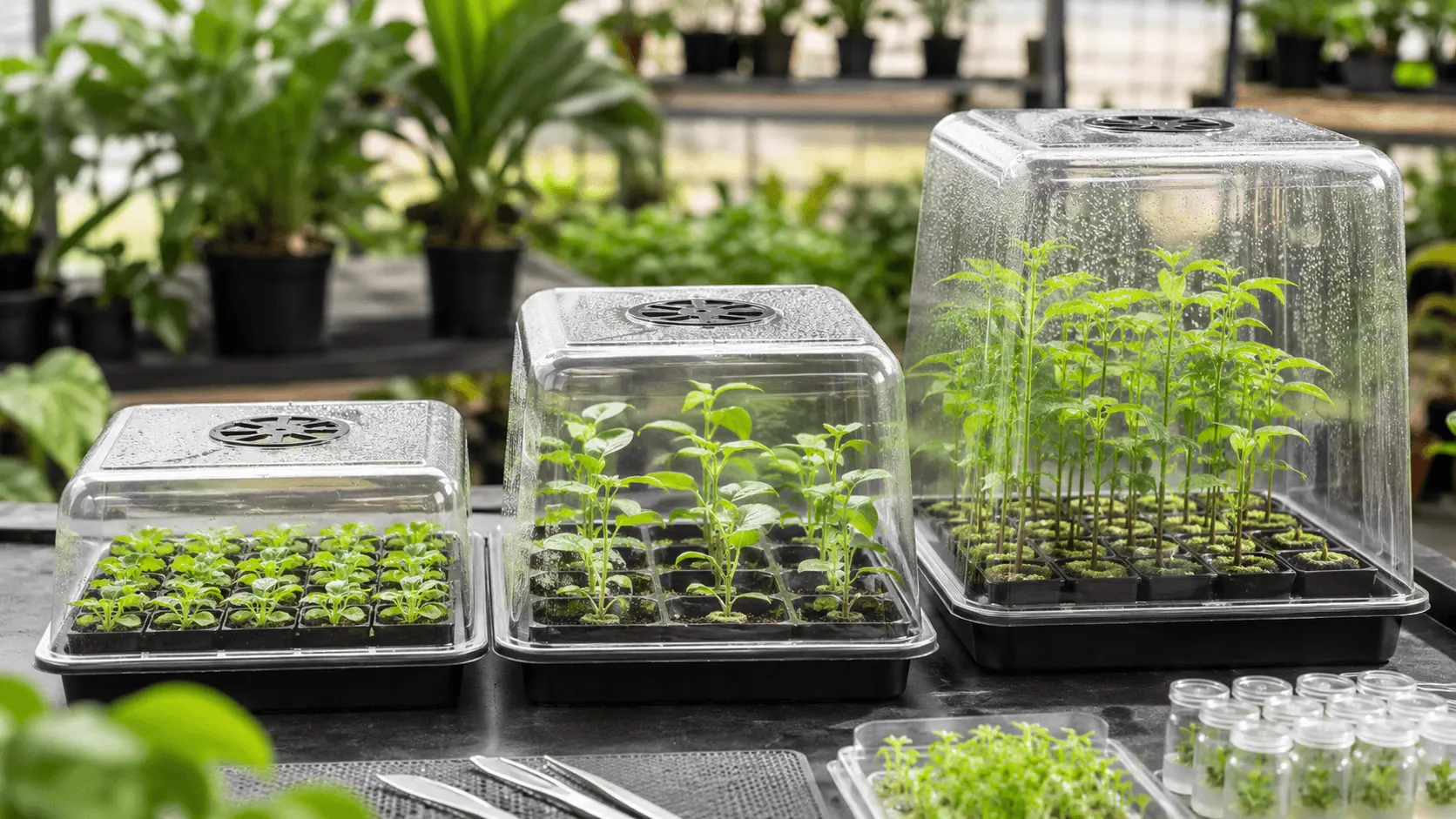
Dome height is not about physical space for leaves. It is about the invisible volume above your growing medium — the headspace — and what that volume does to humidity stability, gas exchange, and ultimately whether your cuttings root or rot. A 2-inch dome and a 7-inch dome sitting on the same 1020 tray create fundamentally different growing environments, even if the temperature and light are identical. The taller dome holds roughly three to four times the air volume. That means three to four times the water vapor buffer, a slower CO₂ swing between day and night, and — if you seal it — a much higher risk of ethylene buildup.
If you source domes for resale or for your own propagation operation, understanding what headspace does is the difference between recommending the right product and watching your customers come back with complaints about failed cuttings and mold outbreaks.
Why Dome Height Is Really About Headspace, Not Plant Height
Every humidity dome creates a sealed or semi-sealed air pocket above the growing media. That air pocket — the headspace — has two jobs:
- Water vapor retention. A larger headspace holds more water vapor, which means relative humidity (RH) stays more stable when temperature fluctuates. A small headspace has limited water vapor capacity, so even a brief temperature spike can cause RH to drop sharply.
- Gas buffering. A larger headspace gives CO₂ and O₂ more room to buffer. During the light period, photosynthesis pulls CO₂ down; during the dark period, respiration pushes it back up. A bigger headspace slows these swings. A small headspace amplifies them.
Research on tissue culture containers proved this decades ago: when scientists controlled the headspace volume and gas exchange rate, tissue-cultured plants developed normally instead of showing abnormal physiology. The container itself — its dimensions and its closure — determines the headspace composition and the rate of gas exchange with the outside environment (Debergh et al., 1992; Demeester et al., 1995).
Here is what that means for your dome selection: when you pick a 2-inch dome over a 7-inch dome, you are not just choosing less vertical space. You are choosing a smaller water vapor buffer and a faster CO₂ cycle. Whether that is good or bad depends entirely on what you are growing and what stage it is at.
The Narrow Humidity Window: 85–95% RH and Why Going Higher Hurts
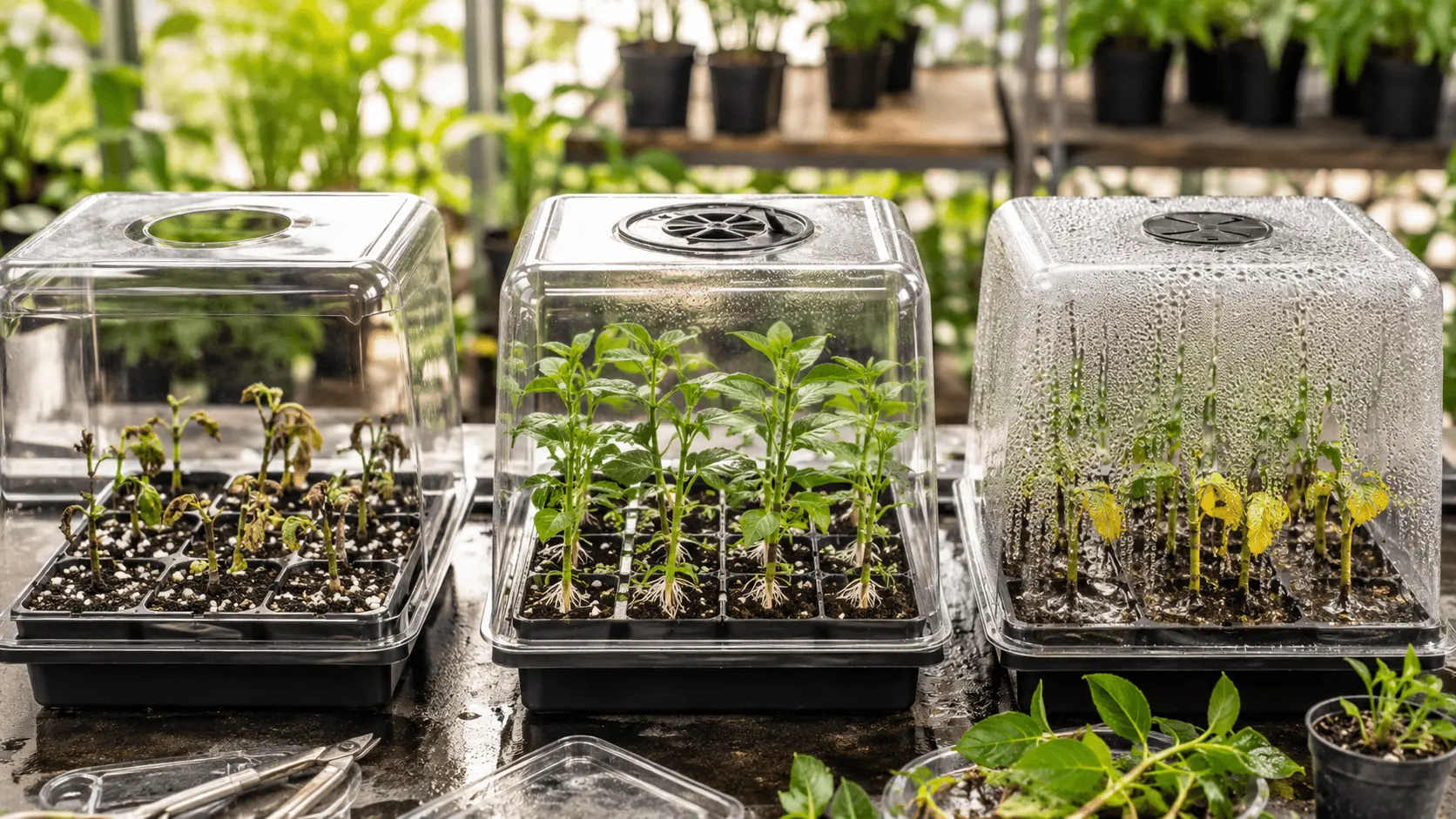
Most softwood and semi-hardwood cuttings root best in a narrow RH range: 85–95%. Go below that, or above it, and you run into specific, well-documented problems.
Below 75% RH: If you have ever unzipped a propagation tunnel and found cuttings with dry, curling leaves despite being under cover, you have seen what happens below 75% RH. Stomata stay closed to conserve water. The cutting cannot photosynthesize effectively, carbohydrate reserves deplete, and the cutting wilts before roots can form.
Above 98% RH: The cutting looks fine on day three. By day five, the stem base is soft. By day seven, Pythium has moved in. Gas exchange between the headspace and the outside air effectively stops, ethylene accumulates, root primordia development is suppressed, and in extreme cases, anaerobic respiration begins. That is the above-98% RH trajectory.
This narrow window explains why passive humidity tools fail silently. A plastic bag thrown over a tray can trap close to 100% RH overnight — but without ventilation, CO₂ builds up and O₂ can drop to levels that trigger anaerobic respiration. A humidity dome with adjustable vents allows you to dial in the right RH for each development stage, rather than gambling with an all-or-nothing seal.
For wholesale buyers, this has a direct implication: the dome you source needs adjustable ventilation. A sealed dome — typically, regardless of height — can push RH above 98% within hours in a warm greenhouse, and your customer’s cuttings will suffer for it.
VPD: A Better Way to Think About Dome Humidity
If you have ever watched cuttings wilt under a dome that reads 90% RH, you have already encountered the problem with relative humidity. RH is a ratio — it tells you how full the air is compared to its maximum capacity at that temperature. But it does not tell you the actual driving force on the plant. That is what Vapor Pressure Deficit (VPD) measures: the gap between how much water the air currently holds and how much it could hold. The smaller the gap, the less the plant needs to transpire. The larger the gap, the harder the plant works to hold onto water.
When researchers grew tomato transplants under low VPD (1.5–2.0 kPa), the plants produced significantly more shoot and root growth during the pre-planting stage than those under high VPD (2.5–4.0 kPa) (Lorenzo et al., 2003). After transplanting, high VPD pushed the root-to-shoot ratio up — but that was an adaptation mechanism, not a growth advantage. And here is the practical takeaway: the low-VPD conditions during the seedling stage did not harm later development. Tomatoes adapted quickly once moved to higher-VPD environments.
The same pattern has been observed in grafted watermelon seedlings: when RH exceeded 90% (low VPD), evapotranspiration rates increased gradually after grafting, and scion-rootstock unions succeeded at higher rates.
What this means for dome selection: your goal is not simply “high RH.” Your goal is a VPD that matches the plant’s developmental stage. A low dome with open vents can maintain 85–95% RH (appropriate VPD) just as well as a tall dome — and it may do it with less risk of overshooting into the danger zone above 98%.
Three Dome Heights, Three Jobs
Based on industry practice and product specifications, humidity domes fall into three height categories. Each creates a distinct headspace environment on a standard 1020 tray.
| Dome Category | Height | Headspace Volume (1020 tray) | RH Stability | Best For |
| Low Dome | ~2 in. / ~5 cm | ~1,400 cm³ | Low — RH can swing 10–15% with temperature changes | Seed germination, short-cycle crops |
| Medium Dome | ~4 in. / ~10 cm | ~2,800 cm³ | Moderate — RH swings ~5–8% | Softwood cuttings, vegetable seedlings |
| Tall Dome | ~7 in. / ~18 cm | ~5,000 cm³ | High — RH swings only 2–3% | Tissue culture acclimatization, grafting, tropical species |
Note: Headspace volumes and RH swing ranges are approximate, based on industry experience and a standard 1020 tray footprint (~27 × 53 cm). Actual values vary by manufacturer.
Dome height is one part of the complete growing system; the broader seedling tray buying guide also explains how to match inserts, cell volume, materials and base trays.
A few things stand out from this comparison:
- The tall dome holds roughly 3.5 times the headspace volume of the low dome. That is not a minor difference — it is a fundamentally different growing environment.
- RH stability improves dramatically with headspace volume. If your customer’s greenhouse temperature fluctuates, a tall dome buffers those swings. A low dome does not.
- But stability cuts both ways. A sealed tall dome will hold RH above 98% far longer than a low dome — which is exactly the problem when ethylene starts accumulating.
Adjustable vents are not a premium feature — they are essential. Without them, any dome height will eventually create an environment where gas exchange stops and problems begin.
Matching Dome Height to Your Propagation Stage
Seed Germination: Low Dome
Seeds need stable high humidity (90–95% RH) and consistent temperature. They do not need headroom — there is no transpiration demand before emergence.
A low dome (~2 in.) is the right choice here. The small headspace reaches target RH quickly, and the short germination window (3–14 days for most species) means the low dome’s RH instability is manageable — especially when temperature is controlled by a heat mat.
Watch for this: Once seeds emerge, the dome must be vented or removed within a day or two. Continued sealing under a low dome causes rapid etiolation and invites fungal growth. If your customer is germinating and growing in the same tray, they will need to switch to a taller dome or remove the low dome entirely after emergence.
Before selecting a low dome for seed germination, use a crop-specific plug tray cell count selection to make sure the cell volume also matches the planned transplant age.
Cutting Propagation: Medium or Tall Dome
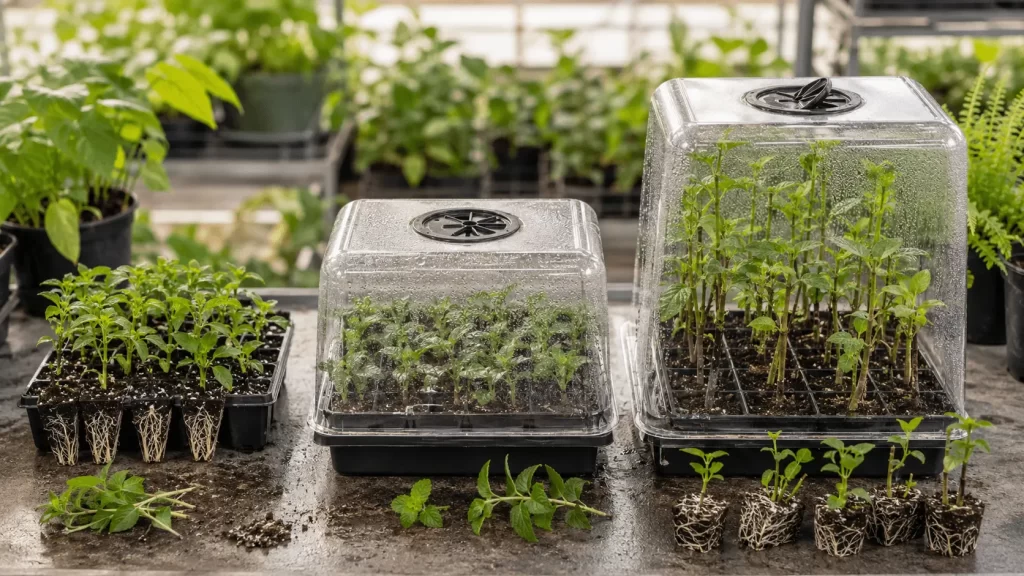
Cuttings have no roots. They depend entirely on high ambient humidity to reduce transpiration while root primordia form. This is the most humidity-sensitive propagation method.
Softwood cuttings (herbs, ornamental soft stems): Root in 7–14 days. A medium dome (~4 in.) typically provides enough headspace and vapor buffer. Adjustable vents are critical — the RH needs to step down as roots develop.
Semi-hardwood and hardwood cuttings (woody ornamentals, fruit crops): Rooting takes 4–8 weeks or longer. A tall dome (~7 in.) is more appropriate — it provides the headspace buffer for a long cycle and physical room for shoot growth. Vents are equally critical here.
If you are sourcing domes for customers who propagate cuttings, here is a practical timeline you can share:
| Days After Sticking | Vent Position | Target RH | What Is Happening |
| 0–3 | Sealed | 90–95% | Cuttings acclimating; no roots yet |
| 4–10 | Vents cracked open | 85–90% | Root primordia forming |
| 11–21 | Vents half open | 75–80% | Roots developing; cuttings hardening |
| After root confirmation | Dome removed | Ambient | Plants transitioning to normal conditions |
Grafting: Tall Dome
Grafted plants have the highest humidity requirement of any propagation method. The scion has no vascular connection to the rootstock until callus tissue forms — typically 2–3 days. During that window, the scion relies entirely on ambient humidity to avoid desiccation.
A tall dome (~7 in.) is the right choice. The large headspace buffers RH against temperature fluctuations, which is critical because a brief RH drop during callus formation can kill the scion. Miss that 48-hour window, and the scion desiccates before the vascular connection forms — a near-total loss, because you cannot reattach a dried scion. Studies on grafted cucurbits have reported that maintaining RH above 90% for the first 2–3 days significantly improved graft success rates.
Tissue Culture Acclimatization: The Tallest Dome for the Hardest Transition
Tissue culture plants live in an environment that is almost the opposite of a greenhouse: near-100% RH, elevated CO₂, low light, and no wind. When they come out of the vessel, they face a shock that kills a significant percentage if the transition is not managed carefully.
The core problem is this: tissue culture plants develop poorly functional cuticles and stomata that cannot close properly. Under the near-saturated headspace of a culture vessel, there is no evaporative demand, so the plant never builds the mechanisms to cope with it. When you move that plant to ambient conditions, it transpires uncontrollably and can desiccate within hours.
A tall dome (~7 in.) with a staged venting strategy provides the bridge between the culture vessel and the real world:
| Days After Ex Vitro Transfer | Vent Position | Target RH | Rationale |
| 1–3 | Sealed | 90–95% | Mimics in-vessel humidity; plant stabilizes |
| 4–7 | Vents cracked | 80–85% | Mild evaporative demand begins; cuticle starts developing |
| 8–14 | Vents half open | 70–75% | Stomata begin functioning; plant acclimates to gas exchange |
| 15–21 | Dome removed | Ambient | Full transition to greenhouse conditions |
As early as the 1980s, researchers recognized that every tissue-cultured plant must go through acclimatization — there is no shortcut. Zimmerman’s work showed that direct rooting in fog systems or under high humidity was often more economical than in-vessel rooting (Zimmerman, 1988) — a point worth considering if your customers run large-scale micropropagation operations.
For wholesale buyers sourcing domes for tissue culture customers: the tall dome with adjustable vents is the single most important product in your catalog for this application. It makes a measurable difference — without it, your customer’s acclimatization losses will be significantly higher.
Three Common Mistakes That Kill Propagation Success
These three errors show up in propagation operations of every size. Each one is easy to make — and each one creates problems that look like disease or poor stock but are really environmental failures.
Mistake 1: “Taller is always better.” You seal a 7-inch dome over 200 cuttings on a warm afternoon, figuring the extra headspace is a safety net. By the next morning, that headspace has become a trap — ethylene has accumulated, CO₂ has risen, O₂ has dropped, and root primordia are already suppressed. Height without ventilation is worse than a short dome with vents.
Mistake 2: “Any dome will do.” The headspace volume difference between a low dome and a tall dome is roughly 3.5x. That is not a minor variation — it changes how fast RH drops when temperature rises, how quickly CO₂ depletes during the light period, and how long the environment stays in the danger zone above 98% RH. Matching dome height to the crop and the stage matters.
Mistake 3: “Seal it and leave it.” This is the most common and most damaging error. A grower seals the dome on day one and does not touch it for two weeks. By day five, the stem bases are soft. By day seven, Pythium has moved into the saturated media. By day ten, the cutting is beyond recovery — and the grower blames the stock, not the dome. Venting is not optional. It is the single most important action after the first few days of high humidity.
Dome Height Selection Checklist
Before you place your next dome order, run through this list:
- Do I know what my customers are propagating — seeds, cuttings, grafts, or tissue culture?
- Do I stock at least two dome heights (medium and tall) to cover the most common applications?
- Do all the domes I source have adjustable ventilation?
- Can I explain to my customers why a low dome creates problems for cuttings and a sealed tall dome creates problems for every propagation stage?
- Have I confirmed that my dome heights are compatible with the tray sizes my customers use (1020 standard, or other)?
- Do I know the approximate headspace volume difference between the dome heights I offer?
Next Step: Review Your Propagation Dome Setup
If you are sourcing humidity domes for wholesale or for your own propagation operation, the dome height you choose directly affects your customers’ rooting success and acclimatization survival rates. The wrong height — or the right height without ventilation — creates problems that look like disease or poor stock but are really environment failures.
Three things you can do right now:
- Send us your product list and target crops. We will help you identify which dome heights and vent configurations match your customers’ propagation stages — from seed germination to tissue culture acclimatization. Include your current tray sizes and the crops you serve.
- Request dome height comparison samples. Seeing the headspace difference between a 2-inch, 4-inch, and 7-inch dome on the same tray makes the concept tangible. We can arrange samples so you can show your customers exactly what they are choosing.
- Ask about adjustable-vent dome options. If your current supplier only offers sealed domes, you are leaving your customers vulnerable to the problems described in this article. We can walk you through vented options that work across propagation stages.
After choosing the height, verify the rim profile and external dimensions because matching domes, inserts and base trays across 1020 systems is not guaranteed between suppliers.
FAQ
Can I use a tall dome for seed germination? You can, but it is unnecessary. Seeds do not need the extra headspace, and the tall dome’s large vapor buffer means RH will stay very high even after emergence — which increases the risk of damping off and etiolation if you are not vigilant about venting early. A low dome is more appropriate and more economical.
What happens if I use a low dome for cuttings? The small headspace makes RH unstable — it drops fast when temperature rises. For cuttings, which need consistently high humidity, those drops can cause wilting before roots form. A medium or tall dome provides the buffer that cuttings require.
Do I really need adjustable vents? Yes. Research consistently shows that the 85–95% RH window is where most cuttings root best, and that RH above 98% suppresses root development through ethylene accumulation. Adjustable vents let you stay in that window and step humidity down as roots develop. Sealed domes cannot do this.
How does dome material affect humidity control? Clear PP or PET domes are the standard — good light transmission, moderate durability. Clear PS transmits light well but is typically more brittle and may not withstand repeated use. Frosted or semi-transparent domes reduce direct light intensity, which can benefit light-sensitive crops during acclimatization. Material does not significantly change headspace dynamics; height and ventilation do.
What about tissue culture vessels — are they a type of humidity dome? In principle, yes. A tissue culture jar or vessel is a sealed container with its own headspace, and the same principles apply: headspace volume affects WRC, gas composition, and plant development. Research by Debergh (1992) and Demeester (1995) showed that container dimensions and closure type directly influence headspace composition and plant morphology. Choosing a taller culture vessel is, functionally, choosing a taller dome.
How quickly should I vent after sticking cuttings? As a general guideline, keep the dome fully sealed for the first 3–5 days to maintain 90–95% RH while cuttings stabilize. Then crack the vents slightly. By day 10–14, vents should be at least half open. Full removal typically happens once roots are confirmed — typically 2–3 weeks for softwood cuttings, longer for hardwood.
Find the Right Tray for Your Growing System
Tell us what you grow and what is not working with your current trays. We will put together a sample set so you can test the fit before you commit.

Written by
ScarecrowGarden
💡About Scarecrow Garden Supplier Co., Ltd.
Scarecrow Garden Supplier Co., Ltd. is a China-based sourcing and wholesale partner specializing in garden tools, landscaping equipment, and outdoor supplies for international wholesalers, distributors, contractors, and brands.
With hands-on experience rooted in real garden use scenarios, we focus on durable materials, functional design, and stable large-volume supply. Our product range covers pruning tools, watering systems, hand tools, outdoor hardware, and customized garden solutions to support both retail and professional landscaping markets.
Beyond products, we help our partners navigate supplier selection, quality control, compliance requirements, and long-term sourcing strategies in China. Through our blog, we share practical insights on product selection, material comparisons, industry trends, and cost-effective purchasing—helping global buyers build stronger, more competitive supply chains.