






How We Reduce Quality Risks in Mixed Garden Product Orders | Scarecrow Garden Supplier
Why Mixed Orders Are More Complex Than Single-Product Orders
If you’re sourcing one product from one factory, the quality control path is straightforward: confirm the sample → production → inspection → shipping.
But garden product sourcing is rarely that simple. A typical mixed order might look like this:
- Metal raised beds from a metal fabrication factory in Hebei (nearest export port: Tianjin)
- Watering cans from a plastic factory in Guangdong (nearest export port: Shenzhen)
- Garden gloves from a textile factory in Shandong (nearest export port: Qingdao)
- Seedling trays from an injection molding factory in Taizhou, Zhejiang (nearest export port: Ningbo)
- Mini greenhouses from a tubing factory in Hebei (nearest export port: Tianjin)
Five products. Five factories. Five sets of standards.
Each factory specializes in its own material and process. A metal fabrication factory knows steel gauges and coating thickness—but it doesn’t know whether the seedling trays you ordered from another factory have the right cell count. A plastic factory knows injection pressure and mold tolerances—but it doesn’t check whether the garden gloves packed in the same container have the right label.
Where do the problems come from?
- Different factories, different quality expectations. What Factory A considers “close enough” on color, Factory B would flag as a defect.
- Different packaging standards. Some factories use sturdy cartons. Others cut costs with thinner cardboard. A more hidden risk: you specify moisture-proof packaging, but don’t emphasize that every layer needs it—the factory may only use moisture-proof material on the outer layer and skip the inner. There’s a real case from the foreign trade industry: a factory exported pet products with a contract requiring PE moisture-proof inner liner bags. But the factory assumed the outer FIBC ton bag already had a PE film built in, so they skipped the inner liner. The goods arrived at the port completely damp and moldy—unsellable. Factories that aren’t experienced with garden products, or factories that cut packaging standards to control costs—the same thing can happen.
- Different lead times. Five factories, five delivery dates—and the slowest one determines your shipping window.
- Different factory completeness. Each factory ships finished products, but the accessories included with each product (screws, instruction sheets, etc.) may not be fully accounted for—the factory’s own QC might miss items, and nobody is checking the completeness of the entire order across all factories.
Here’s a real example: a container with 15 SKUs from 8 factories. Factory A ships raised beds with all bolts included. Factory B ships seedling trays—no accessories needed. But Factory C ships mini greenhouses and forgets the assembly instructions. Factory A doesn’t know. Factory B doesn’t know. Only someone checking the entire order together would catch it.
The quality risk in mixed orders isn’t that one thing goes wrong. It’s when multiple processes overlap that problems are easier to miss.
And the more factories involved, the harder it is to see the gaps.
Common Quality Risks in Mixed Garden Product Orders
| Risk Type | What It Looks Like | Why It Happens More in Mixed Orders |
| Material mismatch | Bulk goods use a different material from the sample | Different factories have different material standards |
| Thickness variation | Metal raised bed walls may be thinner than the sample | Some factories may use thinner material to reduce costs |
| Color deviation | Bulk color doesn’t match the approved sample | Different raw material batches, different factory color mixing |
| Packaging errors | Wrong carton size, labels, or shipping marks | Different factories interpret packaging requirements differently |
| Missing accessories | Screws, wheels, clips, or instruction sheets left out | Each factory only checks its own product—nobody verifies cross-factory accessories |
| Label mix-ups | Wrong product labels or brand labels | Labels get confused when multiple SKUs are packed together |
| Bulk differs from the sample | Function, size, or workmanship doesn’t match the approved sample | Samples are carefully prepared; bulk production standards may slip |
| Damaged outer cartons | Cartons deformed, damp, or torn | Mishandling during transit or improper warehouse stacking |
These aren’t theoretical risks. They happen every day in garden product sourcing. The entire process design of Scarecrow Garden Supplier is built to keep these risks inside China—so they don’t follow your container across the ocean.
The good news: most of them can be caught before your goods leave China—if you have the right process in place. Here are the five steps we follow.
Step 1: Confirm Product Details Before Ordering
Risk control starts before the order is placed.
Before we place an order with any factory, we confirm these details with you:
- Dimensions: exact length, width, height, and thickness (e.g., wall thickness for metal raised beds)
- Material: specific material grade (e.g., 304 stainless steel, color-coated steel coil)
- Color: color code or physical photo and video confirmation—including comparison under natural light, indoor lighting, and indoor without lighting
- Accessory list: what’s included with each product
- Packaging requirements: carton specifications, inner packaging method, label content
- Target market requirements: any special regulations or standards that need to be met
We don’t just ask you to fill in a form. We go through these details with you, product by product, because each product category has its own common pitfalls. Metal raised beds? Wall thickness and coating type. Plastic seedling trays? Material grade and UV resistance. Garden gloves? Fabric weight and sizing consistency.
The more precisely these details are confirmed, the lower the chance of problems later. We record all of this in the order file, and it becomes the reference point during inspection.
This matters more than you might think. A watering can listed as “green” can show up in a shade you’d never have approved. A seedling tray spec that says “durable PP plastic” can arrive feeling flimsy—because “PP” covers a wide range of grades. These aren’t edge cases. They’re the most common disputes in garden product sourcing, and they almost always trace back to details that were left vague at the ordering stage.
But confirmation on paper isn’t enough. The “blue” on a spec sheet may not be the same “blue” you have in mind. You need the real thing.
Step 2: Use Samples to Reduce Uncertainty
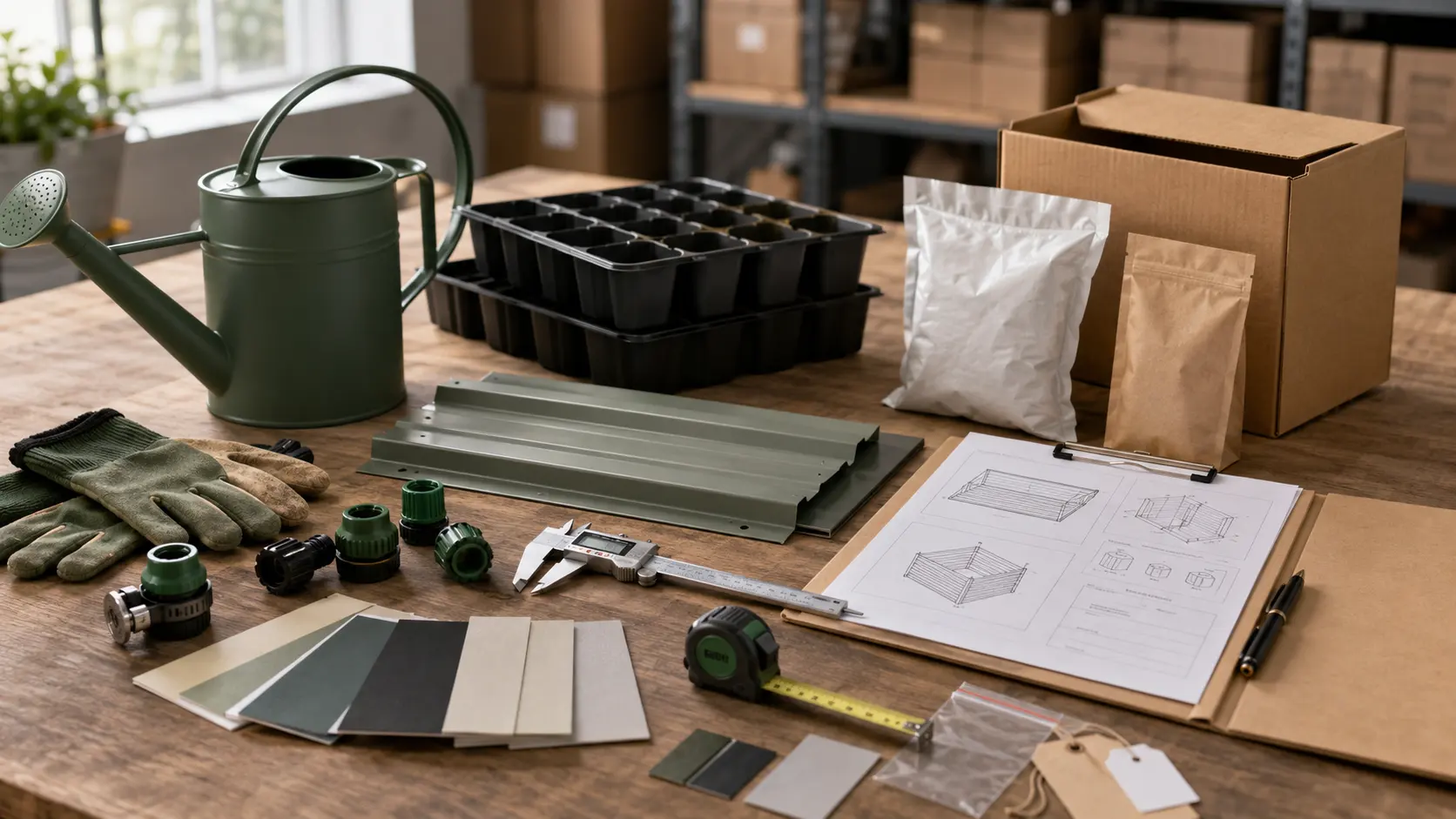
Samples aren’t a formality. They’re the reference standard for bulk production.
We use a dual-sample system:
- Approval sample: Sent to you for confirmation. You check dimensions, material, color, function, and packaging. Once you approve it, let us know.
- Reference sample: Kept at our warehouse. When bulk production is complete, our quality inspectors compare the bulk goods against the reference sample—color match, thickness, accessories, everything.
Why two samples? Because if we only have one and it’s sitting at your warehouse, we have no physical reference when bulk goods arrive. The dual-sample system ensures there’s always a real object to compare against—not memory, not photos.
Here’s what that looks like in practice: your order includes 200 metal raised beds. The factory sends production photos that look fine. But when the goods arrive at our warehouse, one of our inspectors places the reference sample next to a bulk unit and notices the wall feels thinner. Based on industry experience, a spec of 0.8mm can arrive at 0.6mm—on paper, both are “galvanized steel,” but the difference is real. Without that reference sample sitting right there, this would have shipped—and you’d be the one discovering it after the container arrived.
That’s the difference a reference sample makes. It turns “I think something’s off” into “I can measure the gap.”
Step 3: Warehouse Inspection
This is the most critical step.
When goods from different factories arrive at our warehouse in Nanjing, four dedicated quality inspectors check each batch—appearance, specifications, accessories, and packaging—against your approved reference sample. Accessories are verified item by item. Packaging is reviewed for consistency. Problems are caught before shipping.
Why is warehouse inspection different from factory inspection? Because factory inspection checks one product from one factory. Warehouse inspection checks everything together—after goods from multiple factories have arrived, before they’re consolidated into one shipment. This is where cross-factory issues surface: the wrong labels on the wrong products, missing accessories that no single factory would notice, and packaging that doesn’t match your requirements.
When eight factories’ products arrive at our warehouse over the same week, each batch gets checked individually—then checked again as a complete order. That’s how we catch the assembly instructions that one factory forgot to include, even though every other factory’s products were fine.
A factory inspector checks their own product. Our warehouse inspectors check your entire order.
For the specific steps of our warehouse inspection process and the special checkpoints for garden products, see our article: Why Mixed Garden Product Orders Need a Pre-Shipment Warehouse Inspection.
Step 4: Provide Photos and Video Before Shipping
You’re not on-site. But you can still see your goods.
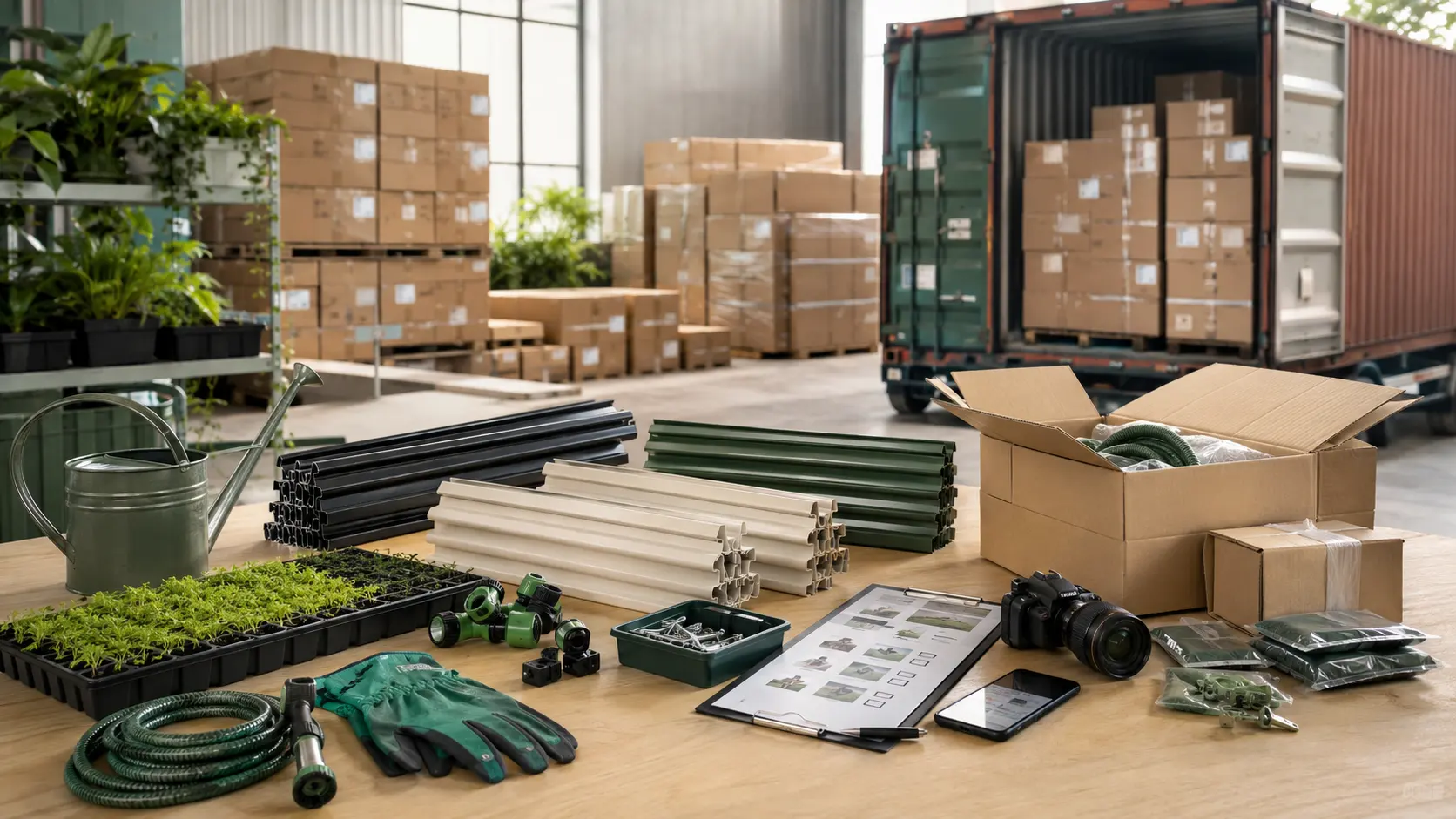
Before any shipment leaves, we proactively provide:
- Actual product photos for each item
- Close-up photos of packaging and labels
- Photos of the full container load
- Product operation videos when needed
These aren’t polished marketing shots. Their records that let you confirm: “This is exactly the condition of the goods.” If you spot any issues, we can address them before the container ships—instead of discovering problems after it arrives at your port.
We don’t wait for you to ask. Photos and video are sent as part of the process—not as an optional extra you have to remember to request. When our inspectors check your goods, the camera is already running.
If you’re concerned about issues when goods from different factories are mixed together—we proactively provide warehouse inspection photos and reference sample comparison records at every stage, so you can see the actual condition of each product before it ships.
Step 5: Resolve Problems Before Shipping
This is the most important sentence in this article:
Based on industry experience, the lowest-cost time to fix a product problem is before it ships—not after it arrives overseas.
Before shipping, fixing things at the warehouse—replacements, missing parts, repacking—costs are manageable. After shipping, the costs multiply. Based on industry experience, resolving the same issue after shipment typically costs several times more than catching it at the warehouse—when you factor in return shipping, claims processing, and reshipping. More importantly, post-shipment problems directly affect your sales schedule and customer relationships.
Think about what happens when a container of mixed garden products arrives at your warehouse, and 15% of the raised beds have the wrong color. You can’t sell them. You can’t easily return them to China. You file a claim, wait weeks for a response, and in the meantime your shelves are half-empty during peak season. That’s the real cost of post-shipment quality problems—not just the product cost, but the missed sales opportunity.
Our entire process—from confirming product details, to the dual-sample system, to warehouse inspection, to pre-shipment photo confirmation—serves one purpose: catch problems before they leave China—keep them inside the border, so they don’t follow your container across the ocean.
About Third-Party Inspection
For large orders or products where you have strict quality standards, if you need third-party inspection, we can help arrange it.
Next Step: Review Your Quality Control Plan for Mixed Orders
You focus on selling. Scarecrow Garden Supplier can help you source, verify, organize, and ship.
If you’re planning a mixed garden product order—or if you’ve had quality issues with mixed orders before—send us your product list. We’ll walk through the key details to confirm for each product, set up the dual-sample process, and show you exactly where our process catches what others miss.
Contact: Queenie@gardentoolswholesale.com
Turn Your Product Ideas into a Practical First Order
Send us your product list and target market. Our team will help you confirm the product direction and suggest a realistic first-order plan based on your market and sales channel.
Written by
ScarecrowGarden
💡About Scarecrow Garden Supplier Co., Ltd.
Scarecrow Garden Supplier Co., Ltd. is a China-based sourcing and wholesale partner specializing in garden tools, landscaping equipment, and outdoor supplies for international wholesalers, distributors, contractors, and brands.
With hands-on experience rooted in real garden use scenarios, we focus on durable materials, functional design, and stable large-volume supply. Our product range covers pruning tools, watering systems, hand tools, outdoor hardware, and customized garden solutions to support both retail and professional landscaping markets.
Beyond products, we help our partners navigate supplier selection, quality control, compliance requirements, and long-term sourcing strategies in China. Through our blog, we share practical insights on product selection, material comparisons, industry trends, and cost-effective purchasing—helping global buyers build stronger, more competitive supply chains.