






Updated 13 hours ago
Rattan Planter Packaging and Nesting: Reducing Surface Damage and Carton Volume
SCARECROW GARDEN SUPPLIER
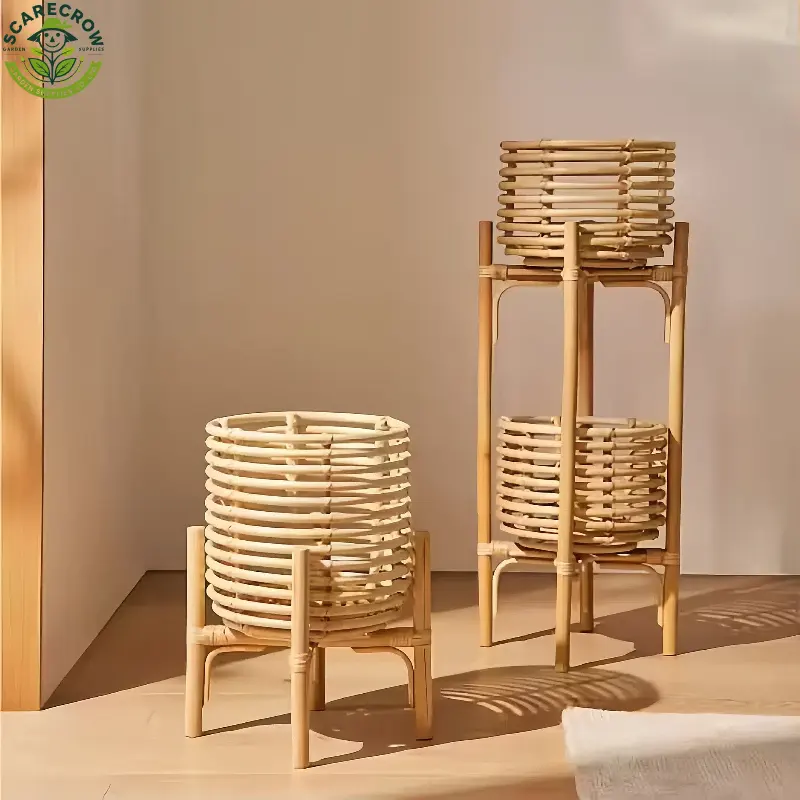
A rattan planter is one of the most packaging-sensitive products in a garden catalog. The woven surface can abrade. The frame can deform under pressure. The inner pot can crack. And unlike a metal tool that can be wrapped in bubble wrap and shipped flat, a rattan planter has an irregular shape that resists efficient carton packing.
For B2B buyers, packaging is not a detail — it is a cost driver, a damage risk, and a determinant of how many units fit in a container. Getting it wrong means dented products, freight waste, and customer returns that erode margin.
Why Rattan Planters Are Packaging-Sensitive
Four characteristics make rattan planters difficult to package well:
- Weave abrasion: When two woven surfaces press against each other in a carton, the raised texture of the weave acts like sandpaper — the contact points scuff and fade before the carton is even opened. The damage is most visible on the rim and base, where contact pressure is highest during stacking.
- Frame deformation: The metal frame (aluminum or steel) can deform if the planter is compressed or stacked without proper support. A deformed frame means the planter does not sit flat, wobbles, or has an asymmetrical shape.
- Liner and inner pot damage: Plastic inner pots can crack if compressed. Coir liners can deform. If the inner pot shifts during transit, it may arrive misaligned or broken.
- Decorative finish damage: Painted, stained, or coated surfaces can chip or scratch. The woven texture creates raised areas that are first-contact points — these are where finish damage appears first.
Nesting Designs — What Can Nest, What Cannot, and How Separators Protect Surfaces
Nesting is the most effective way to reduce carton volume for rattan planters. The principle is simple: most rattan planters have a tapered shape — narrower at the base, wider at the top. A second planter can be inserted into the first, base-first, so the two nest together like stacking cups.
What can nest:
- Tapered (conical) designs where the base is smaller than the top opening
- Planters with removable or flexible inner pots that can be taken out during shipping
- Planters whose frame can withstand the weight of a nested unit above
What cannot nest:
- Straight-walled designs (cylindrical planters with no taper)
- Square planters in certain orientations (though some square designs can nest if tapered in one direction)
- Planters with fixed, rigid inner pots that prevent the next planter from inserting
- Planters with protruding decorative elements (handles, feet, rims) that block nesting
How nesting changes carton volume:
In a traditional one-planter-per-carton configuration, four planters require four cartons. With nesting, multiple planters can be stacked within a single carton — the tapered design allows the base of one planter to insert into the opening of the one below. Depending on the taper angle and planter height, nesting can potentially double the number of units per carton compared to individual packaging.
But nesting is only effective if the surfaces are protected. When two woven surfaces contact each other, they abrade. Separators are required:
- Corrugated board dividers: Cut to fit between nested planters, preventing direct weave-to-weave contact.
- Foam sheets: Thin foam sheets between planters provide cushioning and prevent surface abrasion.
- Plastic bags: Each planter can be bagged individually before nesting, providing a moisture barrier and a slip layer that reduces friction.
- Edge and corner protection: Foam or paperboard corner protectors at the frame’s contact points prevent finish damage at the most vulnerable areas.
Protective Materials — Bags, Foam, Paper and Moisture Considerations
| Material | Purpose | When to Use |
| Plastic bag (individual) | Moisture barrier, slip layer for nesting | Always — protects against humidity and surface contact |
| Foam sheet (thin) | Cushioning between nested units | When nesting multiple planters in one carton |
| Corrugated divider | Structural separation | When planters are heavy or the weave is delicate |
| Corner protector (foam or paperboard) | Frame edge protection | Always — frame edges are the first contact points in a drop |
| Paper fill (void fill) | Prevents movement in loose spaces | When the carton has gaps around the planter |
| Pallet wrap (outer) | Moisture protection for the pallet | When shipping in humid conditions or by sea |
Moisture consideration: PE rattan itself does not absorb water, but the inner pot, any coir liner, and the frame (if steel) are moisture-sensitive. Condensation inside the carton during sea freight can cause mold on coir liners and corrosion on steel frames. A moisture barrier (plastic bag or carton liner) is essential for sea freight.
Pack Count, Carton Dimensions and Gross Weight — Use Real Data to Compare Configurations
The buyer should request actual packaging data from the supplier for each configuration — not estimates. Compare:
| Data Point | Individual Pack | Nested Pack |
| Units per carton | 1 | Varies (2-8 depending on taper and size) |
| Carton dimensions (L×W×H) | Larger per unit | Smaller per unit |
| Gross weight per carton | Lower | Higher (more units per carton) |
| CBM per unit | Higher | Lower |
| Units per 20ft container | Fewer | More |
| Freight cost per unit | Higher | Lower |
Take a 30cm tapered planter: individually packed, one unit per carton might occupy roughly 0.06 CBM. Nested four per carton, the carton might be roughly 0.12 CBM — the per-unit CBM drops from 0.06 to 0.03, potentially doubling the number of units that fit in a container. These are illustrative figures — actual CBM depends on the planter’s taper angle, height, and the separator thickness used between nested units.
Do not claim a percentage freight reduction unless you have calculated it from actual old and new carton data with stated shipment assumptions. The actual savings depend on the planter size, taper angle, nesting quantity, and destination freight rate.
Retail Pack vs Bulk/Nested Pack — Channel Trade-offs
| Packaging Type | Advantages | Disadvantages |
| Retail pack (individual carton with branding) | Display-ready, no repacking needed | Higher carton volume, higher freight cost per unit |
| Bulk/nested pack | Lower freight cost, more units per container | Requires repacking at destination for retail display |
The trade-off for the buyer: If the product goes to a garden center for retail display, individual retail packaging may be necessary — the customer sees the box on the shelf. If the product goes to an importer or distributor who repacks for their own channels, bulk/nested packaging saves freight cost and the repacking happens at the destination warehouse.
The repacking burden is real. A buyer who receives nested bulk packs must have labor available to unpack, inspect, and repack into retail-ready packaging. A distributor receiving 500 nested planters needs warehouse staff to unpack, inspect, and repack each one into retail packaging — if that labor is not available, the freight savings evaporate into repacking costs.
Sample Packaging Check — Unpack, Repack, Inspect
The packaging sample is the reference for bulk production. Inspect it as if you were the customer receiving it.
Test procedure:
- Photograph the sealed carton — all six sides, before opening.
- Open the carton and photograph the layout — before removing anything.
- Remove each planter and inspect:
- Weave surface: any abrasion, scuffing, or color transfer?
- Frame: any deformation, bending, or coating damage?
- Inner pot: any cracks, misalignment, or damage?
- Finish: any chips, scratches, or paint transfer?
- Repack the carton — can you fit everything back as it was? If the repacking is difficult or the contents do not fit properly, the packaging design has a problem.
- Check for missing accessories — drainage plugs, saucers, inner pots, manuals. Compare against the packaging BOM.
What to record:
| Inspection Point | What to Check | Buyer-Defined Criteria |
| Carton condition | No crushing, tearing, or water damage | Compare to approved sample |
| Weave surface | No abrasion or scuffing on contact points | Compare to approved sample |
| Frame integrity | No deformation; planter sits flat | Compare to approved sample |
| Inner pot condition | No cracks; properly seated | Compare to approved sample |
| Finish quality | No chips, scratches, or color transfer | Compare to approved sample |
| Separator placement | Dividers or foam between nested units | Confirm per packaging spec |
| Accessory completeness | All accessories present per BOM | Count against BOM |
| Moisture protection | Plastic bag or liner present | Confirm per packaging spec |
| Repack test | Contents fit back properly | Contents fit without force |
Buyer Verification Checklist: Rattan Planter Packaging
| Field | What to Specify |
| Nesting quantity | How many planters nest per carton? |
| Separator type | Corrugated, foam, or bag between nested units? |
| Inner pot protection | Is the inner pot secured against movement? |
| Carton dimensions | Outer dimensions (L×W×H) in cm |
| Gross weight | Per carton, including all contents |
| Net weight | Product weight only |
| CBM per carton | Cubic meters — for container loading calculation |
| Units per carton | Pack count |
| Pallet requirements | If applicable — pallet dimensions, units per pallet, pallet weight |
| Moisture protection | Plastic bag, carton liner, or desiccant? |
| Label / marking | Shipping mark, barcode, country of origin |
| Retail vs bulk | Which packaging type for which destination? |
Before placing your order:
- Request the packaging drawing and nesting data — carton dimensions, nesting quantity, separator type, and CBM per unit.
- Open a sample carton and run the full inspection — check weave surfaces, frame integrity, inner pot condition, and repack test.
- Compare nested vs individual packaging for your freight route — calculate CBM per unit and units per container for both configurations using actual supplier-provided data.
Explore Rattan Planter Options
Compare rattan planter designs, nesting, packaging and sourcing options before approving bulk configurations.
View Wholesale Rattan PlantersResearch Notes
- CBM figures (0.06 per unit individual, 0.03 per unit nested) are illustrative examples for a 30cm tapered planter. Actual CBM depends on planter size, taper angle, nesting quantity, separator thickness, and carton design. Buyers should calculate from actual supplier-provided carton data.
- Nesting effectiveness depends on the planter’s taper angle and frame strength. Not all tapered planters can be nested safely — verify on samples that the frame withstands the weight of nested units above.