






Updated 3 hours ago
Rattan Planter Materials Explained: PE Rattan, Frame Construction and UV Claims
SCARECROW GARDEN SUPPLIER
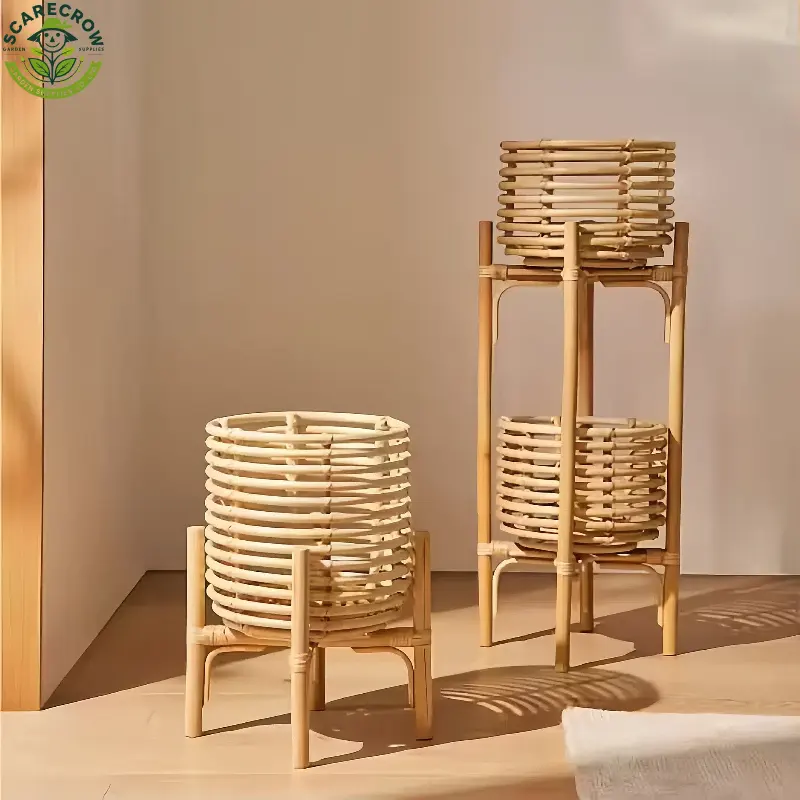
A rattan planter looks straightforward — a woven exterior, a frame inside, and a pot to hold soil. But the material behind the weave, the metal in the frame, and the evidence behind the “UV resistant” claim all determine whether the planter lasts three seasons or three months on a sunny patio.
Natural Rattan vs Synthetic Outdoor Weave — Know What You Are Actually Sourcing
Natural rattan comes from climbing palms in the Arecaceae family. It is a plant material — flexible when processed, attractive in appearance, and traditional in furniture making. Untreated natural rattan is generally less suitable for continuous outdoor exposure; it absorbs moisture, is susceptible to mold and mildew, and deforms when exposed to rain or humidity over time. Treatment, shelter, and construction all affect how natural rattan performs — it is not automatically limited to indoor use only.
PE rattan (polyethylene rattan, also called synthetic rattan or resin wicker) is a manufactured material extruded from polyethylene resin. PE has low water absorption, which can help resist mold and moisture damage. It can be formulated with UV stabilizers to slow color fading under sunlight. However, the material’s low absorption does not guarantee that the finished product will not accumulate water, develop mold in trapped moisture areas, or degrade over time — construction, drainage, and environment all matter.
Most rattan planters sourced for outdoor garden use are PE rattan, not natural rattan. But “PE rattan” on a spec sheet is a material category, not a performance guarantee. The quality of the resin, the presence and concentration of UV stabilizers, the thickness and width of the weave strand, and the consistency of the extrusion all vary by supplier and affect real-world durability.
What buyers should ask:
- Is the rattan natural or synthetic PE?
- Is the PE made from 100% new (virgin) material, or does it include recycled content?
- What is the strand width and thickness?
- Is there a UV stabilizer added to the resin? Suppliers may not disclose the concentration — what matters more is whether they can provide test method, duration, and sample change data.
Some suppliers state “100% New Polyethylene” — this is useful information. Recycled PE can have inconsistent properties due to variable source material and processing history, which may affect durability under UV exposure. However, virgin PE is not automatically more durable than recycled PE in all cases — the actual performance depends on the resin formulation, UV stabilizer package, contamination control, extrusion quality, and overall compound design. Buyers should request test data or sample comparison rather than assuming virgin PE guarantees outdoor durability.
PE Rattan and Other Synthetic Weave Descriptions — What to Ask the Supplier
Beyond “PE rattan,” suppliers may use various terms to describe the weave material. Here is what to look for:
| Supplier Term | What It Likely Means | What to Verify |
| “PE rattan” | Polyethylene synthetic weave | Virgin or recycled? UV stabilizer? |
| “HDPE rattan” | High-density polyethylene | Confirm material grade; properties depend on formulation |
| “PVC rattan” | Polyvinyl chloride | PVC may become brittle under UV exposure depending on formulation and stabilizer package; ask for test data |
| “UV resistant” | Generic claim — no specific test or duration | Ask: what test method? How many hours? What is the acceptance criterion? |
| “Weatherproof” | Generic claim — implies water and UV resistance | Ask for specific test evidence |
| “5000 hours UV” | Specific duration claim | Ask: which test standard (ISO 4892-2 or -3)? Is a test report available? |
Multiple suppliers state “UV exposure of 5000 hours” for their PE rattan. This is a common claim — but without a specified test method and report, the number is not verifiable. “5000 hours” under ISO 4892-2 (xenon arc) is not the same as 5000 hours under ISO 4892-3 (fluorescent UV), and neither is directly equivalent to 5000 hours of real outdoor exposure.
Frame Construction — Steel, Aluminum and What Holds the Planter Together
The weave is what the customer sees. The frame is what holds the planter together under load — soil, water, and the weight of the planter itself. Frame material and construction are the structural backbone.
Aluminum frame is commonly offered for outdoor rattan planters. Suppliers may describe it as “top-grade aluminum frame with powder coating.” Aluminum is lightweight, does not rust (though it can oxidize), and is easy to form into the curved shapes that rattan planters require. Wall thickness varies by supplier and should be confirmed on the sample.
Steel frame is used in some products, particularly where higher strength or lower cost is needed. Steel is heavier than aluminum and susceptible to rust if the coating is compromised. Steel frames need an appropriate corrosion-protection system for the intended environment — such as powder coating or galvanizing. A scratch or chip in the coating exposes bare steel, which can rust in contact with moisture.
Stainless steel frame appears in some products. Stainless steel offers strong corrosion resistance but at a significantly higher cost.
| Frame Material | Weight | Corrosion Resistance | Cost | Common Use |
| Aluminum | Light | Good (does not rust; may oxidize) — design/coating dependent | Medium | Commonly offered for outdoor planters |
| Steel (powder-coated) | Heavy | Depends on coating integrity — design/coating dependent | Lower | Used in various products |
| Stainless steel | Heavy | Excellent — grade dependent | High | Used in some products |
What to verify on the frame:
- Material type and wall thickness (confirm the actual measurement on the sample)
- Coating: is the frame powder-coated? What color?
- Joints: how are frame sections connected — welded, bolted, or sleeved?
- Weld quality: are welds clean and complete, or are there gaps and spatter?
- Load-bearing points: where the planter will carry the most weight (base, corners), is the frame reinforced?
Weave Quality — Tension, Edge Finishing, Cut Ends, Uniformity and Abrasion Points
The quality of the weave is visible on the sample but invisible on the spec sheet. Five characteristics determine whether the weave looks good on a retail shelf and stays tight after use:
Tension: The weave should be tight against the frame. Loose weave sags and gaps appear between strands. Test by pressing firmly on the weave — it should resist and return to position, not stay depressed. Define your acceptance criteria for tension on the approved sample.
Edge finishing: Where the weave strand turns around the frame edge, the turn should be clean and tight. Loose or baggy edge turns indicate inconsistent weaving and will loosen further with use.
Cut ends: The ends of weave strands should be tucked and hidden, not visible on the surface. Exposed cut ends are sharp, catch on clothing, and indicate that the weaver did not finish the work properly. Run a hand over the surface — you should not feel any sharp strand ends.
Uniformity: The spacing between weave strands should be consistent. Gaps that vary in width, or strands that are wider in some areas than others, indicate inconsistent material or weaving technique.
Abrasion points: Where the weave contacts the frame — particularly at corners and curves — the strand can rub against the metal and wear through over time. Look for whether the frame has protective covering at these contact points, or whether the weave is directly against bare metal.
UV and Weather Claims — What Evidence Should Support Them
“UV resistant” and “weatherproof” are among the most common — and least specific — claims on rattan planter spec sheets. Buyers should treat these as claims to be verified, not facts to be accepted.
Relevant test standards:
| Standard | Method | What It Tests |
| ISO 4892-2 | Xenon arc lamp | Simulates full-spectrum sunlight including UV, visible, and infrared. Accelerated weathering. |
| ISO 4892-3 | Fluorescent UV lamp | Simulates UV portion of sunlight. Focuses on UV degradation. |
What buyers should request:
- Which test standard was used? (ISO 4892-2 or -3)
- How many hours of exposure?
- What was the acceptance criterion? (Color fastness, structural integrity)
- Is a test report available from the supplier or a third-party lab?
If a supplier states “5000 hours UV” but cannot provide the test method or report, the claim is not verifiable. This does not mean the product is poor quality — but the buyer cannot confirm the claim independently. For buyers serving markets with strong sun exposure (Australia, Middle East, southern US states), UV durability is a factor that can affect customer satisfaction and return rates.
Buyer Verification Checklist: Rattan Planter Materials
| Field | What to Specify |
| Weave material | PE rattan; virgin or recycled; strand width and thickness |
| Frame material | Aluminum, steel, or stainless; wall thickness |
| Frame coating | Powder coating; color; coverage at joints and welds |
| Frame joints | Welded, bolted, or sleeved; weld quality |
| Weave quality | Tension, edge finishing, cut ends, uniformity, abrasion points |
| UV test | Method (ISO 4892-2 or -3), hours, acceptance criteria, report |
| Dimensions | Overall size; inner pot dimensions |
| Inner pot / liner | Material, fit, removability |
| Drainage | Drainage holes; plug or saucer included |
| Load capacity | Stated weight capacity |
| Nesting | Can planters nest for shipping? How many per carton? |
| Packaging | Protection between units; carton dimensions; gross weight |
Before committing to an order:
- Request the full rattan planter specification — weave material (virgin or recycled PE, strand dimensions), frame material and wall thickness, UV test method and report.
- Compare samples with a hands-on weave and frame check — pull the weave, inspect welds, feel for cut ends, and check frame coating coverage.
- Challenge the UV claim with specifics — ask which test standard (ISO 4892-2 or -3), how many hours, and what acceptance criteria were used.
Explore Rattan Planter Options
Compare rattan planter materials, frames, drainage and packaging options before approving products for your market.
View Wholesale Rattan PlantersResearch Sources Used
- ISO 4892-2 — Plastics — Methods of exposure to laboratory light sources — Part 2: Xenon arc sources. International Organization for Standardization.
- ISO 4892-3 — Plastics — Methods of exposure to laboratory light sources — Part 3: Fluorescent UV lamps. International Organization for Standardization.
- Note: UV test standards define the test method, not pass/fail criteria. Specific exposure duration, acceptance thresholds, and pass/fail criteria are defined by the buyer, supplier, or a product-specific standard. Buyers should request the test method, duration, and acceptance criteria from the supplier — not just a “UV resistant” or “5000 hours” claim.