











Updated 2 months ago
Plant Label Packaging: How Pack Count and Carton Design Affect Landed Cost
SCARECROW GARDEN SUPPLIER

Plant label retail packs and export cartons compared for packing and freight planning
An importer receives a quotation for 100,000 PP plant labels. The unit price is $0.12 per piece. A second supplier quotes$0.14 per piece for the same specification. The importer chooses the first supplier — the price is lower.
The order arrives. The cartons are larger than expected — each carton holds 2,000 labels in loose polybags, with no inner protection. The importer’s warehouse team spends two days counting, sorting, and repacking the labels into retail packs of 10. During repacking, they find that approximately 3% of the labels are warped from compression in transit — the cartons were packed too tightly, and the labels at the bottom of each carton are bent.
The importer calculates the actual cost: $0.12 per piece (product) +$0.02 per piece (repacking labour) + $0.0036 per piece (3% wastage from warped labels) =$0.1436 per piece. The second supplier, who quoted $0.14 per piece with retail-ready packs of 10 in shrink-wrap and a carton configuration that held 5,000 labels in a smaller carton, would have cost less in total — because the repacking labour and wastage were already built into the price.
Unit price is only one part of landed cost. For plant label buyers, packaging is primarily a cost decision, not just a presentation decision. The distinction matters: comparing unit prices without comparing carton dimensions, pack count, and breakage risk means you are comparing part of the cost — not the cost. (Illustrative example. Actual specifications, pricing, and outcomes vary by supplier, quantity, and order requirements.)
Unit Price Is Only One Part of Landed Cost
Landed cost is the total cost of getting the product from the supplier’s warehouse to your shelf, ready to sell. For plant labels, this includes:
| Cost Component | What It Includes | How Packaging Affects It |
| Product cost | The per-piece price of the labels | May include or exclude retail packaging, inner protection, and sorting |
| Packaging cost | Retail pack, inner protection, header card, barcode label | Each element adds cost; some suppliers include it in the unit price, some quote it separately |
| Carton cost | The shipping carton and its materials | Larger cartons cost more; more cartons mean more carton cost |
| Freight cost | Shipping from supplier to buyer | Driven by volume (CBM) and weight — both affected by packaging efficiency |
| Repacking cost | Labour to count, sort, and repackage if the product arrives in bulk | Eliminated if the supplier delivers retail-ready packs; significant if they deliver loose bulk |
| Breakage/wastage cost | Labels damaged in transit or repacking and cannot be sold | Higher with inadequate packaging; near-zero with proper protection |
| Storage cost | Warehouse space for cartons before they are unpacked | Larger cartons take more space; retail-ready packs can go straight to shelf |
A buyer who compares only the product cost is not seeing the full landed cost. Packaging, freight, repacking, wastage, and storage — these are where packaging decisions make the difference.
Retail Pack vs. Export Carton: Two Levels of Packaging
Before diving into specific packaging decisions, it helps to understand that there are two levels of packaging that serve different purposes. Buyers sometimes confuse them — or specify one and forget the other.
| Level | Purpose | What the Customer Sees | Cost Driver |
| Retail pack | The pack the end customer opens — polybag, shrink-wrap, box, blister card | This is the product | Material, printing, assembly labour |
| Export carton | The shipping carton that holds multiple retail packs during transit | The customer does not see this (unless the retail pack is the carton) | Carton material, size, protection level |
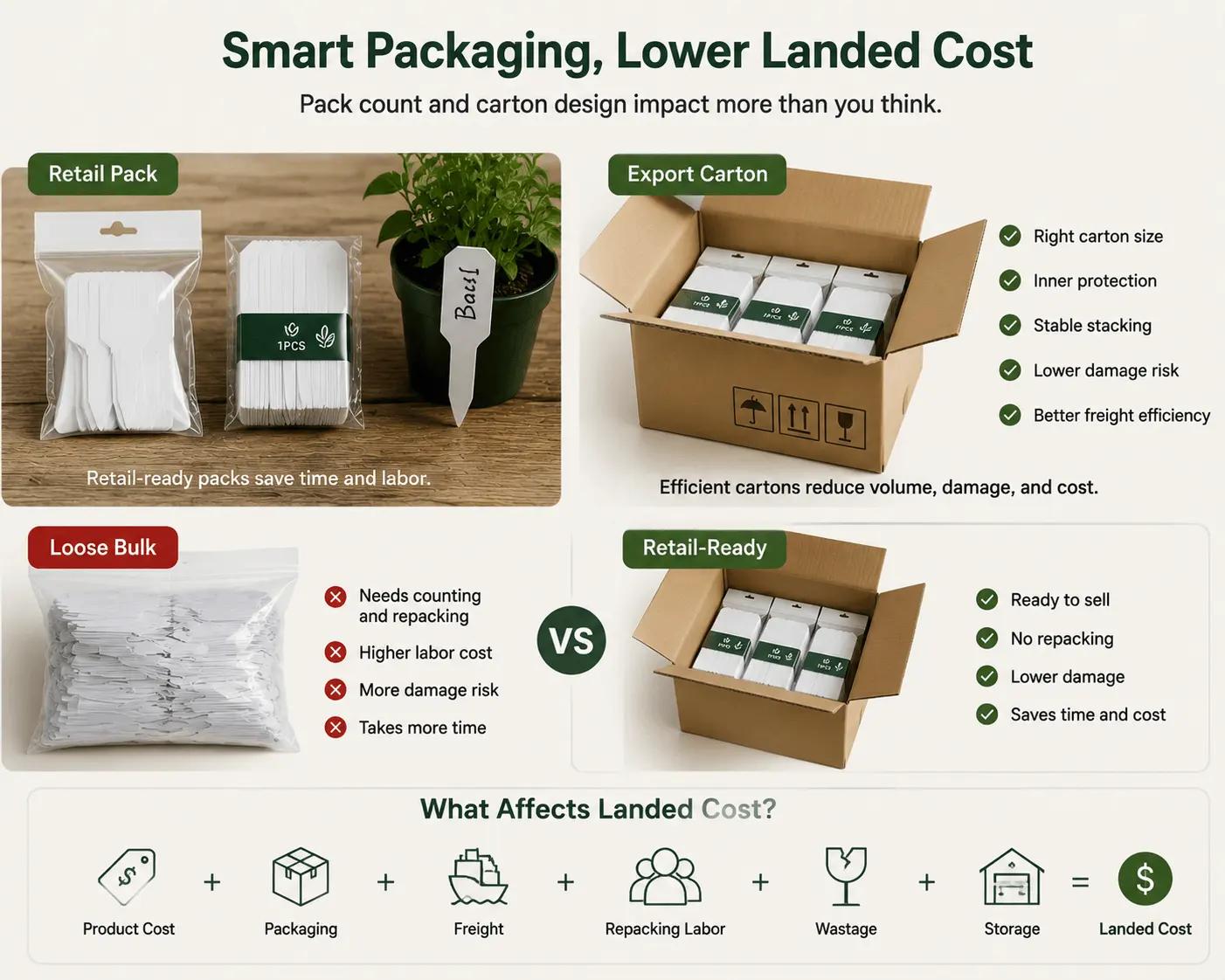
A buyer who specifies “retail packaging” but does not specify the export carton may receive retail packs that are correct but shipped in a carton that crushes them. A buyer who specifies the export carton but not the retail pack may receive labels in bulk that need repacking. Both levels need to be specified — they are separate packaging decisions. Keep this two-level framework in mind as we look at how each level affects cost.
For branding and retail-ready packaging decisions, see our private label plant tag packaging guide.
Choose the Format Before You Finalize the Pack
Confirm the product format before deciding the final packing method. Different plant label sizes, shapes and formats can require different packing structures for practical handling, retail presentation and shipment.
Pack Count Changes More Than the Retail Offer
The number of labels per retail pack affects not just the retail price point but also the packaging cost, the carton efficiency, the freight volume, and the repacking labour.
How Pack Count Affects Cost
| Pack Count | Packaging Cost Per Piece | Carton Efficiency | Repacking Required | Typical Application |
| Loose bulk (no retail pack) | Lowest — no retail packaging | Highest — maximum labels per carton | Highest — buyer must count, sort, and pack | Example: nursery supply, not retail |
| 10 per pack (shrink-wrap) | Low — minimal packaging material | High — packs nest efficiently | None — shelf-ready | Example: standard retail |
| 10 per pack (retail box) | Medium — printed box adds cost | Medium — boxes take more space | None — shelf-ready | Example: premium retail |
| 5 per pack | Higher per piece — same packaging for fewer labels | Lower — smaller packs mean more air per carton | None — shelf-ready | Example: entry-level retail |
| 50 per pack | Lowest per piece — bulk packaging | Highest — maximum density | None — bulk retail | Example: value/bulk buyer |
The Trade-Off
A buyer who chooses loose bulk to save on packaging cost per piece may spend more on repacking labour than they saved. A buyer who chooses retail-ready packs pays more per piece in packaging but eliminates repacking labour and reduces wastage. The right choice depends on the buyer’s operation — but the choice should be made with full cost visibility, not on unit price alone.
Example: The Hidden Cost of Repacking
| Scenario | Supplier A (Loose Bulk) | Supplier B (Retail-Ready) |
| Unit price | $0.12 | $0.14 |
| Packaging | None — loose polybag | Shrink-wrap, 10 per pack |
| Repacking labour | $0.02 per piece (count, sort, pack) | $0 |
| Wastage from repacking | 3% warped from bulk transit | 0% — protected in retail packs |
| Wastage cost | $0.0036 per piece | $0 |
| Landed cost per piece | $0.1436 | $0.14 |
In this example, the “cheaper” supplier costs 3% more in total. The numbers are illustrative — actual costs vary by order size, labour rates, and freight — but the principle holds: unit price without packaging context is not a complete cost comparison.
PP Labels: Packing Density vs. Deformation Risk
PP labels are lightweight and nest efficiently — which means a carton can hold a large number of labels. But high packing density creates a risk: labels at the bottom of a full carton are under significant compression, and PP labels can warp under sustained pressure.
For PP flatness and warping checks in bulk production, use our PP plant label quality control checklist.
The Compression Problem
PP labels warp due to residual stress from uneven cooling during production — but they can also warp after production when packed too tightly or stored under heavy cartons. A label that was flat when it left the factory may arrive warped if the carton was overpacked or stacked too high in transit.
How to Balance Density and Protection
| Factor | High Density (More Labels Per Carton) | Low Density (Fewer Labels, More Protection) |
| Freight cost per piece | Lower — more labels in the same volume | Higher — more air per carton |
| Deformation risk | Higher — bottom labels under compression | Lower — less pressure on individual labels |
| Carton count | Fewer cartons needed | More cartons needed |
| Practical approach | Insert a rigid card between layers to distribute pressure; limit stack height | Pack with dividers or individual sleeves |
The buyer should specify the maximum carton stack height and whether insert cards are needed — rather than assuming the supplier will choose the right packing density. For more detail on PP warping and how to check for it, see our PP QC checklist (Article 14).
Slate Labels: Protection vs. Weight and Volume
Slate labels are heavier and more fragile than PP. Protecting them in transit requires internal separation and edge protection — but each layer of protection adds weight and volume, which increases freight cost.
The Protection-Volume Trade-Off
| Protection Level | What It Looks Like | Weight Added | Volume Added | Breakage Risk |
| Minimal | Labels in direct contact, polybag only | Negligible | Minimal | High — chipping and breakage likely |
| Basic | Paper sheets between labels | Low | Low | Medium — edges still vulnerable |
| Standard | Foam or bubble wrap between each label, edge guards | Moderate | Moderate | Low — most impact absorbed |
| Maximum | Individual sleeves, corner protectors, rigid inner box | High | High | Lower — most impact absorbed; actual breakage depends on transit conditions and handling |
How to Choose
The right protection level depends on the shipping distance, the handling stages, and the value of the product. For a domestic shipment of low-value slate labels, basic protection may be sufficient. For an international shipment of premium slate labels, standard or maximum protection is justified — because the cost of breakage (unsellable product, customer complaints, replacement shipping) exceeds the cost of the protection.
Slate Weight and Freight
Slate density is approximately 2.6–2.8 g/cm³ — roughly three times the density of PP at ~0.9 g/cm³. This means a carton of slate labels weighs significantly more than a carton of PP labels of the same count. Weight and volume may affect the two materials differently — calculate using actual carton data and your freight method rather than assuming which factor dominates. A buyer comparing PP and slate shipping costs should account for this difference.
For slate breakage, edge and packaging checks, use our slate plant label quality control checklist.
Carton Dimensions Matter for Freight
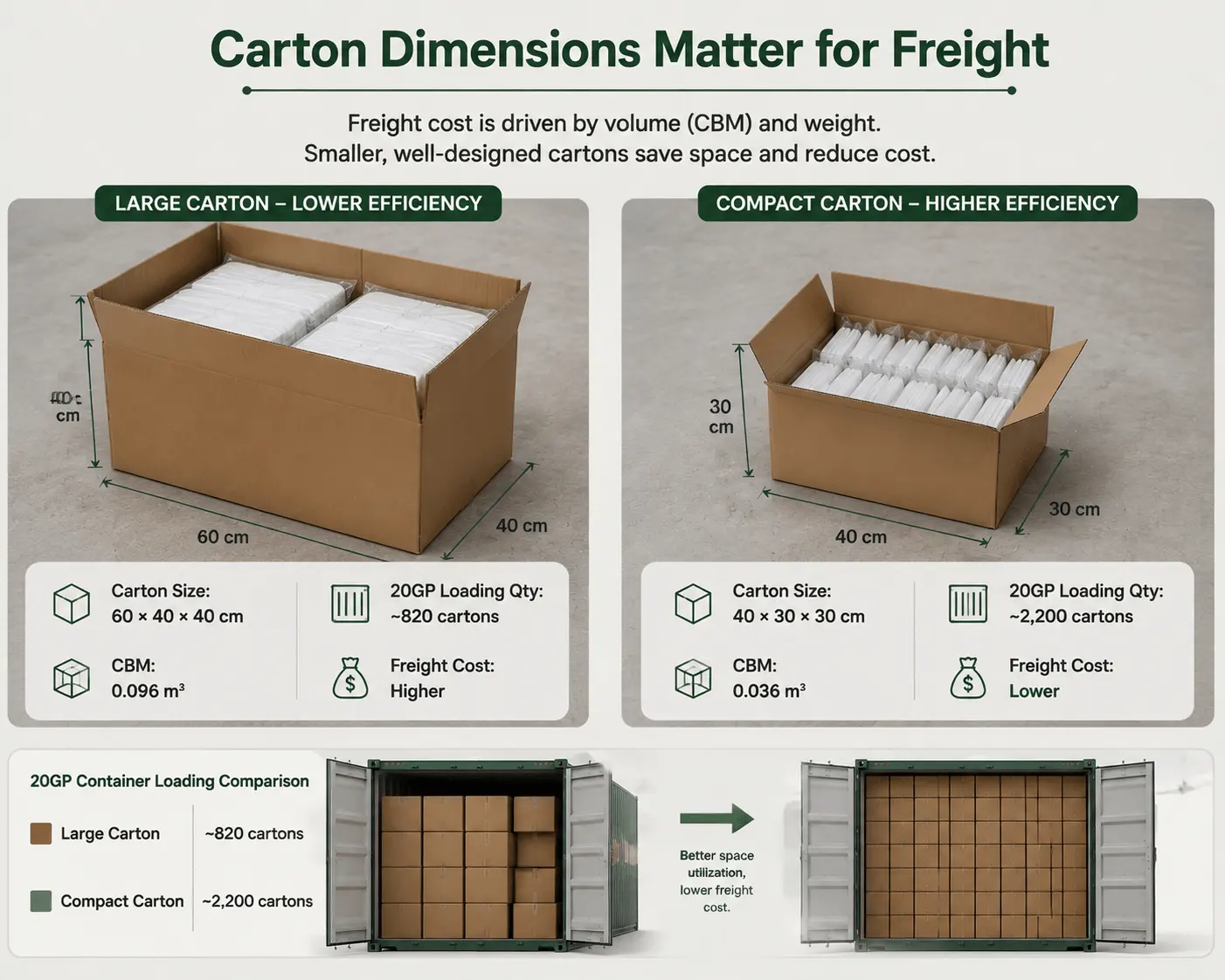
Freight is priced by volume (CBM for sea freight) or by weight and dimensional weight (for air freight). Carton dimensions directly determine how many cartons fit in a container or how much air freight costs.
What to Request From the Supplier
| Data Point | Why You Need It | What to Do With It |
| Carton dimensions (L × W × H) | Calculate total volume and CBM | Multiply by carton count to get total shipping volume |
| Gross weight per carton | Calculate total weight | Multiply by carton count to get total shipping weight |
| Net weight per carton | Verify product count | Compare gross vs. net to check packaging weight |
| Pieces per carton | Calculate carton count and verify packing density | Divide total order by pieces per carton |
| Carton count | Plan warehouse receiving and storage | Confirm against delivery note on arrival |
Why This Matters
Two suppliers quoting the same product at the same unit price may deliver very different freight costs because their carton configurations differ. Supplier A packs 2,000 labels per carton in a 50×40×30cm carton. Supplier B packs 5,000 labels per carton in a 55×45×40cm carton. For a 100,000-label order, Supplier A ships 50 cartons (3.0 CBM); Supplier B ships 20 cartons (1.98 CBM). The freight saving from Supplier B’s more efficient packing can offset a higher unit price.
[TECHNICAL DATA REQUIRED: confirm carton dimensions, pieces per carton, and gross/net weight for each SKU in our range]
How to Compare Packaging Proposals
Understanding why packaging affects cost is the first half of the job. The second half is turning that understanding into a tool you can send to suppliers. When comparing packaging options from different suppliers, ask both to quote the same order using the same parameters.
Comparison Table
| Parameter | Supplier A | Supplier B |
| Total order quantity | 100,000 pieces | 100,000 pieces |
| Pieces per retail pack | 10 | 10 |
| Retail pack type | Shrink-wrap | Shrink-wrap with header card |
| Packs per carton | 200 | 250 |
| Pieces per carton | 2,000 | 2,500 |
| Carton count | 50 | 40 |
| Carton dimensions (L×W×H cm) | ||
| Gross weight per carton | ||
| Total CBM | ||
| Total gross weight | ||
| Inner protection | None | Insert card between layers |
| Breakage/deformation risk | Higher — no internal protection | Lower — insert card distributes pressure |
| Repacking required | No — retail-ready | No — retail-ready |
| Unit price (product only) | ||
| Packaging cost per piece | ||
| Estimated freight per piece | ||
| Estimated landed cost per piece |
The last row — estimated landed cost per piece — is the number that matters. Everything above it is the breakdown that gets you there.
Packaging Data to Request Before Order Confirmation
Before confirming an order, request the following packaging data from the supplier. This data feeds directly into your freight calculation and warehouse planning.
| Data Item | What to Ask | Why You Need It |
| Retail pack specification | Pack type, pieces per pack, material, printing | Confirms what the customer receives |
| Inner protection | What is between labels — foam, paper, sleeves, insert cards | Determines deformation and breakage risk |
| Packs per carton | How many retail packs in each shipping carton | Determines carton count |
| Pieces per carton | Total labels per carton | Cross-check against packs per carton × pieces per pack |
| Carton dimensions | L × W × H in cm | For CBM calculation and warehouse planning |
| Gross weight per carton | Including product and all packaging | For total weight calculation |
| Net weight per carton | Product only | To verify product count |
| Carton count | Total cartons for the order | For receiving and storage planning |
| Total CBM | Carton count × carton volume | For freight quotation |
| Total gross weight | Carton count × gross weight per carton | For freight quotation |
| Stack height limit | Maximum recommended stacking height | To prevent compression damage in transit and storage |
| Carton mark details | Product name, quantity, PO number on carton | For customs and warehouse receiving |
Planning Your Retail Pack Quantity?
Share pieces per retail pack and total order quantity for packing evaluation. These two numbers provide a clearer basis for reviewing suitable pack structures, carton arrangements and customization options.
Review retail-pack format, master carton arrangement and customization requirements based on the actual quantities.
Next Step: Use Landed Cost as a Negotiation Tool
If you are sourcing plant labels, request packaging data from each supplier before comparing prices. Calculate the estimated landed cost — product + packaging + freight + repacking + wastage — for each option. The supplier with the lowest unit price may not be the supplier with the lowest landed cost.
But do not stop at the calculation. Take your landed cost analysis to the supplier with the lower unit price and ask: “If you can match the retail-ready packaging and carton efficiency of Supplier B, can you adjust your unit price?” Your cost analysis is not just a selection tool — it is a negotiation tool. It tells the supplier exactly what they need to change to win the order, and it gives you a concrete basis for the conversation instead of a vague “your price is too high.”
If you are unsure which packaging configuration suits your operation, request samples in two or three packaging formats and test them in your actual warehouse and fulfillment process. The packaging that arrives intact, counts correctly, and goes straight to your shelf — without repacking — is the packaging that costs the least.
Need Packing Data for Cost Estimation?
Discuss packing data needed for freight and landed-cost estimation. Start with the actual packing configuration so shipping volume, freight requirements and order costs can be evaluated on a clearer basis.
Related Articles
Private Label Plant Tags: Packaging & Branding Guide