








Updated 2 months ago
Slate Plant Label Quality Control Checklist for Importers
SCARECROW GARDEN SUPPLIER

Slate plant labels inspected for natural variation, edges, cracks and hole position
An importer receives 20,000 slate plant labels. The bulk order was placed after sample approval — the sample was measured, tested, and signed off. The cartons arrive. The QA inspector opens the first carton and pulls out a handful of labels.
The first thing she notices: no two labels are exactly the same. The colour ranges from deep grey to charcoal with a greenish undertone. The thickness varies — some labels feel noticeably thicker than others. One label has a hairline line running across the surface. Another has a small chip on the corner.
Is this a quality problem? Or is this what natural slate looks like?
This is the central challenge of slate label QC. With PP labels, the inspector compares the bulk against the approved sample and looks for deviations — warping, flash, colour drift. With slate, the inspector faces a different question: some variation is inherent to the material. Where do you draw the line between “natural variation” and “quality defect”?
The answer is not to abandon standards for natural materials. It is to define the line before the order — and then check the bulk against that definition. The rule is simple: for slate, you are not checking that every piece is identical — you are checking that every piece falls within the range you agreed. No agreed range, no QC.
For slate material characteristics, construction and packaging considerations, start with our [slate plant labels buying guide].
Natural Variation Does Not Mean No Quality Standard
Slate is a natural metamorphic rock. Every piece is unique in colour, texture, and to some extent, dimension. This is not a defect — it is the material’s character. But “natural” does not mean “anything goes.”
Reviewing Slate or Reusable Stone Labels?
Review slate and reusable stone label options before setting QC requirements. Compare the product format, dimensions, finish and packing basis first, then define the inspection points that should be followed for bulk orders.
What Is Natural Variation (Expected and Acceptable)
| Characteristic | What It Looks Like | Why It Is Acceptable |
| Colour range | Deep grey to charcoal, possibly with greenish or purplish undertones | Natural mineral variation between stone layers |
| Surface texture | Smooth to slightly textured, with natural veining | Slate’s natural cleavage surface is not perfectly uniform |
| Thickness range | Varies within agreed tolerance (e.g. ±0.5–2mm, depending on supplier) | Natural stone cannot match injection-moulded precision |
| Edge character | Slightly uneven, following the natural cleavage line | Slate breaks along natural planes — edges are not machine-cut straight |
| Surface veining | Hairline lines on the surface that do not catch a fingernail | Natural mineral veins, not structural cracks |
What Is a Quality Defect (Not Acceptable)
| Defect | What It Looks Like | Why It Is Not Acceptable |
| Structural cracks | Lines that go through the label body; fingernail catches when run along the line | Compromises structural integrity; label may split |
| Large chips or breakage | Missing material at edges or corners beyond minor natural cleavage | Affects appearance and may crumble further in handling |
| Hole position error | Hole off-centre enough to weaken the label or prevent hanging hardware from fitting | Label cannot be used as intended |
| Severe surface pitting | Deep pits or craters on the writing surface | Affects writing legibility and product appearance |
| Thickness outside tolerance | Consistently thinner or thicker than the agreed range | Affects packaging fit, stacking, and customer perception |
| Wrong dimensions | Overall length or width does not match the order specification | Product does not match what was ordered |
The distinction between natural variation and quality defect is the foundation of slate QC. If you have not defined this distinction before the order, you will be debating it with the supplier after delivery — when the labels are already in your warehouse.
Size and Thickness Range
Once you know what natural variation looks like, the next question is: does every piece fall within the range you agreed? Slate’s natural characteristics mean that dimensional consistency is looser than PP. But “looser” does not mean “undefined.”
Use the [plant label sample evaluation guide] to record the approved dimensions and visual baseline before production.
What to Measure
| Dimension | Tool | Acceptance Basis |
| Overall length | Ruler or caliper | Matches order spec within agreed tolerance |
| Overall width | Caliper | Matches order spec within agreed tolerance |
| Thickness | Caliper | Within agreed range — [TOLERANCE REQUIRED: confirm specific range with supplier before order] |
How Slate Thickness Works
Natural stone cannot achieve the dimensional precision of injection-moulded plastic. The tolerance for your order should be agreed with the supplier before production. For garden label applications, thickness variation usually does not affect functionality — but it can affect packaging fit and stacking.
What This Means for QC
- Measure 20 samples from different cartons — Record the range, not just the average. If 20 labels measure 3.8–4.4mm and the agreed tolerance is ±1mm on a 4mm spec, the range is within tolerance. If labels consistently measure 3.0mm, that is outside tolerance.
- Check for consistency, not uniformity — You are not looking for every label to be identical. You are looking for the range to stay within what was agreed.
- Flag outliers, not averages — A single label at 5.2mm in a batch that averages 4.0mm is an outlier. It may not be a batch problem, but it should be noted.
Cracks, Chips and Edge Condition
Dimensions can be within range and the label can still fail — if it has a crack. This is the most contested area of slate QC — because the line between “natural edge character” and “unacceptable damage” is subjective unless you define it.
The Fingernail Test
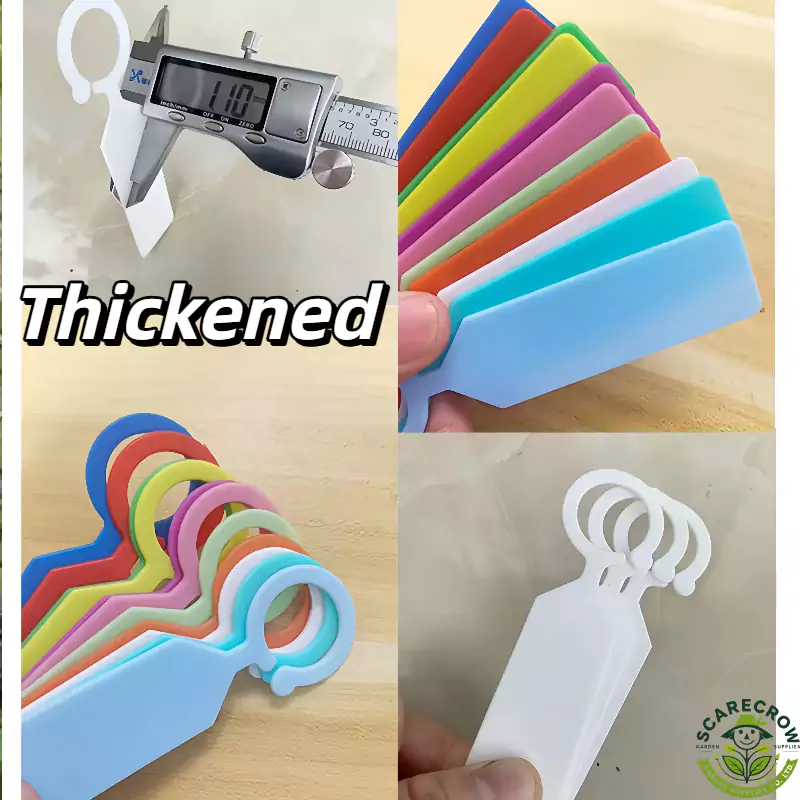
The single most useful tool for slate QC is a fingernail. Run your nail along any line on the label surface:
- If your nail slides smoothly — it is surface veining. Natural, acceptable.
- If your nail catches — it is likely a crack. Investigate further.
This test takes two seconds per label and distinguishes the most common source of dispute: “is this a crack or a vein?” This is a quick screening check. When in doubt, confirm with visual inspection, gentle pressure, or comparison against the approved visual guide.
Crack Classification
| Type | Description | Verdict |
| Surface vein | Visible line, fingernail does not catch | Acceptable — natural |
| Hairline surface crack | Fingernail catches slightly, does not go through | Borderline — note and monitor; acceptable for nursery use, may not be acceptable for retail |
| Structural crack | Visible crack that goes through the label body, or can be opened by gentle pressure | Not acceptable — reject |
| Edge split | Clean break along the edge, following natural cleavage | Acceptable if minor (a few mm); not acceptable if it removes significant material |
Chip Classification
| Type | Description | Verdict |
| Minor edge flake | Small flake off the edge, consistent with natural cleavage | Acceptable — natural cleavage character |
| Corner chip | Small chip at a corner | Acceptable for nursery supply; may not be acceptable for retail display |
| Large chip | Missing material affecting the writing area or label structure | Not acceptable — reject |
| Multiple chips | Several chips on the same label, suggesting rough handling | Not acceptable — indicates packaging or handling issue |
Edge Condition
Slate edges are naturally uneven — they follow the stone’s cleavage plane. This is not a defect. But edges should be free of sharp burrs that could cut fingers. A quick touch test along all four edges confirms whether the edge is safe for handling.
Hole Position and Hardware Fit
A label can have the right dimensions and no cracks — and still be unusable if the hole is wrong. If the slate label has a hole for hanging (with wire, string, or clip), the hole is a functional feature — and its accuracy affects whether the label can be used as intended.
What to Check
| Item | How to Check | Acceptance Basis | |
| Hole position | Ruler — measure from hole centre to label edges | Roughly centred; not so close to the edge that the label breaks when hung | |
| Hole diameter | Caliper or test hardware fit | Matches spec — wire/string/clip must pass through cleanly | |
| Hole edge condition 孔边条件 | Visual + touch | Smooth, no cracks radiating from the hole | |
| Hardware fit (if supplied with wire/clip) | Insert the actual hardware | Fits without forcing; label does not crack when hardware is inserted |
Why This Matters
A hole that is too close to the edge creates a weak point — the label may crack at the hole when hung or when the hardware is inserted. A hole that is too small means the wire or clip does not fit. A hole with radiating cracks means the label may split during use.
For labels supplied with hardware (wire stake, clip, or string), always test the actual hardware on a sample of labels — not just the hole diameter. The hardware and the hole are a system, and they need to work together.
Surface Appearance and Writing Area
Dimensions, cracks, and holes can all be correct — and the label can still disappoint the customer if the writing surface is wrong. The writing surface is where slate’s natural character meets the customer’s practical need. A surface that is too rough makes writing difficult. A surface that is too smooth may look like plastic. The right surface is somewhere in between — and it should be consistent with the approved sample.
What to Check
- Writing area flatness — Place a straight edge across the writing area. Is there significant dipping or bulging? Minor texture is natural; deep pits or craters that affect writing are not.
- Surface roughness vs. approved sample — Run a thumb across the writing area. Does it feel similar to the approved sample? A significantly rougher or smoother surface may affect writing performance.
- Contamination — Check for dust, oil, or residue on the surface. This is not a stone defect — it is a production or packaging issue, but it affects the customer’s first impression.
What Not to Demand
Do not demand that every slate label have the same surface texture. Natural stone varies — and that variation is part of the product’s appeal. The QC question is not “does every label look the same?” but “does every label provide a functional writing surface?”
Set Matching and Pack Accuracy
An individual label can pass every check — and the set can still look wrong. If the slate labels are sold as sets (e.g. 5-piece or 10-piece sets), the labels within each set need to be consistent enough that the set looks intentional — not random.
What to Check
| Item | How to Check | Acceptance Basis |
| Size consistency within set | Compare labels in the same set | Length and width within agreed tolerance; no outlier that is visibly larger or smaller |
| Colour harmony within set | Visual comparison | Colours do not need to match exactly, but should be in the same tonal range |
| Piece count per set | Count manually | Matches order spec |
| Set count per carton | Check against carton mark | Matches order spec |
| Hardware count (if applicable) | Count wire/clip/string per set | One per label, or as specified |
Natural Tonal Variation Within Sets
If the order includes sets with natural tonal variation (e.g. a 5-piece set with labels in different natural tones — not artificial colour mixing), the set should still look intentional — not like random leftovers were thrown together. The colour range within a set should be defined: “charcoal to deep grey” is a range. “Grey to green to purple to black” may look like a quality issue, not a feature. A practical approach: define the colour range using 2–3 reference photos from the approved sample. If a label in the bulk order falls outside the tonal range of those photos, it is an outlier worth flagging.
If you are still comparing materials rather than inspecting bulk goods, see our [PP vs slate plant label comparison].
Packaging Protection
Every label can be within spec — and still arrive damaged if the packaging fails. Slate is heavier and more fragile than PP. Packaging protection is not just a logistics concern — it is a quality concern. Poor packaging causes damage that becomes a quality defect.
Have Specific Acceptance Requirements?
Share dimensions, edge expectations, packing requirements and sample references. We can help organize the key points that should be followed during sample approval and bulk inspection.
What to Check
| Item | What to Look For |
| Inner protection | Each label separated by protective material (foam, paper, or bubble wrap) — or at minimum, labels are not in direct contact with each other |
| Edge protection | Edges and corners protected against chipping during transit |
| Set integrity | Sets held together — labels do not shift and collide inside the carton |
| Carton condition | No crushed corners, no water damage, no signs of rough handling |
| Carton weight | Gross weight matches packing list — significant deviation may indicate missing or extra material |
The Relationship Between Packaging and Quality
If you find a high rate of edge chips or corner breaks in the bulk order, the first question is not “is the slate bad?” but “is the packaging adequate?” Slate that chips in transit is often a packaging problem, not necessarily a material problem. In most cases, fixing the packaging resolves the issue — but if breakage rates remain high after packaging improvements, the slate itself may need review.
This shift in perspective — from material to packaging — changes how you interpret the numbers. If breakage is concentrated at edges and can be resolved by improving packaging, that is typically a packaging issue. If breakage involves large cracks through the label body and persists after packaging improvements, the slate itself may need review.
Create a Visual Acceptance Guide
The most effective slate QC tool is not a spreadsheet — it is a set of photos.
What to Create
Before the bulk order arrives (or at sample stage), create a visual guide with two columns:
| Acceptable | Not Acceptable |
| Photo of a label with natural colour variation | Photo of a label with severe discolouration or contamination |
| Photo of a label with surface veining (fingernail test shown) | Photo of a label with a structural crack (fingernail catching) |
| Photo of a label with minor edge flake | Photo of a label with a large chip or corner break |
| Photo of a label with natural thickness variation | Photo of a label that is visibly too thin or too thick |
| Photo of a set with harmonious colour range | Photo of a set with random, mismatched colours |
To create the guide: take 5–10 photos at sample stage — 2–3 showing acceptable natural variation, 2–3 showing borderline cases, and 2–3 showing clear defects. Photograph each label flat on a white background under even light. Label each photo with what it shows and whether it passes or fails.
Why This Works
A visual guide does what a tolerance spec cannot: it shows the inspector and the supplier exactly what “acceptable” and “not acceptable” look like. When a dispute arises, the guide resolves it — not by arguing about whether a 3mm chip is “minor” or “major,” but by comparing the label to a photo.
This guide should be created at the sample stage, agreed with the supplier, and used as the reference for bulk inspection. It is the slate equivalent of an approved sample — but for visual characteristics that cannot be captured in a dimension.
Next Step: Define Before You Inspect
Slate QC works when the standards are defined before the bulk arrives — not after. If you wait until the cartons are in your warehouse to decide what is acceptable, you are not doing quality control. You are doing damage assessment.
The rule is the same as for PP labels: every check starts with the approved sample and the agreed standard. But for slate, there is an additional step — you also need the visual acceptance guide, because natural variation cannot be defined by numbers alone.
If you are placing a slate label order, send your supplier the tolerance, the acceptance criteria, and the visual guide before production starts. If you have received a bulk order, use the checklist above — and remember that the goal is not to make natural stone look like plastic. The goal is to confirm that the natural variation is within the range you agreed, and that the defects that matter are caught.
Approve the Sample Before the Bulk Order
Use approved samples and photos as the reference before a bulk order. Confirm the physical product and retain clear visual evidence so the same reference can be used when reviewing bulk production.
Related Articles
Slate Plant Labels Buying Guide for Bulk Orders
How to Evaluate Plant Label Samples Before Bulk Ordering
Slate vs PP Plant Labels: B2B Material Comparison