









Updated 2 months ago
PP Plant Label Quality Control Checklist for Importers
SCARECROW GARDEN SUPPLIER

PP plant labels checked for dimensions, flatness and moulding quality
An importer receives 80,000 PP plant labels. The bulk order was placed after sample approval — the sample was measured, tested, and signed off. The cartons arrive at the warehouse. The warehouse manager opens one carton, pulls out a handful of labels, and they look fine. He signs the delivery note.
Three weeks later, the importer’s retail customer reports that 15% of the labels in their packs are warped — not visibly broken, but bent enough that they do not sit flat in the retail packaging. Another customer found that the stake diameter is 4.3mm — the sample was 4.0mm. The labels do not fit their pot trays without forcing, which cracks the stake. A third customer found colour variation between cartons — the labels from carton 1 are noticeably whiter than those from carton 3.
The warehouse manager looked at the labels. They looked fine. But “looking fine” is not quality control. Quality control means more than looking at the labels — it means checking the bulk order against the approved specification, systematically, with measurements, not just impressions.
This article is a structured QC checklist for PP plant label bulk orders. It is built around one principle: QC starts from the approved sample, not from a general idea of what “good” looks like. The rule is simple: if you can do the QC without the approved sample in your hand, you are likely not doing QC — you are doing an impression check. (Illustrative example. Actual specifications, pricing, and outcomes vary by supplier, quantity, and order requirements.)
Start With the Approved Specification
Before checking anything, you need the approved sample and the order specification on hand. These are your baseline — not your memory of what the sample looked like, and not a general sense of what PP labels should be like.
If the approval baseline has not been documented yet, use our plant label sample evaluation guide before bulk inspection.
Confirm PP Label Specifications Before Bulk Inspection
Confirm the PP label format, dimensions and surface requirements before bulk inspection. A clear specification reference makes it easier to check production consistently against the approved sample.
What to Have Ready Before Inspection
| Item | Why You Need It |
| Approved sample (physical, with signed approval record) | The physical reference for all visual and dimensional comparisons |
| Order specification sheet (PO / PI with dimensions, material, colour, pack quantity) | The contractual baseline — if the bulk does not match, you have grounds for action |
| Sample approval photos (measurements, writing tests, close-ups) | Visual reference for comparison — especially for colour and finish |
| Packing requirement (pieces per pack, packs per carton, carton marks) | For verifying count and packaging compliance |
If you do not have an approved sample, you do not have a QC baseline. You have a product and an opinion. Every check below depends on having something specific to compare against.
Dimensions and Thickness Consistency
Dimensional consistency is the first thing to verify — because if the dimensions are wrong, every subsequent check is moot.
For PP format, writable-area and surface-selection details, see our PP plant label guide.
What to Check
| Dimension | How to Check | Acceptance Basis |
| Overall length | Measure 10–20 samples from different cartons with a caliper | Matches approved sample within agreed tolerance |
| Head width | Caliper measurement | Matches approved sample |
| Stake diameter | Caliper measurement | Matches approved sample — critical for pot/tray fit |
| Stake-to-head junction | Visual + manual (gentle bend) | No cracks, no separation |
| Hole diameter (if applicable) | Caliper | Matches spec — affects hanging hardware |
How to Sample
You do not need to measure every label in an 80,000-piece order. But you do need to sample across the batch. The sampling approach below is a practical spot-check for identifying issues in a bulk order. It is not a formal acceptance sampling plan. If your company uses AQL-based inspection, follow your internal QA procedures for sample size and acceptance criteria.
- Pull from different cartons — Do not measure 20 labels from the same carton. Pull from the first, middle, and last cartons in the shipment.
- Pull from different positions within each carton — Labels at the bottom of a carton may be compressed differently than those at the top.
- Record the range, not just the average — If 10 labels measure 14.8–15.2cm, the average is 15.0cm — but the range tells you whether the moulding is consistent or drifting.
Tolerance Reference
All dimensional acceptance should be based on the approved sample and the tolerance agreed in the order specification. If no tolerance was defined, discuss and agree one with the supplier before placing the order. If you need a specific tolerance for your application, define it in the order specification — do not wait until the bulk arrives to decide what is acceptable.
Molding and Edge Finish
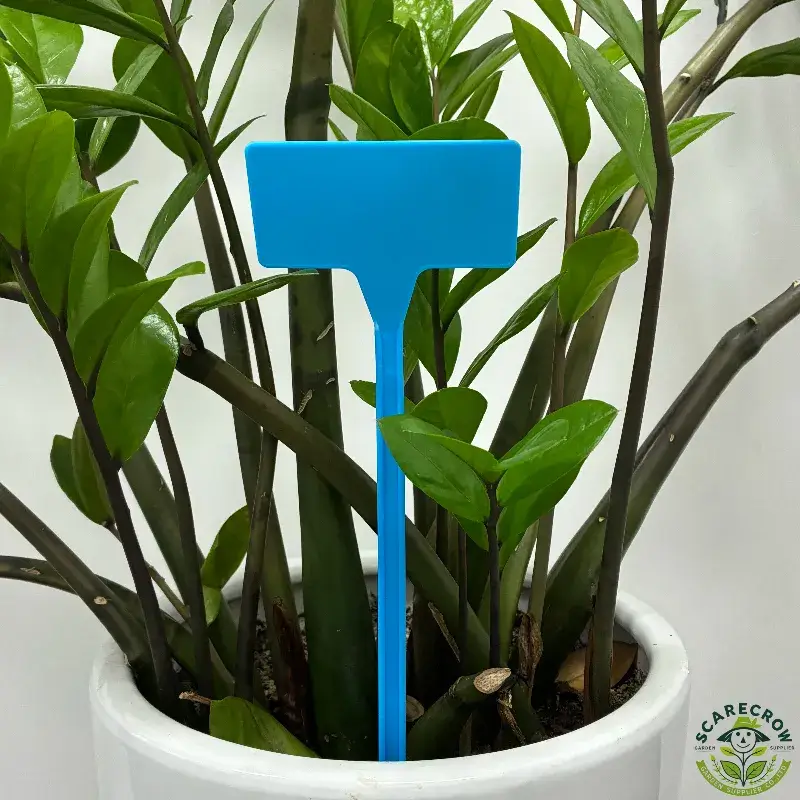
Dimensions tell you whether the label matches spec. Moulding defects tell you whether the production process is stable. Moulding defects are a key quality issue to check in PP plant labels. They are also the most visible — if you know what to look for.
Defect Checklist
| Defect | What It Looks Like | Why It Matters |
| Flash | Thin excess material at the mould parting line | Affects appearance; may need trimming; indicates mould wear or pressure issues |
| Short shot | Incomplete fill — missing material at the stake tip or head edge | Structural weakness; label may snap at the unfilled point |
| Sink marks | Shallow depressions on the surface, usually at the junction | Indicates uneven cooling; may affect writing surface flatness |
| Weld line | Visible line where two flow fronts meet | May be cosmetic only, or may indicate a weak structural point |
| Burn marks | Discolouration, usually at the end of the flow path | Indicates trapped air or overheated material; affects appearance |
How to Check
- Visual inspection — Hold the label flat against a light source. Flash, sink marks, and burn marks are visible as shadows or colour differences.
- Touch test — Run a finger along the edges and the stake-to-head junction. Flash feels like a thin ridge. Sink marks feel like a shallow dip.
- Bend test — Gently bend the label at the junction. If it snaps or cracks, the moulding may have a structural issue at that point.
Acceptance Logic
Not every moulding defect is a rejection reason. A small amount of flash that does not affect function or appearance may be acceptable for bulk nursery supply. A short shot that leaves the stake tip incomplete is not. The acceptance standard should be defined in the order specification — if it is not, use the approved sample as the reference: if the bulk has more flash, more sink marks, or more variation than the approved sample, it is a deviation worth discussing.
Flatness and Warping
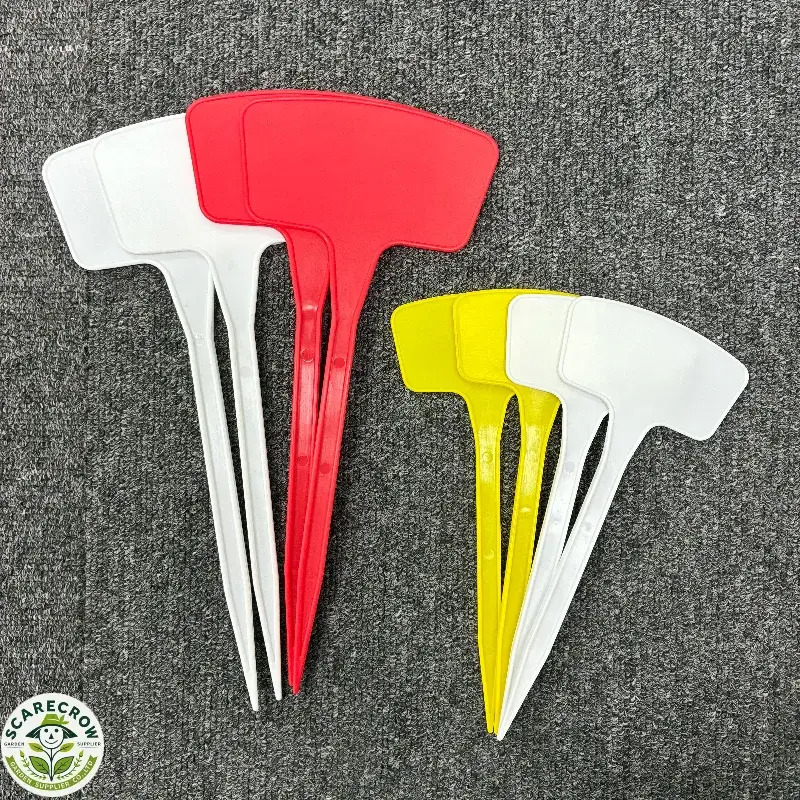
A label can match every dimension and still fail in the customer’s hands — if it does not lie flat. Warping is the defect that most often passes visual inspection in the warehouse and fails in the customer’s hands. A label that is slightly warped may look flat when stacked in a polybag — but when a customer pulls it out and tries to insert it into a pot, it tips sideways.
Why Warping Happens
PP labels warp when cooling is uneven — one side of the label cools and contracts faster than the other. This can happen due to mould temperature variation, uneven wall thickness, or residual stress in the material. Simply put: if the mould or cooling process has an issue, labels in the same carton may warp in the same direction. That is why the stack test matters — a leaning stack reveals a consistent warp that individual labels may hide.
How to Check
- Flat surface test — Place 10 labels individually on a flat surface (a table or bench). Do they lie flat, or do they rock? A label that rocks has a warp.
- Stack test — Stack 20 labels. Does the stack lean to one side? If so, individual labels may have a consistent warp direction.
- Visual against straight edge — Hold a ruler or straight edge along the length of the label. Any gap between the label and the edge indicates a warp.
Why It Matters
- Pot insertion — A warped label does not push straight into soil. It angles off to one side, looking crooked.
- Retail packaging — A warped label does not sit flat in a shrink-wrapped pack. The pack looks puffy or uneven on the shelf.
- Stacking and counting — Warped labels do not nest cleanly, making counting and packing slower and less accurate.
Color and Batch Consistency
A label can match every dimension, have clean moulding, and lie perfectly flat — and still cause a customer complaint because the colour is wrong. Colour consistency is a quality issue that most buyers do not check until a customer complains. PP colour can vary slightly between production runs — and if your order was produced in multiple runs, the cartons may contain visibly different shades.
What to Check
- Cross-carton comparison — Pull one label from each carton in the shipment. Lay them side by side on a white surface under the same light. Is there visible colour difference?
- Against approved sample — Compare the bulk labels against the approved sample. Is the colour the same, lighter, or darker?
- Within-carton consistency — Pull 10 labels from the same carton. Are they consistent?
What to Look For
| Scenario | Likely Cause | Action |
| Bulk matches sample, all cartons consistent | Single production run, correct colour batch | Accept |
| Bulk matches sample, but cartons vary slightly | Multiple production runs with slight colour drift | Accept for nursery supply; may be an issue for retail packs where cartons are mixed |
| Bulk differs from sample | Wrong colour batch or sample was not from same production | Compare against order spec; raise with supplier |
| Visible colour difference within a single carton | Mixed production runs in same carton | Raise with supplier — indicates packing error |
Important Note
PP colour can vary slightly between production runs, particularly with custom colours or smaller batch sizes. This is a material characteristic, not necessarily a defect. A practical test: compare labels from different cartons side by side on white paper under the same light, against the approved sample. If the colour difference is visible in this comparison, it is worth discussing with the supplier. If no tolerance was defined in the order, agree one before the next order. The question is whether the variation is within the range you and your customer find acceptable — and that should be defined before the order, not debated after delivery.
Writing Surface Consistency
Colour and dimensions can be correct, but if the writing surface has changed, the product still fails at the point of use. A writing surface that worked on the approved sample may not be consistent across the bulk. Surface finish is determined by the mould — and surface finish can vary between production runs if the mould has been reworked or if moulding conditions change. A quick spot-check confirms whether the bulk matches the approved sample surface.
Quick Check
- Visual — Hold a label from the start of the run and one from the end under the same light. Is the surface gloss the same?
- Touch — Run a thumb across the writing area. Does it feel the same as the approved sample?
- Writing spot-check — Write on 3–5 labels from different cartons with the writing tool your customer uses. Is the writing legibility the same as the approved sample?
This is a spot-check, not a full writing test — that was done at the sample stage. The goal here is to confirm that the bulk production has not introduced a surface change that would affect writing performance. For a detailed writing test methodology, see our guide on plant label writing surfaces.
Counting and Packaging Accuracy
Every physical attribute can be correct — and the order can still be wrong because the count is off. Counting errors are the most tedious QC issue — and the most common cause of customer complaints about “missing pieces.”
For earlier procurement risks that can create bulk-order problems, review our plant label sourcing mistakes guide.
Three-Level Count Verification
| Level | What to Check | How |
| Piece count | Number of labels in a retail pack or polybag | Count one or two packs manually — do not assume the count is correct |
| Pack count per carton | Number of packs or polybags per carton | Check the carton mark against actual contents |
| Carton count | Total number of cartons received | Match against the packing list and delivery note |
What to Look For
- Piece count accuracy — If the order specifies 50 pieces per pack, count one or two packs. A miscount of 1–2 pieces per pack across 1,600 packs adds up to a significant shortage or overage.
- Label and barcode — If the retail pack has a barcode or product label, verify it matches the order. Wrong barcodes on retail packs are a costly error — they may require relabelling the entire shipment.
- Carton mark accuracy — The carton mark (product name, quantity, PO number) should match the actual contents. A wrong carton mark can cause customs or warehouse receiving errors.
How to Record Defects
If you find defects, record them in a way that is actionable — not just “some labels are bad.”
Have Specific PP Label QC Requirements?
Share the dimensions, packing and acceptance points that need to be followed. We can organize these requirements into a clearer inspection basis before bulk production is checked.
Defect Record Format
| Field | What to Fill In |
| Defect type | e.g. Flash / Warping / Short shot / Colour variation / Count error |
| Location on product | e.g. Stake-to-head junction / Edge / Writing surface |
| Quantity affected | e.g. 3 out of 20 sampled from carton 5 |
| Carton number | Which carton the defective samples came from |
| Photo | Close-up photo of the defect, with a ruler or reference object for scale |
| Comparison to approved sample | How does the defect differ from the approved sample? |
| Severity | Cosmetic only / Affects function / Affects packaging |
| Action requested | Accept as-is / Sort and rework / Replace affected cartons / Hold for supplier discussion |
AQL Note
If your company uses AQL (Acceptable Quality Limit) sampling standards, apply them according to your internal QA procedures. The checks in this article are practical guidance for what to look for — they do not replace a formal AQL inspection plan. If you do not use AQL, the sampling approach above (10–20 labels from different cartons and positions) is a reasonable starting point for a bulk order inspection.
Next Step: Build QC Into Your Order Process
Quality control does not start when the bulk arrives. It starts when you place the order — by defining the specification, the tolerance, the acceptance standard, and the packing requirement clearly enough that the supplier knows what you will check. Then, when the bulk arrives, you have a baseline to check against.
Every check in this checklist ends with the same question: does the bulk match the approved sample? If you do not have that sample, every check becomes an opinion.
If you are placing a PP label order, send your supplier the specification and acceptance points before production starts. If you have received a bulk order and need to verify it, use the checklist above — and compare everything against the approved sample, not against a general idea of what “good” looks like.
Ready for Pre-Shipment Confirmation?
Confirm how the approved requirements should be checked before shipment. Turn agreed specifications, packaging requirements and acceptance points into a clear final-check basis before the goods are released.
Related Articles
How to Evaluate Plant Label Samples Before Bulk Ordering
How to Choose PP Plant Labels for Nursery & Retail
9 Plant Label Sourcing Mistakes Bulk Buyers Should Avoid